How to do influencer marketing in India: where to start, and which route fits your brief
How to do influencer marketing in India, from a first brief to the report. Five questions show which of five routes fits your brief, then seven steps: find creators, check them, put the fee, the usage and the label in writing, brief and approve, pay, and count the result creator by creator.
Playbooks 19 min read The vexo.club desk
In this article14 sections
To do influencer marketing in India, a brand sets one objective, finds creators whose audience matches its customers, agrees the fee, the usage rights and the ASCI label in writing, and measures the result against the objective. Five questions below show which route fits your brief. vexo.club is one route; this page says when another fits better.
Key takeaways
In short
- Pick the route before the creators; each leaves you different work.
- Check a creator’s audience before you ask for a rate.
- Put the deliverables, the usage window and the ad label in writing before anyone films.
- Count results creator by creator, and mark what cannot be verified.
- Brief by the calendar: festive and wedding-season work is booked early.
vexo.club is an influencer marketing agency run from one desk in Delhi NCR, so one of the routes below is its own. The planner marks it only when it fits the answers, and the page says which route is shorter when it does not.
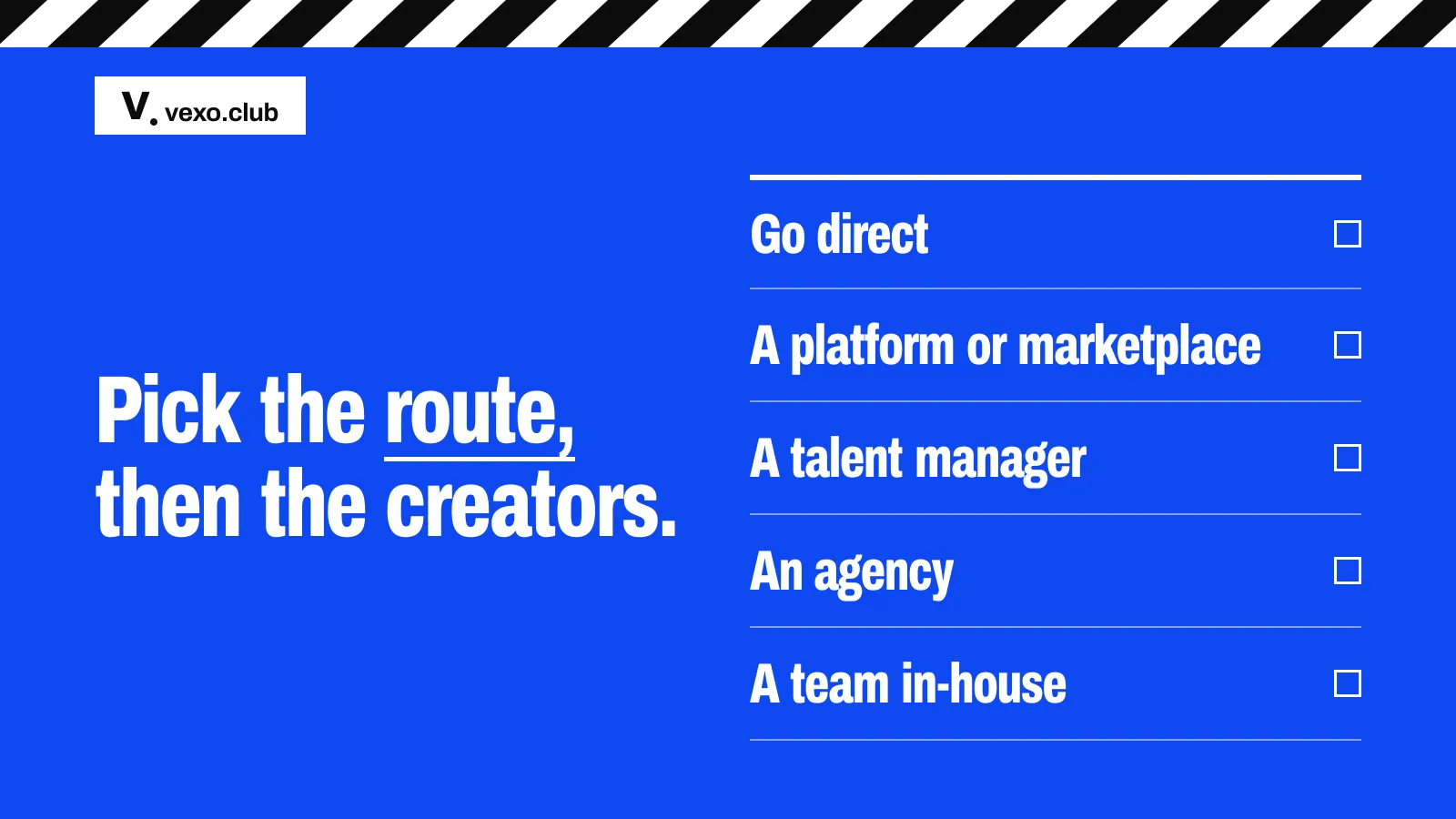
Which route fits your brief?
Answer as many of the five questions as you can. A route is marked when it fits every answer you have given, and nothing is hidden: each of the five routes keeps its card, with what it is, when it fits, the work it leaves with you, what it costs in words and where to start. No question asks about money, and your answers are not stored; they only mark the cards.
Which route fits your brief
A route is marked “Fits your answers” when it fits every answer you have given. The mark is drawn; each card’s “Fits when” line and the table below say the same in words. The agency route is never marked for one or two creators.
Go direct
You find the creators, message them, agree terms and pay them yourself.
- Fits when
- Up to ten creators; your team handles contracts, payment and TDS; posts stay on the creators’ pages; one language
- The work it leaves with you
- Finding and checking creators, the contract, usage terms, TDS, the ad label and the report
- Cost, in words
- Creator fees and your team’s time
Use a platform or marketplace
Software where you search for creators, send offers and track posts yourself; the platforms’ own tools, such as Instagram’s creator marketplace, are a version of it.
- Fits when
- Three or more creators; your team runs it
- The work it leaves with you
- Briefing, negotiation, usage terms, disputes, TDS and the ad label; the software finds and tracks
- Cost, in words
- A subscription or a commission, plus creator fees
Work through a talent manager
A manager or management agency that represents particular creators and books them for you.
- Fits when
- One or two particular creators; either side can hold the paperwork
- The work it leaves with you
- Comparing creators across managers, the usage terms, the ad-label check and the report
- Cost, in words
- Creator fees and the manager’s commission
- Start here
Hire an agency
A team that shortlists, contracts, produces and reports across many creators, and answers for the result.
- Fits when
- Three or more creators; you want contracts, payments, TDS and the label handled
- The work it leaves with you
- The goal, the budget band, approvals and the final say
- Cost, in words
- Creator fees and an agency fee; ask for them as separate lines
Build a team in-house
Your own people do the four jobs (finding, contracting, producing, reporting) every month.
- Fits when
- Three or more creators, every month, your team holds the paperwork
- The work it leaves with you
- Everything, including hiring the people and choosing the tools
- Cost, in words
- Salaries and tools, plus creator fees
- Start here
Routes can be mixed: a platform or a roster to find creators, an agency for the campaigns that need one accountable party, and an in-house lead who owns the calendar. If more than one route is marked, start with the route that leaves you only work you can do.
The same decision as a table
| Route | Fits when | The work it leaves with you | Cost, in words | Start here |
|---|---|---|---|---|
| Go directYou find the creators, message them, agree terms and pay them yourself. | Up to ten creators; your team handles contracts, payment and TDS; posts stay on the creators’ pages; one language | Finding and checking creators, the contract, usage terms, TDS, the ad label and the report | Creator fees and your team’s time | |
| Use a platform or marketplaceSoftware where you search for creators, send offers and track posts yourself; the platforms’ own tools, such as Instagram’s creator marketplace, are a version of it. | Three or more creators; your team runs it | Briefing, negotiation, usage terms, disputes, TDS and the ad label; the software finds and tracks | A subscription or a commission, plus creator fees | |
| Work through a talent managerA manager or management agency that represents particular creators and books them for you. | One or two particular creators; either side can hold the paperwork | Comparing creators across managers, the usage terms, the ad-label check and the report | Creator fees and the manager’s commission | |
| Hire an agencyA team that shortlists, contracts, produces and reports across many creators, and answers for the result. | Three or more creators; you want contracts, payments, TDS and the label handled | The goal, the budget band, approvals and the final say | Creator fees and an agency fee; ask for them as separate lines | |
| Build a team in-houseYour own people do the four jobs (finding, contracting, producing, reporting) every month. | Three or more creators, every month, your team holds the paperwork | Everything, including hiring the people and choosing the tools | Salaries and tools, plus creator fees |
Read the marks as a rule of thumb for a first campaign, not a forecast. The agency route is never marked for one or two creators, because at that size a talent manager or going direct is the shorter way. Where two routes are marked, the difference is usually who holds the paperwork, and the cards say so. Routes also mix: a roster to find creators, an agency for the campaigns that need one accountable party, and one person in your own team who owns the calendar.
Pick the route before the creators
How do you do influencer marketing in India, step by step?
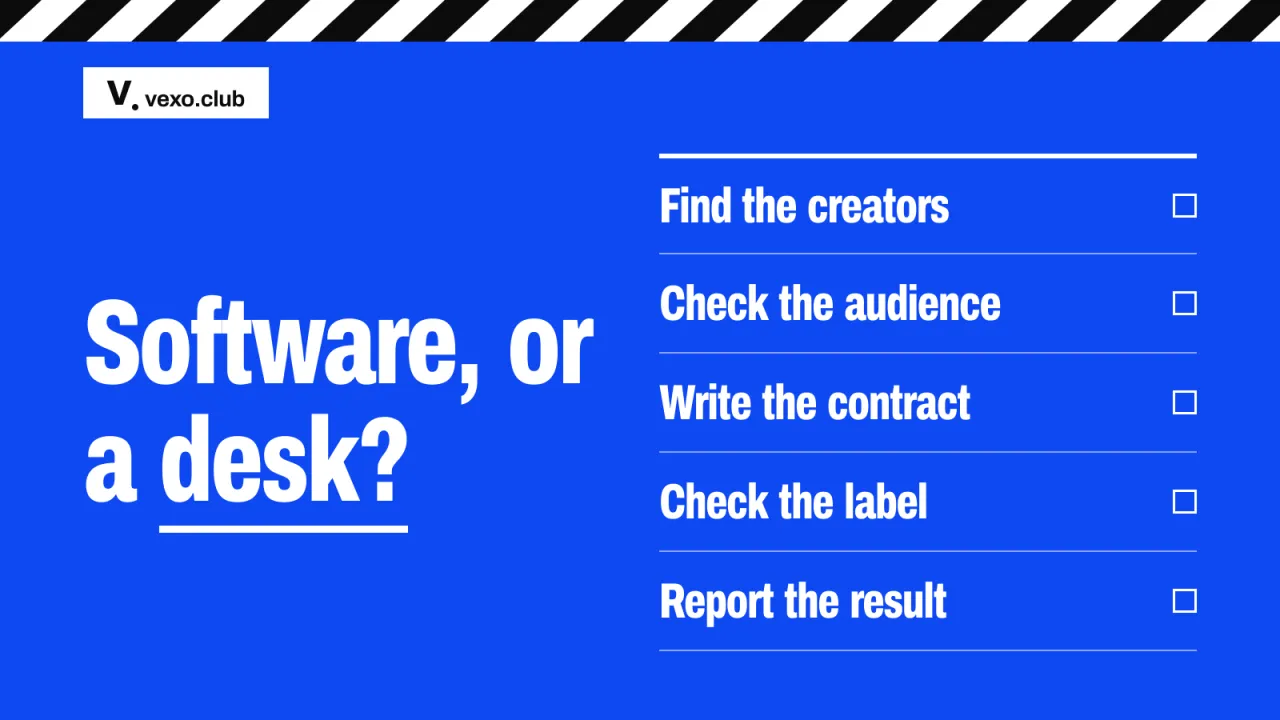
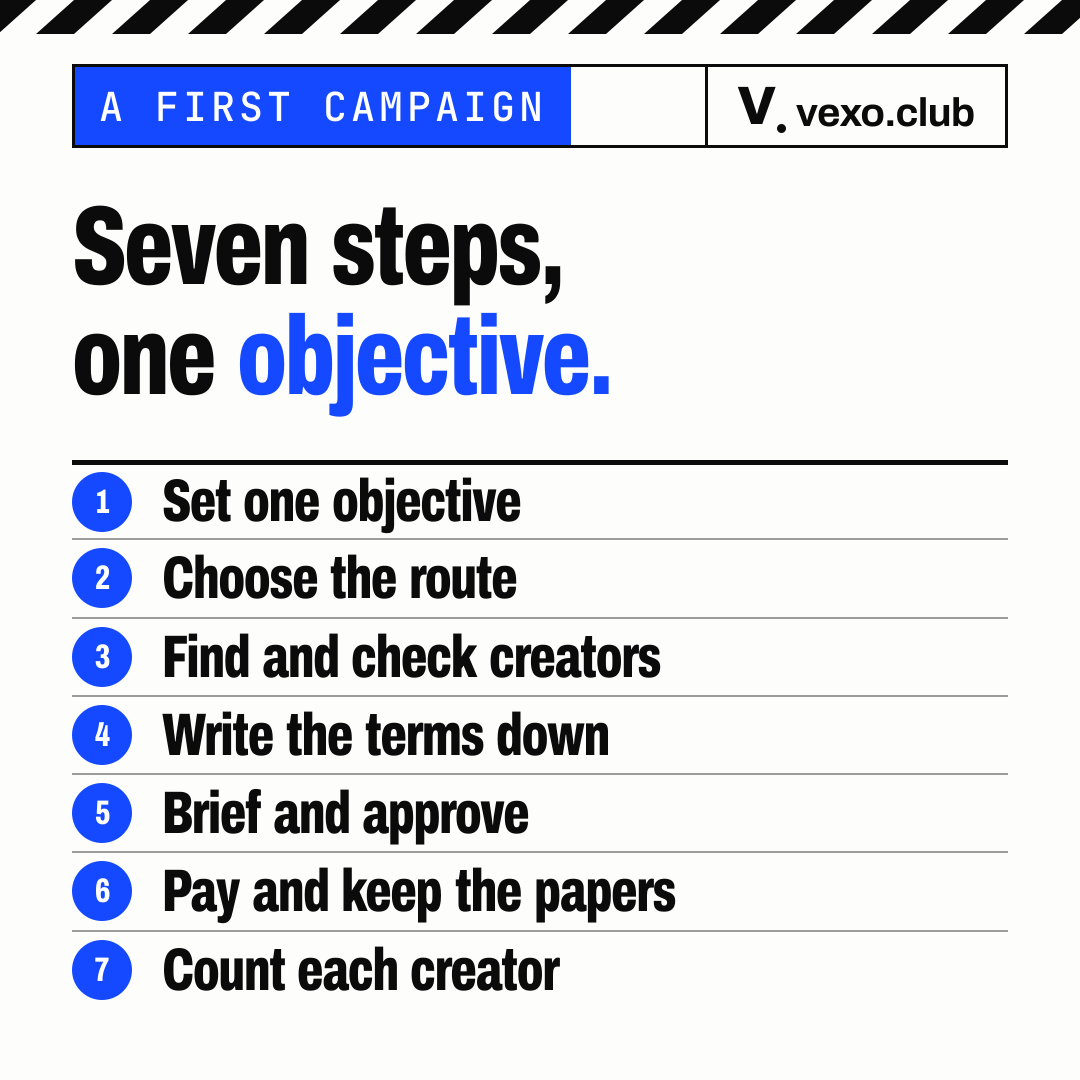
Seven steps, whichever route you chose. Each links to the post that goes deeper, and none of them needs an agency. They are the same steps whether you hold them yourself or hand them to a desk; what the route changes is who does each one.
- Set one objective and one audience. What should a customer do or know after seeing the post, and who is the customer, in which city and language? One objective can be counted; three cannot. The influencer campaign checklist keeps the order of everything that follows.
- Choose the route. The planner above marks the routes that fit your answers, and each card says what the route leaves with you. The choice decides who holds the contracts, the payments and the label, so make it before you look at a single creator.
- Find creators, and check each audience before you ask for a rate. How to find influencers in India sets out seven routes to names. How to check an influencer’s audience before you pay sets out the exports to ask for.
- Put the fee, the usage rights and the label in writing. The deliverables, the dates, where the post may run and for how long, any exclusivity and the paid label go into the contract before anyone films. The influencer contract clauses that change the price explains each line.
- Brief, approve and publish. One brief for each creator, one round of approval for the claim and the label, then the post on the agreed date. Briefing a creator so you only need one revision shows the shape.
- Pay, and keep the tax papers. The creator’s invoice, the tax deducted at source where the law requires it, and GST where it applies. TDS on influencer payments in India sets out which entry applies to a cash fee and which to a product a creator keeps.
- Count the result, creator by creator. Against the one objective, with every figure that cannot be verified marked as such. Measuring influencer marketing ROI without inventing it sets out what each method sees and misses.
The seven steps of a first influencer campaign in India
Where does influencer marketing in India run?
Mostly on Instagram and YouTube, with LinkedIn for B2B. In the briefs the desk scopes, Instagram and YouTube carry most of the work, and each does a different job in a plan: Instagram is for short video and everyday presence, and YouTube is for long-form reviews, explainers and Shorts. The platform changes the format; it does not change the rule, so every paid post carries the label on any of them. How influencer marketing works in India sets out the platforms, the rules and the published research.
It also runs in many languages. A creator trusted in one language is often unknown in the next, so a national brief is usually several regional ones. The desk keeps a page for each of these cities, and each says what changes in a brief for that market:
- Delhi NCR: Hindi and Hinglish carry most of the region’s creator content, and English leads in Gurugram and South Delhi lifestyle, finance and B2B.
- Mumbai and Pune: Marathi, Hindi and English, often all three in one caption.
- Bengaluru: two tracks in one feed, English-first creators and Kannada creators.
- Hyderabad: Telugu first, with Hindi, Urdu and English alongside.
- Chennai: written in Tamil first, with Tanglish on Reels and Shorts.
- Kolkata: Bangla first, not Bangla translated.
- Jaipur: Hindi first, with a line of Rajasthani for warmth.
- Ahmedabad: Gujarati-first briefs, with Uttarayan and Navratri booked early.
- Chandigarh: Hindi first with Punjabi beside it, and every location named by the jurisdiction it sits in.
The desk runs all of them from one desk in Delhi NCR and has no office in the other cities. Running a regional launch in four languages shows how approvals work when one claim has to survive each of them, and where a creator lives is not where the audience lives, which is why the audience check comes before a rate.
Where do you find influencers in India?
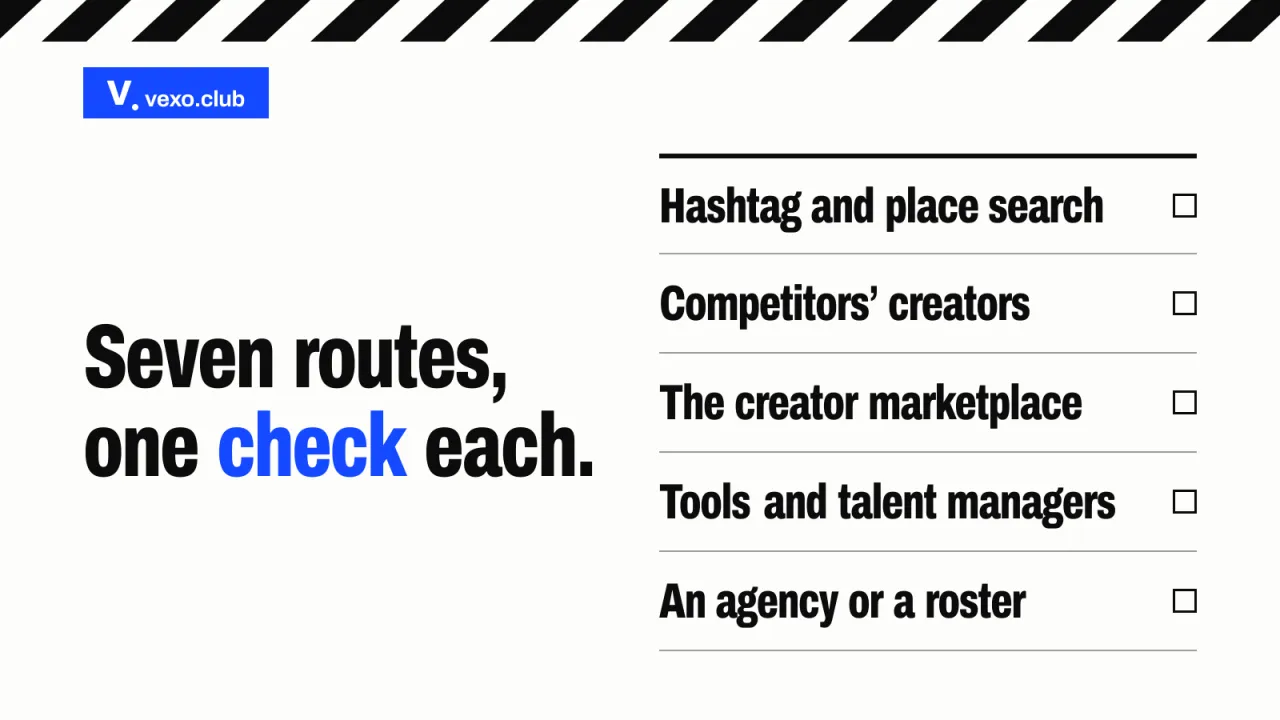
Seven routes find names, and how to find influencers in India sets out each one with the check that goes with it and what it costs you. In short:
- On the platforms themselves, by hashtag, place and language.
- In the posts of brands in your category, and the creators your competitors already work with.
- Through Instagram’s creator marketplace, Meta’s own tool (what Meta says it is).
- In a discovery database or a marketplace, which leaves the contract, the tax and the label with you (platform or agency).
- Through a talent manager, for particular creators (influencer management agency).
- From an agency’s shortlist (influencer marketing agencies in India lists the companies and the lists that name each).
- On a roster you can browse, such as vexo.club’s: find influencers in India by size and niche, where every creator listed agreed to be listed.
Whichever route finds the name, the audience check comes before the rate. How to hire influencers in India covers booking one creator end to end, and how to find and vet micro-influencers covers the smaller end.
How do you check a creator before you pay?
Before any rate is agreed, read the audience from the creator’s own exports and not from a screenshot: where the viewers are, what language they comment in, and whether the same accounts turn up under every post. Then read the track record: earlier paid posts and their labels, any exclusivity with a competitor, and whether the content already matches your brief.
Before you pay a creator
- Where the viewers are and what language they comment in, from the creator’s own export and not a screenshot
- Whether the same accounts turn up under every post, or the comments could sit under anything
- Whether earlier paid posts carried the paid-partnership label
- Whether the creator is tied to a competitor, and for what dates
- Whether the content they already make is the content your brief needs
How to check an influencer’s audience before you pay sets out the exports to ask for, and how to read a media kit you did not commission says what a media kit can and cannot show. A creator who cannot share an export is a creator whose audience you cannot check.
What does influencer marketing cost in India?
It depends on five things: the creators, the formats, the usage rights, the production and any exclusivity. No honest price exists before a brief does, which is why this page prints none. A quote is a stack of lines, and each line moves on its own: the creator’s fee for each deliverable, the usage rights with their window, production, exclusivity, the agency’s or the manager’s fee if there is one, GST, and any paid media behind a post that runs as your ad.
What decides the cost explains each and shows published third-party ranges with their sources; vexo.club publishes no rate card of its own. Whichever route you take, ask for every line separately so the quotes can be compared. How influencer agencies charge covers the models an agency may use.
What should be in writing before a creator posts?
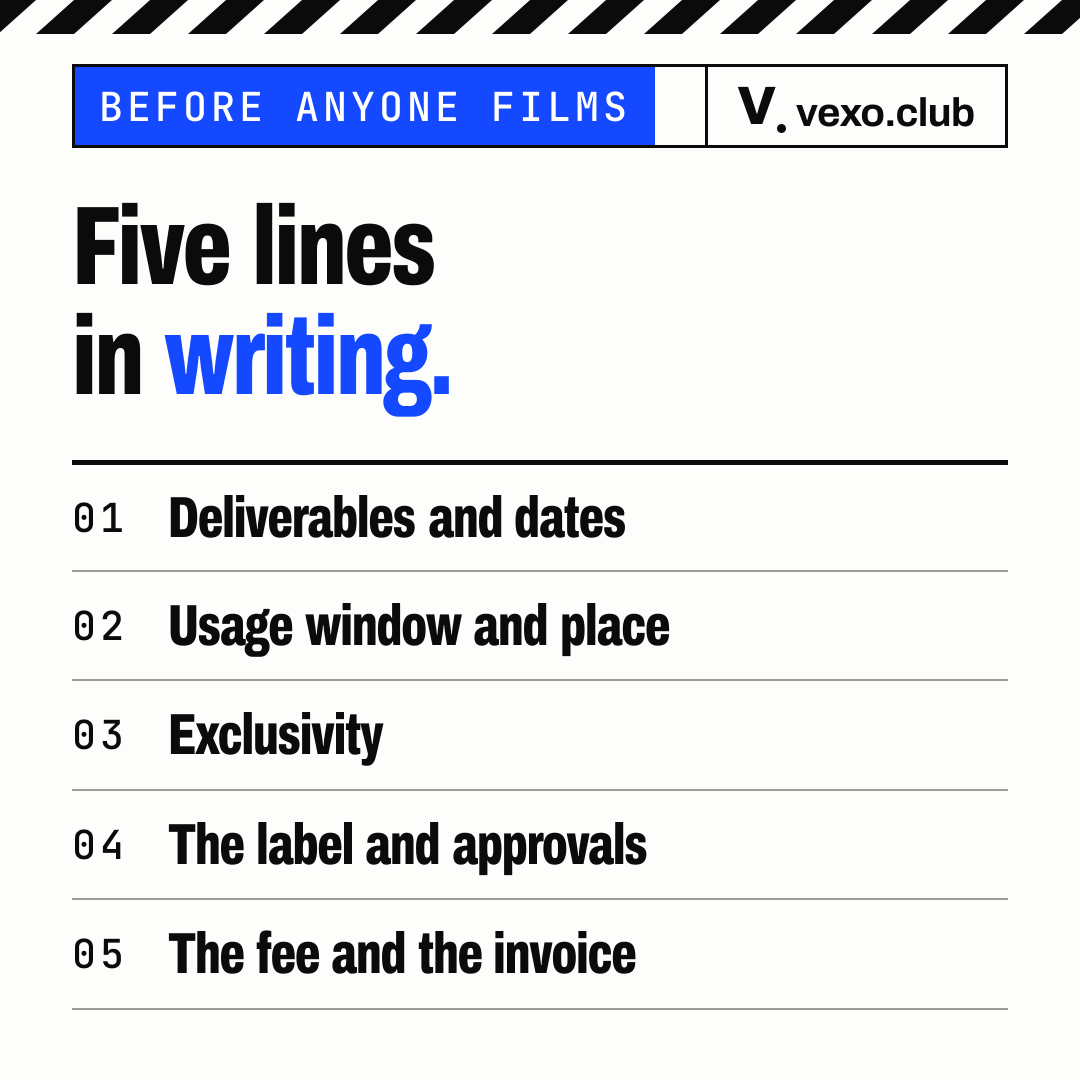
Seven lines, agreed before anyone films:
- The deliverables and the dates. What is made, on which platform, and by when.
- The usage rights. Where the post may run (the creator’s page alone, or also your ads) and for how long. Usage rights are where budgets quietly break.
- Exclusivity. Which category, and for what dates.
- Approvals. Who approves the claim and the label, and in how many rounds, before anything goes live.
- The label. That the post carries the paid label ASCI asks for, upfront.
- The fee and the payment. The amount for each line, the invoice it needs, the tax deducted and when payment falls due.
- Takedown. What happens if the post has to come down, and what the creator may not say about your brand.
What to put in writing before a creator posts
Creator whitelisting, explained for brand teams covers what running a post as your own ad has to say, since that right is the one most often left unwritten.
What rules apply?
Three, for almost every brand, and each is sourced in the post it links:
- The paid label. A creator post that is paid for needs a clear label, upfront, and the brand answers for it as well as the creator. ASCI disclosure for brands sets out who labels what and who checks.
- Tax. Tax is deducted at source on a creator’s cash fee, or on a product the creator keeps, once a threshold is crossed. TDS on influencer payments in India sets out which entry applies.
- AI-made content. From 29 December 2026 an ad whose AI-made content could mislead a buyer must carry an AI label under ASCI’s guidelines, and since 20 February 2026 platforms must label synthetic content. AI-generated content labelling for brands reads both texts.
Health and finance carry rules of their own: the NMC’s advertising guidelines for doctors and hospitals, and SEBI’s for finance creators, which finfluencers in India sets out. None of this is legal advice. The version in force on the day a post goes live is the one that applies, so read the current text and take advice on anything that touches a regulated category.
How do you brief, approve and publish?
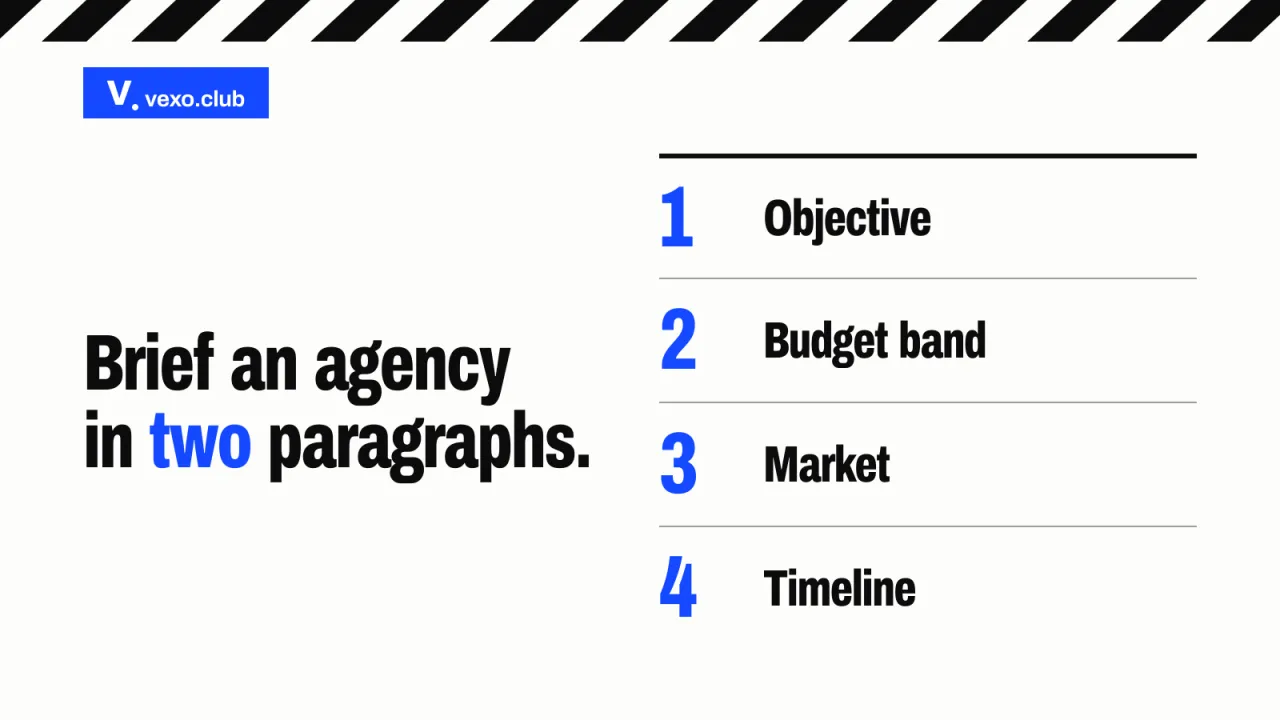
One brief for each creator, not a forwarded deck. The influencer marketing brief template holds the lines a brief needs: the objective, the claims the post may and may not make, the label, the dates and the usage. How to brief an influencer marketing agency in two paragraphs is the version for an agency, and briefing a creator so you only need one revision is the version for the creator.
Approve in one round where you can. The brand checks the claim, the label and the link, and leaves the creator’s voice alone. The label is checked before the post goes live on every route: where an agency is involved its operator reads each draft, and where none is, a named person on the brand side does. Then publish on the agreed date, watch the first hours, and keep the post’s own data for the report.
How do you measure it?
Decide the method before launch, because most methods cannot be added afterwards: a code or a tracked link for each creator, a holdout or a geo test, a read of brand search, and the platform’s own data marked as platform-reported. Count the result creator by creator against the one objective, and mark every figure that cannot be verified. Measuring influencer marketing ROI without inventing it sets out what each method sees and misses, and does influencer marketing work in India reads the published evidence and says where it stops.
The site’s own Indian creator benchmarks count followers and languages from the roster’s records and hold no engagement rate, so this page prints none. An engagement rate, where it is used, belongs beside the post and the day it was read.
When should a first campaign go live?
Work back from the date. On the desk’s route a shortlist comes back in 18 hours, contracts and briefing take inside a week, and first content is live in 10–14 days for most categories. Going direct depends on how fast creators reply and sign, so ask each creator for dates before you plan a launch around them.
From brief to first content, on the desk’s route
- Day one Brief sent
- 18 hours Shortlist back
- Inside a week Contracts and briefing done
- 10–14 days, for most categories First content live
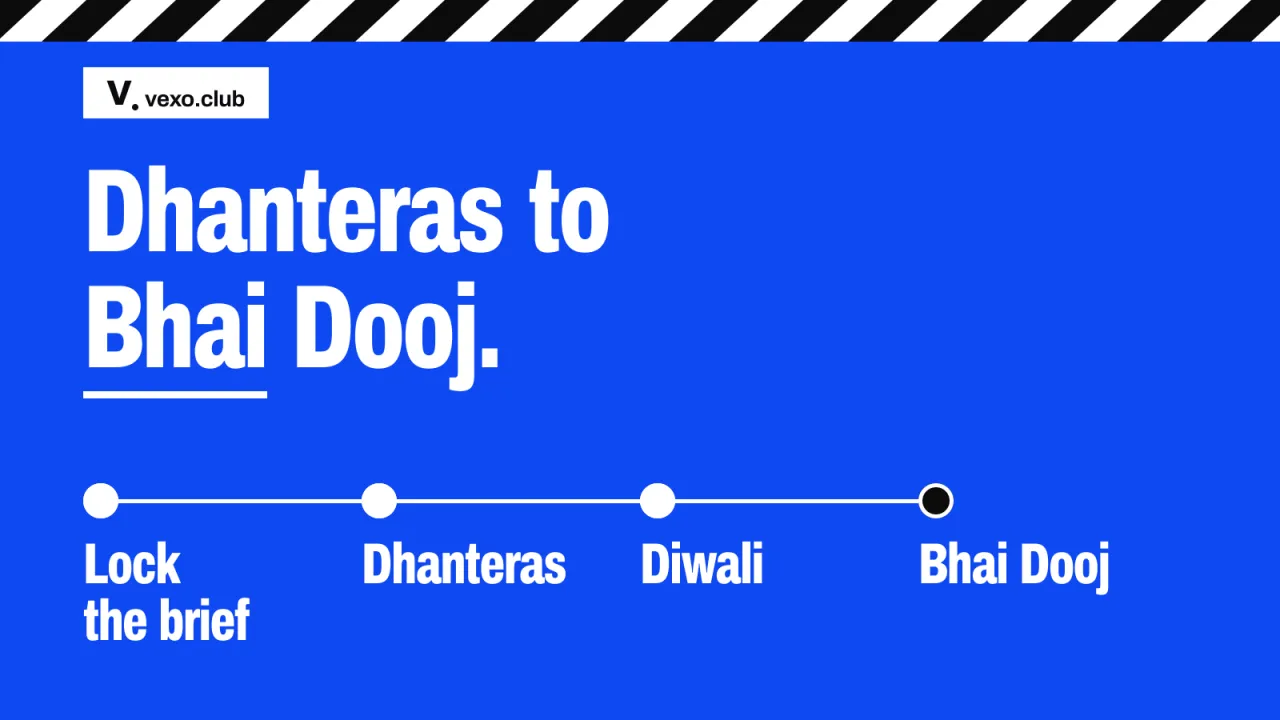
Festive and wedding-season work is booked early, because the creators and the dates fill first. Planning festive-season influencer campaigns in India and influencer marketing in wedding season set out the windows, and the calendar holds them by city.
Questions brands ask
How do I do influencer marketing in India? Choose a route first, then run one small campaign: one goal and one audience, a shortlist checked before anyone quotes a rate, terms and the ad label agreed in writing, a brief, approvals, then results counted creator by creator. The planner at the top of this page shows which route fits your brief.
Where can I find influencers in India? On the platforms themselves, by hashtag, place and language; in the posts of brands in your category; through Instagram’s creator marketplace; in discovery databases; through talent managers; or on a roster such as vexo.club’s, where every creator listed agreed to be listed.
Do I need an agency for influencer marketing? Not always. With up to ten creators, posts that stay on the creators’ own pages, one language and someone on your team who can contract, pay, deduct TDS and check the ad label, going direct is often enough. An agency earns its fee when a brief needs three or more creators and you want the contracts, payments, TDS and the label handled for you; for one or two particular creators, a talent manager is the shorter route.
Which route does vexo.club take? The agency route. One senior operator per brief shortlists and contracts the creators, runs the production and reports the results, from one desk in Delhi NCR, for brands across India. When a brief is better run another way, the desk says so before it quotes.
What rules apply to influencer marketing in India? ASCI requires a clear label on a paid post. Tax is deducted at source on a creator’s fee once a threshold is crossed. ASCI requires an AI label where AI-made content could mislead, and platforms label synthetic content. The NMC bars a registered doctor from endorsing a product, and SEBI limits who regulated firms may associate with.
Do I have to label a paid post? Yes. A post that is paid for needs a clear label, and so does one for a free product, a commission, a trip or an agreement to post, because each is a material connection. ASCI asks for the label upfront, in the video and in the first lines of the caption, not behind “more”. Use the platform’s paid-partnership tag as well.
What goes into the cost of a first campaign in India? It depends on five things: the creators, the formats, the usage rights, the production and any exclusivity. The cost page explains each and shows published third-party ranges with their sources; vexo.club publishes no rate card of its own.
How long does a first campaign take? On the desk’s route a shortlist comes back in 18 hours, contracts and briefing take inside a week, and first content is live in 10–14 days for most categories. Going direct depends on how fast creators reply and sign, so allow longer and ask each creator for dates first.
How do I measure influencer marketing? Decide the method before launch: a code or a tracked link per creator for sales, a holdout or a brand-search check for reach, and one sheet that marks every figure that cannot be verified. The ROI note sets out what each method sees and misses.
Which platform should a first campaign use? The one your buyer already spends time on. In the briefs the desk scopes, Instagram and YouTube carry most of the work and LinkedIn matters for B2B: Instagram for short video and everyday presence, YouTube for long-form reviews, explainers and Shorts. The platform changes the format, not the rule, and every paid post carries the label.
Sources
The rules above are read from primary documents, and each rule post opens them and says the day. The documents they open:
- ASCI, Guidelines for Influencer Advertising in Digital Media, the label, where it goes and who answers for it.
- ASCI, Guidelines for Responsible Labelling of Synthetically Generated Content in Advertising, the AI label.
- National Medical Commission, Guidelines on Ethical Advertising and Public Communication, doctors and hospitals.
- SEBI, circular of 22 October 2024 on the association of regulated persons, finance creators.
- The Income-tax Act, 2025, in the Gazette, tax at source on a creator’s fee or a product.
Send a brief
If the planner marked the agency route for your brief, send it to the desk from the route planner: the message opens with “From the route planner: the agency route fits this brief.”, and a creator shortlist comes back in 18 hours. If it marked another route, the desk says so before it quotes.
Pages this note links to
- ASCI, Guidelines for Influencer Advertising in Digital Media (opens in a new tab) ascionline.in
- ASCI, Guidelines for Responsible Labelling of Synthetically Generated Content in Advertising (opens in a new tab) ascionline.in
- National Medical Commission, Guidelines on Ethical Advertising and Public Communication (opens in a new tab) nmc.org.in
- SEBI, circular of 22 October 2024 on the association of regulated persons (opens in a new tab) sebi.gov.in
- The Income-tax Act, 2025, in the Gazette (opens in a new tab) egazette.gov.in
Cite this page
How to do influencer marketing in India: where to start, and which route fits your brief. vexo.club, published 01 Nov 2026. https://vexo.club/blog/how-to-do-influencer-marketing-in-india
Send the desk a brief: it comes back as a shortlist and a directional band, never a public price.
Brief the desk