Finfluencers in India: what SEBI and ASCI require, and what a brand checks first
Finfluencers are finance creators who explain money on YouTube and Instagram. SEBI bars the firms it regulates from associating with unregistered advisers, and ASCI asks for credentials upfront.
Benchmarks10 min readThe operators’ desk
In this article9 sections
Finfluencers are finance influencers: creators who explain investing, tax, insurance and credit to an audience on YouTube and Instagram. A brand that books one settles three things first — whether the creator gives advice that needs SEBI registration, whether the brand is itself a SEBI-regulated entity (in which case SEBI’s rules can bar the association outright), and how the paid mention is labelled under ASCI’s guidelines.
This guide comes from vexo.club — an influencer marketing company run from one desk in Delhi NCR. It reads two primary documents that govern this category, SEBI’s circulars of October 2024 and January 2025 and ASCI’s influencer guidelines, links both, and names only the creators it could confirm from their own pages. It is not legal advice, it gives no investment advice, and it prints no follower counts, no earnings and no ranking.
What a brand settles before booking a finance creator
In short
- SEBI’s rule binds the firms it regulates and their agents: no direct or indirect association with a person who gives securities advice without registration, or who claims returns without permission.
- Investor education is not one of the two prohibited activities, but SEBI’s FAQ tests it: education should not name a security in a way that indicates its future price, advice or a recommendation.
- ASCI asks a financial influencer to show qualifications upfront, and, for stocks and investments, a SEBI registration number with their name.
- The brand checks the creator’s status as the creator states it, reads it against the public SEBI list, and writes the script so it explains and does not recommend.
What is a finfluencer?
A finfluencer is a creator whose subject is money. The word covers a wide range: a chartered accountant explaining a tax form, a planner walking through a budget, an educator teaching what a mutual fund is, and a trader posting views on shares. The rules treat these differently, so the first useful question is not how many people follow the creator but which of these the creator does.
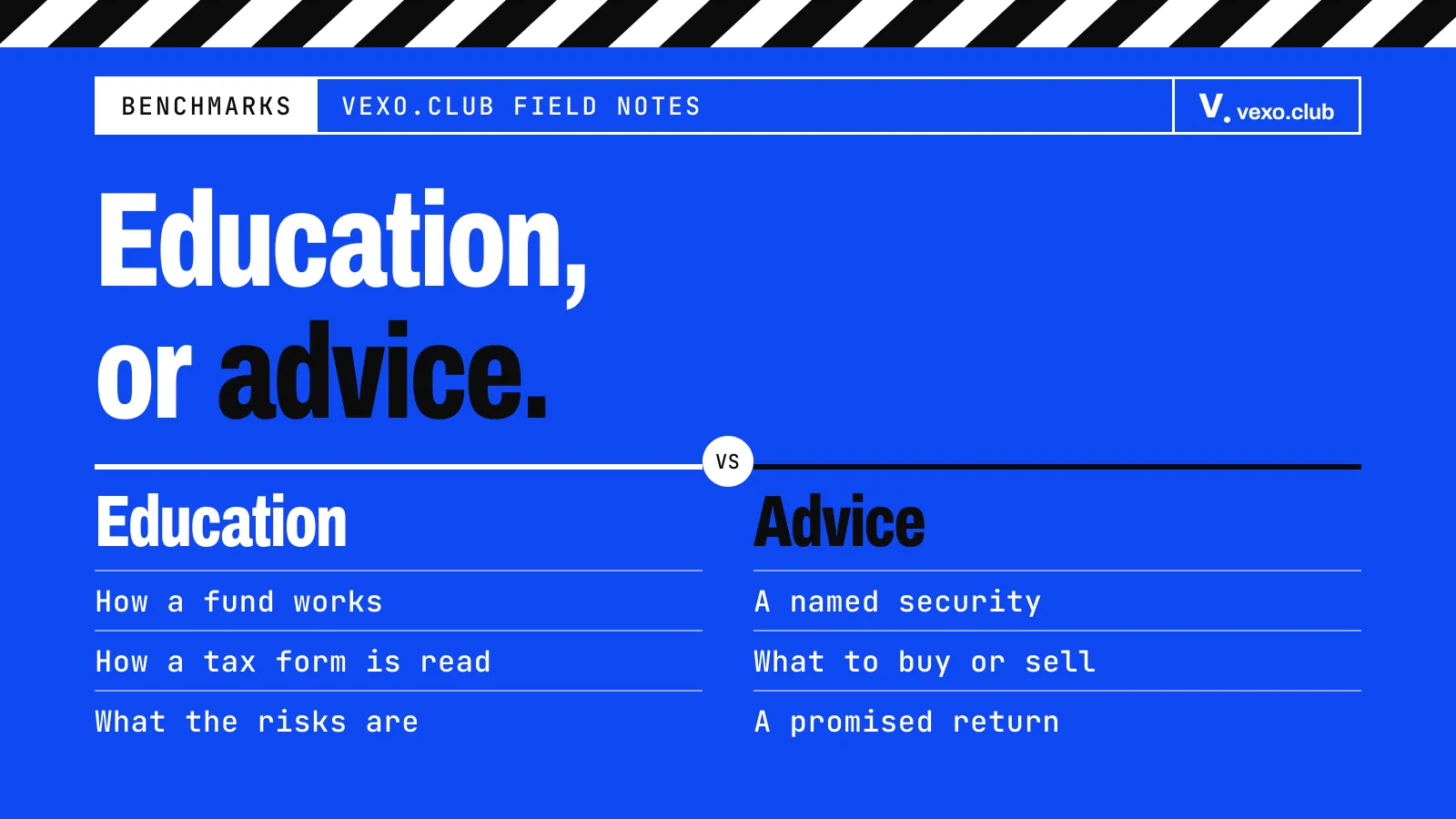
The line that matters runs from education to advice. SEBI’s circular lets a person who is engaged in investor education stay outside its association rule, provided that person does not give advice or recommendations on securities and does not claim returns. The scale below places common kinds of finance content on that line, as the desk reads SEBI’s FAQ. The line itself is SEBI’s to draw, and where a script comes close to it, a brand takes advice from counsel.
From education to advice
Education Advice
- Explaining what a mutual fund or a fixed deposit is At Education
- Walking through a budget or a tax form At Education
- Comparing kinds of insurance cover in general terms Another regulator governs insurance. Leans Education
- Naming a security on screen with a view on where its price is going Leans Advice
- Telling viewers what to buy or sell At Advice
- Saying or implying what a security will return At Advice
Who are the top finance influencers in India?
This guide ranks no one, because a list sorted by followers says nothing about whether a creator’s content sits on the education side of the line. The live subscriber count for any channel is on its own YouTube page, and Social Blade keeps the history. Counts move daily, so none is quoted here. What a brand needs instead is a sort by kind, and a look at what each creator says about themselves.
The named creators below are the ones the desk could confirm from their own pages. Educators and course makers. CA Rachana Phadke Ranade’s About page lists courses on the stock market, mutual funds, fundamental and technical analysis and futures and options, with a contact for brand collaborations. The page gives no SEBI registration number, so this guide states none for her. Roster creators. Sharan Hegde is recorded as a personal finance creator in Delhi, on Instagram and YouTube, covering investing, taxation, insurance, credit and money management for young Indians. Sanjana Aggarwal is recorded in Delhi, on Instagram, in English and Hindi, making content on investing, wealth building and money management. The category page is Finance & Business creators.
Neither roster record carries a SEBI registration number, so the desk states none for either creator. A brief that touches securities starts by asking each creator what, if anything, they hold, and the answer is written into the brief as the creator gives it.
What do SEBI’s rules say about brands working with finfluencers?
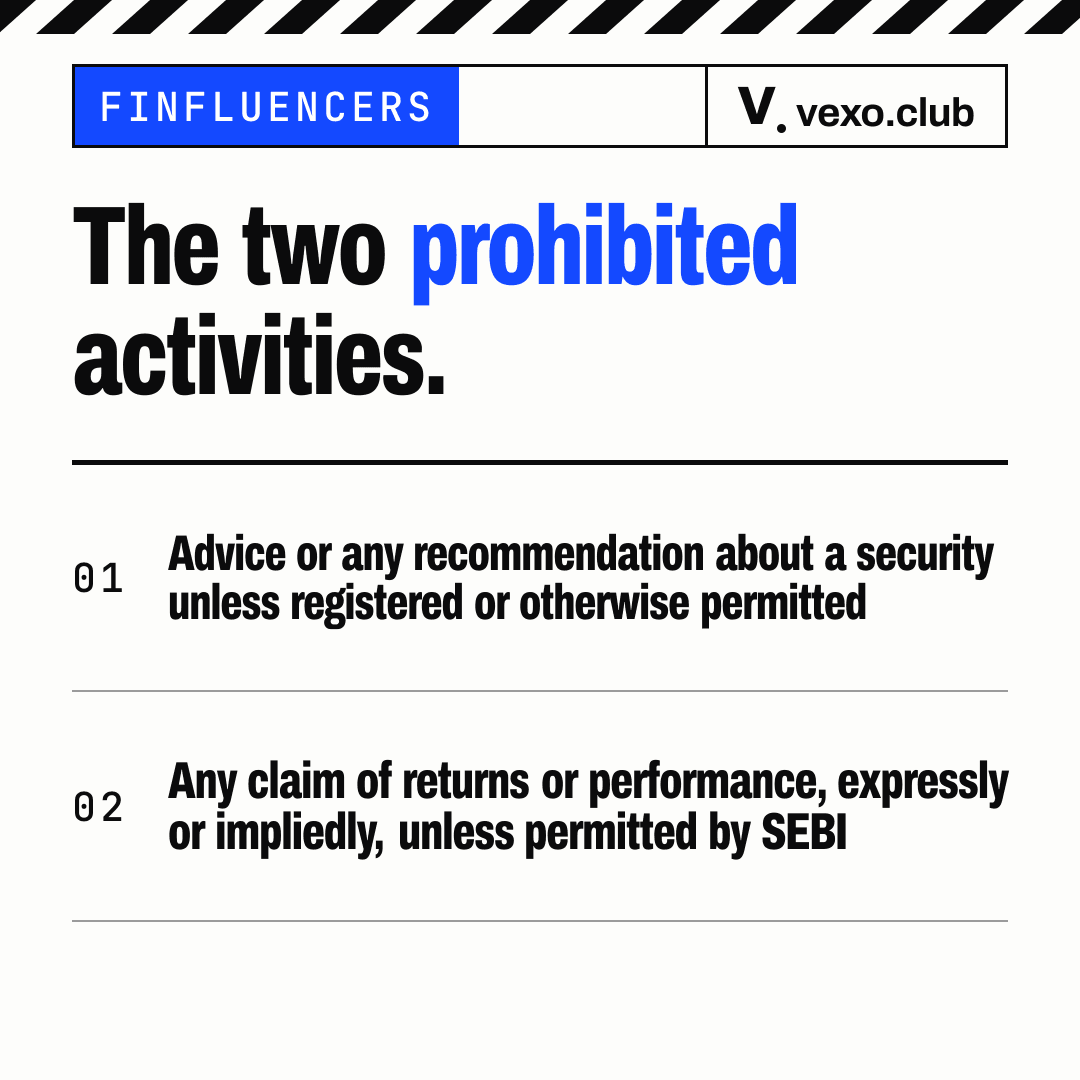
SEBI amended three sets of regulations in 2024 — for intermediaries, for stock exchanges and clearing corporations, and for depositories — and they were published in the Official Gazette on 29 August 2024. SEBI’s circular of 22 October 2024 sets out what they provide: persons regulated by SEBI, and their agents, shall not have any direct or indirect association with another person who provides advice or any recommendation about a security unless registered or otherwise permitted, or who makes any claim of returns or performance, expressly or impliedly, unless permitted by SEBI.
The rules, in the order the issuing bodies dated them
- 15 July 2021 ASCI’s influencer guidelines gain an addendum on what evidence disputes a material connection
- 17 August 2023 ASCI adds the addendum for health and financial influencers
- 29 August 2024 SEBI’s amendment regulations are published in the Official Gazette and come into force
- 22 October 2024 SEBI’s circular tells regulated entities to end existing contracts with persons doing either prohibited activity Within three months of the circular.
- 29 January 2025 SEBI’s circular of FAQs explains who is regulated, what association means and what education is
- 8 May 2026 SEBI changes its FAQ answer on education and market price data The updated circular records the change.
The October circular gave regulated entities three months from its date to end existing contracts with such persons. SEBI’s January 2025 circular, updated on 8 May 2026, answers the practical questions in an annexure, and its answers shape how a brief for a regulated brand is written. In its own words, association means a transaction involving money or money’s worth, the referral of a client, an interaction of information technology systems, or any other association of a similar nature. Making or receiving a payment, or sharing client information, with such a person is association.
The same annexure answers three questions a marketing team asks. Branding and promotion with another person is allowed, provided that person is not engaged in either prohibited activity. Advertising or lead generation through a marketing agency is a violation if the regulated entity or its agent indirectly ends up associated with a person doing either activity. And an association is not excused because the product being promoted is outside SEBI’s remit: the circular’s own example is a broker associating with a person who promotes an insurance product while engaged in a prohibited activity, which it calls a violation. Potential actions, it says, include penalty, suspension or cancellation of registration, and debarment.
The two activities SEBI’s association rule is about
Which brands do the rules reach?
SEBI’s association rule reaches the persons SEBI regulates and their agents, and the circular gives employees, mutual fund distributors and authorised persons of stock brokers as examples of agents. A brand SEBI does not regulate is not bound by that rule directly, but ASCI’s guidelines apply to every advertiser, and another regulator may apply to the product. The comparison sets out the difference.
Who each rule reaches
| SEBI-regulated entity | Its agents | A brand SEBI does not regulate | |
|---|---|---|---|
| SEBI’s association rule binds it | Yes | Yes | No, though another regulator may apply |
| May associate with an unregistered adviser who gives securities advice | No | No | No, under ASCI’s addendum for investment advice |
| Responsible for who its partners and agents associate with | Yes | Through the regulated entity | Not applicable |
| ASCI’s influencer guidelines apply | Yes | Yes | Yes |
| Needs the creator’s credentials shown upfront | Yes | Yes | Yes |
| Best for | Writing an education-only brief | Passing the same limits down the chain | Checking the creator, the claim and the label |
What counts as investor education, and what counts as advice?
SEBI’s FAQ says investor education is not one of the two prohibited activities, so a regulated entity may associate with a person engaged in it, as long as that person does not give advice or recommendations or claim returns. It describes a person engaged solely in education as one who is not engaged in either prohibited activity. It adds a practical test: such a person should not use market price data of the preceding thirty days to speak of or display the name of any security, including a code name, in a talk, video, ticker or screen share in a way that indicates a future price, advice or a recommendation. That answer was revised on 8 May 2026; before the revision it read three months. A brand reads the current text, not this paragraph.
Where investor education sits

For a script, the test comes down to a few habits. Explain how a product works and let the viewer decide. Do not point at a named security and say where it is going. Do not promise or hint at a return. The do-and-don’t below is the desk’s working practice for a finance brief, written from those lines.
Briefing a finance creator
Do
Ask for explanation: how a product works, what the terms mean, what the risks are
Don’t
Ask for a pick, a target or a call on a named security
Do
Let the creator state what they are and hold, in their own words, and write it into the brief
Don’t
Assume a qualification, or print one the creator has not stated
Do
Keep any mention of returns to what the product’s own documents say
Don’t
Imply what a viewer will earn
Do
Put the label and the creator’s credentials where they open the video
Don’t
Leave them in the bio or at the end
What does ASCI require of a financial influencer?
ASCI’s influencer guidelines apply wherever there is a material connection between an advertiser and an influencer, which includes payment, free products and other benefits. Their Addendum 2, dated 17 August 2023, covers influencers in banking, financial services and insurance and in health. It says that influencers who give advice, or promote or comment on the merits of commercial goods and services in these fields, must hold the necessary qualifications and certifications.
For stocks and investments, the addendum says the influencer should be registered with SEBI and show the registration number with their name and qualifications. For other financial advice, it asks for suitable qualifications such as an IRDAI insurance licence, a CA or a CS, and says the influencer must abide by the disclosure requirements financial regulators set. In a video they are superimposed upfront or spoken as the opening remark, in a text post they come before the reader has to read the post, and in a podcast they are called out at the beginning. The influencer must be able to prove them if ASCI asks. The same addendum says an influencer without the qualifications can still share generic information that is not in the nature of technical advice.
What ASCI’s addendum asks to be shown upfront
- The influencer’s qualifications and certifications, stated with their name
- For stocks and investments, the SEBI registration number
- For other financial advice, a suitable qualification such as an IRDAI licence, CA or CS
- Superimposed on screen or spoken as the opening remark of a video
- Stated before the reader reaches the post, in a text post, and at the start of a podcast
- Proof held ready, in case ASCI asks
The paid label sits on top of that. ASCI’s list of permitted labels includes Advertisement, Sponsored, Partnership and Affiliate, and for a live stream it asks for the label at the beginning and the end. The full method is in ASCI disclosure for brands.
Some of the labels ASCI permits

What can a finance creator make content about?
Plenty, and most of it is education. Topics for a financial Instagram page or a finance YouTube channel, kept on the explanation side of the line, include how a budget is built, how a tax form is read, what an emergency fund is for, how different kinds of insurance differ, how a credit score works, what a mutual fund or a fixed deposit is, and what the common mistakes are. These are subjects a viewer can search for and a creator can answer without pointing at a security.
A format that travels well is the explainer with a worked example from the creator’s own life, and the one that causes trouble is the call to action tied to a named security. A brand that wants reach on this kind of content briefs it as a series of explainers and puts the product in the example, not in a recommendation.
What should a brand check before booking a finfluencer?
Work in a fixed order, and put each step in the brief. First read what the creator says about themselves on their own page. Then ask what registration or qualification they hold, and take the answer as they state it. Check it against the public SEBI list of registered investment advisers or research analysts, which can be searched by name or registration number. Then settle what the script may say, and how it is labelled.
The order a finance brief is checked in
- Read the creator’s own page Bio, About page and channel description, as the creator wrote them
- Ask what they hold Registration or qualification, stated by the creator, in writing
- Check the public list SEBI’s registers of investment advisers and research analysts
- Settle education against advice The script explains and does not recommend or promise
- Label and show credentials ASCI label, and credentials upfront, in the video itself
- Review before it posts The claim, the label and the credentials, read against the brief
The audience check applies here as it does anywhere, and how to check an influencer’s audience before you pay sets out the method. Usage matters in finance because an ad that runs a creator’s clip is also an association, so read usage rights before the contract. A finance brief for Delhi NCR starts at the Delhi desk page, and a brief for anywhere can be sent to the desk.
Questions brands ask
Is a finfluencer the same as a SEBI-registered adviser? No. Finfluencer is a description of what a creator makes, finance content. A SEBI registration is a status the creator either holds or does not, and it is listed on SEBI’s public registers. A brand takes the creator’s own statement of it and checks it there.
Can a SEBI-regulated brand pay a finance creator to promote it? Only if the creator is not engaged in either prohibited activity: giving securities advice without registration, or claiming returns without SEBI’s permission. SEBI’s circular says branding and promotion is allowed on that condition, and that paying such a person is an association. Counsel settles the specific case.
Does a finance creator have to show a SEBI number on every video? ASCI’s addendum asks an influencer who gives investment advice or comments on the merits of stocks and investments to be registered with SEBI and to show the number with their name and qualifications. The credentials go upfront in the video, or at the start of a text or audio post.
Does vexo.club have finance creators? Yes. The roster lists Sharan Hegde and Sanjana Aggarwal under Finance & Business, from their records, and neither record carries a SEBI registration number. Each is booked brief by brief, and a securities brief begins with what the creator states they hold.
Are the rules the same for insurance and credit content? Not entirely. ASCI asks for suitable qualifications such as an IRDAI licence, a CA or a CS for other financial advice, and another regulator may apply to the product. SEBI’s circular also says a regulated entity cannot associate with a person who promotes a non-SEBI product while engaged in a prohibited activity.
More on how an influencer marketing company works
Send the desk a brief — it comes back as a shortlist and a directional band, never a public price.
Brief the desk