AI-generated content in Indian ads and creator posts: what must be labelled from 29 December 2026, and who labels it
ASCI’s AI labelling rules apply from 29 December 2026 and MeitY’s synthetic-media rules already do. Which creator content needs a label, and who adds it.
Playbooks Updated 17 min read The operators’ desk
In this article11 sections
From 29 December 2026, an Indian ad whose AI-made content could mislead a buyer about the product must carry an AI label under ASCI’s guidelines. A testimonial nobody gave, or a deepfake, is barred already under the ASCI Code, and no label cures it. Since 20 February 2026, MeitY’s IT Rules have required platforms to label synthetic content.
This guide comes from vexo.club: an influencer marketing agency run from one desk in Delhi NCR. It quotes both texts in their own words, as of 18 October 2026: ASCI’s Guidelines for Responsible Labelling of Synthetically Generated Content in Advertising and the IT Amendment Rules 2026 in the Gazette. It is a working guide for briefs, not legal advice.
AI labelling for Indian brands, in short
- Two rule sets apply at once. ASCI’s guidelines apply to the advertiser; MeitY’s IT Rules apply to platforms, and the largest must make the person uploading declare AI content.
- ASCI sorts AI content in ads into three groups: prohibited even with a label, label required, and no label needed.
- A fabricated testimonial, a deepfake, or a person’s likeness used without consent is prohibited under the ASCI Code already, and no label cures it.
- A virtual influencer, a real face or voice cloned with consent for personalised messages, and a render of a product not yet built all need a label.
- The AI label sits beside the paid-partnership label. It does not replace it.
What are ASCI’s guidelines on AI-generated ads, and when do they apply?
ASCI’s guidelines on AI-generated ads are its rules for synthetically generated content in advertising, released on 29 September 2026 and in effect three months from publication: they say when an ad must disclose that AI made or materially changed it, and which uses are not allowed at all. ASCI’s press release says ads that break its Code “remain prohibited, irrespective of whether an AI label is used”.
ASCI defines synthetically generated content as content in an ad that is “artificially or algorithmically originated, created, generated, modified, or materially altered using a computer resource, to appear real, authentic or true” and that depicts a person or event in a way likely to be believed real: wording close to the IT Rules’ own. ASCI’s examples reach further, to renders and sound effects, so a brand follows the examples. Every such ad must still meet the whole ASCI Code.
ASCI asks brands three questions to decide whether a label is needed. In short:
- Is the AI content central to the ad’s persuasive message, or does it materially influence purchase decisions?
- Would it mislead people about the product’s claims, performance or benefits if it carried no label?
- Would leaving out a disclosure create a false impression of what the product does?
The guidelines print no start date. The text is dated 17 September 2026 under the title of the chairman of ASCI’s Board of Governors, and ASCI released it on 29 September. Counted from the release, three months ends on 29 December 2026; counted from the date on the text, it would end on 17 December, so a brief for December work is safer labelled from the earlier date.
How India’s AI content rules arrived
- 10 February 2026 MeitY notifies the IT Amendment Rules by Gazette notification G.S.R. 120(E)
- 20 February 2026 The amended IT Rules come into force for platforms
- 12 May 2026 ASCI releases draft guidelines, with comments open until 13 June
- 29 September 2026 ASCI releases the final guidelines
- 6 October 2026 The NMC’s advertising guidelines, with rules on AI, apply with immediate effect
- 29 December 2026 ASCI’s guidelines take effect, three months from publication
Which AI content is prohibited, even with a label?
Any ad that is illegal, infringes rights, makes misleading claims or breaks the ASCI Code is prohibited whatever the label says. ASCI gives four examples: a fabricated endorsement or testimonial, an exaggerated result shown with AI, a place that does not exist shown as real, and unauthorised copyrighted work, a deepfake or a person’s likeness used without consent. ASCI describes the first as using AI to falsely represent “that a real person has used, experienced, approved, recommended or endorsed a product or service when they have not”.
Its example of the second is a weight-loss ad showing an AI-generated lean, toned body that does not represent the product’s actual or substantiated results. ASCI’s draft release of 12 May 2026 also named “an AI-generated fake doctor promoting a supplement”; the final text drops the example, though a fabricated endorsement is still prohibited.
Which AI content needs a label?
A label is mandatory where AI content materially influences consumer decisions and leaving it unlabelled would mislead. ASCI’s examples, in its order:
- Synthetically generated influencers and ambassadors
- A real person’s likeness or voice replicated, even with their consent, for personalised messaging
- Fabricated events or settings that may change how people understand the product
- A product that does not exist yet, such as a 3D model of an unbuilt housing complex
- AI sound effects central to the product, such as audio quality in a headset ad
- Paid or sponsored product suggestions made by AI, labelled “Sponsored by [Brand]”
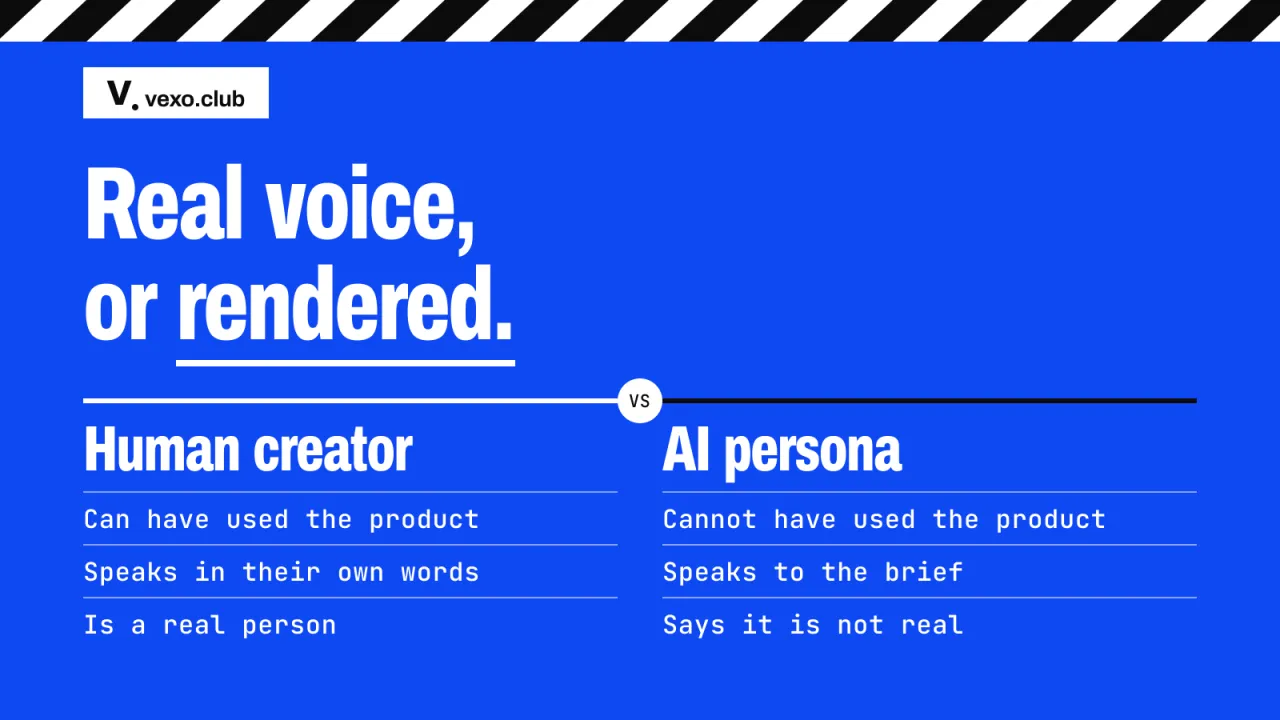
For creator work the second matters most. A clone made with consent for personalised messaging is labelled, and on the desk’s reading so is any clone that carries the ad’s message. A clone that makes the creator appear to endorse what they never endorsed is prohibited.
Which AI content needs no label?
No label is needed where AI makes minor changes with no material impact on a consumer’s ability to make an informed choice. ASCI lists five groups:
- Routine editing, colour correction, light adjustment, noise reduction and standard blemish removal that do not alter the ad’s core claims
- Decorative backgrounds, ambient music, jingles and crowd sounds unrelated to what the product can do
- Obvious fantasy, such as “a fairy repairing a broken product with magic dust”
- Text and administrative uses, such as generating advertising copy
- Accessibility: subtitles, closed captions, translations and accurate audio descriptions
The line runs through the product claim. An AI-generated backdrop in a skincare ad needs no label. An AI-generated result on the skin is a claim about the product, and on the desk’s reading it is either labelled or, if it shows more than the product delivers, prohibited. The May draft asked for a label on “synthetically generated visuals for product performance unless the visuals replicate how the product actually performs”; the final text drops that example, so this reading is one for counsel, not the creator.
ASCI’s three groups of AI content in ads

What do MeitY’s IT Rules 2026 require?
Since 20 February 2026, the IT Rules have required platforms to label synthetic content and block the unlawful kind, and the largest platforms (‘significant social media intermediaries’ in the rules) must ask every uploader to declare it. The change came by Gazette notification G.S.R. 120(E) of 10 February 2026.
The rules cover content “artificially or algorithmically created, generated, modified or altered using a computer resource” so that it looks real and passes for a real person or event, and leave out routine, good-faith edits and accessibility uses. They set three duties:
- A platform whose service lets people make or share such content must stop the unlawful kind, including false depictions of a real person or event likely to deceive (rule 3(3)).
- Everything else must be “prominently labelled”, with a prefixed disclosure for audio, and carry permanent metadata “to the extent technically feasible”, which the platform may not let anyone remove.
- A significant social media intermediary must “require users to declare whether such information is synthetically generated information”, verify the answer and label it (rule 4(1A)).
The same notification shortened the clocks: three hours to remove unlawful content after a court order or government intimation (it was thirty-six), and two hours on a complaint about intimate images or impersonation, including artificially morphed images (it was twenty-four). A deepfaked creator can use that two-hour route. MeitY’s draft second amendment of April 2026 would keep the label on screen “throughout the duration of the content”; the desk found no notification of it by 18 October 2026.
Who labels what: the platform, the advertiser or the creator?
Each rule names a different party: ASCI holds the advertiser responsible for the ad, the IT Rules hold the platform responsible for labels and metadata, and on the largest platforms the person uploading declares the content. ASCI’s Secretary General and CEO, Manisha Kapoor, says in the release: “The responsibility remains with advertisers to ensure that the end communication is honest, transparent and compliant with the ASCI Code.”
In creator work the duties stack. ASCI’s influencer guidelines put the responsibility for disclosure on the advertiser “and also upon the Influencer”, and let the advertiser call on the influencer to edit or delete a post. The creator answers the platform’s AI question on upload.
Three rule sets that reach AI content in creator marketing
| ASCI’s AI guidelines | The IT Rules | The NMC’s guidelines | |
|---|---|---|---|
| Who it applies to | Advertisers, for every ad | Platforms; the largest collect uploaders’ declarations | Doctors, hospitals and medical institutions |
| When it applies | Three months after the September release | Since February, by Gazette notification | Since October, with immediate effect |
| What needs a label | AI content that would mislead without one | Lawful synthetic content that passes for a real person or event | Any permitted AI promotional content, with a source mark |
| What it prohibits | Fake testimonials, deepfakes, misleading AI results | Unlawful synthetic content, including deceptive depictions of real people | AI promotional campaigns for commercial interest, and AI-made patient testimonials |
| The wording it gives | Audio or video created or enhanced using AI | A prominent label, or a spoken disclosure first for audio | A source mark stating that the content’s origin is AI |
YouTube’s help page on AI disclosure, as of 27 October 2026, requires creators “to disclose content that is generated or meaningfully altered with AI when it appears realistic”, yet lists “Cloning one’s own voice to create voiceovers or dubs” as needing no disclosure. A platform’s rule does not settle ASCI’s question for the ad.
Who answers for the AI label under each rule

Format by format: what a creator brief must say
A creator brief names every AI-made or AI-altered asset, the ASCI group it falls in, the label it carries and who answers for it, before anyone shoots. The matrix puts the assets briefs commonly hold against ASCI’s groups.
Which AI content needs which label
| ASCI’s group | What the post carries | Who answers for the label | |
|---|---|---|---|
| A virtual influencer or AI ambassador | Label required | An AI label, the paid label, and a line that it is not a real person | The advertiser; the operator declares it on upload |
| A real face or voice, cloned with consent | Label required | An AI label and the paid label | The advertiser; the creator declares it on upload |
| A real face or voice, used without consent | Prohibited | Nothing: it is not made | Not applicable |
| A testimonial the person never gave | Prohibited | Nothing: no label cures it | Not applicable |
| A render of a product not yet built | Label required | An AI label | The advertiser |
| An on-screen AI presenter who could pass for a real person | Label required | An AI label, and the paid label on a creator’s post | The advertiser; whoever uploads declares it |
| An AI voice-over in no real person’s voice | Depends on the three questions | An AI label where the answer is yes | The advertiser |
| Real footage with colour, light or noise fixes | No label | The paid label only | Not applicable |
| Subtitles, captions and translations | No label | The paid label only | Not applicable |
For an asset the matrix does not list, the decision runs in the same order every time.
The labelling decision for one creator asset
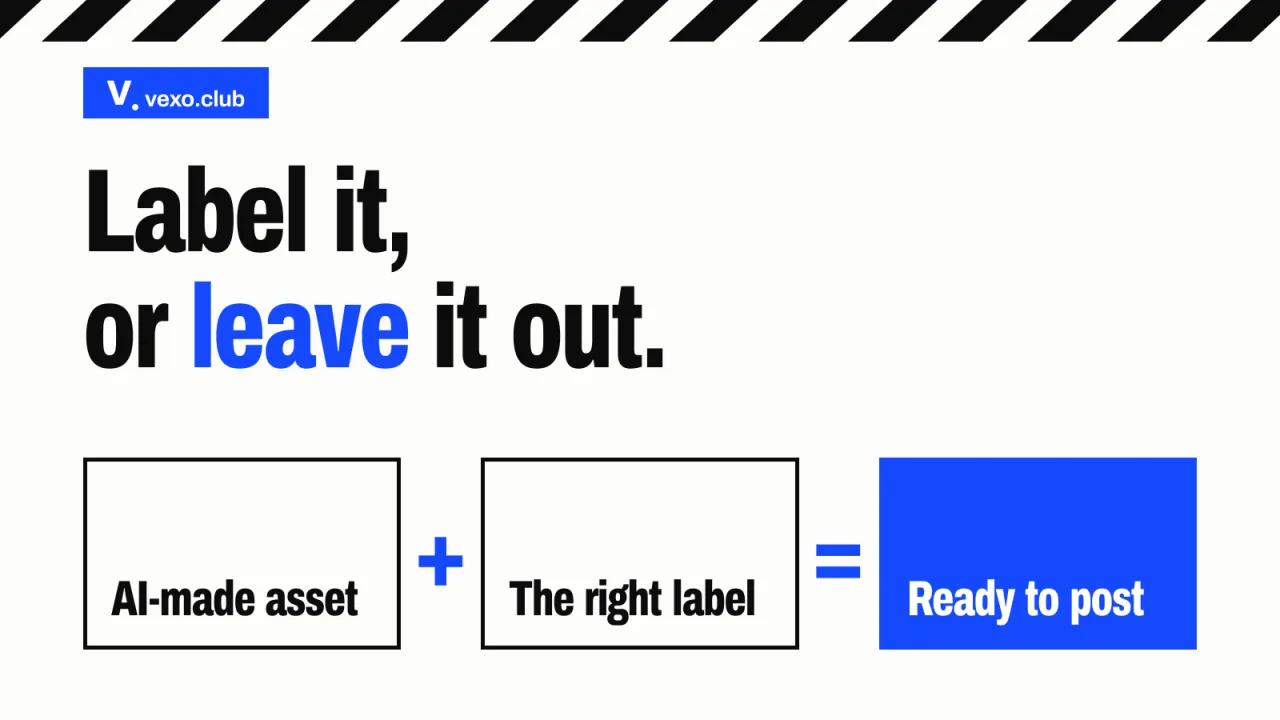
- Is it only a routine edit, decoration, obvious fantasy, copy or an accessibility aid? If yes, no label. Anything that could pass for a real person, place, event, product or product sound goes to the next step.
- Is it on the prohibited list? A testimonial nobody gave, a likeness without consent, a result the product does not deliver: drop it.
- Ask ASCI’s three questions Central to the message, misleading without a label, a false impression of the product.
- Choose the words The platform’s AI label, or the brand’s own wording that accurately informs, beside the paid label.
- Declare it on upload The creator answers the platform’s AI question truthfully.
What do the Consumer Affairs guide and the NMC add?
The Department of Consumer Affairs’ endorsement guide treats virtual influencers as endorsers, and the NMC bars doctors and hospitals from AI-made patient testimonials. The PIB release of 20 January 2023 says the guide was written “for celebrities, influencers and virtual influencers on social media platforms”, and that any of them with an audience “must disclose any material connection with the advertiser”.
Enforcement of the AI label is untested, since ASCI’s guidelines take effect only in December. ASCI is a self-regulatory body, “committed to the cause of self-regulation in advertising” in its own release. The statute behind the endorsement guide is the Consumer Protection Act 2019, which the PIB release says protects consumers “from unfair trade practices and misleading advertisements”, and the Department’s guidelines on misleading advertisements and endorsements followed on 9 June 2022.
For doctors and hospitals, the NMC’s guidelines of 6 October 2026 set their own AI rules (read here in a copy hosted by Medical Dialogues); the detail is in the NMC’s rule on AI testimonials.
What should the AI label say, and where does it go?
ASCI lets a brand use the platform’s own AI label or its own words that accurately inform the consumer, and gives “Audio/Video created using AI” and “Audio/Video enhanced using AI” as examples. The guidelines set no position or duration; disclaimers follow the ASCI Code’s disclaimer guidelines where they apply.
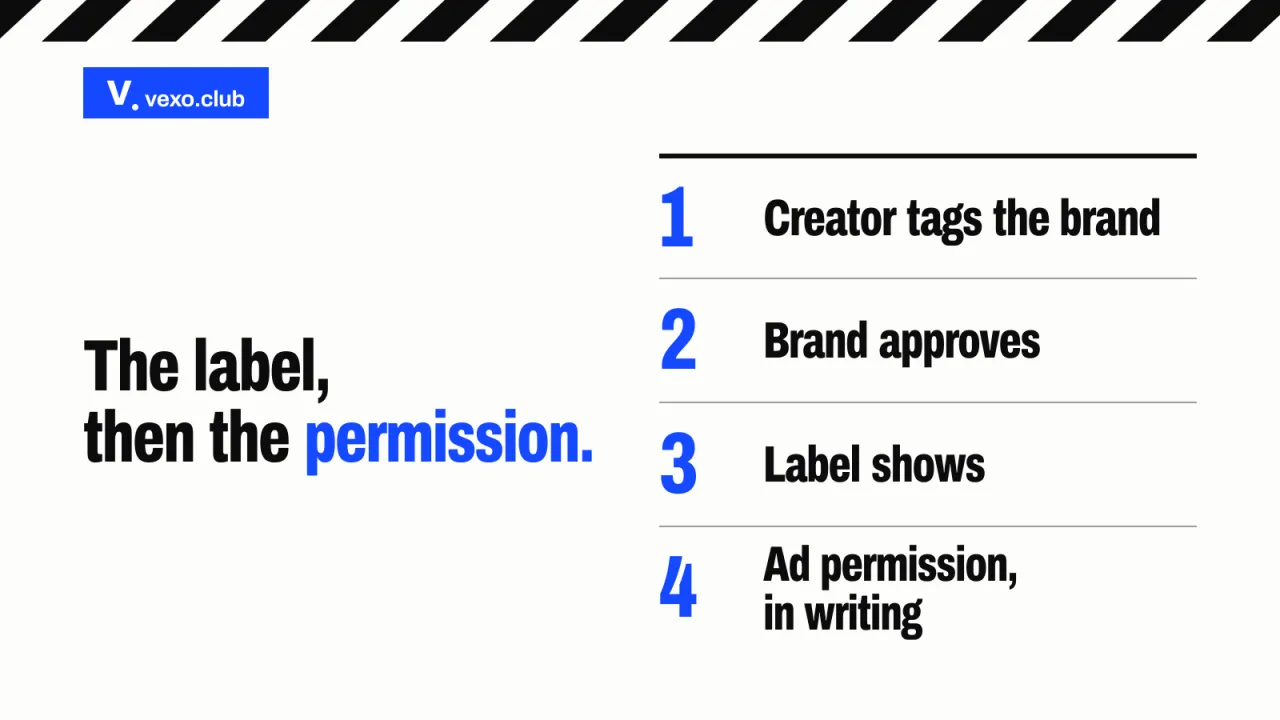
The AI label does not replace the paid one, which ASCI’s influencer guidelines still require; see ASCI’s disclosure rules for brands and, for Instagram, how the paid partnership label works. Those guidelines add that a virtual influencer “must additionally disclose to consumers that they are not interacting with a real human being”. So a virtual creator’s post needs three disclosures: paid, made with AI, and not a person.
The label wording ASCI suggests

What should the creator agreement and the final check cover?
The creator agreement adds five lines for AI, and the check before posting confirms each one. The lines sit with usage rights and the contract clauses that change the price, because a cloned voice or face is a use of the creator’s likeness.
Five lines an AI clause adds to the creator agreement
- The AI asset list Every element made or altered with AI, named before the shoot, with its ASCI group
- Consent and likeness Written consent from any real person whose face or voice is replicated, and for which use
- The labels The AI label, its wording and its place, beside the paid label
- The platform declaration The creator answers the upload question truthfully on every platform
- Correction and takedown Who edits or removes the post if a label is wrong or a complaint arrives
The pairs below are the desk’s working practice for a brief with AI in it.
AI in a creator brief
Do
Name each AI asset and its ASCI group in the brief
Don’t
Leave the creator to guess what was made with AI
Do
Get written consent before a face or voice is cloned
Don’t
Treat a label as a substitute for consent
Do
Show the product as it really performs
Don’t
Let a generated result stand in for the product’s own
Do
Keep the paid label and add the AI label
Don’t
Swap one label for the other
Do
Check the label on the live post
Don’t
Assume the platform added it
The AI label belongs in the same pass as the paid label, which the desk checks before a post goes live, beside the audience check it runs before casting. The questions for that pass:
Before an AI-made post goes live
- Is every AI-made or AI-altered element listed, with its ASCI group?
- Is anything on the prohibited list, such as a testimonial nobody gave?
- Is there written consent for every real face or voice that was replicated?
- Does the post carry the AI label where ASCI requires one, in words a viewer reads?
- Does it still carry the paid-partnership label?
- Did the creator answer the platform’s AI question truthfully on upload?
- For a health brand, does the NMC’s rule on AI apply?
The desk’s studio lists AI video among its services (product renders, avatar and voice, dubbing), so the three groups apply to the studio’s production work as much as to a creator’s post. A brief that uses an AI voice, render or presenter can be sent to the desk with the asset list, and a creator shortlist comes back in 18 hours.
Questions brands ask
Do AI-generated ads need a label in India? Where the AI content could mislead, yes. From 29 December 2026 (three months from ASCI’s 29 September release, since the text prints no start date) ASCI requires a label when AI content materially influences buying decisions and would mislead without one. Since 20 February 2026 the IT Rules have also required platforms to label synthetic content that passes for a real person or event. Routine edits, decoration, obvious fantasy and accessibility uses need no ASCI label.
Can a brand use an AI clone of a creator’s face or voice? Only with the creator’s written consent and, on the desk’s reading of ASCI, with a label. ASCI requires a label for replicating a real person’s likeness or voice, even with consent, for personalised messaging, and prohibits a deepfake or a person’s likeness used without consent. A clone may never make the creator appear to endorse something they did not.
Who is responsible for the AI label, the brand or the platform? Both, under different rules. ASCI holds the advertiser responsible for the ad and the influencer for their disclosures; the IT Rules make platforms label synthetic content and, on the largest platforms, collect the uploader’s declaration. ASCI accepts a platform’s AI label, but the brand answers for whether the ad carries one.
What should an AI label say? ASCI gives “Audio/Video created using AI” and “Audio/Video enhanced using AI” as examples, and accepts other wording that accurately informs the consumer, including a platform’s own label. A paid product suggestion made by AI must say “Sponsored by [Brand]”.
Does a small AI edit need a label? No, if it does not alter the substance or core claims of the ad: ASCI needs no label for routine editing, colour correction, light adjustment, noise reduction or blemish removal, and the IT Rules leave routine, good-faith edits out. An edit that changes what the product appears to do is not small.
Where does the AI label check sit in a campaign? In two places: the brief and the check before posting. The brief lists each AI-made asset with its ASCI group, so the label and any consent are settled before the shoot. The check before a post goes live confirms that the live post carries the label the brief agreed.
Sources
- Guidelines for Responsible Labelling of Synthetically Generated Content in Advertising (opens in a new tab) ascionline.in
- IT Amendment Rules 2026 in the Gazette (opens in a new tab) meity.gov.in
- press release (opens in a new tab) ascionline.in
- draft release of 12 May 2026 (opens in a new tab) ascionline.in
- draft second amendment (opens in a new tab) meity.gov.in
- influencer guidelines (opens in a new tab) ascionline.in
- help page on AI disclosure (opens in a new tab) support.google.com
- PIB release of 20 January 2023 (opens in a new tab) pib.gov.in
- copy hosted by Medical Dialogues (opens in a new tab) medicaldialogues.in
Cite this page
AI-generated content in Indian ads and creator posts: what must be labelled from 29 December 2026, and who labels it. vexo.club, published 22 Oct 2026, updated 28 Oct 2026. https://vexo.club/blog/ai-generated-content-labelling-rules-india-brands
Send the desk a brief: it comes back as a shortlist and a directional band, never a public price.
Brief the desk