Diwali influencer marketing in India: the brief-by calendar from Dhanteras to Bhai Dooj
Diwali runs five days, Dhanteras to Bhai Dooj, and nearly every Indian market marks the same ones. When a Diwali campaign brief has to lock, the themes that earn their place over a sale banner with a diya on it, and the disclosure rules for a crowded festive caption.
Playbooks 11 min read The operators’ desk
In this article6 sections
A Diwali brief is a different problem from a festive-season brief. The festive season runs from Navratri into Bhai Dooj and is a different festival in every market: garba in Gujarat and Mumbai, Durga Puja in Kolkata, Dasara in Hyderabad. Diwali is the one week inside that season that nearly every Indian market marks on the same days, which is exactly why it carries the heaviest single load of any festive brief and why it deserves its own calendar rather than a line inside a broader one.
This is a Diwali influencer marketing playbook from vexo.club, an agency run from one desk in Delhi NCR. It reads the puja calendar from Drik Panchang, links every source, and prints no rate and no result of its own. The dates below are as Drik Panchang’s New Delhi list stood on 24 October 2026.
Diwali campaign briefs, in short
- Diwali runs from Dhanteras to Bhai Dooj, 6 to 11 November this year, on dates nearly every market in India marks together.
- A brief that starts the week Diwali does is late. Diyas, rangoli stock, home stylists and family casts are booked out before the week begins.
- Gifting, home and new-beginnings themes carry the ritual; a sale banner with a diya pasted on it borrows the colours instead.
- The ASCI disclosure label still applies on every paid post, and a caption crowded with greetings is exactly where it gets buried.
- Decide before the shoot whether the asset ends on Diwali night or carries into the weeks after: the two need different usage windows.
When does a Diwali brief have to lock?
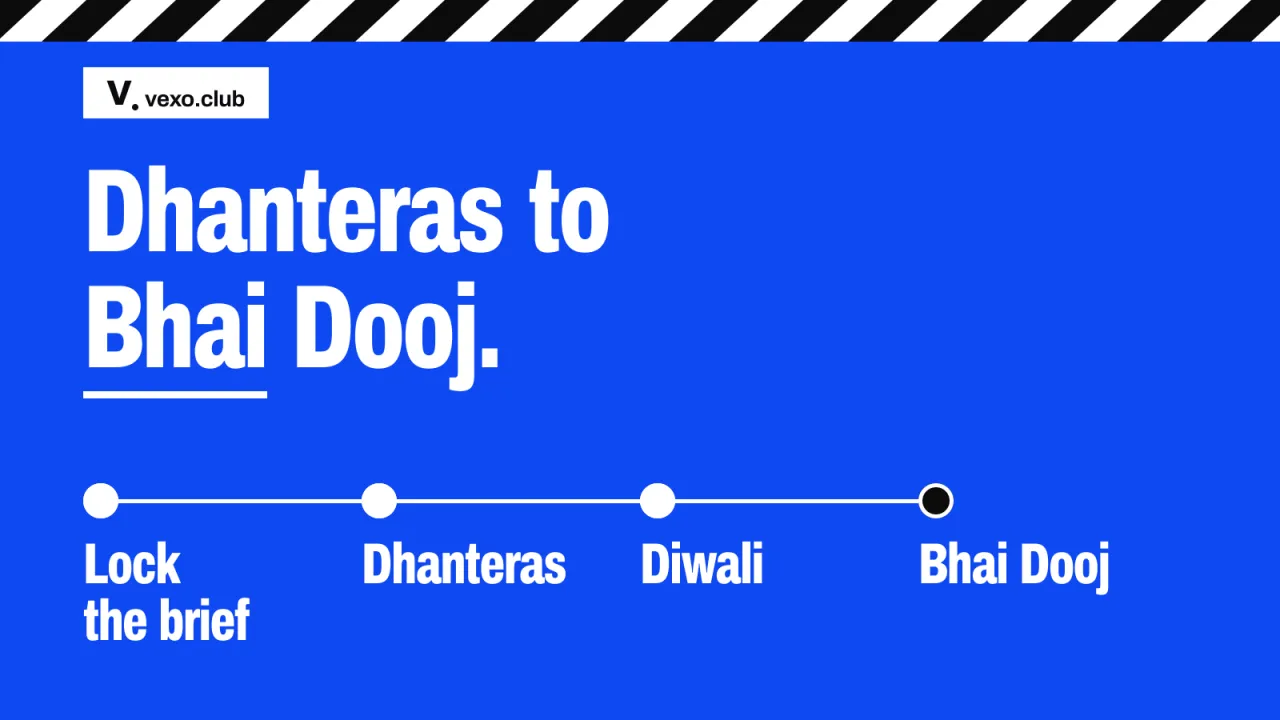
Diwali is usually counted as a five-day festivity, from Dhanteras to Bhai Dooj, and in 2026 it runs across six days, Friday 6 November to Wednesday 11 November on Drik Panchang’s Diwali calendar for New Delhi, read on 24 October 2026: Dhanteras on 6 November, Kali Chaudas on 7 November, Lakshmi Puja (the day Drik also names Diwali itself) on Sunday 8 November, Govardhan Puja on 10 November and Bhai Dooj on 11 November. Maharashtra’s festivities open a day earlier, on Govatsa Dwadashi, and Gujarat’s open two days earlier; the days above are the common national run. Dates move every year with the lunar calendar, so check the current panchang when you lock a plan for a year other than 2026.
Brief-by dates for a Diwali post in 2026
| Live on Dhanteras, 6 Nov 2026 | Live on Lakshmi Puja, 8 Nov 2026 | |
|---|---|---|
| Brief signed and shortlist agreed | Fri 16 Oct 2026 | Sun 18 Oct 2026 |
| Shoot starts | Fri 23 Oct 2026 | Sun 25 Oct 2026 |
| Approvals closed and label checked | Fri 30 Oct 2026 | Sun 1 Nov 2026 |
| First post live | Fri 6 Nov 2026 | Sun 8 Nov 2026 |
The 2026 Diwali week, Dhanteras to Bhai Dooj
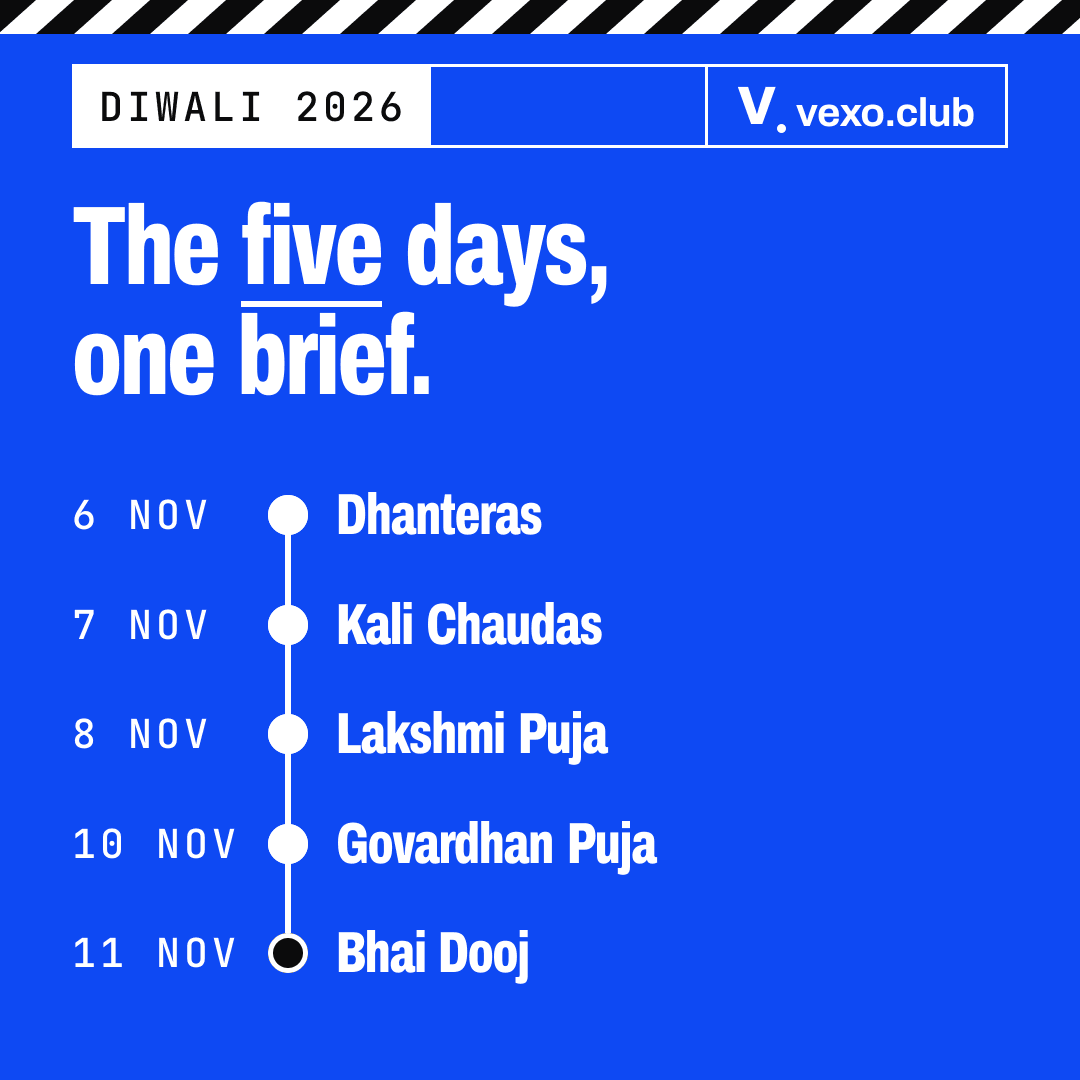
Three weeks out is not production time, it is the margin a festive week removes from you. Diya and rangoli vendors, home stylists and the families who appear in a Diwali reel are the same ones every other brand in the category wants for the same few days, and a prop sourced the week before Diwali is sourced at whatever is left. The rule holds whichever day of the five your post is tied to: work back from that day, not from Diwali in general.
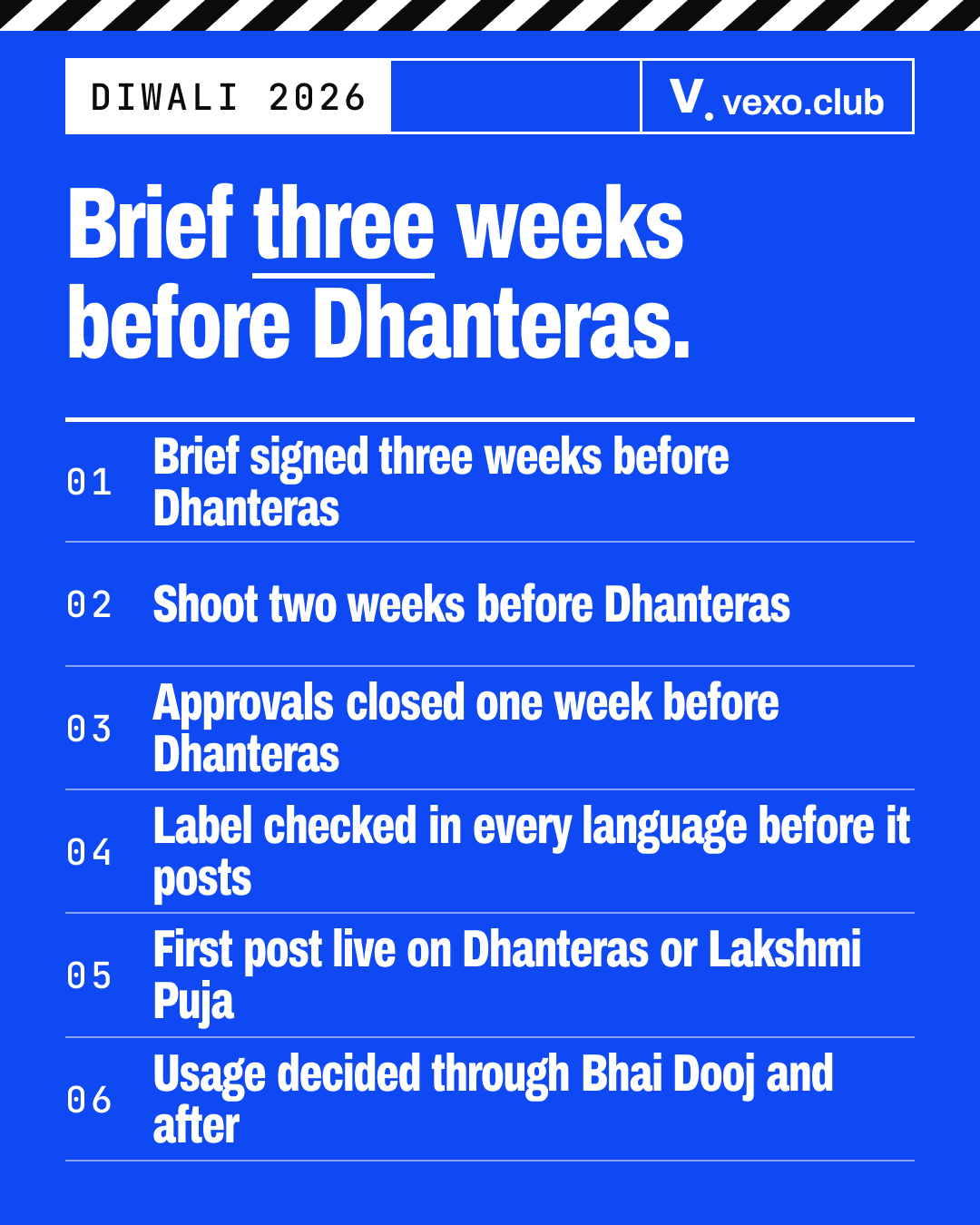
The brief-by rule for a Diwali post
Which content themes work for Diwali, and which read as generic?
Four themes carry a Diwali brief on their own weight: gifting, because Diwali is when a list of people gets a list of things and the act of choosing is the content; home, because the festival already builds the set (a swept, lit and rangoli-marked home needs no studio standing in for one); family, the reunions, the elders and the children in frame together; and new beginnings, the Dhanteras purchase, the new ledger a business owner opens, the gold, the vehicle or the home bought under a muhurat. Each of these is something a creator can show happening, not a line they read over a product shot.
What plays at Diwali, and what reads as filler
| Gifting | Home and rangoli | New beginnings | A discount banner | |
|---|---|---|---|---|
| What it shows | A gift chosen and given, on camera | A home lit, swept and styled before guests arrive | A ledger opened, a store readied or a purchase made on Dhanteras | A product with a diya placed beside it |
| Why it works, or does not | The ritual of giving is the content, not a backdrop to it | The home is already the set the festival built | Diwali is when a family or a business marks a fresh start | Diyas and a countdown dressed up as a reason to buy |
| Where it is shot | At the gifting moment itself, not staged after | In the home, not a studio standing in for one | At the counter, the till or the new purchase | Anywhere, which is the problem |
| What the caption needs | Who the gift is for, named if the creator wants to | What was cleaned, lit or cooked, not a stock greeting | What is new, and why today is the day for it | A reason beyond the discount, or it reads as an ad with a diya on it |
Six Diwali themes that carry a brief
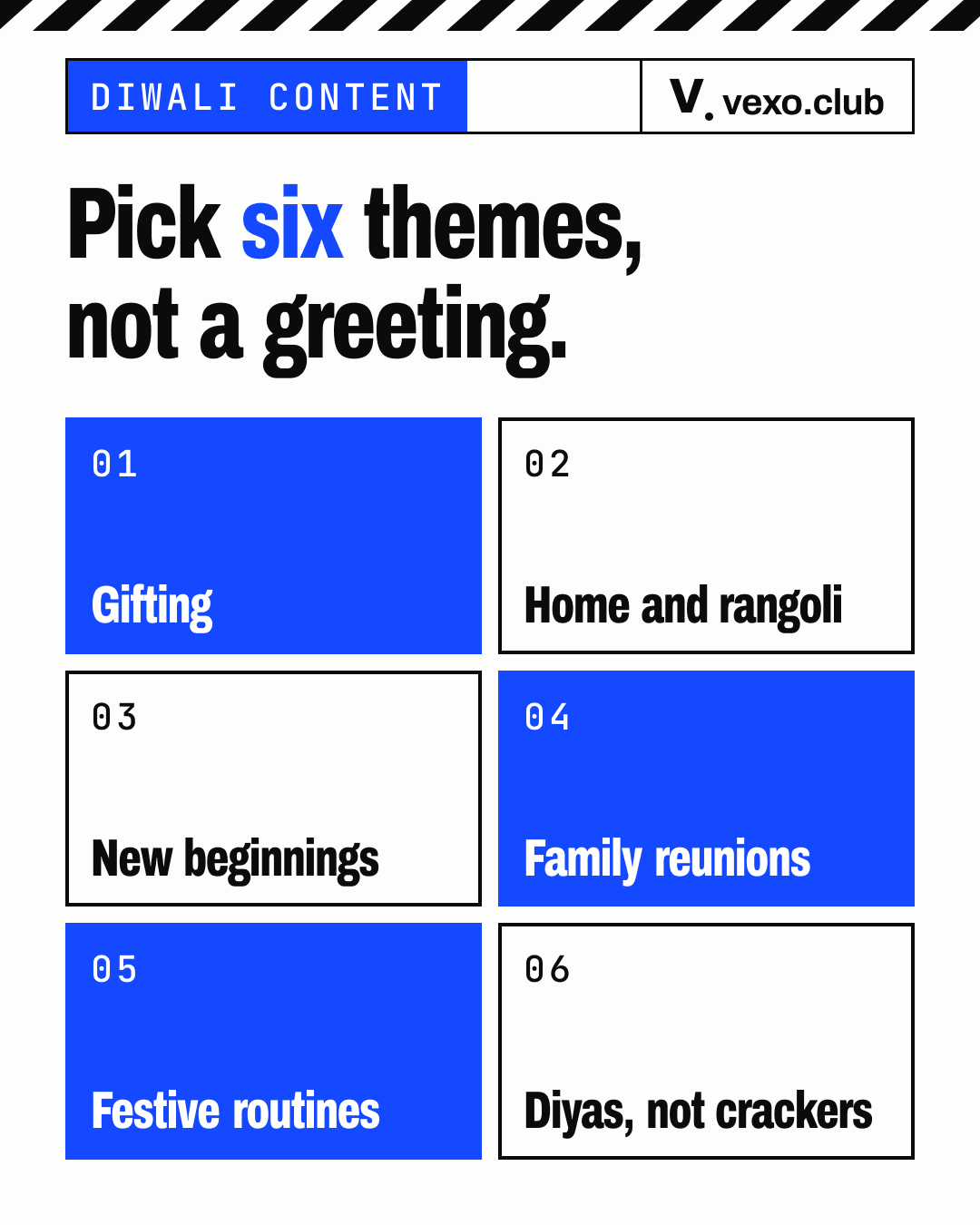
A brand defaults to the fourth column when the brief has not decided which of the first three it is. A Diwali creative route that could run on any festival, with the diya swapped for a different prop next time, has not used Diwali at all; it has borrowed its colours. Checking an influencer’s audience sets out how to confirm a creator’s own festival (their city, their language, their household) before casting them into one of these four, so the gift or the home on screen is plausibly theirs.
What does disclosure need, and when, for a Diwali campaign?
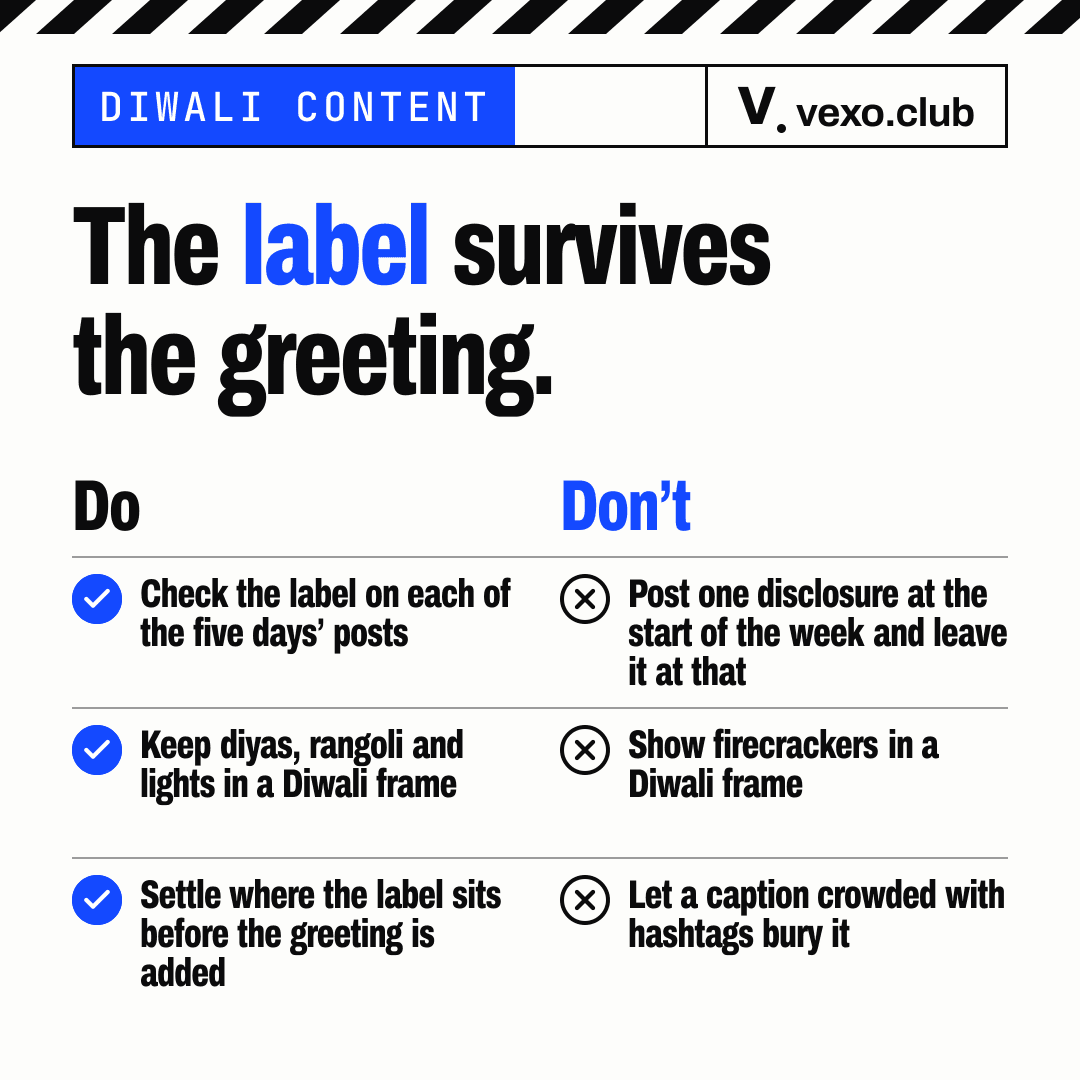
Every paid Diwali post carries the same ASCI disclosure requirement as any other sponsored post in India; ASCI disclosure for brands sets out which posts count, where the label sits on each format and who checks it. What is specific to Diwali is the shape of the week: a campaign running across Dhanteras, Lakshmi Puja and Bhai Dooj is five separate posting moments, each with its own caption, not one disclosure covering the run. A label checked on the Dhanteras post has not been checked on the Bhai Dooj one.
Does a Diwali asset outlive the festival?
Diwali night only Into the new year
- A Shubh Deepavali greeting with no product in it At Diwali night only
- A gifting reel for a named product In the middle
- A home-styling or rangoli tutorial Leans Into the new year
- A Dhanteras purchase or new-launch reel At Into the new year
A caption crowded with greetings, emoji, hashtags and family tags is where a label gets lost, so settle its placement before the greeting is written, not after. Where a campaign runs in more than one language (a Hindi caption and a Tamil one marking the same Deepavali), the label is checked in each, not translated once and assumed to carry over. And in frame, the house rule is diyas and lights, never firecrackers: a Diwali visual built on diyas is the one this desk ships, and it is the one that ages well past the ban notices and air-quality coverage that follow most festive weeks.
What a Diwali caption has to carry besides the greeting
Where the content is close to a product claim rather than a greeting (a new launch timed to Dhanteras, a gold or jewellery piece shown as a purchase), the claim is written with the words that cannot change marked before the shoot, the same discipline any sponsored post needs. Content made or altered with AI carries its own separate labelling question, which AI-generated content labelling rules for brands covers; a Diwali brief that uses a synthetic voice for a personalised greeting or an AI-dressed home falls under it too.
How is a Diwali brief different from planning the wider festive season?
Planning festive-season influencer campaigns in India covers the whole run from Navratri to Bhai Dooj, and its point is that the same weeks are a different festival in every market, so a national idea has to be cast, written and timed separately city by city. Diwali sits inside that run but does not follow its own rule: Dhanteras, Lakshmi Puja and Bhai Dooj land on the same days almost everywhere Diwali is marked at all, so a Diwali brief can run off one national calendar rather than a market-by-market one. What still has to be cast locally is the language of the caption and the shape of the household on screen, not the date.
That is the difference this guide exists to cover: the festive-season piece is the plan for the whole season across every market; this one is the calendar and the content rule for the single week inside it that carries the most weight, with the dates, the themes and the disclosure questions that are specific to Diwali rather than to the season around it.
A checklist for the week before a Diwali brief
Before a Diwali brief goes out, check six lines:
Six lines a Diwali brief carries
- The festival day each post is tied to: Dhanteras, Lakshmi Puja or Bhai Dooj
- The theme: gifting, home, family or new beginnings, not a generic greeting
- The claim, with the words that cannot change marked
- The usage window, and whether the asset outlives Diwali night
- Where the disclosure label sits, checked in every language the caption runs in
- Diyas and rangoli in frame, never firecrackers
vexo.club runs a Diwali brief the way it runs any other: one operator, a shortlist back in 18 hours, contracts and briefing inside a week, and the label checked before each day’s post goes live rather than once for the week. A Diwali campaign for influencer marketing in India can be sent to the desk through the form, on WhatsApp or by email, and the open brief template has a line for the theme, the usage window and the approver.
Questions brands ask
When does Diwali fall in 2026, and when should a brief lock? Dhanteras is Friday 6 November 2026 and Bhai Dooj is Wednesday 11 November, on Drik Panchang’s New Delhi calendar. On this guide’s count, sign the brief about three weeks before the day your post is tied to, shoot two weeks before and close approvals one week before.
What should a Diwali influencer marketing campaign in India include? A theme the ritual actually carries (gifting, home, family or new beginnings) cast to a creator whose household and language make it plausible, a claim with its unchangeable words marked, a usage window decided before the shoot, and the ASCI disclosure checked on every day’s post, not once for the week.
Why does a sale banner with a diya on it read as generic? Because the diya is a backdrop rather than the content. A gifting, home or new-beginnings post shows the ritual happening; a product shot with a diya beside it only borrows the festival’s colours and would work with any prop swapped in.
Does a Diwali post need the ASCI disclosure label? Yes, on every paid post, the same as any sponsored content in India. The Diwali-specific risk is a caption crowded with greetings and hashtags, which is where the label gets buried; settle its placement before the greeting is written.
How is this different from the general festive-season plan? The festive-season guide covers Navratri to Bhai Dooj as a different festival in every market. Diwali itself lands on the same days almost everywhere it is marked, so a Diwali brief runs off one national calendar, while the caption’s language and the household on screen still need casting market by market.
Sources
- Drik Panchang’s Diwali calendar for New Delhi (opens in a new tab) drikpanchang.com
Cite this page
Diwali influencer marketing in India: the brief-by calendar from Dhanteras to Bhai Dooj. vexo.club, published 30 Oct 2026. https://vexo.club/blog/diwali-influencer-marketing-campaigns-india
Influencer marketing across India
Send the desk a brief: it comes back as a shortlist and a directional band, never a public price.
Brief the desk