TDS on influencer payments in India: which section of the Income-tax Act 2025 applies to cash fees and to barter products
TDS on influencer payments in India: the Income-tax Act 2025 entry for a product a creator keeps, the two entries for a cash fee, and who deducts. Quoted from the Gazette text, with worked illustrations and a model contract clause for your chartered accountant to check.
Pricing Updated 16 min read The operators’ desk
In this article11 sections
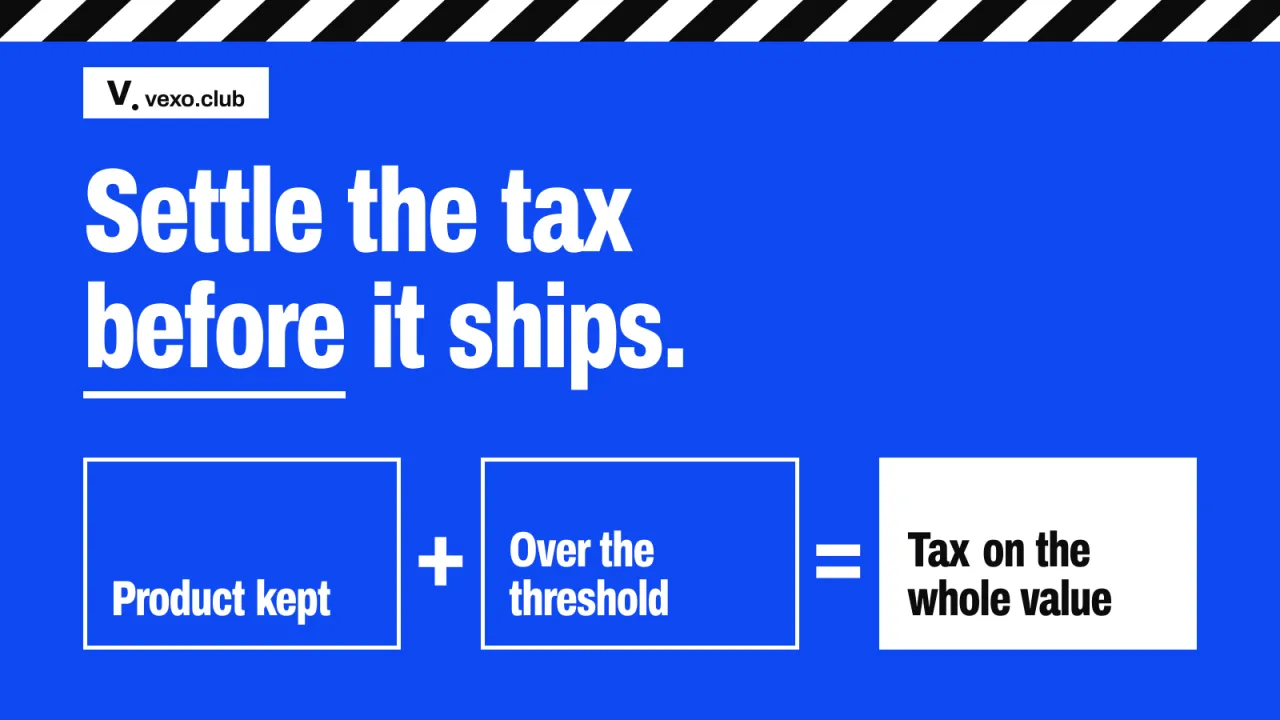
A brand run as a company or firm in India deducts tax at source on a creator’s cash fee under the contractor or professional-fee entries of section 393(1) of the Income-tax Act, 2025, once their thresholds are crossed. On a product the creator keeps, the tax is 10% of its value once the year’s total to that creator exceeds ₹20,000.
This guide comes from vexo.club: an influencer marketing agency run from one desk in Delhi NCR. It quotes the Act as published in the Gazette of India on 21 August 2025 and the Finance Act, 2026 of 30 March 2026, which amended some TDS sections before the Act took effect but not the entries used here (both as of 18 October 2026). It is not tax advice, and no chartered accountant (CA) has reviewed it: confirm every line with yours before the first payment or parcel.
TDS on influencer payments, for a brand
In short
- A product a creator keeps is a benefit or perquisite. Once the year’s total to that creator crosses the threshold, tax is due on the whole value.
- A product sent back after the shoot is not treated as a benefit under the guidance on the old section, though that guidance says it depends on the facts of the case.
- A cash fee falls under the contractor entry or the professional-fee entry, and the Act names advertising in both. Which one applies is your CA’s call.
- Where the benefit is wholly in kind, the provider must make sure the tax has been paid before the product is handed over.
- A creator who gives no PAN is deducted at a higher rate, and the PAN goes on every bill.
Which influencer payments carry TDS?
Three kinds of payment to a creator resident in India can carry tax deducted at source (TDS): a fee in money, a benefit in kind such as a product the creator keeps, and a prize.
TDS is tax the payer withholds from a payment and deposits with the Government; the creator then claims credit for it. A creator not resident in India falls under section 393(2), a separate table.
Payment type, the entry it meets and who deducts
| Entry in the Act | Who deducts | What to keep on file | |
|---|---|---|---|
| A fee paid to the creator by the brand | Contractor or professional-fee entry | The brand | Invoice, PAN and contract |
| A fee paid through an agency | The same entries, at each step | The brand on the agency’s invoice; the agency on the creator’s fee | Both invoices and both contracts |
| A product the creator keeps | Benefit or perquisite entry | Whoever provides the product | Its value, the PAN and proof the tax was paid |
| A product sent back after the shoot | Not treated as a benefit | No deduction under the benefit entry | Proof of the return |
| A sponsored trip, stay or event pass | Benefit entry, unless booked in the brand’s name for the shoot: ask | Whoever provides it | The booking, the name on the invoice and the value |
| A prize in a contest | Winnings or benefit entry: ask | Whoever pays the prize | The contest terms |
A barter collaboration, where the product is the whole payment, needs the most care: there is no cash to deduct from, so the brand must make sure the tax is paid before the parcel leaves. The paperwork is in barter collaborations and their paperwork.
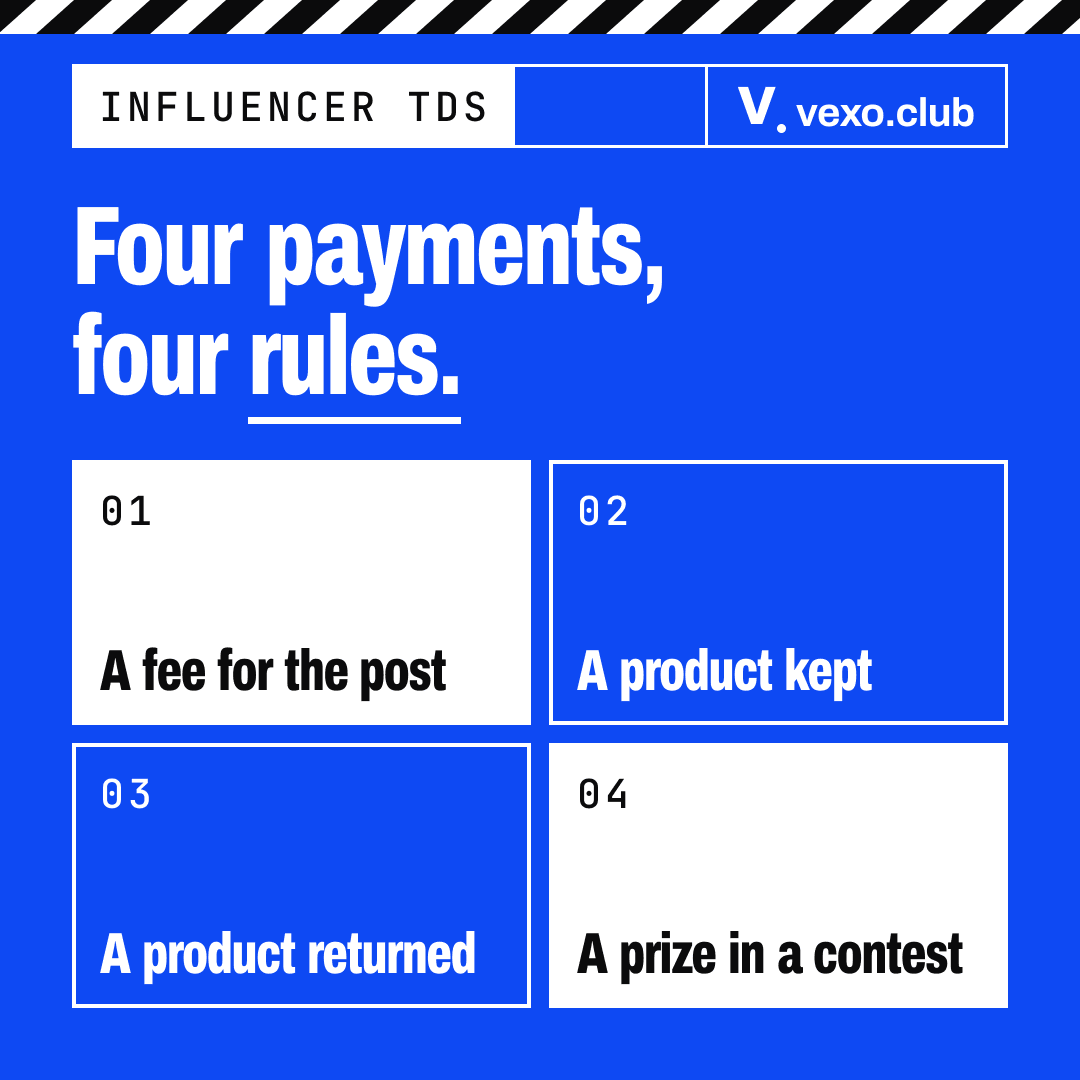
Four influencer payments, and the rule each one meets
Which section of the Income-tax Act, 2025 applies to a product or perk?
Section 393(1), Table serial 8(iv), from 1 April 2026. The entry covers “Any benefit or perquisite, whether convertible into money or not, arising from business or the exercise of a profession of any resident”, at “10% of value or aggregate of values of such benefit or perquisite”, with a threshold of “₹ 20,000”, on page 403 of the Gazette text.
Section 393(1)(a) deducts tax “on the entire amount of such income or sum, where the amount or aggregate of amounts exceeds the threshold limit”, counted over the tax year, the financial year from 1 April (section 3). Note 6 says that where the benefit is wholly in kind, or the cash part cannot cover the tax, the provider “shall ensure that the tax required to be deducted has been paid” before providing the benefit.
The payer the entry names is a “specified person”: under section 402(37), anyone who is not an individual or Hindu undivided family (HUF), or an individual or HUF whose business turnover exceeded one crore rupees, or professional receipts fifty lakh rupees, in the previous tax year (Gazette text, page 430). Without a valid PAN, the rate is the highest of the entry’s rate, the rates in force and 20% (section 397(2)(b)).
This is the old section 194R of the 1961 Act, renumbered: TDSMAN’s reference page, dated 20 August 2026, maps one to the other, and ClearTax’s explainer, last updated 21 April 2025, describes the old section the same way: 10% on benefits above ₹20,000 a year, from 1 July 2022.
How the benefit rule moved into the 2025 Act
- 1 July 2022 Section 194R of the 1961 Act applies to benefits given to a resident
- 21 August 2025 The Income-tax Act, 2025 receives the President’s assent and is published in the Gazette
- 20 March 2026 The Income-tax Rules, 2026 are notified, with new forms
- 30 March 2026 The Finance Act, 2026 amends parts of the TDS chapter, leaving the benefit entry as it was
- 1 April 2026 The 2025 Act comes into force; the rule now sits in section 393(1), Table serial 8(iv) Section 536 keeps an obligation already incurred under the 1961 Act.
Is a product sent to a creator a benefit?
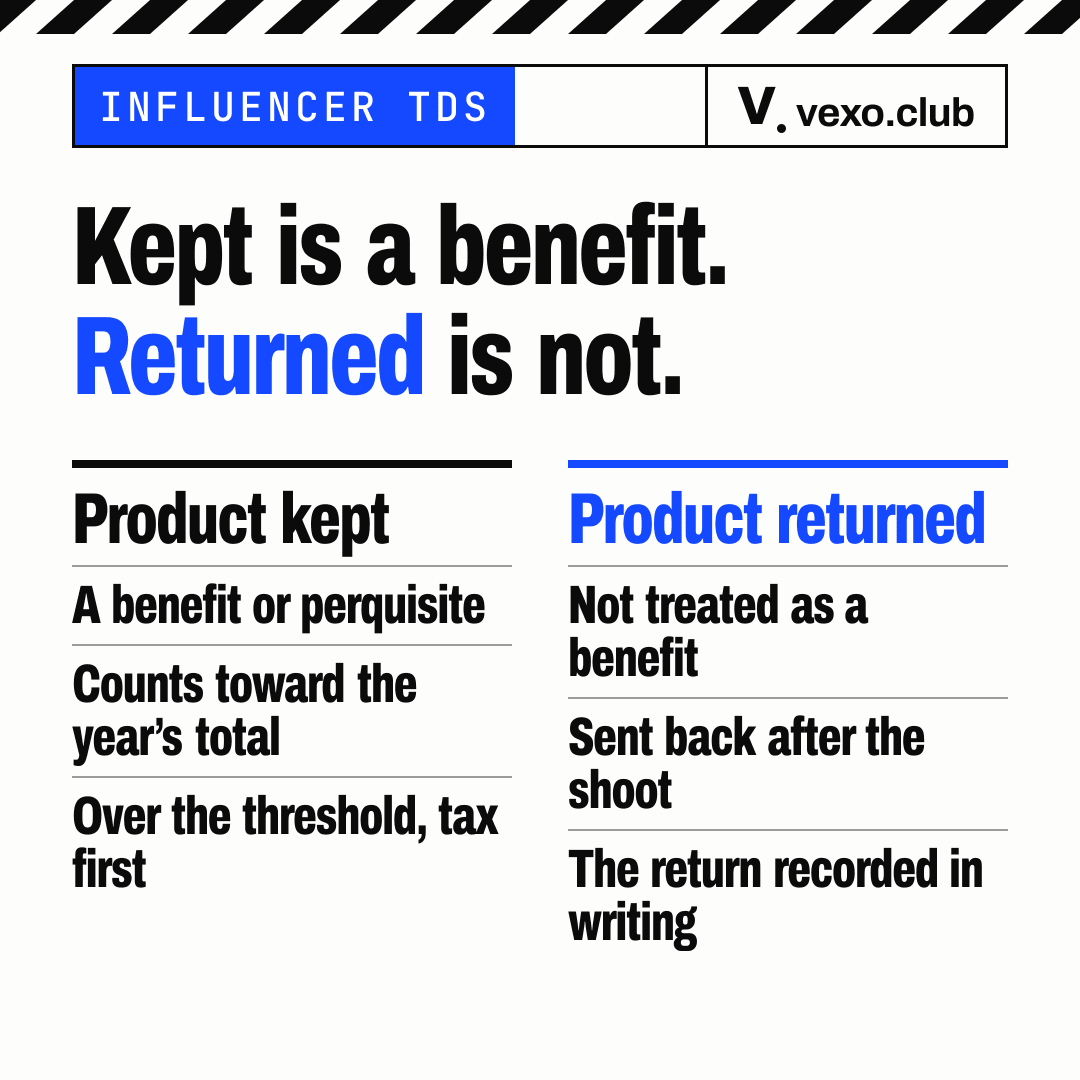
A product the creator keeps is a benefit, and one sent back after the content is made is not treated as one. The line comes from the Central Board of Direct Taxes’ guidance of 2022 on section 194R, not from the Act; the guidance says it depends on the facts of the case.
The desk quotes the guidance here through ClearTax’s summary, last updated 21 April 2025: “if such products are returned to the manufacturing company, then they will not be treated as a benefit or perquisite.” Section 536(2)(j) keeps a 1961-Act circular in force “so far as it is not inconsistent” with the new Act.
Kept, sent back, lent: three ways a product is treated
| Kept by the creator | Sent back after the shoot | Lent for a set period | |
|---|---|---|---|
| A benefit under the rule | Yes | No | Depends |
| Counts toward the year’s total | Yes | No | Depends |
| What the brand records | Its value and the date it was handed over | The date it came back, in writing | The loan terms and the date it came back |
| What the contract says | Who pays the tax before release | That it comes back, and by when | What happens if it does not come back |
The value is the product’s fair market value, with two exceptions in ClearTax’s summary: what a brand makes is valued at the price it charges customers, not at cost, and goods it bought in at the price it paid. Whether stock from a contract manufacturer counts as made or bought is a question for your CA.
A product the creator keeps, and one the creator sends back
What does the benefit rule look like in numbers?
A ₹30,000 product that one creator keeps, with nothing else given to that creator in the tax year, crosses the ₹20,000 threshold, so tax of 10%, ₹3,000, must be paid before it is handed over (rate and threshold from the Gazette text).
A product worth ₹15,000 on its own stays under the threshold. A second worth ₹10,000 to the same creator that year takes the total to ₹25,000, and the Act’s “aggregate of values” wording points to ₹2,500 on the total; how to catch up on the first is your CA’s call. Both are illustrations with the published rate, not advice.
How are a sponsored trip, an event pass and a contest prize treated?
A trip, a stay or an event pass given to a creator as a reward or an extra is a benefit in kind and counts toward the same yearly total as a product; ClearTax’s summary lists “foreign trips, and free tickets for events given to promote sales”. Travel and a stay booked in the brand’s name only so the creator can make the content are treated differently in the 2022 guidance; ask your CA before booking.
A prize is less settled: section 393(3) has a separate table for winnings from “any lottery”, “crossword puzzle” or “card game and other game of any sort” (Gazette text, page 408), so agree the entry with your CA before the result is announced.
Which section covers a cash fee to a creator?
A cash fee falls under one of two entries in Table serial 6 of section 393(1): payments to contractors for “work”, or fees for professional services. The Act names advertising in both, so the entry for a creator fee is a reading of the contract, for your CA to make.
The contractor entry, serial 6(i), covers a sum for “carrying out any work” under a contract with a “designated person”, which includes “any company” (section 402(11)); “work” shall include “advertising” (section 402(47)). The rate is 1% if the contractor is an individual or HUF and 2% otherwise, above ₹30,000 for a single sum or ₹1,00,000 for the year. The professional-fee entry, serial 6(iii), is 10% above ₹50,000 a year, and section 402(28) defines professional services to include “the profession of … advertising” (Gazette text, pages 401, 402, 427 and 429 to 431).
The two entries a creator fee can fall under
Contractor entry, serial 6(i)
- Payer: a designated person, which includes any company
- Work is defined to include advertising
- One rate for an individual or HUF, another for anyone else
- A threshold for each sum and one for the year
Professional-fee entry, serial 6(iii)
- Payer: a specified person, which includes any company
- Professional services include the profession of advertising
- One rate for professional fees
- A threshold for the year
On a single ₹60,000 fee to an individual creator, the contractor entry takes 1%, or ₹600, and the professional-fee entry 10%, or ₹6,000. On a single ₹50,000 fee with nothing else that year, the professional-fee entry takes nothing, since ₹50,000 does not exceed its threshold, while the contractor entry takes ₹500. Illustrations with the Gazette text’s rates, for a creator who has given a PAN; not advice. A creator holding a lower-deduction certificate from the tax department (section 395) is deducted at its rate while it is valid.
Who deducts when an agency pays the creator?
Whoever makes the payment deducts: section 402(27) makes the payer, or for a company the company itself, the “person responsible for paying”. When a brand pays an agency and the agency pays the creator, there are two deductions: the brand’s on the agency’s invoice, and the agency’s on the creator’s fee.
For a product, Note 6 puts the duty on the one who provides it: the brand for a product it ships to the creator, the agency for one it buys and hands over. A mixed chain needs the contract to say who provides what.
What does the creator’s invoice need to show?
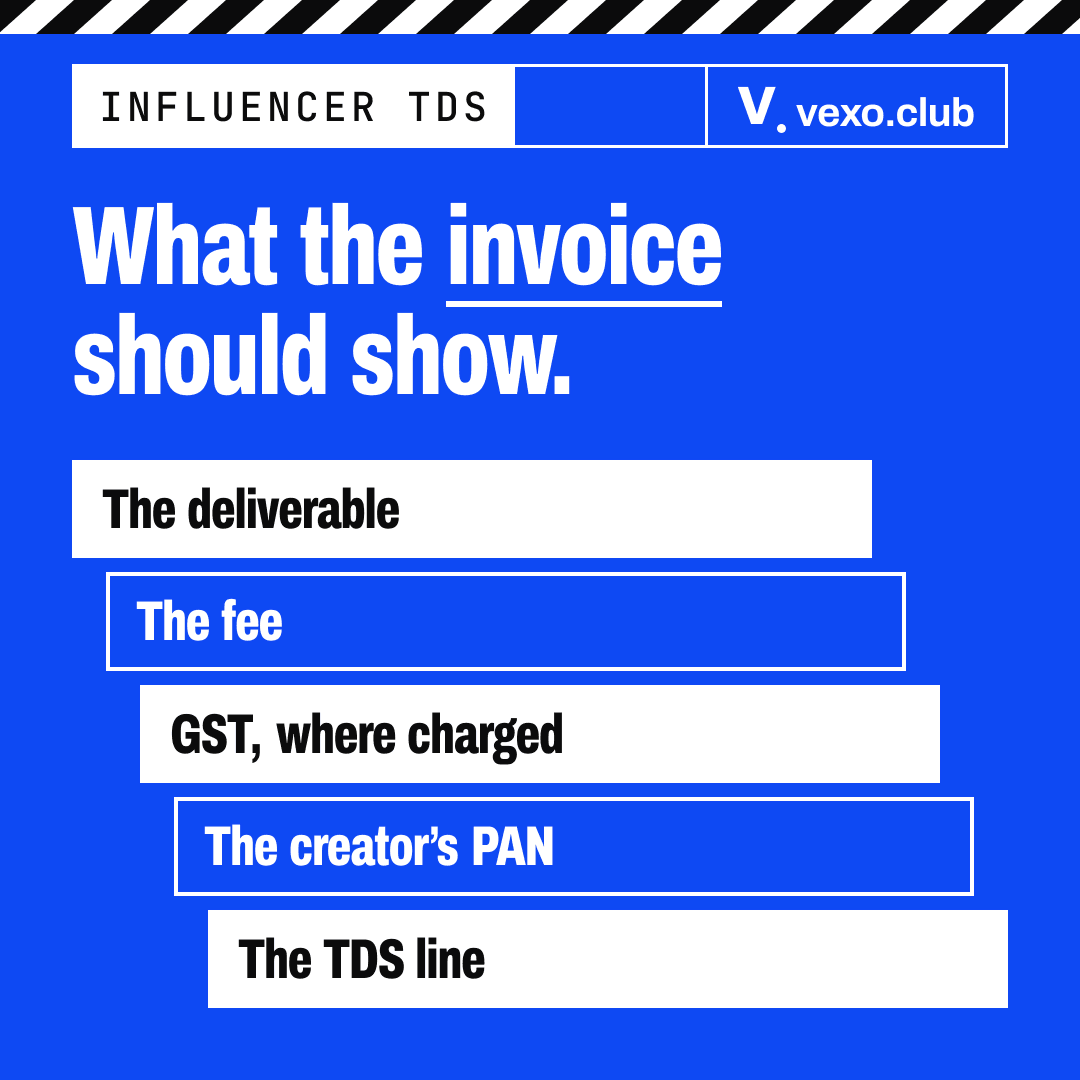
A creator’s invoice should show the deliverable, the fee, GST on its own line where it is charged, the creator’s PAN and the TDS line. The Act itself requires only the PAN: section 397(2)(h) says it “shall be indicated in all bills, vouchers, correspondence and other documents”. The other lines keep the deduction traceable.
The five lines a creator’s invoice carries
GST is a separate tax and outside this guide. How a creator’s quote is built is in what a rate card contains and on the cost drivers page. Before paying, run through these:
Before the finance team pays a creator
- Does the invoice carry the creator’s PAN?
- Does it name the deliverable, the platform and the dates?
- Is the fee on its own line, with GST on a separate line where it is charged?
- Is the TDS line worked on the entry your CA named?
- Is every product the creator keeps listed with its value?
- Does the contract say who pays the tax on that product?
What does the brand’s finance team file?
The finance team deposits the tax, files a statement for the period and issues the creator a certificate. Section 397(3) leaves the time and form of the deposit and the statement to the Rules (“as may be prescribed”), and section 395(4) requires a certificate showing the amount and rate deducted.
The Income-tax Rules, 2026, notified on 20 March 2026 according to the government’s release, set the forms and dates. The statement’s filing utility lists a section code for each Table entry; use the one for serial 8(iv) on a benefit, and confirm it with your CA. A payer that fails to deduct or to pay is “deemed to be an assessee in default” (section 398(1)).
From invoice to certificate
- Agree the entry Your CA reads the contract and names the entry for the fee or the benefit.
- Collect the PAN On the invoice and in the contract, before the first payment.
- Deduct or settle At credit or payment, whichever is earlier; for a benefit in kind, before it is handed over.
- Deposit the tax Within the time the Rules prescribe.
- File the statement For the period the Rules prescribe, with the codes the filing utility lists.
- Issue the certificate To the creator, with the amount and the rate deducted.
What goes in the creator contract?
A tax clause that names the entry for the fee, says whether each product comes back or stays, and who pays the tax on what stays. A starting point for your CA to edit:
- The Brand will deduct tax at source on the Fee under section 393(1) of the Income-tax Act, 2025, Table serial [6(i) or 6(iii)], and issue the certificate the Act requires.
- Products in Schedule [A] will be [returned by (date) / kept by the Creator].
- For kept products, [the Creator will pay the tax and give the Brand proof before dispatch / the Brand will pay the tax before dispatch].
- Creator PAN: [PAN]. Lower-deduction certificate: [number, valid until].
Payment terms are in the contract clauses that change a creator’s price, and the rule in brief is in the glossary entry on TDS on benefits.
TDS on creator payments
Do
Settle the tax before a kept product leaves the warehouse
Don’t
Ship the product and work out the tax after the post goes live
Do
Add up every benefit to the same creator across the tax year
Don’t
Test each parcel against the threshold on its own
Do
Collect the creator’s PAN before the first payment
Don’t
Pay first and chase the PAN later
Do
Record in writing whether each product comes back
Don’t
Leave the return to a chat message
Do
Name in the contract the entry your CA chose
Don’t
Let each invoice pick its own section
A brief that needs the tax lines written into the creator agreements can be sent to the desk; the finance questions go to your CA with this page open.
Questions brands ask
Is TDS deducted on influencer payments in India? Yes, when the payer is one the Act names and a threshold is crossed. A cash fee falls under the contractor or professional-fee entry of section 393(1) of the Income-tax Act, 2025, and a product the creator keeps under the benefit-or-perquisite entry. Your chartered accountant confirms which entry applies.
Does TDS apply to a product given to an influencer? If the creator keeps it, yes: once the value given to that creator in the tax year exceeds ₹20,000, tax at 10% of the value is due under section 393(1), Table serial 8(iv) of the Income-tax Act, 2025. Under the 2022 guidance, a product sent back after the shoot is not treated as a benefit, depending on the facts of the case.
Who deducts TDS when an agency pays the creator? The payer at each step: the brand on the agency’s invoice, and the agency on the fee it pays the creator. For a product, whoever provides it must make sure the tax is paid.
What changed for influencer TDS under the Income-tax Act, 2025? From 1 April 2026 the old section 194R became section 393(1), Table serial 8(iv), with a 10% rate and a ₹20,000 threshold in the Gazette text; the Finance Act, 2026 left that entry unchanged.
Who pays the tax on a product the creator keeps? The Act does not say. Under Note 6 to the Table in section 393(1) of the Income-tax Act, 2025, the provider “shall ensure that the tax required to be deducted has been paid” before handing the product over. The contract should say who pays and what proof the brand keeps.
Does the desk handle TDS on creator payments? The desk shows creator fees as line items, and its contracts name the invoice and the tax documents a payment needs. The deduction belongs to whoever pays.
Sources
- Income-tax Act, 2025 (opens in a new tab) egazette.gov.in
- Finance Act, 2026 (opens in a new tab) egazette.gov.in
- TDSMAN’s reference page (opens in a new tab) blog.tdsman.com
- ClearTax’s explainer (opens in a new tab) cleartax.in
- government’s release (opens in a new tab) pib.gov.in
Cite this page
TDS on influencer payments in India: which section of the Income-tax Act 2025 applies to cash fees and to barter products. vexo.club, published 23 Oct 2026, updated 28 Oct 2026. https://vexo.club/blog/tds-on-influencer-payments-india
Influencer marketing across India
Send the desk a brief: it comes back as a shortlist and a directional band, never a public price.
Brief the desk