Influencer marketing platform or agency: what each does, and which fits a brief
An influencer marketing platform is software a brand runs itself; an agency is a team that runs the campaign. Which fits depends on the creators, languages and platforms in the brief, and who answers for the post.
Playbooks 11 min read The operators’ desk
In this article10 sections
An influencer marketing platform, or influencer app, is software a brand uses itself to find creators, message them and track the work, and an agency is a team that does that work and answers for the result. A platform fits a brand with one clear brief, a handful of creators and a person who can run it; an agency fits a brief that spans languages, platforms or many creators, or one with a date that cannot move.
This guide comes from vexo.club — an influencer marketing agency run from one desk in Delhi NCR — so it has a stake in the answer and says so first. It describes the two kinds of tool in general and names no third-party influencer platform, app or competitor, because products change and the trade-off does not; the only tools it names are Meta’s own, from Meta’s pages. Where it quotes Meta or ASCI, the page is linked, and Meta changes its tools often enough that the page you open today is the one that counts.
Platform or agency, in short
- A platform is software the brand runs; an agency is a team that runs the campaign and answers for it.
- Software is strongest at finding creators, which is the shortest part of a campaign. The contract, the audience check, the label and the report come after.
- A platform fits one clear brief, a few creators and a person in house who can run it.
- An agency fits a brief across languages, platforms or many creators, or a fixed date. Many brands use both: find on the tool, then hand the shortlist to a desk.
What is an influencer marketing platform, and what does an influencer app do?
A platform is software the brand logs into. The usual jobs are search and filters to find creators, a way to message them or send a brief, somewhere to keep contracts and approvals, payments to creators and a report on the posts. “Influencer app”, “collaboration app” and “collab app” are the same idea described by whoever is searching, a brand looking for creators or a creator looking for brands. Products differ in which of those jobs they cover, so the useful question about any one of them is which jobs it does and which it leaves to you.
An influencer marketplace is a platform where creators list themselves and brands search the list. A creator who types “application for collaboration” or “my influencer app” is usually after one of these, a place to be found by brands. vexo.club is not an app. The way in for a creator is an application to the roster, on the creators page, reviewed every week.
What a platform does, and what an agency does
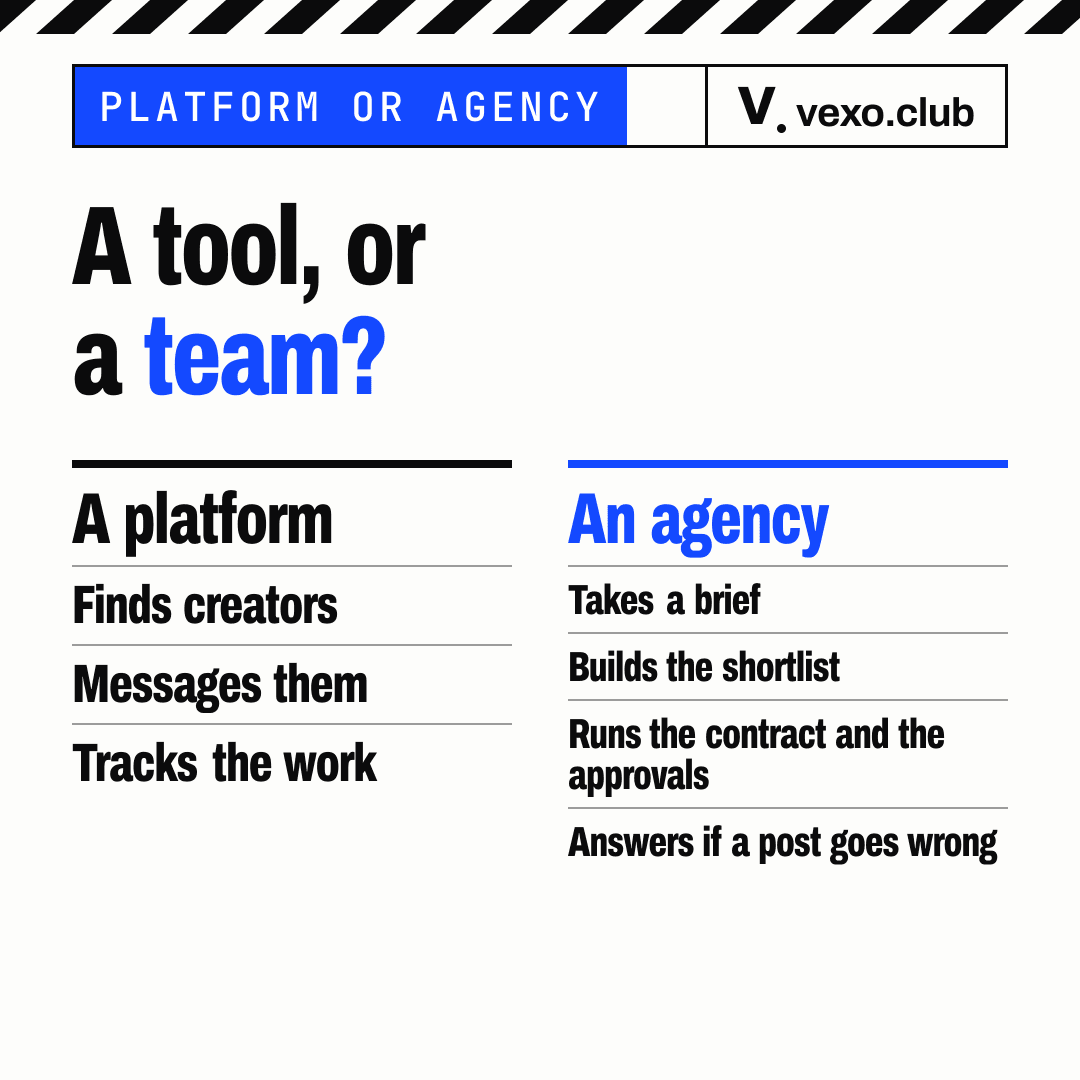
What is the difference between a platform, a marketplace and an agency?
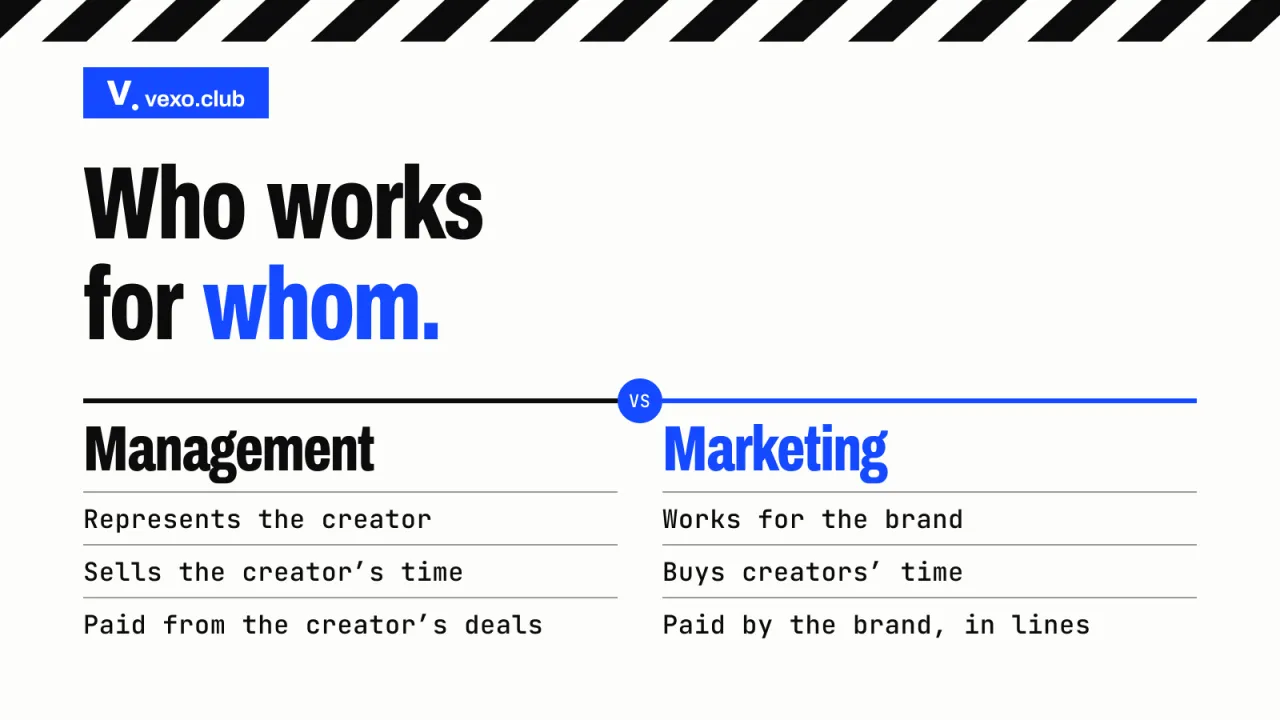
A platform is software the brand runs. A marketplace is software where creators list themselves, and the brand still does the work. An agency is a team: it takes a brief, builds the shortlist, runs the contract and the approvals, and answers if a post goes wrong. The table sets the jobs against the three. Software products differ, so for the first two the honest cell is often “depends”, and the way to settle it is to ask the seller to show the job being done on a real brief.
The jobs in a creator campaign, and who does each
| Platform | Marketplace | Agency desk | |
|---|---|---|---|
| Search for creators | Yes | Yes | Yes |
| Audience read from the creator’s own exports before a rate | Depends | Depends | Yes |
| Contract and usage terms written | Depends | Depends | Yes |
| Approval rounds run | Depends | Depends | Yes |
| Paid label checked on each post | Depends | Depends | Yes |
| Casting and scripts by language | Depends | Depends | Yes |
| One report across creators | Depends | Depends | Yes |
| Who answers if a post goes wrong | The brand | The brand | The desk |
| Best for | One clear brief and a person to run it | A brand that knows who it wants to ask, and a creator who wants to be found | A brief across languages, platforms or a fixed date |
What work is left after you find a creator?
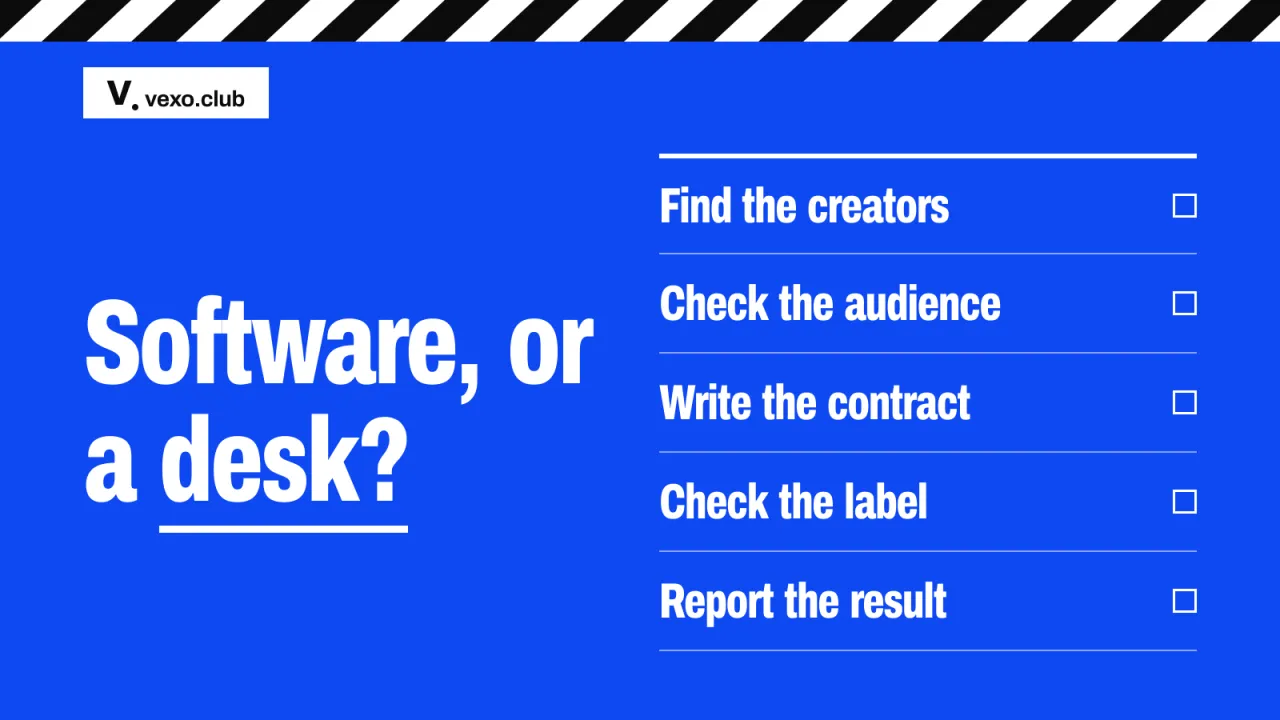
Finding is the part software does best, and it is the shortest part of a campaign. What follows is the same whichever tool found the creator, and each step has an owner. If no one is named as the owner, it is the brand. The steps below are the ones a self-serve tool leaves with the brand unless the product says otherwise.
The work that starts when the creator says yes
- Brief One objective, the claims, the dates
- Audience check Exports read before a rate is agreed
- Contract Deliverables, usage window, exclusivity
- Approvals The claim and the label checked before it posts
- Post and watch Checked again once it is live
- Report One sheet across creators, read against the brief
Each step has a page of its own. Briefing a creator so you only need one revision covers the first, how to check an influencer’s audience before you pay the second, and the influencer contract clauses that change the price the third. A tool can hold the documents. It cannot read the audience export for you, and it does not know what you agreed.
Whichever tool found the creator, the work is the same

When does a platform fit a brand?
A platform fits when the brand has one clear brief, a handful of creators, a person who writes creator contracts and reads an audience export, and an audience in one market. Then the software saves time on search and tracking, and nobody pays for work the brand can do itself. Instagram’s own creator marketplace is the plainest example. Brands join in Meta Business Suite, search and filter creators, look at portfolios, and message them or send a project to several, as Meta’s announcement describes, and Meta named India among the markets it was extending the tool to. The desk’s guide to the Instagram creator marketplace goes through it.
Running the campaign on a platform alone
What it gives
- Control of the brief and the shortlist Nobody sits between the brand and the creator.
- Fast search, and a record of who was asked
- A fit for a small, clear brief
What stays with the brand
- The contract, the audience check, the label check and the report Unless the product does them, which differs by product.
- Casting and writing across languages
- Creators who are not on the tool
- Answering for a post that goes wrong
Verdict Enough for a clear brief and a person to run it.
When does an agency fit a brand?
An agency fits when the brief is wider than one person can run: several languages, more than one platform, many creators, paid media behind the posts, or a date that cannot move. It also fits when nobody on the brand side writes creator contracts or can answer for the label and the usage terms. The fee buys someone accountable, not creators the brand could not have found. How agencies charge is set out in retainer, commission or fixed fee, and the four routes to a creator, from platform search to an agency, are in how to hire influencers in India.
Which route a brief points to
Tool plus a desk for the gaps
Wide brief, A person in house to run it
- Search and track in house
- The desk runs languages and paid media
An agency desk
Wide brief, No one to run it
- Brief to report from one operator
- Contracts, label checks and approvals included
A platform
Simple brief, A person in house to run it
- Search, message and track in house
A small brief, run by a desk
Simple brief, No one to run it
- One creator, one format
- Or a leaner route, if the desk says so
Across A person in house to run it No one to run it
Up Simple brief Wide brief
Can a brand use a platform and an agency together?
Yes, and many do. A brand can find creators on the tool and hand the shortlist to a desk to run, or let the desk shortlist and keep its own conversations in the tool. The one rule is that every job has a named owner. Meta’s September 2026 post on its Creator Marketing Hub says the hub brings discovery, permissions, ad creation and messaging into one place, rolling out through the rest of 2026, so the line between finding and running keeps moving.
vexo.club is an agency, not a platform. It has no self-serve search and no public rate card, and its own pages say that a brand looking for a self-serve platform or a per-post marketplace is not who it fits. A brand that found creators on a tool can send the desk a brief that names them.
Using a platform and an agency together

How do you choose between them?
Six questions settle most briefs. Every yes moves the brief toward a desk; a brief with six noes is one software may handle on its own.
Six questions before you pick a route
- Does the brief run in more than one language or market?
- Will more than a handful of creators post?
- Is there a date that cannot move?
- Will paid media run behind the posts?
- Is there nobody in house who writes creator contracts?
- Would you rather one operator answered for the label and the claims?
What should a brand check on either route?
The checks do not move with the tool. Read the audience export before the rate. Agree usage in writing, because a platform’s permission screen is not a contract, and usage rights covers the lines. And label every paid post. ASCI’s influencer guidelines say that using a platform’s disclosure tool should be considered in addition to the influencer’s own disclosure, and that the advertiser must ensure the post is in line with the ASCI Code. ASCI disclosure for brands sets out who labels what.
Checks that stay the same whichever tool you use
Do
Read the audience export before you read the quote
Don’t
Rely on a score the software shows without knowing its method
Do
Agree the usage window in writing
Don’t
Treat a permission screen as the contract
Do
Check the label on the draft, and again after the post is live
Don’t
Assume the platform’s tag is the whole disclosure
Do
Ask what the seller does after the creator says yes
Don’t
Buy software to solve a staffing problem
What should you ask before you sign with either?
Ask a platform’s seller to show a finished job, not a feature list: a brief, a shortlist, a signed agreement and a report, from a real campaign. Ask how it reads an audience and whether you can see the method. Ask what happens to your data and your conversations if you leave. Ask an agency the same, plus who the named operator is, how its fee is built, and who answers when a post breaks the label rule. A good answer is specific. A vague one, from either, is a reason to keep looking.
A campaign that spans Delhi NCR and other cities can begin from the Delhi desk page, and the creators the desk works with are on the roster. The agency’s own account of how a campaign runs is on the influencer marketing agency page.
Questions brands ask
What is an influencer marketing platform? It is software a brand uses to find creators, message them and track the work. What it covers differs by product: some stop at search, others add contracts, payments or reporting. Ask the seller to show the job done on a real brief before you pay.
Is vexo.club an influencer platform or an agency? An agency. It takes a brief, sends a shortlist with audience-fit data, and one operator runs the contract, the approvals and the report. It has no self-serve search and no public rate card.
Are influencer apps enough for a first campaign? They can be, when the brief is one language and one market, a handful of creators post, and someone in house writes the contract and reads the audience export. Each of those that is missing moves the brief toward a desk.
What is the difference between an influencer marketplace and an agency? A marketplace is where creators list themselves and the brand searches and does the work. An agency shortlists to the brief, runs the contract and approvals, and answers for the result.
Does using a platform change who is responsible for the paid label? No. ASCI’s guidelines put responsibility on the advertiser and on the influencer, and the platform’s own tag is to be used in addition to the influencer’s disclosure. The brand still checks the draft and the live post.
As a creator, which app gets me brand collaborations? This guide names no third-party app. Meta says creators join the Instagram creator marketplace from their professional dashboard in the Instagram app, and brands then search the list. The route to the vexo.club roster is an application on the creators page, and every applicant gets a reply.
Send the desk a brief — it comes back as a shortlist and a directional band, never a public price.
Brief the desk