Coordinating multiple influencers in one campaign: the scheduling playbook
How to coordinate multiple influencers in one campaign window: a shared brief, a staggered publish calendar, an approval queue that does not stall the schedule, and keeping creators off each other’s messaging.
Playbooks 10 min read The vexo.club desk
In this article8 sections
A single creator on a single post is a conversation. Ten creators publishing inside the same two-week window is a logistics problem, and most of what goes wrong in that window has nothing to do with any one creator’s work. It is the calendar: five drafts landing on one inbox the same afternoon, three creators quietly posting the same line because they were all sent the same brief with no steer on tone, two others clashing because nobody staggered the dates and the feed reads like one brand talking to itself across six accounts. This is the logistics playbook for coordinating multiple influencers in one campaign window: the brief that keeps everyone reading from the same page, the approval line that does not collapse into a queue, the staggered calendar that spaces creators out rather than dropping them on the same day, and the read for duplicate or clashing messaging before it goes live rather than after.
What to take from this article
In short
- A campaign with many creators is a scheduling problem before it is a creative one. The brief is the easy part.
- One brief every creator reads removes most of the drift that produces duplicate or clashing posts later.
- Stagger publish slots into waves instead of one shared date. A shared date turns a dozen endorsements into one crowded feed.
- The approval queue, not the creators, is usually where a coordinated window actually slips.
- One person owns the calendar end to end, so a single creator’s delay is absorbed in a buffer instead of resetting every other slot.
Why a coordinated window is a different problem
A brief to one creator scales in one direction: more rounds of feedback, more drafts, more messages back and forth. A brief to many creators at once scales in two directions, because every creator’s timeline now has to sit beside every other creator’s timeline without colliding. A delay from one creator stops being that creator’s problem alone. It can push a publish slot into a day already booked by someone else, or leave a gap in the sequence a later post was meant to react to. Treat the campaign as a single calendar with many owners, not as several single-creator briefs running in parallel on the hope that they land in the right order on their own.
One brief, read by everyone
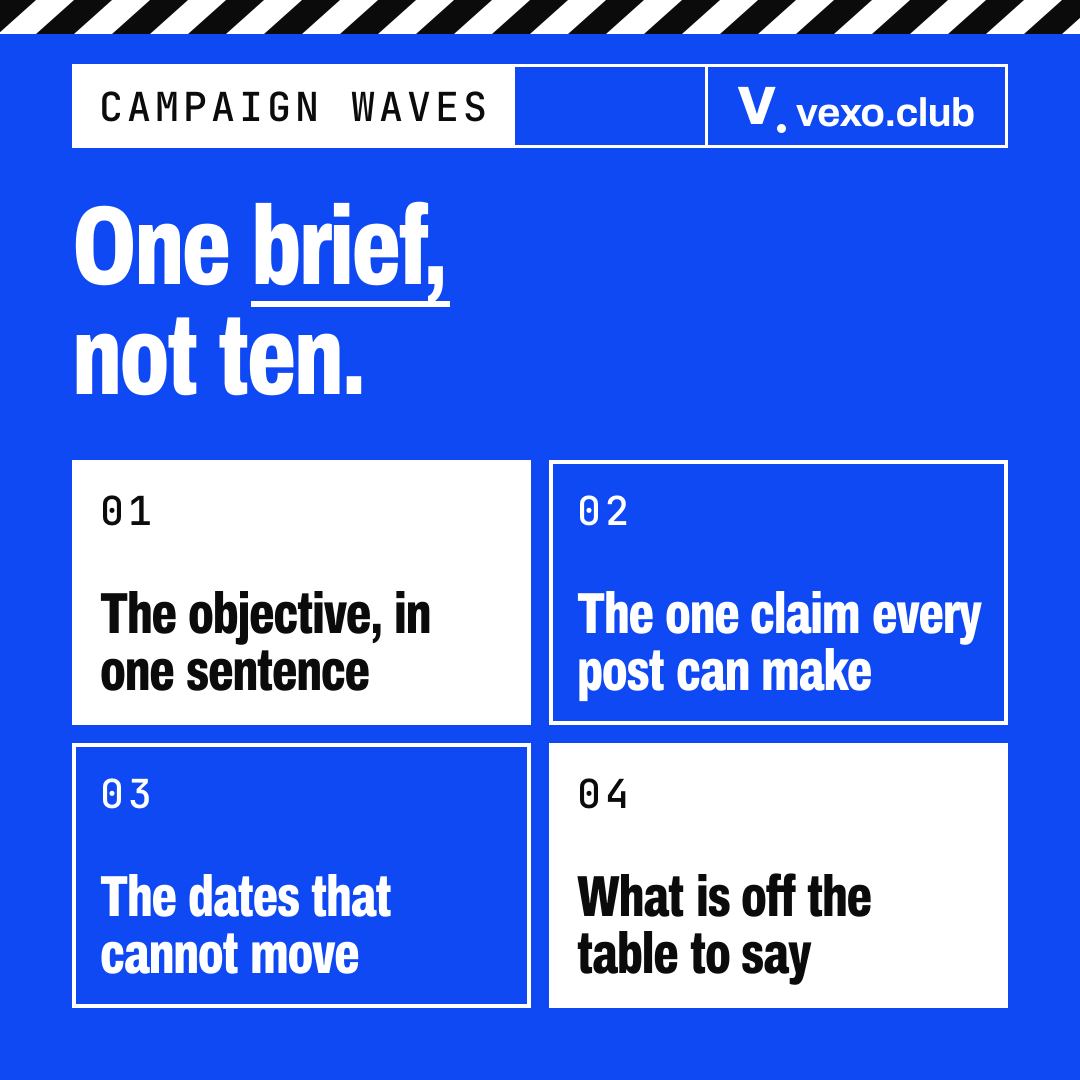
The fastest way to produce duplicate or clashing content across many creators is to brief them separately, in slightly different words, over slightly different calls. One creator hears ‘focus on the price’, another hears ‘focus on the design’, a third gets no steer at all and defaults to whatever worked for them last time, and the three posts read like three different campaigns. The fix is one brief document every creator reads, not a summary relayed secondhand through a handful of separate calls: the objective in one sentence, the one claim every post is allowed to make, the dates that cannot move and what is explicitly off the table to say. How to hire influencers in India sets out the shape of a single brief; coordinating many creators is the same brief sent once and read by all of them rather than retold creator by creator.
What one shared brief holds for every creator in the window
Staggering the publish calendar
A shared publish date is the easiest mistake to make and the hardest one to undo once ten creators have already confirmed it. Ten posts landing in the same two days do not read as ten independent endorsements. They read as one paid push, and an audience that sees three of them in a row tunes out the fourth. Stagger the calendar into waves instead: an opening wave that sets the claim, a middle wave that fills the days between with a different angle on the same product, and a closing wave that reaches a different segment of the audience once the first reactions are already visible. The 14-day launch playbook runs a staggered calendar of this shape for a quick-commerce launch; a multi-creator campaign of any size borrows the same structure.
Building a staggered publish calendar
- Fix the two dates that cannot move When the window opens and when it closes. Everything else is built between them.
- Decide the waves before assigning any creator A lead wave, a middle wave and a closing wave, not one block of simultaneous posts.
- Assign each creator a slot inside their wave A day, agreed in writing, not a rough week.
- Build a buffer into every slot A reshoot or a late approval moves inside the buffer, not the whole window.
- Reconfirm the slot once the draft is approved The slot agreed at briefing and the slot a creator is ready to post in drift without this step.
Why a coordinated campaign stays staggered, not simultaneous
Where approval queues become the bottleneck
Ask anyone who has run a campaign with many creators where the schedule actually slipped, and the answer is rarely the creators. It is the approval queue: one person reading a stack of drafts over a couple of days, replying to each one as it lands, sending feedback in pieces across separate messages, and losing track of which creator is waiting on which note. A queue that grows faster than it clears pushes every publish slot behind it, and the slots were staggered for a reason a late approval quietly undoes.
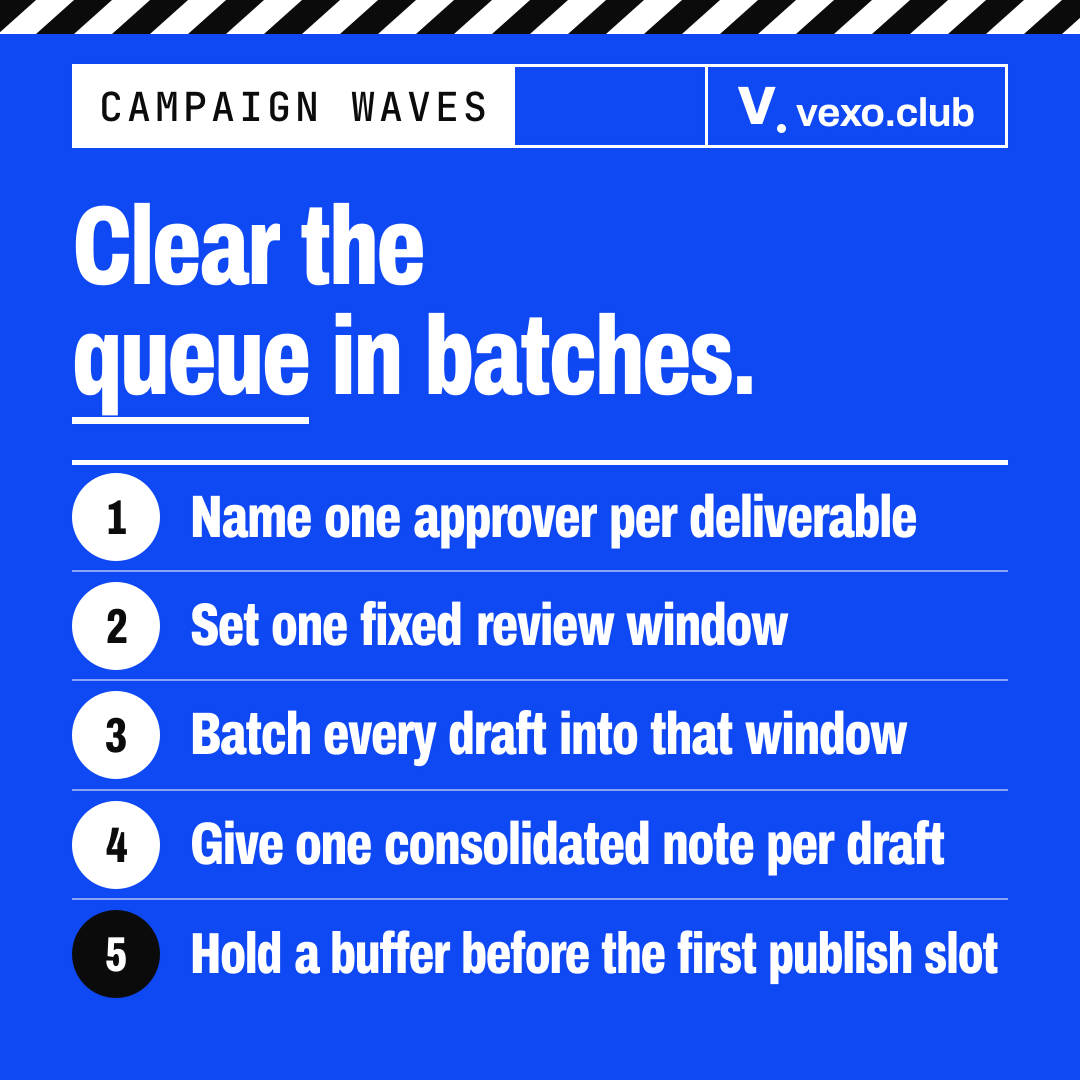
Treat the approval line itself as a scheduled part of the campaign, not a gap that absorbs whatever time is left over. Name one approver per deliverable type before drafts start arriving. Fix a review window that every batch is read inside, rather than a running inbox nobody ever fully clears. Give one consolidated round of notes per draft instead of a drip of separate messages that a creator has to piece back together.
Running an approval line across many creators
Do
Name one approver per deliverable type before drafts start arriving
Don’t
Let every draft route to whoever is free that day
Do
Set a fixed review window, the same for every batch
Don’t
Review drafts in the order creators happen to send them
Do
Read a batch of drafts in one sitting
Don’t
React to each draft as it lands, all day
Do
Give one consolidated round of notes per draft
Don’t
Send feedback in pieces across separate messages
Do
Hold a buffer day between the last approval and the first publish slot
Don’t
Schedule the first post the same day the last draft is approved
Clearing an approval queue across many creators at once
Avoiding duplicate or clashing messaging
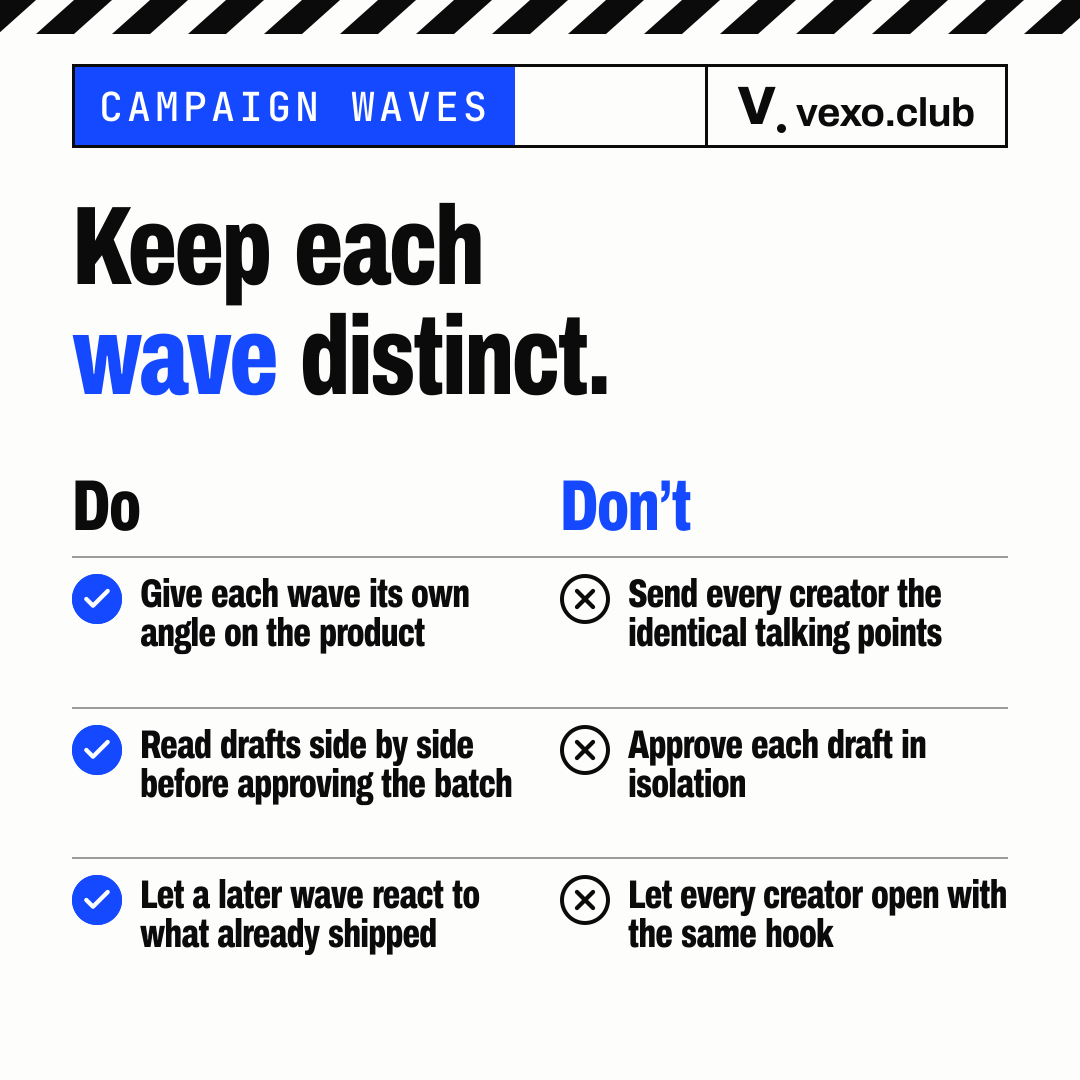
Creators briefed on the same product tend to converge on the same few things to say about it, especially when the brief hands over one headline claim with no room to make it their own. Read across the waves to check whether that is happening. If three creators in the opening wave all open with the identical line, the audience that follows more than one of them notices immediately, and the whole campaign reads like a script read out by different people rather than independent reactions. The risk runs the other way too: a later creator making a claim the brand never cleared with an earlier one, so two posts in the same window quietly contradict each other.
Give each wave its own job instead of its own copy of the same brief. The lead creator sets the claim. The supporting wave earns a second angle built to avoid the lead creator’s exact wording and shot: a use case, a comparison, an unboxing. The closing wave reinforces into a different audience and is read against both earlier waves before it is approved, not approved on its own, so it never repeats a line already used or contradicts a claim the first two waves already cleared.
What each wave of the calendar owns, and avoids repeating
| What this wave owns | What it avoids repeating | Where it sits in the window | |
|---|---|---|---|
| The lead creator | The core claim, and the first look at the product | Nothing: this wave sets the line the others build on | Opens the window |
| The supporting wave | A second angle on the same product: a use case, a comparison, an unboxing | The lead creator’s exact wording and shot | Fills the middle days, staggered |
| The closing wave | Reinforcement into a different audience segment | Any claim the earlier waves have not already cleared | Closes the window, once first reactions are visible |
Keeping creators off each other’s messaging in one window
Running the week itself
Once the calendar is staggered and the approval line is scheduled, the remaining job is holding the shape of the plan against whatever the week actually does. One person owns the calendar end to end for the whole window, not one owner per creator, because only a single view of the full schedule can see that a delay from the fourth creator has left a gap the fifth creator’s post was meant to fill. Build a buffer day into every slot rather than scheduling back to back, so a reshoot or a late approval moves inside the buffer instead of resetting every slot behind it.
Reconfirm the actual publish slot with each creator again once their draft is approved. The slot agreed at briefing and the slot a creator is ready to post in drift more often than either side expects, and the gap between them is cheap to close a day ahead and expensive to discover on the morning it was meant to go live.
Where the desk fits in
This is the coordination problem for one large, dated campaign window, not the always-on motion covered in running a micro influencer seeding program, which has no fixed dates and no shared brief to begin with. Once the calendar is set, the paperwork under every creator’s slot still needs settling: the deliverables, approvals and exits set out in influencer contract red flags, and the full stage-by-stage order in the influencer marketing checklist. A seasonal window with a fixed close date that cannot move, such as a Diwali campaign, is the sharpest version of this problem, because the closing date is set by the calendar rather than by the brand. Send the desk a brief with the creator count and the window, or see who already runs coordinated campaigns on the roster.
Questions brands ask
How many creators can one campaign window realistically coordinate? As many as one calendar owner can hold a clear view of at once. The limit is not a headcount. It is whether one person can still see every slot, every approval and every wave without losing track of where a delay has landed.
What is the biggest cause of delay in a multi-creator campaign? The approval queue, more often than the creators themselves. A queue read in pieces, by whoever is free, grows faster than it clears, and every staggered slot behind it slips along with it.
How do you stop creators from posting the same message? Give each wave of the calendar its own job instead of handing everyone the same brief untouched: a lead claim, a second angle built to avoid repeating it, and a closing wave read against both earlier waves before it is approved.
Should every creator publish on the same day? No. A shared date reads as one coordinated push rather than several independent reactions, and an audience that follows more than one creator sees the overlap right away. Stagger publish slots into waves instead.
Who should own the campaign calendar? One person, for the whole window, rather than one owner per creator. Only a single view of every slot can absorb a delay from one creator without resetting the slots around it.
Cite this page
Coordinating multiple influencers in one campaign: the scheduling playbook. vexo.club, published 07 Nov 2026. https://vexo.club/blog/multi-creator-campaign-coordination
Send the desk a brief: it comes back as a shortlist and a directional band, never a public price.
Brief the desk