Influencer contract red flags: what a brand or a creator should refuse to sign
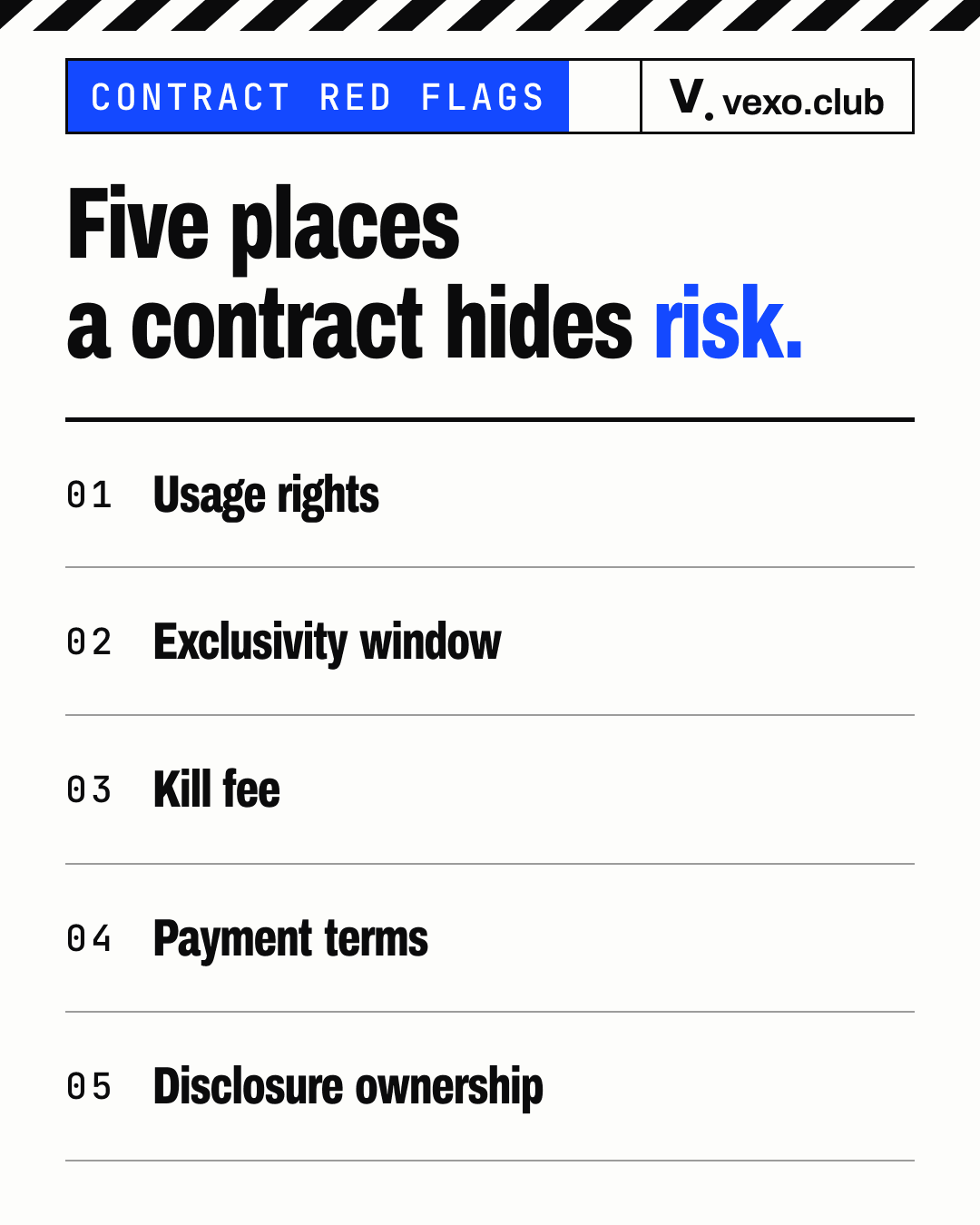
Five places an influencer contract quietly favours one side: usage rights left vague, an exclusivity window with no end, no kill fee for a cancelled shoot, payment triggered on nothing written down, and a disclosure line no one owns. What to refuse, from either side.
Pricing 9 min read The operators’ desk
In this article8 sections
Most disputes over an influencer contract do not come from a clause that was written badly. They come from a clause that was left out, or written loosely enough that each side reads it the way that suits them later. Five places account for most of the trouble: usage rights, exclusivity, cancellation, payment and disclosure. None of them need a lawyer’s vocabulary to spot: they need a read before signing, not after.
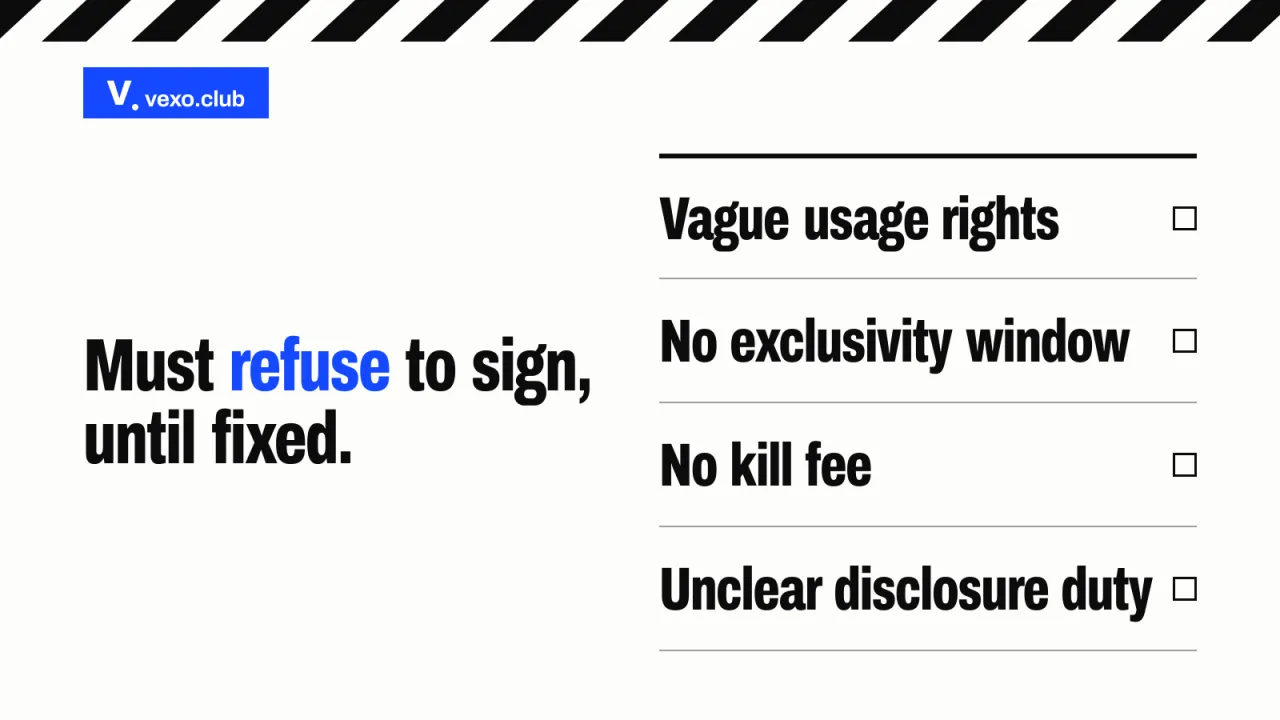
Influencer contract red flags, for either side
In short
- Vague usage-rights wording lets either side claim more than the other agreed to.
- An exclusivity window with no named start, category or end date is open to dispute months later.
- A contract with no kill fee or cancellation line assumes nothing will ever go wrong.
- Payment terms that trigger on an undefined “satisfaction” rather than delivery put the risk on one side only.
- When neither the brand nor the creator is named as owning the disclosure label, no one checks it.
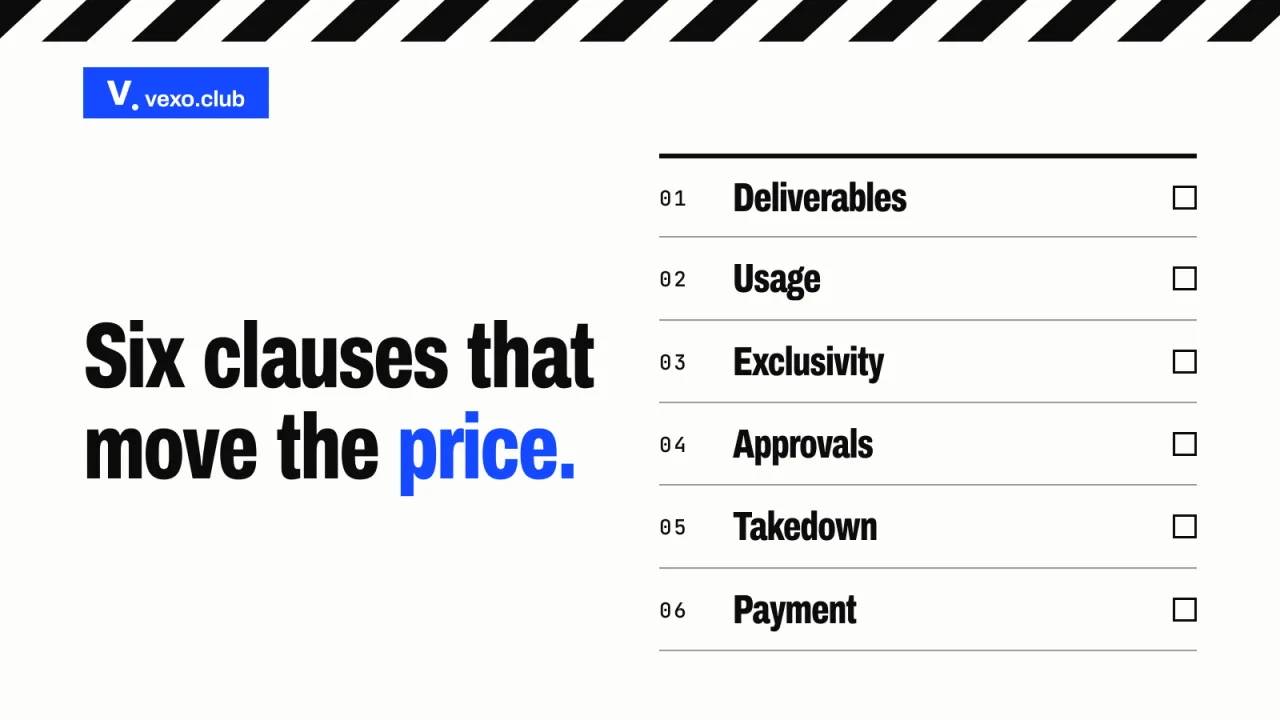
This is a list of what to refuse, not a template. It is written for either side of the table (a brand drafting the agreement, or a creator being handed one) because the same five gaps hurt whichever side did not think to close them. The contract clauses that change the price goes through what a full set of clauses should say, line by line; this is the shorter, blunter version: the shapes a bad one takes.
Five places an influencer contract hides risk
Vague usage-rights language
A usage clause that says the brand may “use the content” gives away more than most creators mean to give, and promises less than most brands think they bought. “Use” could mean an organic repost, an ad run from the brand’s own handle, or the creator’s photograph on a product box two years later: three different rights with three different values, folded into one word.
The red flag is a usage clause with no platform named, no end date, and no distinction between organic reposting, whitelisting and the brand’s own marketing. A phrase like “in perpetuity, across all media, now known or later invented” is the clearest version of the same problem: it reads like thoroughness and works like an open door. Usage rights are where budgets quietly break explains why each right needs its own price and date, and creator whitelisting, explained covers the one most often left loose.
What a usage-rights clause should name
- Which platforms the brand may repost on
- Organic reposting, whitelisting and paid amplification as separate, named rights
- A named end date or renewal point for each right
- What happens to the content once a right ends
A creator who signs a broad, undated licence for a single content fee has sold a right worth repeating income, once, without knowing it. A brand that signs a usage clause with no named platforms has bought a promise it cannot act on the day its own legal team asks exactly what was licensed.
Missing exclusivity windows
Exclusivity without dates is a liability for whoever is bound by it. If the clause names a category (skincare, say), but never says when the lockout starts or ends, the creator cannot plan the next few months of other income, and the brand cannot answer the obvious question when a competitor approaches the same creator a few weeks on.
An exclusivity window with no gaps
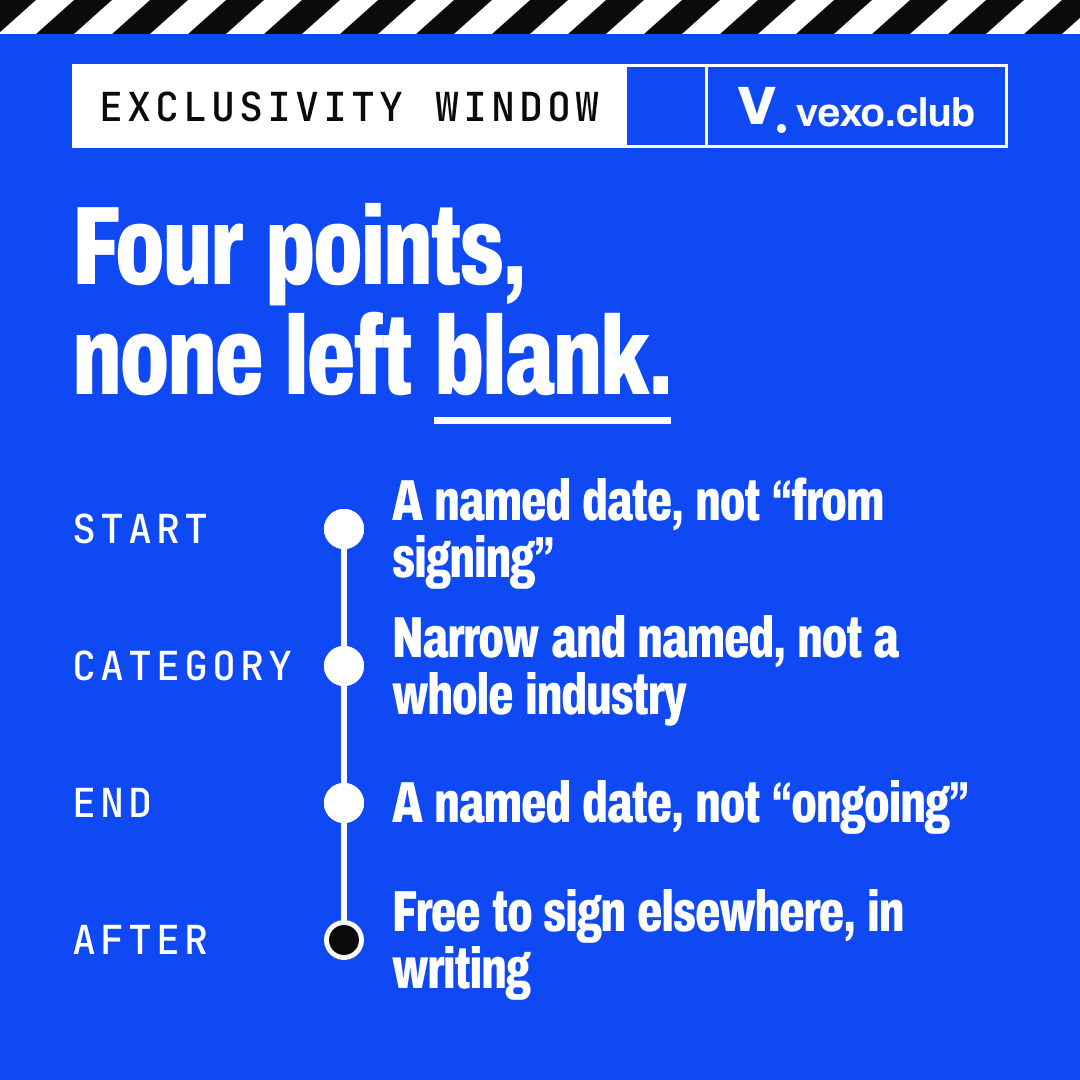
A second version of the same flag is a category defined too broadly to be fair: “beauty” when the brand sells one narrow part of it, written with no fee attached. Exclusivity is a right the creator is giving up, not a courtesy to the brand, and a brief that asks for one without naming the dates, the category and the fee has asked for something it has not agreed to pay for.
No kill fee or cancellation terms
Campaigns get pulled: a product recall, a shift in budget, a brief that changes after the shoot is already booked. A contract that says nothing about what happens then is a contract that assumes nothing ever will.
The red flag is the absence, not a particular number: a cancellation clause with no kill fee, no notice period and no split between work already done and work not yet started. Without it, a creator who turned down other bookings to hold the date has no claim when the brand cancels the week before, and a brand that paid an advance has no clean way to recover it if the creator drops out.
A cancellation clause that names a kill fee
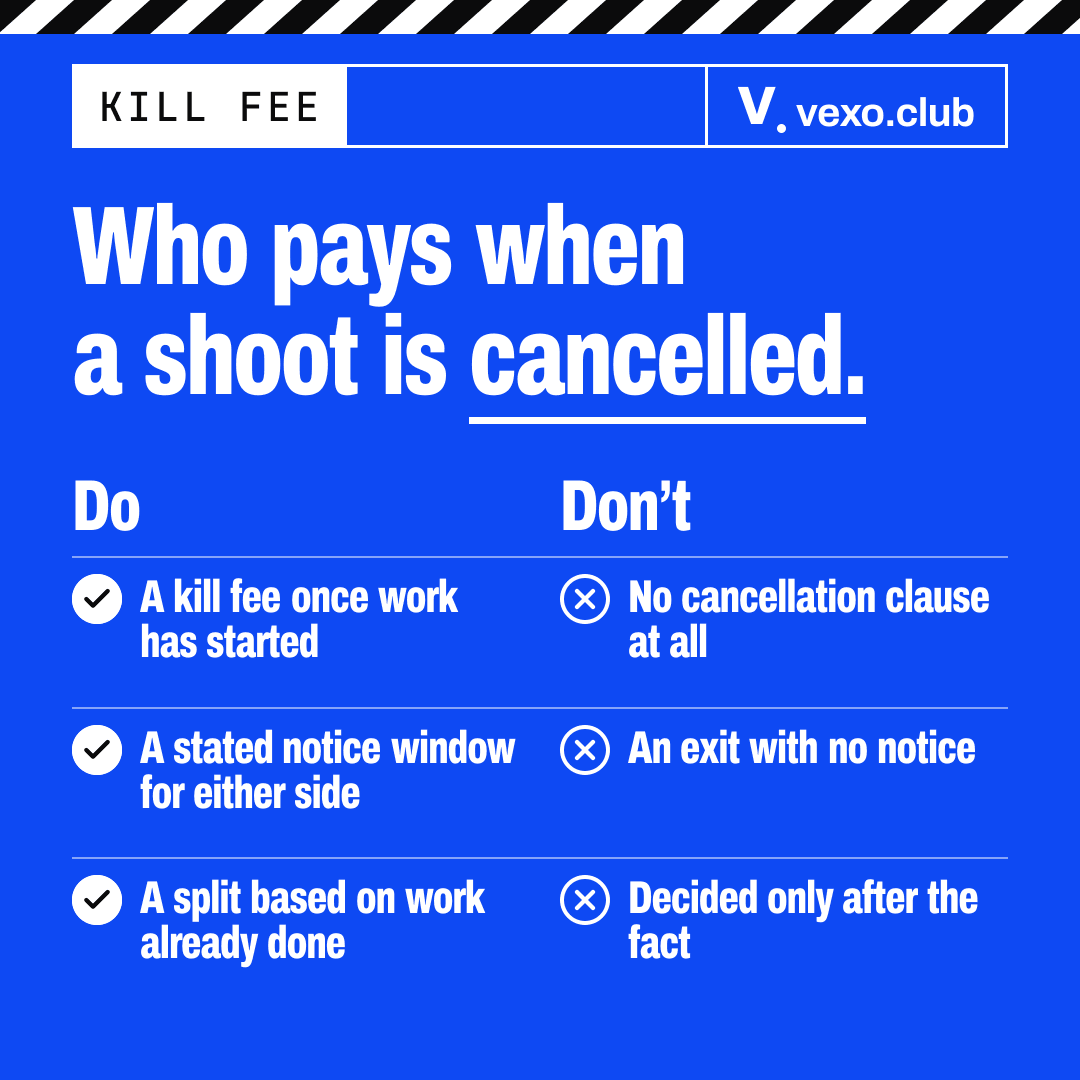
What belongs in the clause is a notice window, a stated split for work in progress against work not started, and which side keeps a deposit already paid. None of that needs a number invented here: it needs both sides to agree one before the shoot is booked, not argue one out after it is cancelled.
Payment terms that favour one side
A payment clause built around a single word, “satisfaction”, is the clearest version of this flag. If the brand is not satisfied, nothing is owed, and “satisfaction” is never defined against the brief. The creator has delivered on spec and still has no trigger to point to for the invoice.
The same flag runs the other way: a creator’s contract that leaves no room for a brand to withhold payment when a deliverable misses the brief entirely, or that ties payment to a platform metric neither side controls. A fair clause ties payment to a delivery date, an approval step both sides already agreed to, or an invoice, not to an undefined feeling on either side.
A one-sided contract and a balanced one
| One-sided | Balanced | |
|---|---|---|
| Usage rights | All platforms, all media, in perpetuity, no end date | Named platforms, named rights, a named end date |
| Exclusivity | No end date, category left open | A start date, a narrow category, an end date |
| Cancellation | No kill fee, no notice window | A kill fee tied to work completed, with notice |
| Payment | Triggered on undefined “satisfaction” | Triggered on a delivery date or an invoice |
| Disclosure | Owner not named on either side | One named owner for wording and placement |
A payment term that would embarrass whoever wrote it, read aloud to the other side, is the one to rewrite before signing. TDS on influencer payments in India covers the tax side of the same line, once the trigger itself is fair.
Unclear disclosure and compliance ownership
A paid post needs a clear disclosure label under India’s advertising rules, and the obligation sits with the influencer as well as the advertiser. A contract that never says who writes the label text, who checks it is present before the post goes live, and who keeps it through edits and reposts, leaves that obligation to assumption.
Who owns the disclosure line
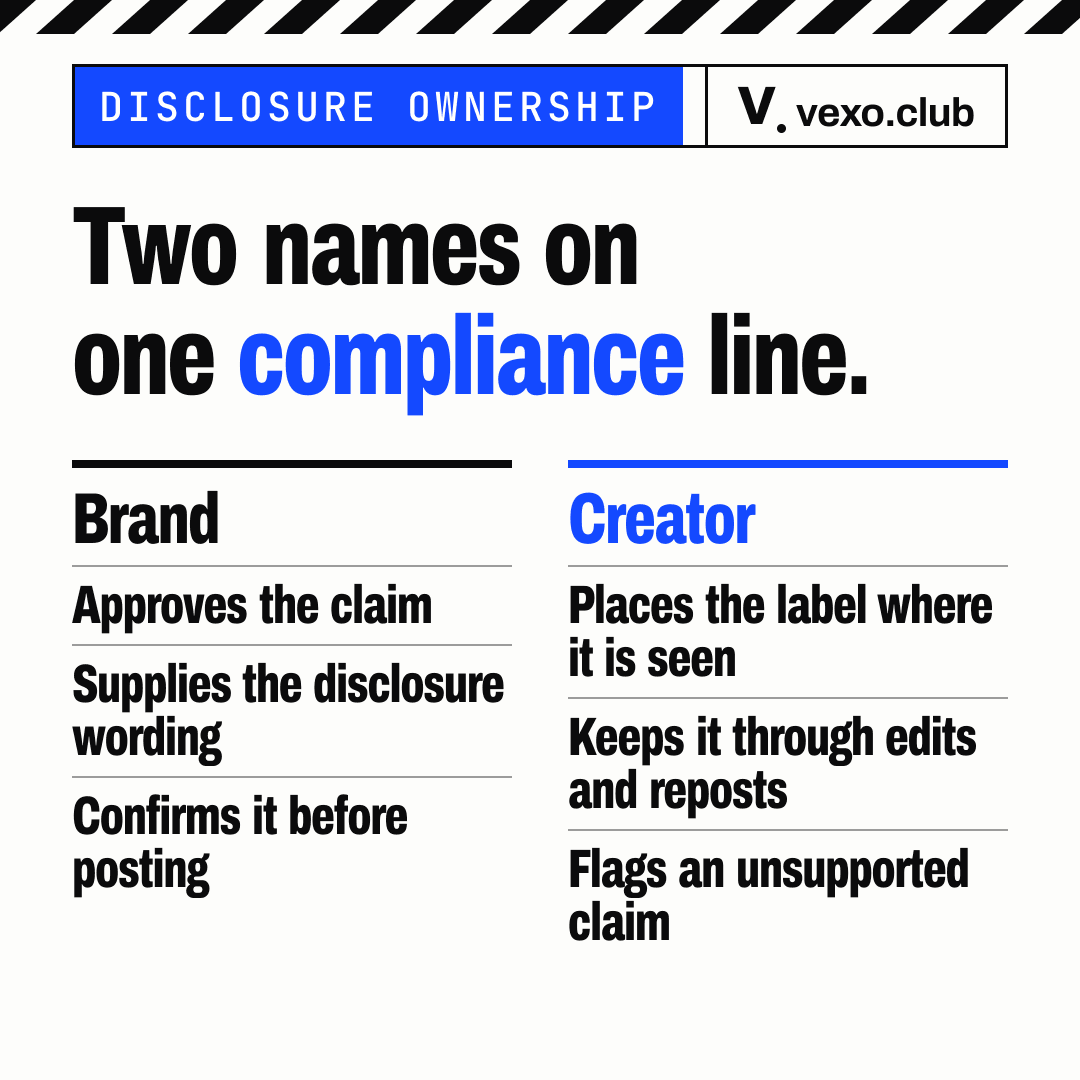
The gap shows up after the post is live, when a label is missing or wrong and both sides find out from a complaint rather than a checklist. ASCI disclosure for brands sets out what the label itself has to say; the contract red flag is simpler than that: nobody is named as the one who checks it.
A related gap sits in the conduct clause, if there is one at all: a morality or bad-acts clause with no cure period and no mirror right for the creator is its own red flag, covered at length in the morality clause guide.
A reading checklist before either side signs
Read the contract once for what it says, and once for what it leaves out. The second read catches most of what matters here.
Before either side signs
- Does the usage clause name every platform and a date each right ends?
- Is the exclusivity category narrow enough to be fair, with a start date and an end date?
- Is there a kill fee or a notice period for cancellation, for either side?
- Does payment trigger on a delivery date or an invoice, not on an open-ended “satisfaction”?
- Is one person named as owning the disclosure label, its wording and its placement?
- Would a lawyer unfamiliar with the campaign understand every clause on one read?
Not legal advice
This is a practical list of places a contract commonly goes wrong, drawn from the clauses the desk sees most often, not a legal opinion on any document, and not a statement of what the law in India requires a contract to say. Contract law gives both sides wide freedom to agree their own terms; the flags above are about fairness and clarity, not a compliance checklist. A brand or a creator should have their own counsel read the actual agreement before signing.
A brief that needs these terms written in from the start can be sent to the desk.
Questions brands and creators ask
What are the most common influencer marketing contract mistakes in India? Vague usage-rights wording, an exclusivity window with no start or end date, no kill fee or notice period for a cancelled campaign, payment terms triggered on an undefined “satisfaction” rather than delivery, and a disclosure clause that names no one as responsible for the label.
What should a usage-rights clause in an influencer contract name? The platforms the content may be used on, with organic reposting, whitelisting, paid amplification and the brand’s own marketing named and dated as separate rights, and what happens to the content once each one ends.
Is an exclusivity clause with no end date a red flag? Yes. An exclusivity window should name a start date, a narrowly defined category and an end date, and should carry its own fee. A category left open or a window with no end leaves the creator unable to plan other work around it.
Should an influencer contract include a kill fee? It should include some cancellation term: a notice period and a split between work completed and work not started. The red flag is not any particular figure in it; it is having no cancellation clause at all.
Who should own the disclosure label in a brand-creator contract? Name one person or role, on either side, who writes the label wording and checks it is present before a post goes live and stays through later edits. A contract that names neither side leaves the disclosure requirement to chance.
Cite this page
Influencer contract red flags: what a brand or a creator should refuse to sign. vexo.club, published 30 Oct 2026. https://vexo.club/blog/influencer-contract-red-flags-india
Send the desk a brief: it comes back as a shortlist and a directional band, never a public price.
Brief the desk