YouTube long-form vs Shorts for brands: which length to brief for which goal
Within YouTube, long-form and Shorts are not competing versions of the same video. A deep explainer or review asks for one; discovery and awareness ask for the other. This sets out how to tell which a brief needs, and how the brief and the budget around it differ once that call is made.
Benchmarks 10 min read The vexo.club desk
In this article8 sections
YouTube long form vs Shorts for brands is usually asked as if it were one choice, made once, for a channel or a creator relationship. It is really a per-brief choice, made against a single goal: what does this video need to do, and does doing it need the viewer to stay for minutes or to decide in seconds. A deep product explainer or a comparative review needs the first. Discovery and awareness need the second. Both live on YouTube, under one creator, often on the same channel, and the two are not a stronger and a weaker version of each other: they are built to different jobs.
This is a YouTube content strategy question for influencer marketing specifically within the platform, not Reels against Shorts across platforms (that comparison is its own guide), and not integration against a dedicated video (that is a deliverable-type question, answered separately). This guide comes from vexo.club, an influencer marketing agency run from one desk in Delhi NCR, and it prints no view count, no watch-time figure and no budget-split percentage, because none can be quoted without a record behind it.
Long-form vs Shorts on YouTube, in short
- Both formats live on one platform and often on one channel; the choice is made per brief, against the goal, not once for the whole relationship.
- A deep explainer or a comparative review needs the time long-form gives it: room to build a case, answer an objection and let search carry it later.
- Discovery and awareness need what Shorts give them: a wide, fast-moving feed, a low cost of trying the next one, and a second chance at reach beyond a channel’s subscribers.
- The brief and the budget change shape with the format, not just the length: a script, a review cycle and a production plan written for one rarely survives being asked to serve the other.
What actually separates a long-form video from a Short, on YouTube itself
YouTube draws the line by length and shape, not by subject. Its help page Understand three-minute YouTube Shorts says a video uploaded after 15 October 2024, square or vertical and up to three minutes, is categorised as a Short; anything longer, or landscape regardless of length, sits outside that category as a regular video. The two are also found differently. YouTube’s page Get started creating YouTube Shorts lists the Shorts feed, search results, the homepage, the channel page, subscriptions and notifications as the places a Short can surface: a wider, faster-moving set of doors than a regular upload gets through organic recommendation and a channel’s own subscriber base.
That difference in where a video is found is the difference a brief has to plan around. A regular upload mostly earns its reach from being recommended against a search or a watch history built over minutes of signal: the kind of signal a long video can carry because it has time to. A Short earns its reach from a feed built for fast decisions, where a viewer moves on in seconds if the first one does not hold. Neither mechanism is better; they are built for different kinds of attention, and a brief that names its goal first can read which mechanism it needs.
Which length fits which goal, on YouTube itself
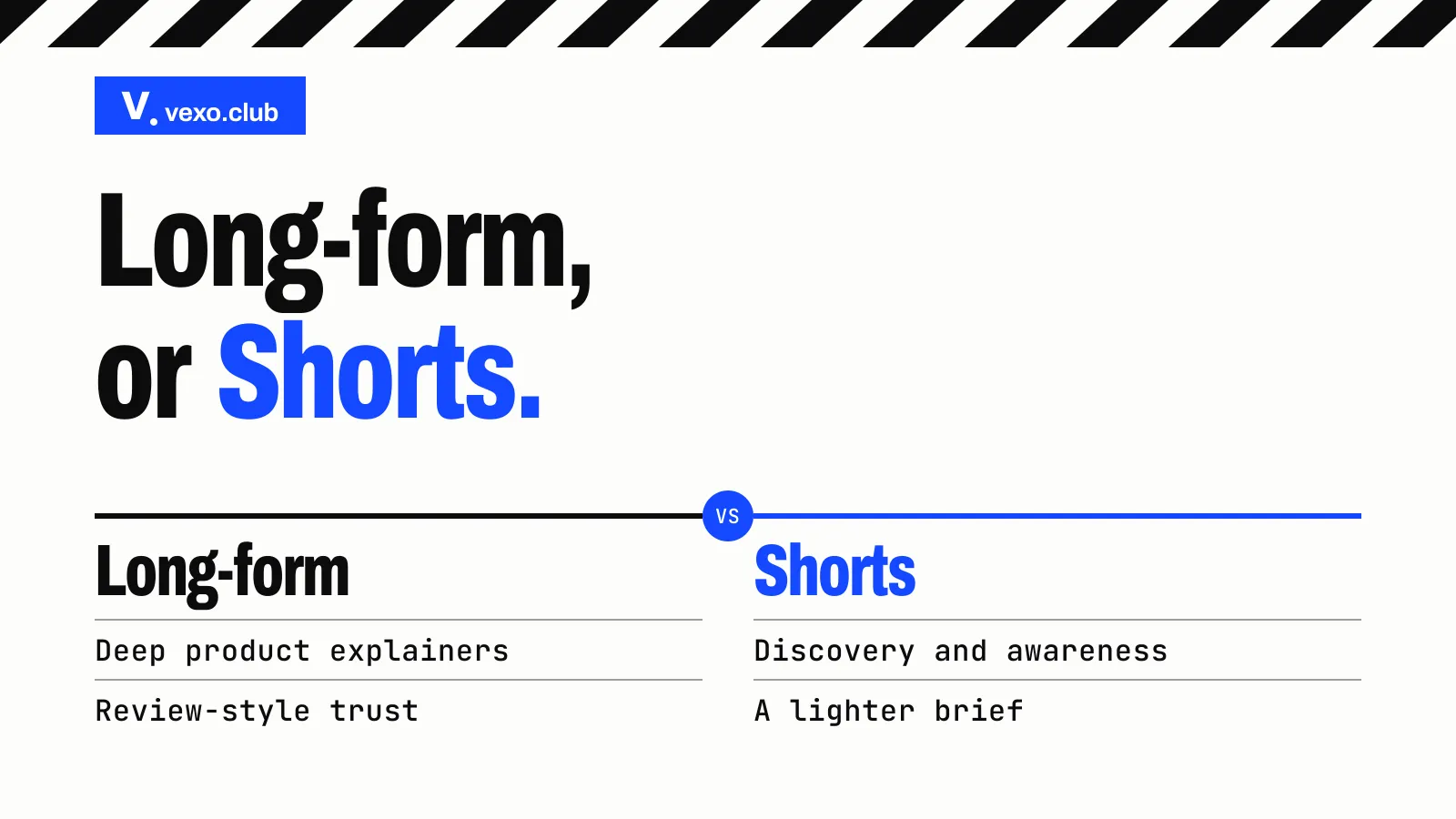
| Long-form | Shorts | |
|---|---|---|
| A deep product explainer | High | Low |
| A comparative or buying-decision review | High | Low |
| A step-by-step tutorial | Medium | Medium |
| Discovery and awareness | Low | High |
| A reminder to an audience that already knows the brand | Low | High |
When the goal calls for long-form
A deep explainer and a comparative review share one requirement: the case takes longer than a feed scroll to make. Long-form gives a brief the room that case needs.
- A real objection has to be answered, not just raised. Price, durability, a competitor’s claim, a limitation the brand would rather skip: long-form has the minutes to raise an objection and answer it on screen, rather than gesture at it and move on.
- The video should keep earning views after launch week. A video that answers a specific, searched question keeps surfacing against that search long after a campaign calendar has moved on, which is a different kind of return than a feed placement that fades with the scroll.
- The creator’s own credibility is the product. A review channel’s audience is there for the channel’s judgement, built up over a video’s worth of testing, comparison and reasoning shown on screen, not compressible into a few seconds without losing the thing the audience trusts it for.
- The purchase itself is considered, not impulsive. A viewer close to a decision on an expensive or technical product is looking for depth, not a second impression; long-form is where that depth lives.
When the goal calls for Shorts
Discovery and awareness share the opposite requirement: reach a lot of people who are not yet looking for the brand, cheaply enough per attempt that trying several hooks is normal. Shorts are built for that.
- The brand needs to be seen by people who do not know to search for it. A Short in the feed does not depend on the viewer already having an interest typed into the search bar.
- One idea, told fast, is the whole job. A single feature, a single moment, a single reaction: a Short that tries to carry a full case instead reads as a trailer for a video that was never made.
- Several creative routes need testing at once. Because each Short is a smaller, faster thing to produce, a brief can afford to try more than one hook and see which one the feed carries further, in a way a single long-form shoot rarely allows.
- The channel needs a second door into its own catalogue. A Short that performs can pull a viewer sideways into the channel’s long-form library, doing the discovery job that a subscriber feed alone would not have done.
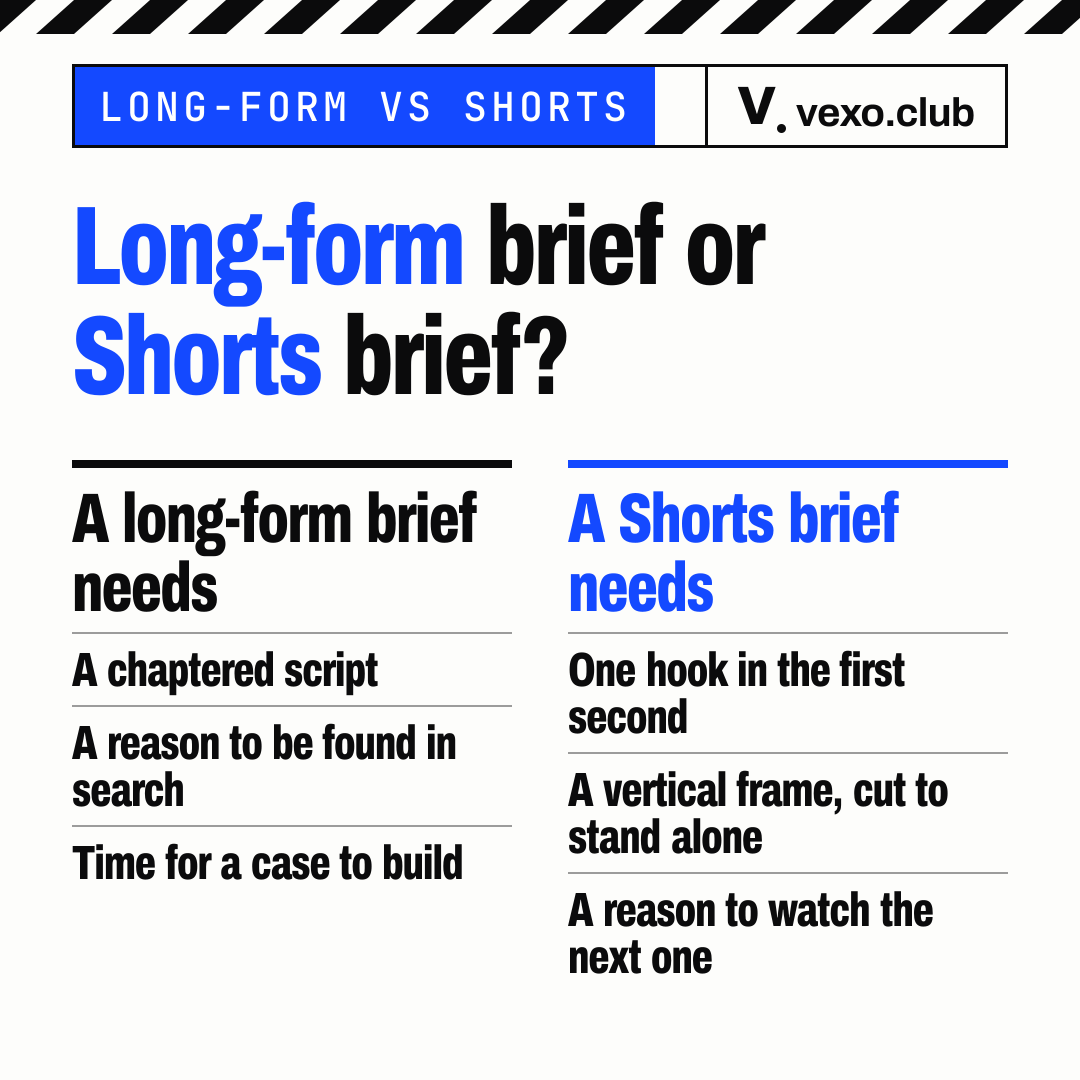
What a long-form brief needs, and what a Shorts brief needs
How the budget differs, qualitatively
Neither format is cheaper in a way that holds across every brief, because the two spend their weight on different things. This is a shape, not a split: the right ratio depends on the brand and the category, and this site prints no percentage against it.
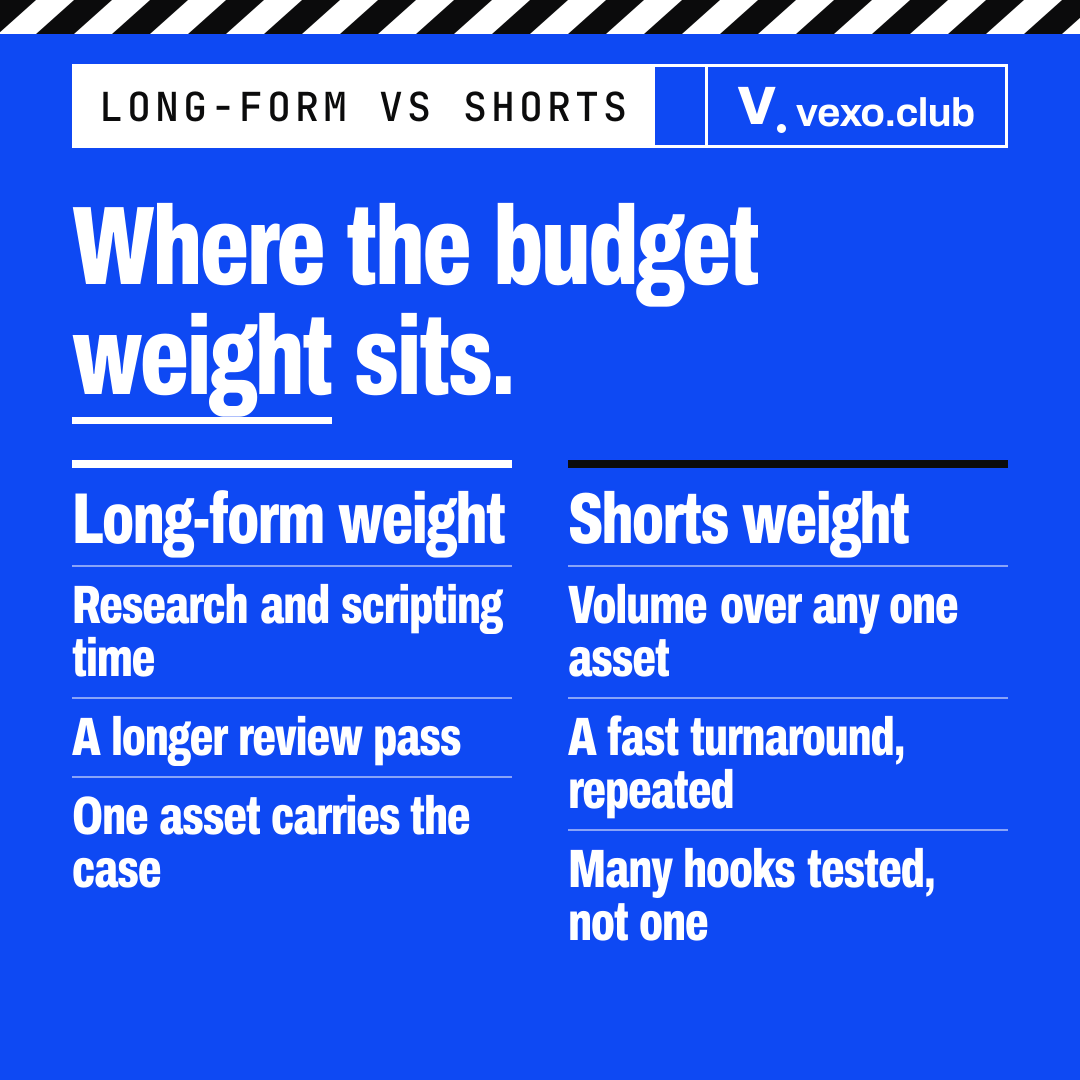
- Long-form carries its weight in research and scripting, not just the shoot. A comparative review or a deep explainer needs the facts assembled, the objections anticipated and a structure that holds for several minutes, before a camera turns on. That groundwork is a line item on its own.
- Long-form carries a longer review pass. More minutes means more claims to check, more places a disclosure label has to sit correctly, and more time a brand reasonably asks to see a cut before it goes live.
- Shorts carry their weight in volume, not depth per asset. A Shorts brief is rarely one shoot; it is several short ones, because the format rewards trying more than one hook rather than perfecting a single long one.
- Shorts carry a faster, repeated turnaround. Each individual Short is a smaller production than a long-form video, but the cadence of producing several of them, reviewed and published on a short cycle, is its own cost.
Where the budget weight sits, long-form against Shorts
How the brief itself differs
A script, a review cycle and a sign-off process written for one length rarely survives being pointed at the other without changes. The table below is drawn from how a brief changes shape, not from a rate card.
Briefing long-form against briefing Shorts
Do
Give a long-form script room to build an argument across chapters
Don’t
Ask a long-form script to also hook like a Short in its first second
Do
Write a Shorts brief around one hook and one idea
Don’t
Compress a long-form explainer’s structure into a Shorts brief and call it the same thing
Do
Set review time to the length: longer for long-form, faster for Shorts
Don’t
Hold both to the same turnaround clock
Do
Decide upfront whether a Short should point back to a longer video
Don’t
Leave the link between the two for the edit to invent after the fact
Can one shoot serve both, inside YouTube
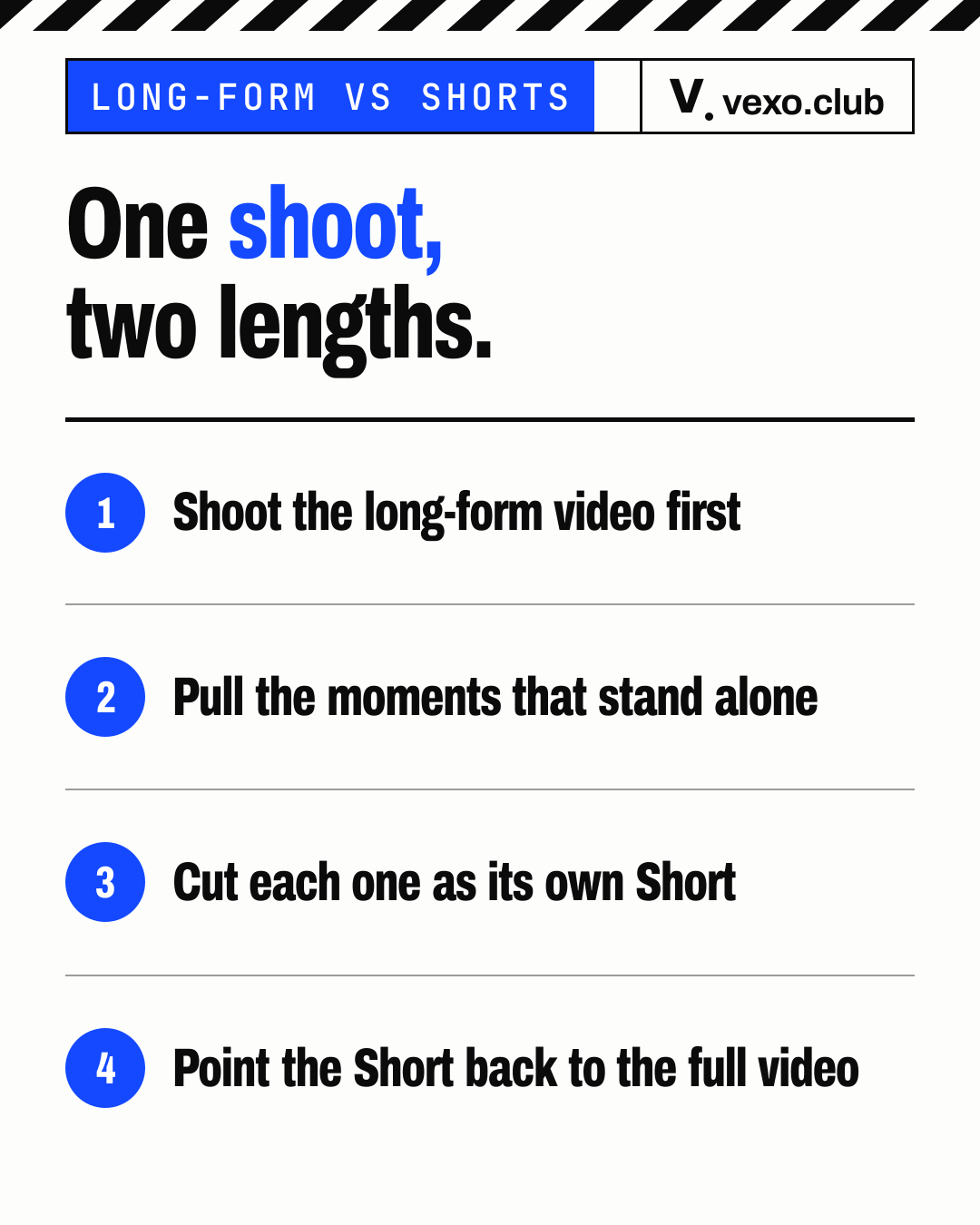
Often, and the usual direction runs from long-form outward rather than the other way round. A long-form video, once shot and edited, carries moments inside it that can stand alone (a single claim, a single reaction, a single demonstration), each of which can be cut as its own Short and published to do the discovery job the long-form video was never built for. Running it the other way, building a long-form video out of a set of Shorts shot for the feed, is harder, because a Short is written to need nothing before or after it, and a long-form case needs its pieces to build on each other in order.
One shoot, two lengths: the long-form to Shorts ladder
The vexo.club roster records which creators run YouTube channels built around long-form review and explainer work, and the shortlist for a brief is matched to that history rather than assumed. YouTube influencer marketing sets out how a brief for the platform is run end to end, and how to brief an influencer marketing agency covers what the rest of a brief should name before either length is chosen.
What to check before the brief goes out
Name the goal before the length, and let the length follow from it rather than from habit or from whichever the creator shot last.
Before a long-form or Shorts brief goes out
- What the video has to do: build a case, answer an objection, or be found by people not yet searching
- Whether the case needs minutes to make, or one idea told fast is the whole job
- Whether the brief is testing more than one creative route, which favours several Shorts over one long-form shoot
- Review time set to the length, not one clock for both
- Whether a Short, if used, should point back to a longer video on the same channel
- The disclosure label, in the form each length needs, checked before publish
Measurement follows the same split: a view, a watch-time figure and a retention curve mean one thing on a three-minute Short and another on a fifteen-minute review, and what we count as reach and the report template keep each length’s own numbers in its own column rather than totalled together. A brief naming the goal, the length it implies and a budget band can go straight to the desk.
Questions brands ask
Is Shorts cheaper than long-form, or the other way round? Neither, as a rule. Long-form carries more weight in research, scripting and a longer review pass; Shorts carry more weight in volume and a faster, repeated turnaround. Which costs more for a given brief depends on how many of each are being produced, not on the format alone.
Should a brand pick one format per creator, or can both run on the same channel? Both can run on the same channel, and often do. The choice is made per brief, against that brief’s goal, not as a standing rule for the whole creator relationship.
Can a long-form video and a Short be produced from the same shoot? Yes, and the usual direction is long-form first: a long-form video is shot and edited, then moments inside it that stand alone are cut as separate Shorts. Building a long-form case out of material shot as standalone Shorts is harder, because a Short is written to need nothing before or after it.
Does a Short help a channel’s long-form videos get found? It can. A Short that performs can pull a viewer into the channel’s long-form catalogue, which is a discovery path a subscriber feed alone does not provide. Whether a given Short does this depends on the creator and the category, and this site does not print a result it has not recorded.
How is this different from Reels vs Shorts, or integration vs dedicated video? Those are different questions. Reels vs Shorts compares Instagram’s short format against YouTube’s. Integration vs dedicated video compares two kinds of deliverable inside a single video. This guide is about length and goal within YouTube itself: long-form against Shorts, for a stated job.
Sources
- Understand three-minute YouTube Shorts (opens in a new tab) support.google.com
- Get started creating YouTube Shorts (opens in a new tab) support.google.com
Cite this page
YouTube long-form vs Shorts for brands: which length to brief for which goal. vexo.club, published 07 Nov 2026. https://vexo.club/blog/youtube-long-form-vs-shorts-strategy-for-brands
Influencer marketing across India
Send the desk a brief: it comes back as a shortlist and a directional band, never a public price.
Brief the desk