Seeding vs paid influencer campaign: a decision framework
Seeding vs a paid influencer campaign is not a budget question. It turns on how much proof a brand already has, what a free unit costs relative to the product’s price, and what the campaign has to prove. Here is the decision framework, by brand maturity, product price point and campaign goal.
Playbooks 11 min read The vexo.club desk
In this article8 sections
Seeding vs paid influencer campaign reads like a budget question, a free product against a signed fee, and that framing gets the decision backwards. A seeding send and a paid, contracted campaign are not two prices on the same line. They are two different instruments, suited to different mixes of brand maturity, product price point and the goal a campaign has to prove. Made on budget alone, the decision either sends an unproven product into a parcel run it has no evidence will work, or pays a full fee for a result a cheaper seeding run would have tested first. This is a product seeding decision framework for making that call before either motion starts, not a guide to running a seeding program once it is chosen (running a micro influencer seeding program covers that ground) and not a guide to paying for one once that is the call either.
What to take from this article
In short
- Seeding vs paid influencer campaign is not a budget question. It is a question of what proof the brand already has, what one free unit actually costs, and what the campaign has to prove.
- A brand with no influencer history should seed before it pays, because seeding produces the proof a paid brief would otherwise be written on guesswork.
- Product price point changes the maths of a free send. A low-priced, repeat-purchase product can seed widely. A high-priced or considered-purchase product rarely earns back the cost of a free unit the way a contract does.
- Seeding answers whether creators respond to a product at all. A paid campaign is the only instrument that can be pointed at a date and a required deliverable.
- Most brands move along this decision rather than picking once, seeding first and paying the creators who earn it, the way set out in running a micro influencer seeding program.
What the decision actually turns on
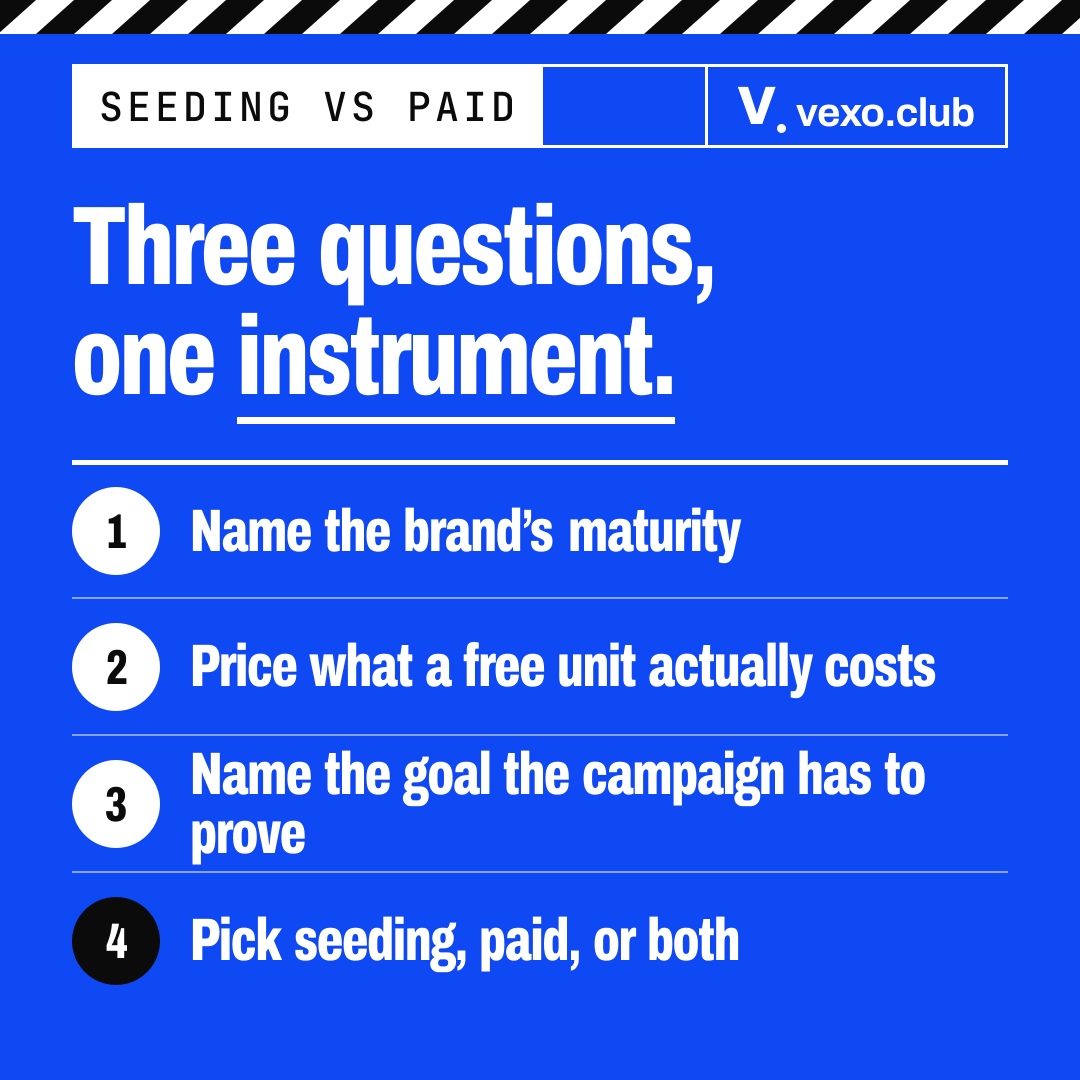
Three things decide whether a brand should seed or pay, and none of them is the size of the marketing budget. Brand maturity decides how much the brand already knows about what a creator does with its product. Product price point decides whether a free unit is a trivial cost or a real one. Campaign goal decides whether the brand needs a chance at content or a guaranteed deliverable tied to a date. Get any one of the three wrong and the other two will not save the decision: a mature brand with a high-priced product can still waste a quarter seeding a product that needed a contract from day one, and a new brand with money to spend can still pay full price for proof a parcel would have produced for less.
The three questions behind seeding vs paid
Where brand maturity and price point point the decision
New brand, low-priced product
New brand, Low-priced product
- Seed wide: a small cost per unit means a long list can be tested before anything is paid
- Use the posts that land to write the first paid brief
New brand, high-priced product
New brand, High-priced product
- Seed a short, careful list only: each unit is a real cost and the audience still needs more proof than a free unit can carry
- Pair a narrow seeding run with a small paid pilot rather than seeding alone
Established brand, low-priced product
Established brand, Low-priced product
- Keep seeding running as a background channel for always-on proof
- Reserve paid budget for a launch moment the seeding bench cannot carry alone
Established brand, high-priced product
Established brand, High-priced product
- Go straight to a paid, contracted campaign
- A free unit is not where the deciding signal sits for this product or this audience
Across Low-priced product High-priced product
Up Established brand New brand
Brand maturity: how much the brand already knows
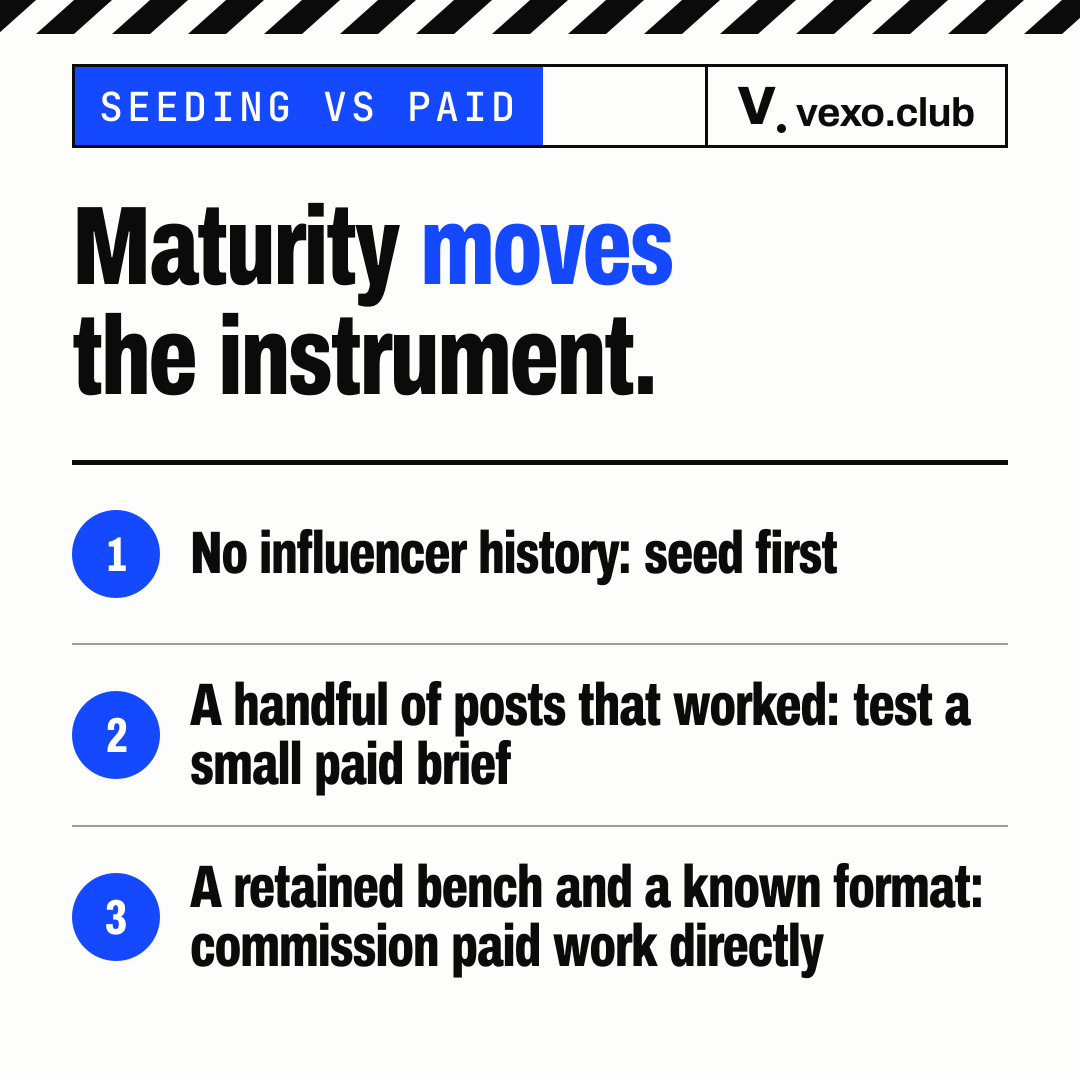
A brand with no influencer history has no evidence yet on what format, tone or niche makes its product look good in someone else’s feed, no track record to show a creator considering a paid deal, and no internal sense of what a good post even looks like for this product. Paying for a campaign from that position means writing a brief on guesswork and hoping the creator’s instincts cover the gap. Seeding first closes that gap at a fraction of the cost: a round of free sends across a short list of creators shows which niches respond, which formats the product suits, and which creators are worth a second look, all before a rupee is committed to a fee.
A brand that already runs a retained bench, or has graduated creators out of a seeding list into paid work the way running a micro influencer seeding program sets out, has already produced the proof seeding exists to generate. For that brand, seeding a new product from scratch is often a step backwards: it already knows which niches convert for it and which creators deliver, so a new product can usually go straight to a paid brief built on that existing knowledge rather than starting the discovery over again.
How brand maturity moves the choice
Product price point: what a free unit actually costs
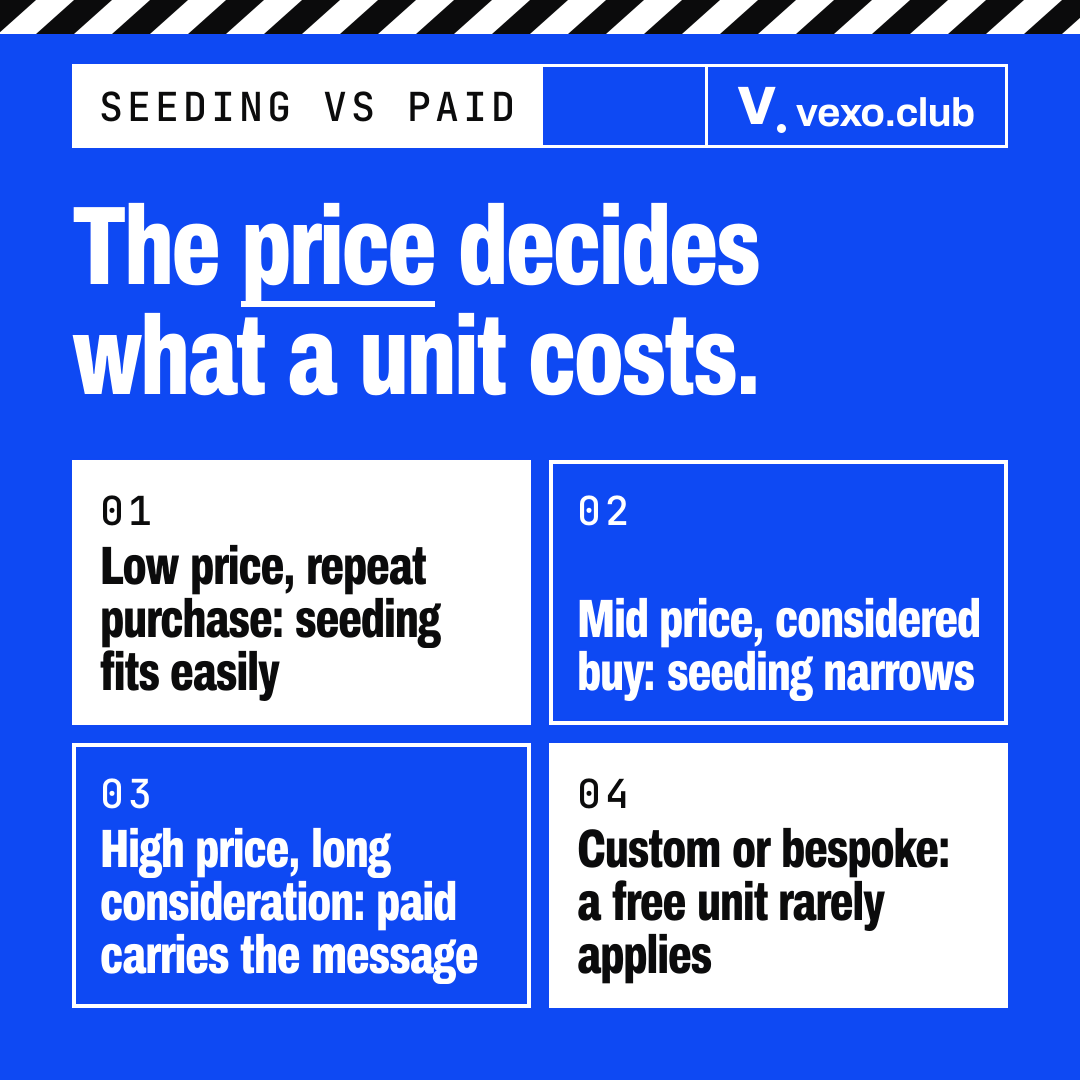
Price point changes the maths of a free send in a way that has nothing to do with the brand’s budget. A consumable or low-priced item a creator would plausibly buy and use again makes a seeding send cheap relative to the chance of a post, so a brand can afford to send to a longer list without the unit cost driving the decision. A high-priced or considered-purchase product turns that same free unit into a real cost per creator, and a single unit may not say enough about the product on its own the way a longer, paid message with room to explain the purchase can.
This is not a rule that a paid campaign is required above some line. It is that above a certain price, the cost of sending a product free starts to compete directly with the cost of paying for a guaranteed post, and at that point the honest question is which one the brand would rather spend on: a longer list of free units with no guarantee attached, or one paid deliverable backed by a contract. What moves a quote is a separate question, answered there; this is only about whether the free-unit route still makes sense at the product’s own price.
What product price point changes about the decision
Campaign goal: a chance at content or a guaranteed deliverable
The clearest way to tell seeding and a paid campaign apart is to ask what the campaign is actually for. If the goal is discovery (finding which niche creators and which formats make the product look good, or proving internally that influencer content works for this product at all), seeding answers that question well, because it runs cheaply at volume and because what a free product produces unprompted is a more honest signal than a paid, scripted post would be.
If the goal is tied to a date (a launch window, a sale period, a specific claim the campaign has to carry, or usage rights to repurpose the content as a paid ad), seeding cannot deliver it, because seeding promises nothing a brand can hold a creator to. The whole shape of a seeding send, set out in running a micro influencer seeding program, is a product with no obligation attached. A paid, contracted campaign is the only instrument built to be pointed at a date and a required result, which is also why usage rights and deliverables are written in before a paid shoot rather than hoped for after it.
Seeding and a paid campaign, side by side
| Seeding | Paid campaign | |
|---|---|---|
| What it answers | Whether creators in a niche respond to the product at all | Whether a specific message reaches and moves a defined audience |
| What it guarantees | Nothing: a post is a bonus, not a deliverable | A deliverable, a date and a format, set out in a contract |
| Usage rights | None: whatever is posted stays the creator’s own | Negotiated and written in before the shoot |
| What it asks of the brand | A product and a short list, no chasing | A brief, a fee and a written agreement |
| Where it fits best | Early proof, low-priced products, a brand with no track record yet | A dated goal, a considered-purchase product, a brand that already knows what it wants |
Signs the decision was made for the wrong reason
The three questions above decide the instrument. Most bad calls come from skipping them and reaching for whichever one is already set up or already budgeted.
Signs the decision was made for the wrong reason
Do
Choose seeding because the brand needs proof it does not have yet
Don’t
Choose seeding because the budget line is empty
Do
Choose paid because the goal has a date and a required deliverable
Don’t
Commission a paid campaign before anyone knows what a winning post looks like for this product
Do
Move a high-priced or bespoke product straight to a paid conversation
Don’t
Ship a shelf of a high-cost product into a seeding list to avoid writing a contract
Do
Let the stated goal decide the instrument
Don’t
Let whichever one is easier to set up decide the goal
Where the two meet
Few brands pick once and stay there. Most move along this decision rather than choosing a permanent side: a brand seeds a new product, watches for the pattern that running a micro influencer seeding program describes (a creator who keeps mentioning the product without being asked twice), and pays the creators who earn it rather than the whole list that was seeded. The framework above is for naming where a brand or a product sits today, not a permanent label on either one. A brand’s maturity changes with every cycle it runs. A product’s price point does not move, but how much proof a brand needs before trusting that price point to a paid brief does.
Seeding and paid are not permanent
Where the desk fits in
This is a framework for deciding which instrument to reach for, not a service the desk sells on its own. Running a seeding program is a brand’s own motion, covered in full in running a micro influencer seeding program; a paid, contracted campaign is where the desk’s own work starts. What a package should contain and how the tier mix and spend should shift by goal are the next two questions once paid is the right call.
When a brand is ready for a paid campaign, send the desk a brief naming the objective, the market and the price point of the product, or look at who already works with the desk on the roster.
Questions brands ask
What is the difference between seeding and a paid influencer campaign? Seeding sends a product free with no fee and no required deliverable; whatever a creator posts afterwards is a bonus. A paid campaign adds a fee, a brief and a written agreement, so the brand can hold the creator to a specific deliverable, a date and usage rights.
How do I decide between seeding vs a paid influencer campaign for a new product? Weigh three things: how much the brand already knows about what works for this product, what a single free unit costs relative to the product’s price, and whether the goal is open-ended discovery or a deliverable tied to a date. A new brand with a low-priced product usually seeds first. An established brand with a high-priced product and a dated goal usually goes straight to paid.
Does product price point decide whether to seed or pay? It is one of three factors, not the only one. A low-priced, repeat-purchase product can absorb a seeding run across a long list because the per-unit cost is small. A high-priced or considered-purchase product makes that same free unit a real cost, which usually points toward a paid, contracted campaign instead.
Can a brand run seeding and a paid campaign at the same time? Yes, and most established brands do: a seeding program runs in the background as an always-on source of proof and new creators, while paid, contracted work carries the campaigns that need a guaranteed deliverable on a date. The two are not mutually exclusive; they answer different questions.
Is seeding the right first move for a brand with no influencer history? Usually, yes. A brand that has never worked with creators has no evidence yet on what format or niche suits its product, and seeding produces that evidence at a fraction of what a paid campaign built on guesswork would cost if the brief turned out wrong.
What is a product seeding decision framework? A way of naming, before either motion starts, whether a brand should send product for free with no obligation or commission a paid, contracted campaign: based on the brand’s maturity, the product’s price point, and whether the goal is open-ended discovery or a deliverable tied to a date.
Cite this page
Seeding vs paid influencer campaign: a decision framework. vexo.club, published 09 Nov 2026. https://vexo.club/blog/seeding-vs-paid-campaign-decision-framework
Influencer marketing across India
Send the desk a brief: it comes back as a shortlist and a directional band, never a public price.
Brief the desk