Talent manager or brand-side agency: who represents whom, and what it does to your negotiation
A talent manager acts for the creator. A brand-side agency acts for the brand. What that changes when you negotiate directly or through a manager: who pays whom, where conflicts of interest sit, how exclusivity really works, how to read a manager’s rate card and how to run a clean negotiation.
Benchmarks 19 min read The vexo.club desk
In this article10 sections
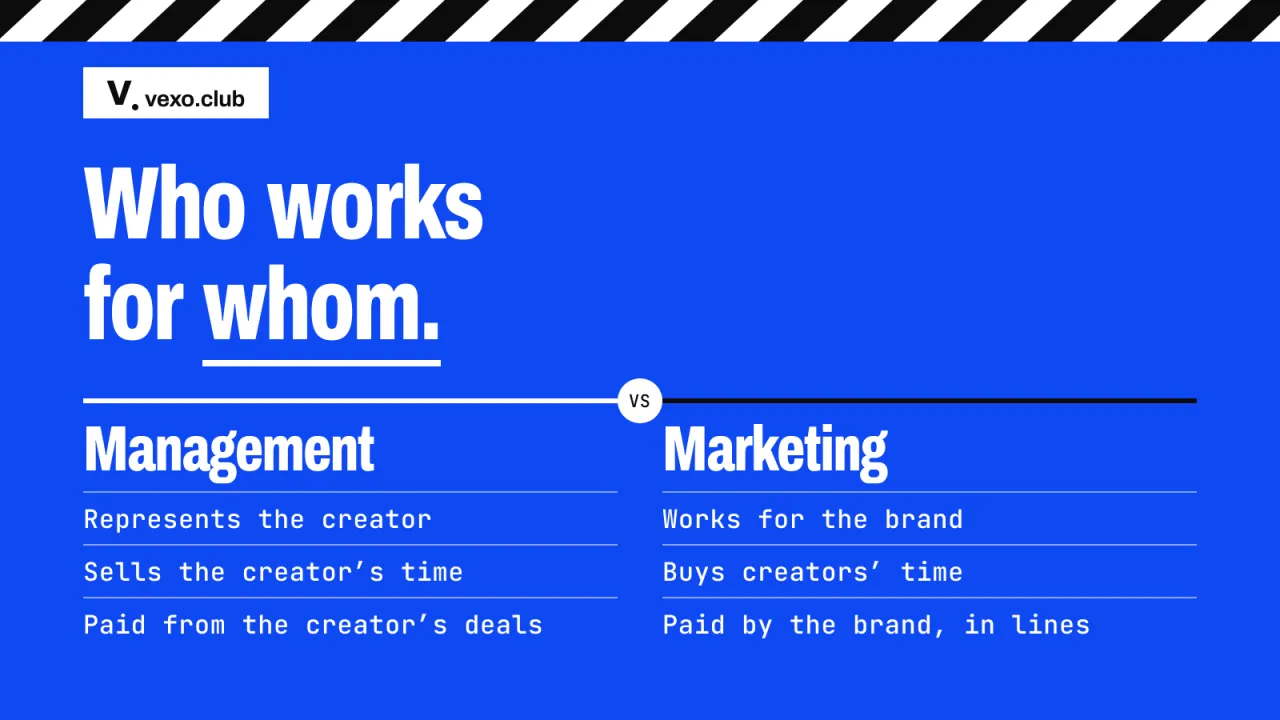
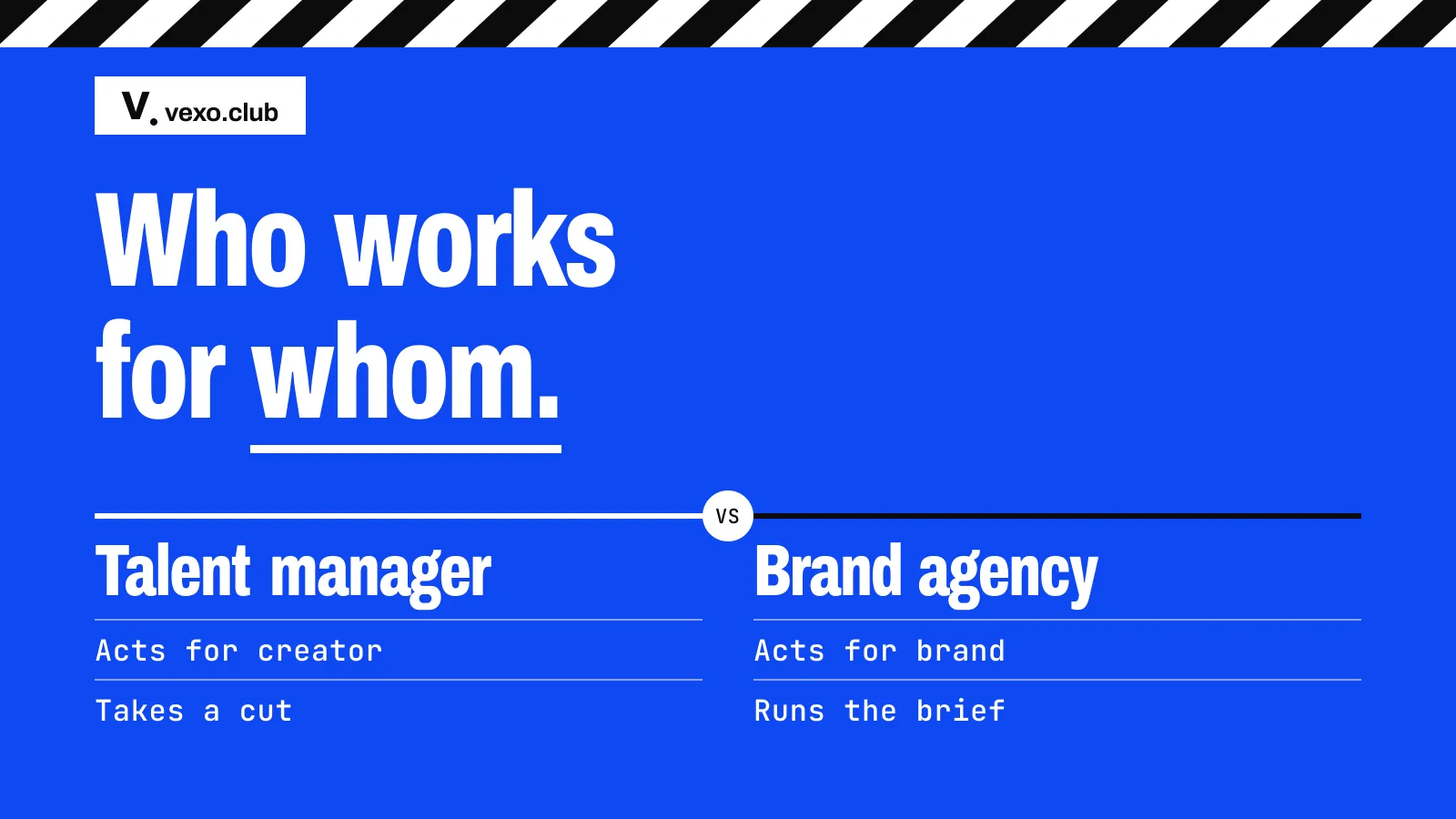
A talent manager works for the creator. A brand-side agency works for you. That one fact explains most of what feels strange when you negotiate with a creator who has a manager. The manager has a reason to raise the fee and to narrow what the creator gives away. Your agency has a reason to do the opposite. The right move for a brand is not to avoid the manager or to beat them. It is to know whose side each person is on, ask for the numbers in separate lines, and agree scope before price.
What to take from this article
In short
- A talent manager acts for the creator and a brand-side agency acts for the brand. A manager has a reason to widen what you ask for and raise the price. Your agency has a reason to narrow both.
- Go through the manager when the creator has one. Going round them rarely saves money and usually costs the relationship.
- You cannot see from outside whether a manager’s commission sits inside the quote or on top of it. Ask, and ask who invoices you.
- The conflict that bites most is a firm that advises you and also holds the creator on its books. Get that disclosed per creator, in the contract.
- Read a rate card as an opening position with assumptions in it. Negotiate scope before price and write usage and exclusivity as separate lines.
The definitions of the two kinds of firm are in influencer management agency, explained. This piece is about what changes when you are the one at the table: who you can deal with directly, who is paid out of what, where conflicts hide, how exclusivity actually binds and how to keep the whole negotiation clean. It is written for a brand manager or founder who has just been told to speak to a creator’s team.
Who is across the table when a creator has a manager?
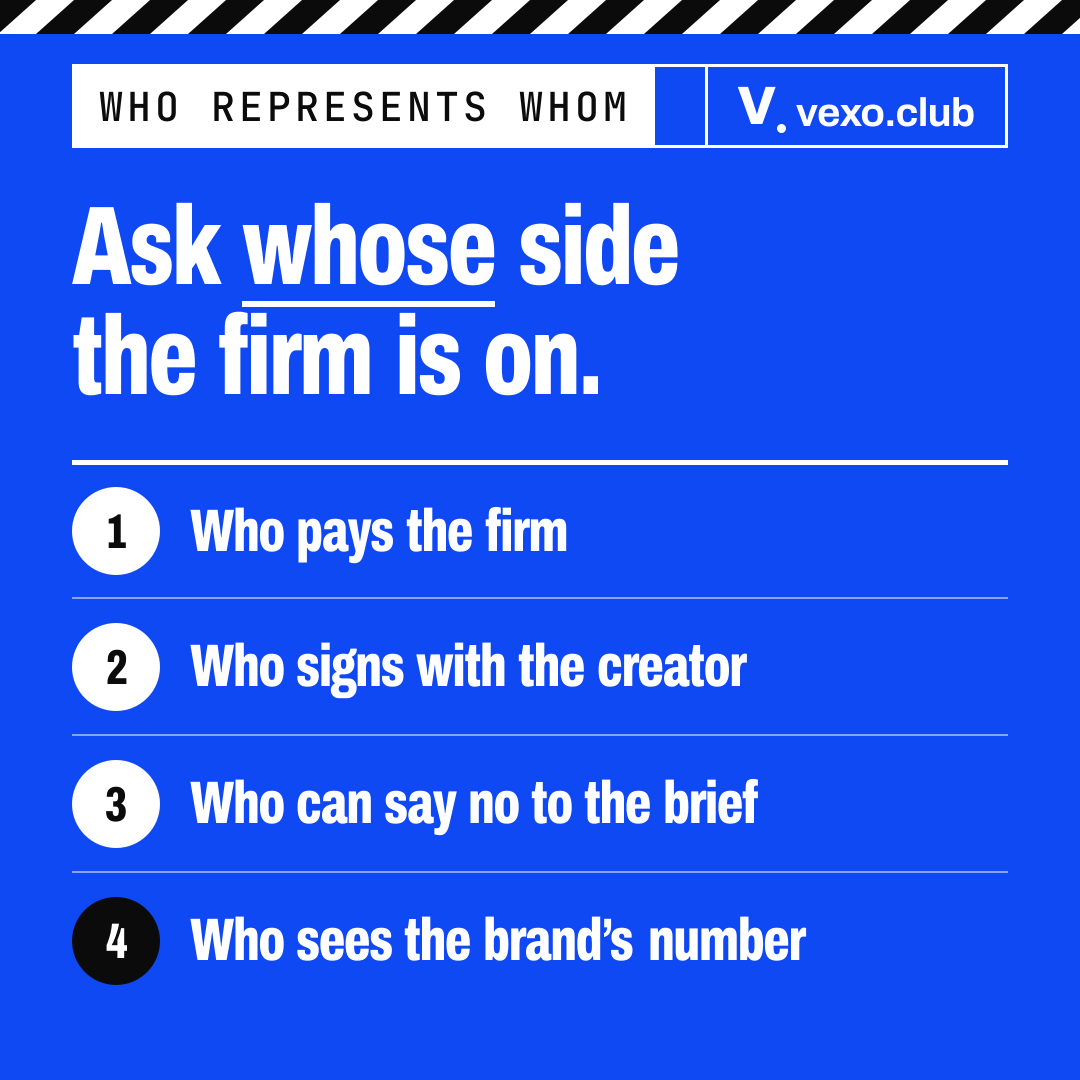
There are three kinds of firm you will meet, and the first call should find out which one you have. A talent manager represents the creator: they take your enquiry, decide whether the creator is interested, name the price and negotiate the terms. A brand-side agency represents you: it casts creators against your brief, contracts them and answers to you for the result. The third kind does both on its books, often under two different names.
The practical difference is whose interest a person is paid to protect. A manager is not your adviser on whether the creator suits your product. That is not their job and they are not paid for it. Your agency is supposed to be that adviser, which is why a firm that is also the manager of the creator it recommends has a problem. More on that below.
Who is across the table, and what each one is built to do
| Acts for | Usually paid by | Leans toward | Can sign for the creator | |
|---|---|---|---|---|
| Talent manager | The creator | A share of the creator’s deals | A higher fee and narrower terms | Only with written authority from the creator |
| Brand-side agency | The brand | The brand, through a fee, a retainer or a share of spend | A plan that fits your brief | No. It signs for you |
| A firm that does both | Both, depending on the deal | Possibly both sides | Whichever side pays more on that deal | Only for creators it holds written authority for |
One more distinction trips people up. Some creators have a manager only for large brand deals and answer small collaborations themselves. Some have a network or an agency that handles their inbox but has no authority to agree anything without a call back. Do not assume. Ask who can agree terms, and ask to see it in writing before you start negotiating usage or exclusivity with someone who may have to ask permission for every line.
Should you negotiate direct or through the manager?
If the creator has a manager listed for business enquiries or tells you to speak to their team, go through the manager. That is the decision rule, and the reason is practical rather than polite. A creator under an exclusive management agreement is often obliged to route brand deals through the manager, so a direct yes from the creator may not be something either of you can honour. Creator-facing guides to management contracts describe that clause as common, though it depends on the individual contract. Going around a manager to get a lower price also tends to end in the same place with an extra week lost and a manager who now knows you tried.
Go direct when the creator has no manager. Go direct also when the manager tells you the creator handles small collaborations themselves, and ask this once and in writing so that nobody argues later. If you already have a working relationship with the creator and then discover a manager has been appointed, tell the manager what you have agreed before and ask how they want to handle repeat work. Do not make them find out.
Negotiating direct or through the manager
Direct with the creator
- Fits a creator who has no manager or who says small deals are theirs to handle
- Fewer layers between your brief and the person who makes the content
- You carry the contract, the reminders and the awkward conversations yourself
- A creator under exclusive management may be bound to send you to the manager anyway
Through the manager
- Fits a creator whose bio or replies name a manager for business
- Someone who can check availability, say no and sign quickly
- Another layer on the price and often on the payment timeline
- Less of a feel for the creator’s own view of your product
The brands that do worst here are the ones that use the creator as a back channel. A message to the creator that says “can you ask your manager to drop the price” puts the creator between two people who are both paid to get a result from them. It reads as pressure and it rarely works.
Four questions that show which side a firm is on
Who pays whom? Commission shapes, without the numbers
Commission in this market comes in a few shapes, and from outside you often cannot tell which one you are in. That matters because it changes what you are actually negotiating. None of these figures are standard enough to quote, so this section deals in who pays whom.
- Out of the creator’s fee. The manager takes a share of what the creator is paid. You see one number and the manager and creator divide it between them.
- On top of the creator’s fee. The manager adds a management line to the creator’s rate and you pay both. Creator-facing guides in India describe both this and the first shape as normal.
- Paid by the brand to a brand-side agency. A fee line, a retainer or a share of the creator spend. How influencer agencies charge lays out what each of these rewards.
- From both sides. A firm that is paid by the brand as an agency and by the creator as a manager on the same deal. That is not wrong in itself. It becomes a problem when it is not disclosed to you.
Two questions settle most of it. First, “is your commission inside this figure or added to it”. Second, “who will invoice me and who receives the money”. If the answer to the first is “inside”, the creator’s own expectation of what they take home sets the floor for the quote. That is why rates often rise when a creator signs with a manager. A July 2026 thread on r/influencermarketing has a brand marketer complaining about exactly that, and a reply explaining that the new rate has to cover the manager’s share. The thread is mostly about the US market, so treat it as a description of the mechanism and not of Indian rates.
Do not conclude that a manager makes a creator more expensive in every case. A good manager sometimes gets the creator better terms and sometimes gets you a faster yes. What you are checking is whether the number is for a clear scope, because a higher price for narrower usage is the real warning sign.
Where the conflicts of interest sit
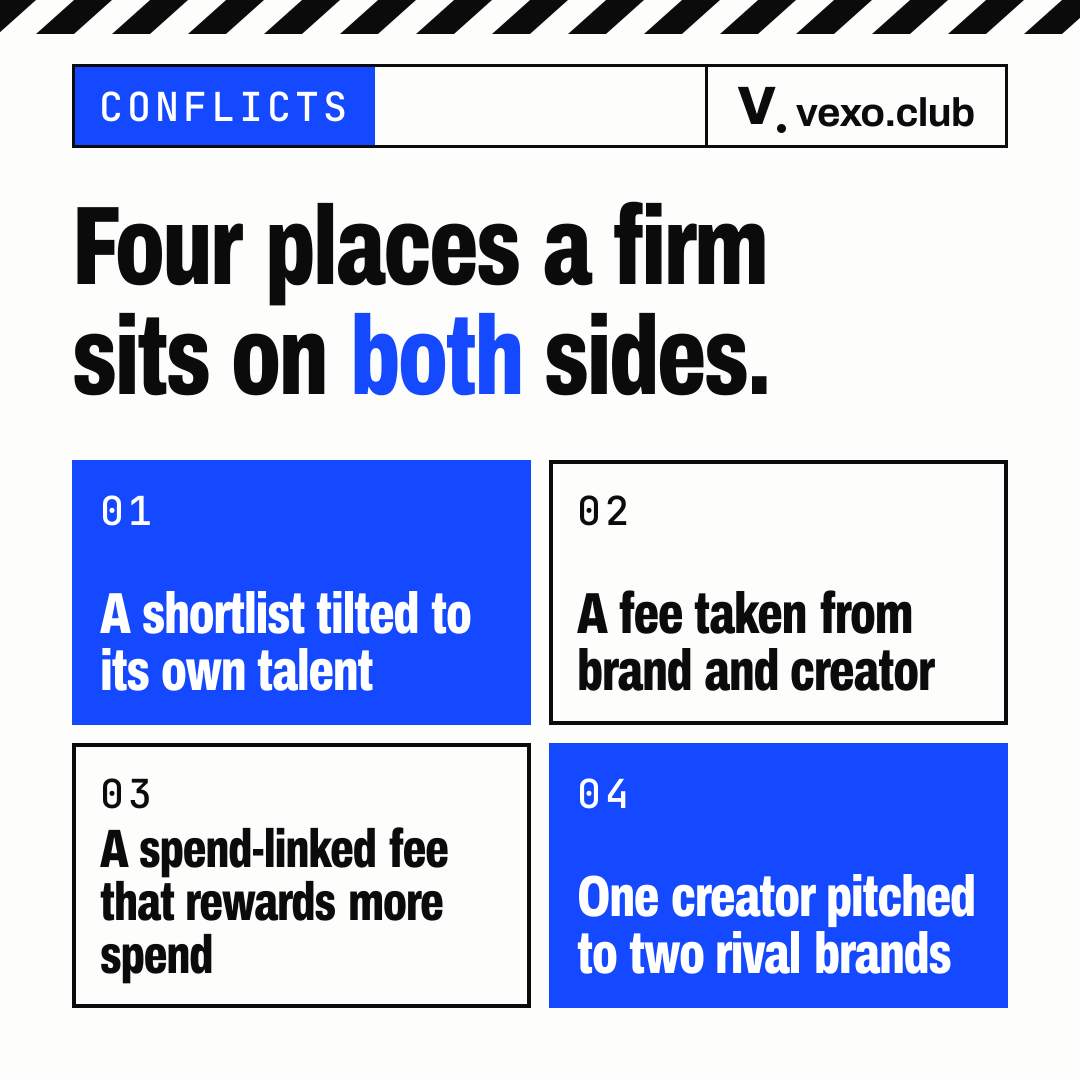
A conflict does not mean anyone is acting in bad faith. It means a person has two reasons pulling in different directions and you cannot see which one is winning. There are four places to look, and the first is the one that matters most.
Your agency also manages the creator it recommends. The shortlist may favour creators the firm earns from on both sides. You cannot tell from the plan alone. The fix is plain: ask, creator by creator, whether the agency or its group has any management, representation or commission interest, and get the answer in writing. The roster-label approach described in the management agency article is one way to do it.
A fee that rises with spend. If your agency is paid as a share of what you spend on creators, a bigger plan means a bigger fee. That is a legitimate model. It just means the recommendation to spend more needs a reason you can check.
A manager with several creators in your category. The manager decides which creator to push for your brief and which to hold for a rival. Their loyalty is to the creator list as a whole. If category exclusivity matters to you, ask the manager to confirm that no other creator on their books is being offered to a direct competitor in your window.
A fee nobody told you about. If a firm takes a commission from the creator side without telling you while it is acting as your agent, that is the situation Indian contract law deals with in section 215 and section 216 of the Contract Act: a principal may repudiate a deal where the agent dealt on their own account and concealed a material fact, and may claim the benefit the agent gained. Whether a particular arrangement falls inside those sections is a question for a lawyer who has read your paperwork. The safer step is to write disclosure into the contract.
Here is a clause you can adapt and give to your legal adviser: “The agency confirms that it has disclosed in writing every creator named in this plan in which it or any group company holds a management, representation or commission interest, and will tell the brand before any such interest arises during the campaign. The agency will not accept any fee or commission from a creator, manager or network in connection with this campaign without the brand’s written consent.”
Where conflicts of interest sit
Exclusivity: whose protection is it really?
Exclusivity is something the creator sells you. They agree not to work with competitors for a period, which restricts their income, and that is why a manager guards it and prices it. It is also the clause where managers and brands most often talk past each other, because two different things carry the same word.
One is exclusivity to you: the creator will not promote your competitors for a defined window. The other is exclusive management: the creator has agreed to deal with brands only through one manager or agency. When a roster or a pitch deck says a creator is “exclusive”, it usually means the second. It tells you who to negotiate with and says nothing about whether the creator is free of your competitor. Exclusive vs non-exclusive creator partnerships covers how much to pay for the first kind.
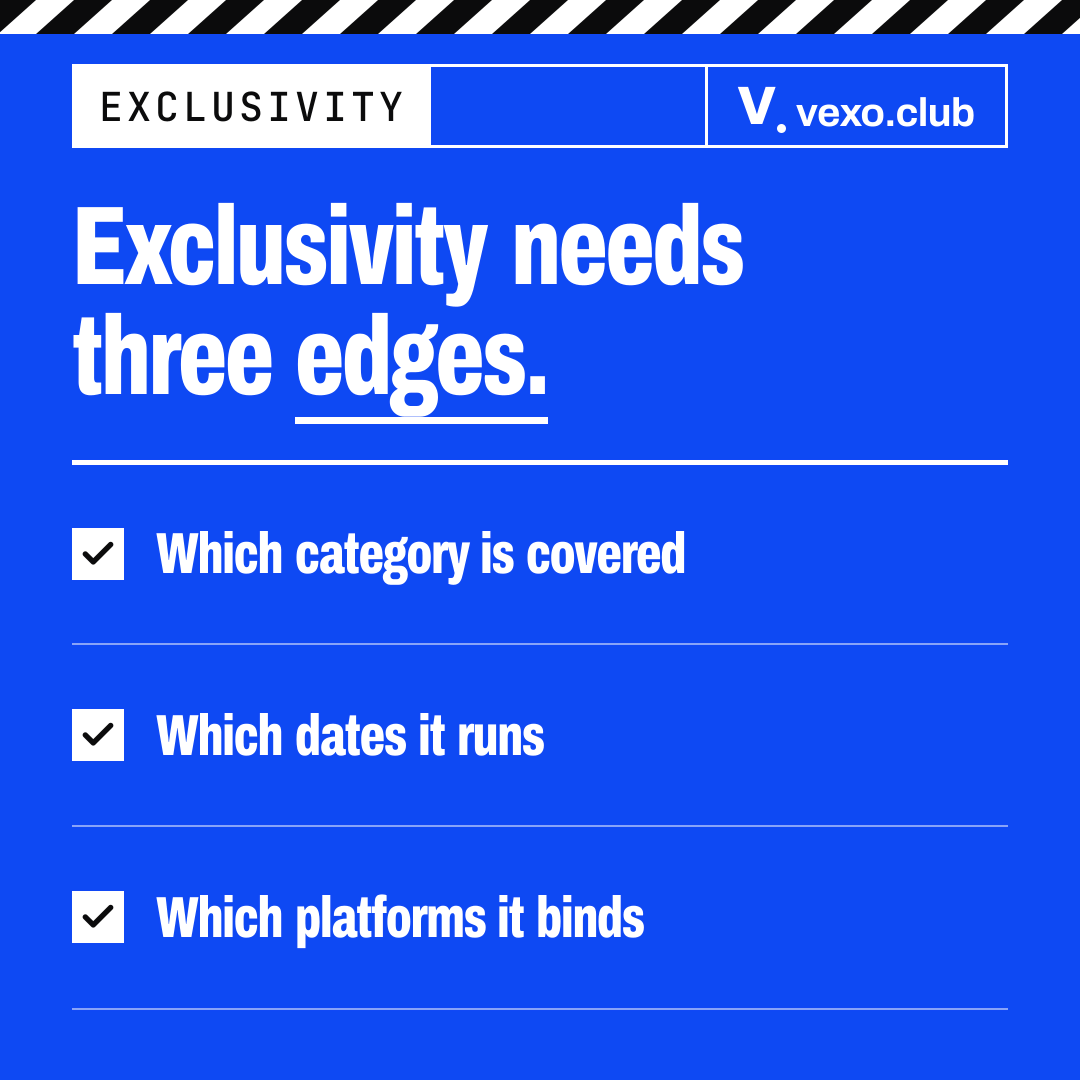
Whenever you do ask for exclusivity, write all three edges: the category, the dates and the platforms. A clause that says “no competitors” without naming a category will be read in whichever direction suits the reader on the day. Name the category in words you would be happy to show a judge, and say whether it covers both paid and organic posts. Then check. In a June 2026 thread an agency-side poster said breaches of exclusivity were mostly found by accident. A weekly look at the creator’s channels during the window is cheap and settles most doubts.
The three edges of an exclusivity clause
How to read a manager’s rate card
A manager’s rate card is the opening position, and it carries assumptions you cannot see. Two cards with the same headline fee can mean very different deals, because one assumes organic posting on one platform and the other includes paid usage across several. What a creator rate card contains explains the numbers behind a creator fee. Here is how to read one in front of a manager.
What can sit inside one manager’s quote
- Creator fee Per deliverable, in a named format
- Usage and whitelisting What you may do with the content, where and for how long
- Exclusivity Which category, which dates, which platforms
- Production and revisions Who shoots, who edits, how many rounds
- Management line Inside the fee or added on top: ask which
- Tax and payment terms GST status of the invoicing entity and the days to pay
Start with what the rate assumes. Most disputes later trace back to one unstated assumption. Look for three silences in particular. A card that never mentions usage usually means organic only, and any paid use will be priced separately. See usage rights for why that line moves the total. A card that never mentions exclusivity means none is included. And a card with a “starting from” fee has not told you what the real fee is for your brief.
Then look at whether the card is the creator’s own or the manager’s. Ask what deliverable counts as one unit, how many revisions are included, who approves the script and what happens if the creator misses the date. These are the places a manager can be generous or tight without moving the headline number. Use the questions below nearly verbatim.
Ask a manager about their rate card, in these words
- What does this rate assume: organic posting only, which platforms, and for how long?
- Is usage or whitelisting included, and if not what is the add-on structure?
- Which category exclusivity is in the quote, for which dates?
- How many rounds of revision are included, and who approves the script?
- Is your management fee inside this number or added to it, and who will invoice me?
- How long is this quote valid, and what are the payment terms and any advance?
- Do you hold written authority from the creator to agree these terms on their behalf?
If the answers come back vague, that is information. A manager who cannot say what the number covers either does not know or does not want to be held to it. Before you reply, test the creator on your side too: reading a media kit and checking an influencer’s audience are how you decide whether any fee is worth paying.
How to run a clean negotiation
A clean negotiation is one where both sides know what is being traded at every step. The order in the figure below is the whole method. Most of the saving comes from the early steps and almost none from haggling over the headline fee.
A clean negotiation, in order
- Confirm who speaks for the creator Written authority, one named contact
- Send a written brief Objective, deliverables, dates, usage, category
- Ask for a quote in lines Fee, usage, exclusivity, production, management
- Trade scope before price Narrow usage or exclusivity, not the creator’s fee
- Write it into one contract Signed by the creator or their authorised signatory
- Fix payment and takedown terms Who invoices, days to pay, who removes a post
Here is an illustrative case, not a real one. A packaged-snacks brand wants a food creator for a festival launch. The manager’s quote includes a reel, several stories, a long usage window and category exclusivity across all food. The brand only needs paid use during the festival fortnight and exclusivity for snacks in that window. It does not ask for a lower fee. It asks for the same reel with usage and exclusivity narrowed to what it needs and sees the price move through scope. The manager keeps a good fee for the creator and the brand stops paying for rights it would never use.
This is the kind of message that starts it well, and it is paste-ready: “We would like to work with [creator] on one reel for [product] in [month]. We need organic posting on Instagram, paid usage for [window] and exclusivity in [category] for [dates]. Could you send a quote with the creator fee, usage, exclusivity, production and your own fee as separate lines, and confirm who will invoice us and the payment terms. Please also confirm that you hold written authority from [creator] to agree this. Our brief is attached.” Notice that it names what you need, asks for lines and asks for authority. Briefing a creator covers what goes into the attached brief.
Scope first, price last
Two habits keep it clean. Keep every term in writing, even when the call went well, and have one contract signed by the creator or their authorised signatory with the manager named as the contact. Also, be ready to walk away without heat. If a manager will not itemise, will not confirm authority or will not give a payment date, the price is not the problem. For the wider contract terms, the contract clauses that change the price and contract red flags for India are the two to read before signing.
Paperwork, tax and who is liable when something goes wrong
Pay only the entity that invoices you and make sure its name matches the contract. Which TDS and GST treatment applies depends on who is the payee, so read TDS on influencer payments and GST invoicing for influencer payments with your accountant before the first payment.
Using a manager does not move your advertising liability. The ASCI influencer guidelines say disclosure responsibility sits with the advertiser and the influencer, and that an advertiser with a material connection has to ensure the post is in line with the code and may call on the influencer to edit or delete it. The Central Consumer Protection Authority’s 2022 misleading-advertisement guidelines, summarised in the PIB release, set duties for the advertiser and the advertising agency and require endorsers to have done due diligence. Check the current text of both. In practice this means your contract with the manager should name who approves the caption, who must add the disclosure and who can take a post down quickly. ASCI disclosure rules for brands goes through that in detail.
Payment is where extra layers show. Agency heads told Storyboard18 in July 2025 that payment delays run through the chain, and some said larger intermediaries hold money for a long time. Whatever your own terms are, write the days to pay into the contract and ask whether the creator has been paid before you chase your own invoice.
When you do not need a manager conversation at all
For small creators the manager question usually does not arise. They reply themselves, they price simply and the paperwork is lighter. Hiring a brand-side agency to buy a handful of small-creator posts is rarely worth the fee. Hiring influencers in India and in-house or agency help you decide where the line sits for your brand. If you are weighing agencies, the proposal scorecard shows how to read what you are quoted.
This week: list every creator on your current plan and write down who actually speaks for each. Ask your agency for the written interest disclosure above. Rewrite your standard enquiry email so it asks for lines and authority. That is enough to make most negotiations cleaner than they were last month.
Questions brands ask
What is the difference between a talent manager and an influencer agency? A talent manager represents the creator and takes a share of their deals. A brand-side agency is hired by you to plan and run the campaign. Some firms do both, so ask which role they play on your deal.
Should I contact the influencer or their manager? Go to the manager if the creator names one for business. Go to the creator if there is none, or if the manager confirms the creator handles small deals alone. Do not use the creator as a go-between to get a lower price from the manager.
Who pays a talent manager’s commission, the brand or the creator? It varies. Sometimes the commission comes out of the creator’s fee and sometimes the manager adds it to the quote so the brand pays it. Ask whether it is inside the figure or on top of it and who will invoice you.
Can my agency also manage the creators it recommends? It can, but it should tell you so, creator by creator, before you approve a plan. Doing both is not wrong. Doing both quietly is. Put the disclosure in your agency contract.
Why do rates jump when a creator signs with a manager? The new rate usually has to cover the manager’s share and justify the arrangement, and the creator often wants the same take-home. It is not always a fair price for the brand. Test it by asking what the rate includes and negotiating scope first.
Does “exclusive” on a creator’s profile mean they will not work with my competitor? Not necessarily. It usually means the creator is exclusively managed by one firm. If you want protection from competitors, ask for exclusivity to you, with the category, dates and platforms written out.
Who is responsible for ASCI disclosure if the manager handled the deal? The advertiser and the influencer both carry responsibility under the ASCI guidelines. A manager in between does not move it. Write into the contract who adds the disclosure, who approves the caption and who removes a post that fails.
How do I know a manager really speaks for the creator? Ask for written authority from the creator and ask who will sign the contract. If neither can be shown, deal with the creator directly or step back. A quote from someone who cannot commit the creator is not an offer.
If you have a manager’s quote you are unsure about or a brief you want to talk through, use the contact page. vexo.club works for brands from Delhi NCR, and where it holds a written agreement with a creator the roster label says so.
Sources
- July 2026 thread on r/influencermarketing (opens in a new tab) reddit.com
- section 215 (opens in a new tab) advocatekhoj.com
- section 216 (opens in a new tab) indiankanoon.org
- June 2026 thread (opens in a new tab) reddit.com
- ASCI influencer guidelines (opens in a new tab) ascionline.in
- PIB release (opens in a new tab) pib.gov.in
- Storyboard18 in July 2025 (opens in a new tab) storyboard18.com
Cite this page
Talent manager or brand-side agency: who represents whom, and what it does to your negotiation. vexo.club, published 23 Nov 2026. https://vexo.club/blog/talent-management-agency-vs-influencer-marketing-agency
Send the desk a brief: it comes back as a shortlist and a directional band, never a public price.
Brief the desk