GST on influencer payments in India: when a creator registers, what the invoice shows, and how a brand claims the credit
GST on influencer payments in India is a separate layer from TDS: a tax the creator charges and the brand may credit, not one the brand withholds. Registration thresholds in outline, what a creator’s GST invoice must show, and how input credit works, with links to the GST portal and CBIC.
Benchmarks 13 min read The vexo.club desk
In this article10 sections
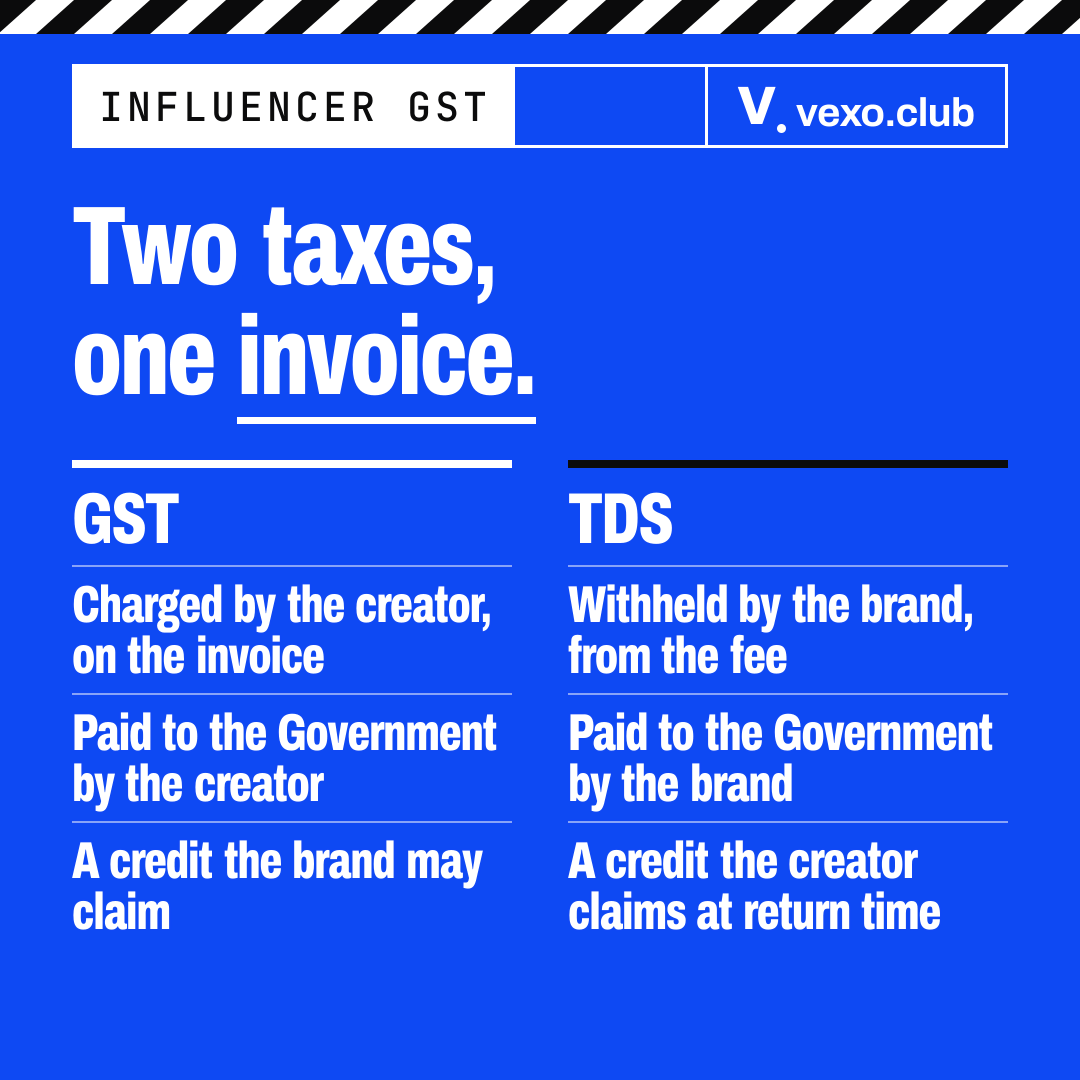
GST on influencer payments in India sits next to TDS on the same brief, not inside it. TDS is tax the brand withholds from a creator’s fee or from the value of a product the creator keeps, under the Income-tax Act, 2025; it is covered in full in TDS on influencer payments in India, which this guide does not repeat. GST is a tax on the supply itself: the creator, if registered, charges it on the invoice, collects it from the brand along with the fee, and deposits it with the Government. The brand, in turn, may be able to treat that tax as a credit against its own GST bill. Two statutes, two mechanisms, one invoice.
GST on influencer payments, for a brand
In short
- GST is charged by the creator and may be credited by the brand. TDS is withheld by the brand and credited to the creator. They sit on the same invoice and answer different questions.
- Whether a creator must register for GST depends on more than one number: the kind of supply, the state and, for goods such as merchandise, whether the sale crosses state lines or runs through an e-commerce operator.
- A registered creator’s invoice needs a fixed set of particulars before a brand can rely on it for a credit claim. A bill without them is not a tax invoice, whatever it is titled.
- The brand’s credit is not automatic on payment. It depends on the creator actually reporting and depositing the tax, among other conditions.
- Rates and thresholds are set by notification and move. This guide gives the structure; the GST portal and CBIC give the number in force today.
This guide comes from vexo.club, an influencer marketing agency run from one desk in Delhi NCR. It is not tax advice, and no chartered accountant or GST practitioner has reviewed it: confirm every line with yours before a brief carries a GST clause. The structure below is read from the GST law and CBIC’s own published material, linked throughout; the rupee thresholds and tax rates those pages carry move with the GST Council’s decisions, so this guide does not quote one as current. Check the GST portal or a practitioner for the figure in force on the day it is needed.
GST and TDS on the same creator invoice, two separate questions
When does a creator need to register for GST?
A supplier of services registers for GST once turnover crosses a threshold the law sets, and that threshold is not one fixed number: CBIC’s own registration material describes different limits for different categories of supplier and for different states, and the figure has moved by notification before. A creator weighing registration should read the current threshold on its own terms rather than carry forward a number seen in an older post or a forwarded message.
Turnover is also not the only door into registration. Section 24 of the CGST Act lists categories that must register regardless of turnover, including anyone making inter-state taxable supplies, anyone supplying through an e-commerce operator that collects tax at source, anyone liable to pay tax on reverse charge and a non-resident taxable person, among others (Section 24, CGST Act, registration rules). Notifications under the Act then exempt small suppliers of services from two of those triggers: a CBIC flyer on registration notes that a service supplier whose all-India turnover is within the threshold need not register just because it makes inter-state supplies or supplies services through an e-commerce operator, while an inter-state supplier of goods generally must register whatever its turnover (Registration under GST law). A creator who also sells merchandise into other states, or who earns through a platform’s own monetisation alongside brand deals, is reading a more layered question than “is my income above the limit”.
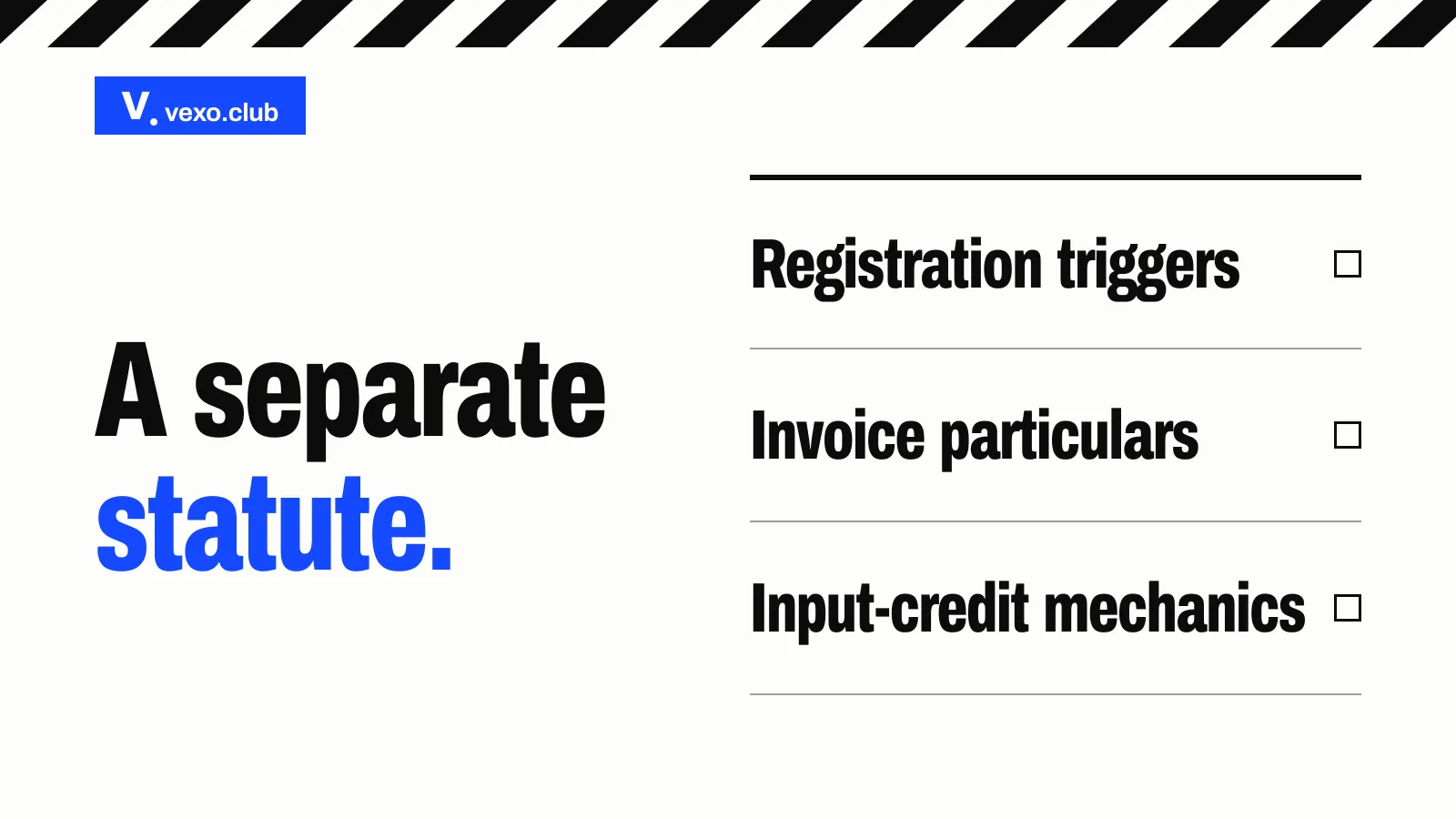
What can require a creator to register for GST, besides turnover
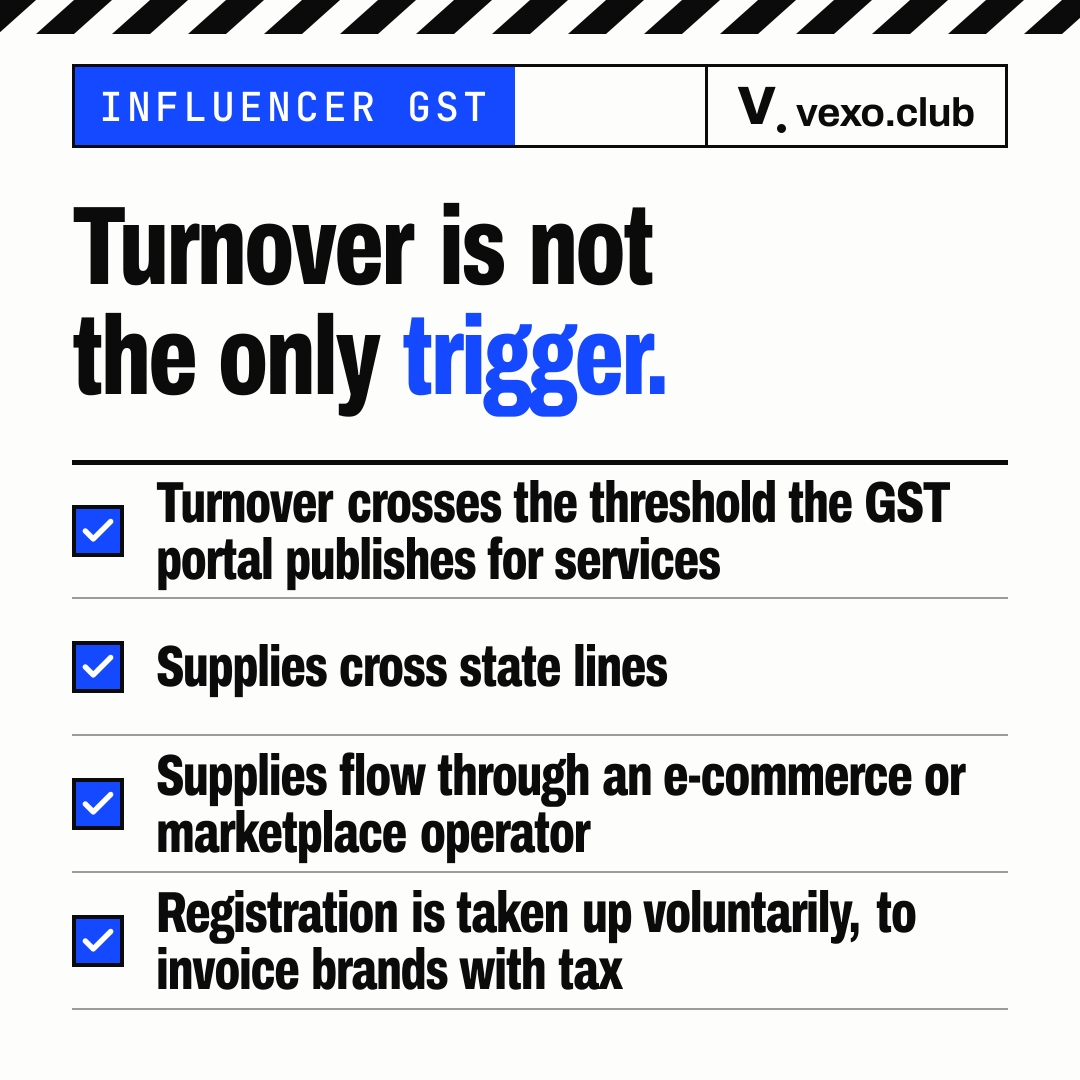
Turnover for this purpose is counted on the creator as a person, across everything they supply under that PAN, not only the brand deals. A creator who also sells merchandise, runs a course, or does consulting on the side adds that turnover to the same total. A brand cannot see a creator’s whole turnover from one invoice, which is one reason the paperwork below matters more than a guess at where a creator sits against the threshold.
Creator type, and what a brand checks before paying
| Registration | Invoice to expect | What the brand records | |
|---|---|---|---|
| Fee-only creator, modest turnover | Depends on the current threshold | Plain bill, or a GST invoice if registered | GSTIN if any, or a note that none applies |
| Fee-only creator, higher turnover or multiple income lines | More likely, ask directly | GST invoice, with tax on its own line | GSTIN, verified against the portal |
| Creator supplying brands across several states | Not on its own: a service supplier within the threshold need not register for billing other states | GST invoice naming the place of supply | The state billed from and billed to |
| Barter-only creator, no cash fee | Ask: value given in kind can still count as a supply | Depends on registration; confirm with the creator | The product’s value and whether tax applies to it |
| Creator paid through an agency | Each party in the chain answers separately | An invoice at each link | The agency’s invoice to the brand and the creator’s to the agency |
Does a barter collaboration count toward GST at all?
A product a creator receives in exchange for a post is consideration, and GST is a tax on supply against consideration, whether the consideration is cash or in kind. The same transaction that barter collaborations and their paperwork treats as a benefit for TDS purposes can also be a supply for GST purposes, counted toward the creator’s turnover, with its own valuation and documentation questions. The two taxes are asking different things about the same parcel, which is exactly why a contract needs both lines, not one.
What does a GST invoice from a creator need to show?
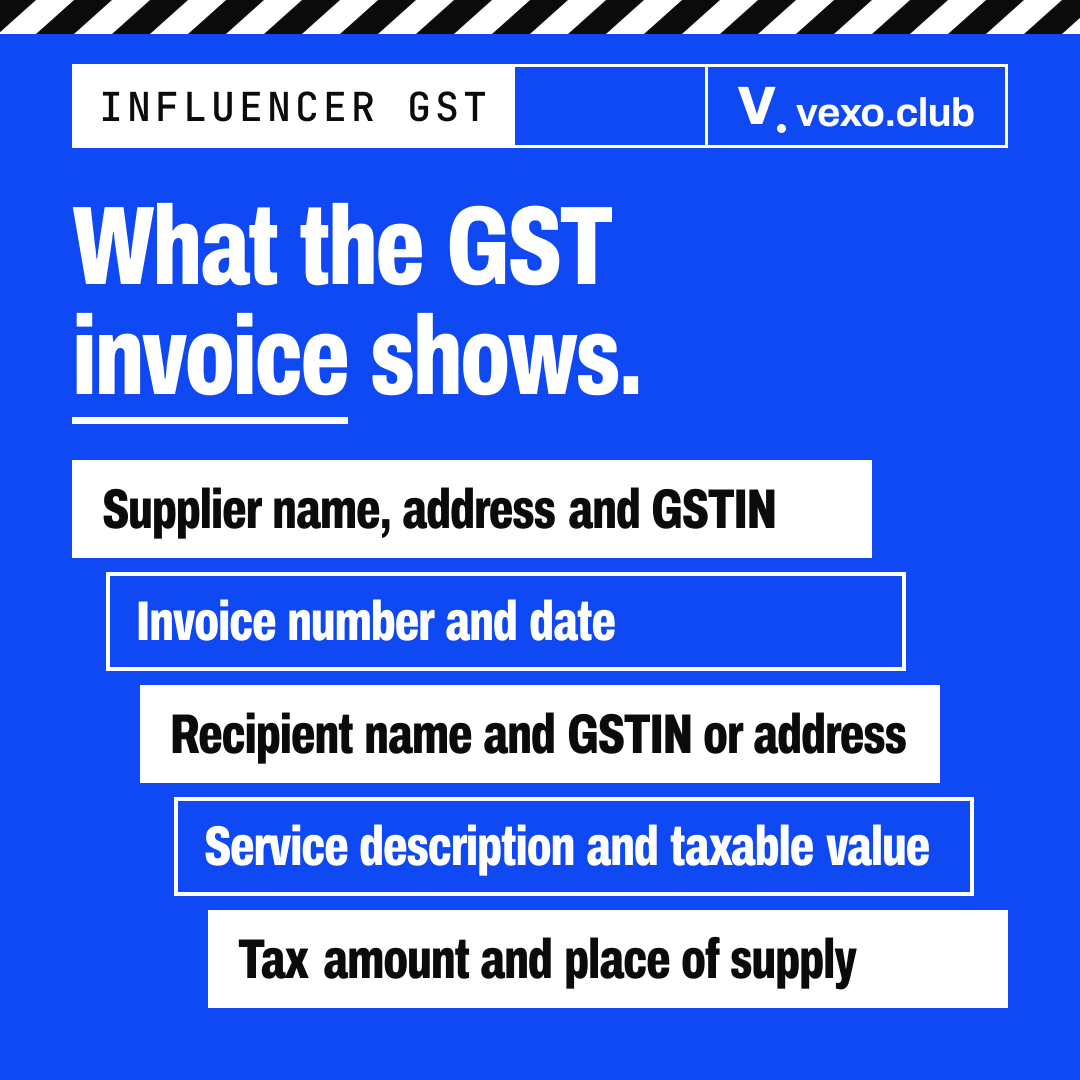
A registered creator issuing a tax invoice is not free to format it however they like. Rule 46 of the CGST Rules sets the particulars a tax invoice carries: the supplier’s name, address and GSTIN; a serial number unique for the financial year; the date of issue; the recipient’s name, address and GSTIN where registered; the HSN code and a description of the service; the total and taxable value; the rate and amount of tax, broken out by head; the place of supply, with the state’s name, for an inter-state supply; whether the tax is payable on reverse charge; and a signature or digital signature (Rule 46 text, summarised in CBIC’s own tax-invoice note). A creator below the threshold and not registered issues a bill, not a GST invoice, and charges no tax on it.
The lines a GST-registered creator’s invoice carries
Why does the place of supply change which tax applies?
Where the creator and the brand sit in the same state, the tax splits into a central and a state component on the same invoice. Where they sit in different states, a single integrated tax applies instead. Nothing about the total changes the brand’s bottom line by design, but the invoice has to carry the right head for the brand’s own filing to match it, which is one more reason the place of supply is one of Rule 46’s named particulars rather than an afterthought on a creator’s bill.
How does the brand’s input credit actually work?
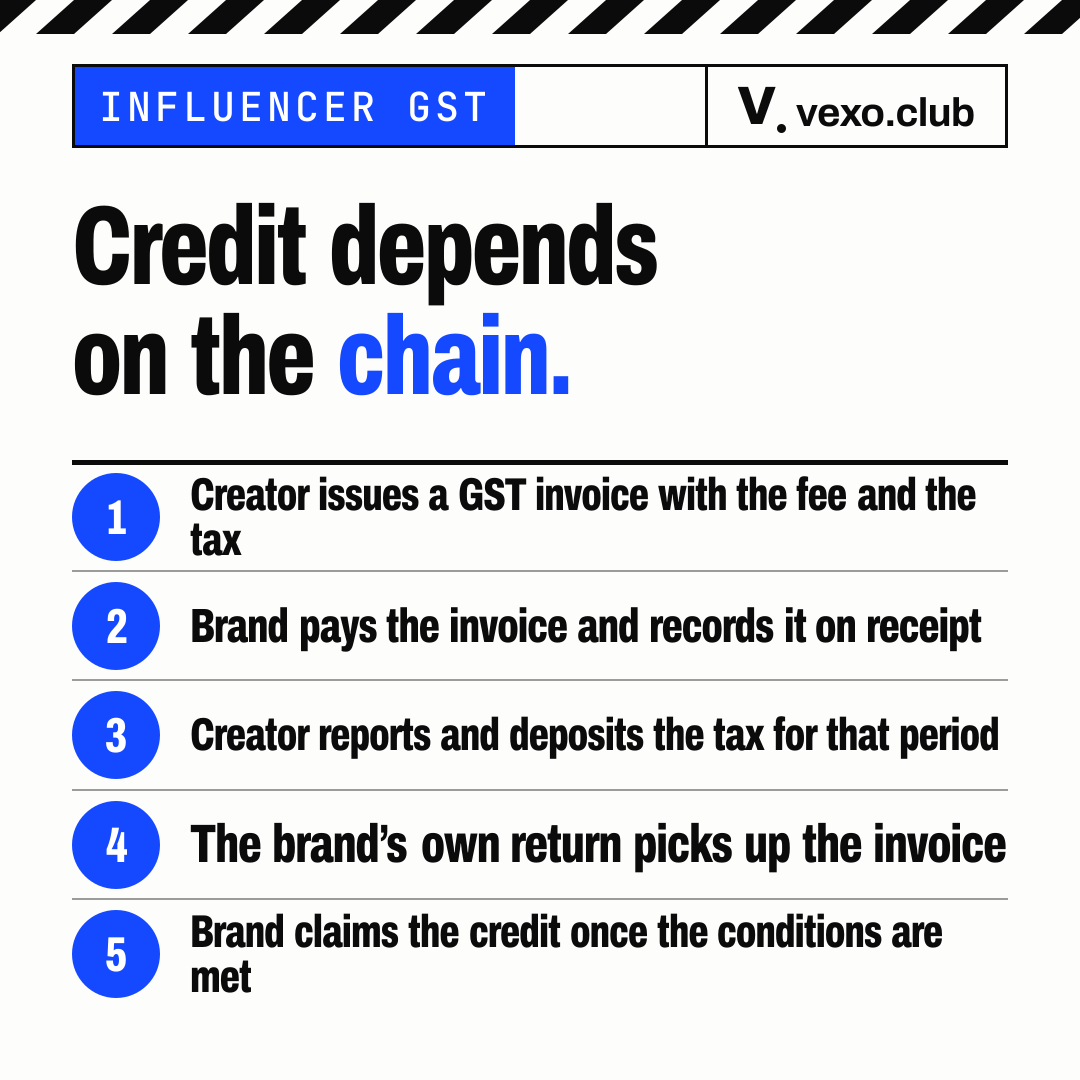
A registered brand that pays GST to a registered creator can, subject to conditions, treat that tax as a credit against the tax it owes on its own supplies. Section 16 of the CGST Act sets the brand’s side of the bargain: the brand must hold a valid tax invoice, the supply must actually have been received, the supplier must have furnished the details so they are reflected back to the recipient, and the brand must have paid the supplier within the time the law allows, among other conditions (Section 16, CBIC, CBIC’s ITC rules, CBIC’s explainer on the credit mechanism). None of that is new to influencer spend specifically; it is the general shape of input credit under GST, applied to a creator’s invoice like any other vendor bill.
The practical point for a brand’s finance team is that the credit is not earned the moment the invoice is paid. It depends on the creator having a valid registration, on the creator actually reporting and depositing the tax for that period, and on that reporting reaching the brand’s own record through the return system. A creator who is unregistered, who has let a registration lapse, or who collects the tax and does not deposit it, leaves the brand holding an invoice that cannot support the credit it priced in. That risk sits with the payer, which is why checking a GSTIN before the first payment is worth the few minutes it takes on the GST portal.
From a creator’s invoice to the brand’s input credit
- Creator raises a tax invoice With Rule 46’s particulars, the fee and the tax on their own lines.
- Brand pays and books the invoice As a supply received for the business.
- Creator reports and deposits the tax For the period the law prescribes.
- The reporting reaches the brand’s record Through the return system, so the brand can see it.
- Brand checks the conditions are met Invoice, receipt, the creator’s reporting, payment within time.
- Brand claims the credit Against the tax it owes on its own supplies.
How a brand’s input credit moves from a creator’s invoice
What changes when an agency sits between the brand and the creator?
The same chain repeats at each link rather than being skipped. The agency charges the brand GST on its own invoice and, if the agency itself paid a registered creator GST on the creator’s fee, the agency may claim that as its own input credit, the way the brand claims credit on the agency’s invoice. A brand paying an agency for creator work is still relying on the agency’s own registration and reporting being in order, the same way it would rely on a creator’s directly, just one link further down the chain.
A registered creator and an unregistered one, on the same brief
Two creators can sit on the same campaign and carry different GST answers, and a brand’s finance team needs the invoice, not the creator’s follower count, to tell the two apart.
Registered creator and unregistered creator, on the same invoice question
| Registered creator | Unregistered creator | |
|---|---|---|
| Issues a GST invoice with tax on its own line | Yes | No |
| Brand can treat the fee as a basis for input credit | depends on the conditions being met | No |
| GSTIN worth checking on the GST portal | Yes | not applicable |
| What the brand files alongside the payment | the GST invoice and proof of payment | the plain bill and the contract |
Before the finance team pays, or claims a credit
A short list, for a creator invoice that is meant to carry GST:
Before paying a creator’s GST invoice, or claiming the credit on it
- Is the creator’s GSTIN valid on the GST portal, and does the name on it match the invoice?
- Does the invoice carry every particular Rule 46 requires, not just a tax amount at the bottom?
- Is the place of supply named, and does the tax split match it?
- Was any product given in kind valued and listed, separately from the cash fee?
- Has the payment to the creator gone out within the time the credit rules allow?
- Does the brand’s own return later reflect this invoice, not just the payment record?
What goes in the creator contract?
A short clause naming who is expected to carry which number, for a GST practitioner to edit before use:
- The Creator confirms their GST registration status as of the date of this agreement and will notify the Brand of any change before the next invoice.
- Where GST applies, it will be shown on the invoice as a separate line from the Fee, with the particulars Rule 46 of the CGST Rules requires.
- The place of supply for this engagement is [state], and the invoice will reflect it.
- Any product given to the Creator under this agreement is listed in Schedule [A] with its value, for GST purposes separately from any TDS treatment.
How a creator’s quote is built, with GST as one line among several, is in what a rate card contains, and the cost drivers behind a brief sit on the cost page. A brief that needs the GST clause written into the creator agreements can be sent to the desk; the registration and credit questions go to a GST practitioner with this page open.
Questions brands ask
Is GST charged on influencer payments in India? For a creator based in India, only where the creator is registered for GST. Registration turns on the current threshold, the kind of supply and the state, plus triggers such as selling goods into other states, not on follower count. An unregistered creator charges no GST and issues a plain bill.
Is GST on influencer payments the same thing as TDS? No. TDS is withheld by the brand from the creator’s income under the Income-tax Act, 2025, covered in TDS on influencer payments in India. GST is charged by the creator on the supply and may be credited by the brand under the CGST and IGST Acts. Both can sit on one invoice, as separate lines answering separate questions.
What does an influencer invoice need for GST in India? If the creator is registered, the invoice needs the particulars Rule 46 of the CGST Rules sets: supplier and recipient details, a serial number and date, the HSN code and a description of the service, the taxable value, the rate and the tax split by head, the place of supply for an inter-state supply, and a signature (CBIC, Rule 46). An invoice missing these is not a tax invoice a brand can rely on for a credit claim, whatever its heading says.
Can a brand claim input credit on a creator’s GST invoice? Yes, where the general conditions for input credit under the CGST Act are met: a valid tax invoice, the service actually received, the creator’s own reporting reaching the brand’s record, and payment made within the time the rules allow. The credit is not automatic on payment alone; it depends on the creator’s own compliance as much as the brand’s paperwork.
Does a barter collaboration carry GST as well as TDS? It can. Value given in kind is consideration, and GST is a tax on supply against consideration, so the same parcel that is a benefit for TDS purposes can also count toward a creator’s GST turnover. Confirm the treatment with a GST practitioner before the product ships.
Does the desk handle GST registration or filing for creators? No. The desk shows a creator’s fee and any GST as separate line items in a brief and writes the GSTIN and invoice requirements into its contracts; registration, invoicing and filing remain the creator’s own compliance, and the brand’s credit claim remains its own.
Sources
- the GST portal (opens in a new tab) gst.gov.in
- Section 24, CGST Act (opens in a new tab) taxinformation.cbic.gov.in
- registration rules (opens in a new tab) taxinformation.cbic.gov.in
- Registration under GST law (opens in a new tab) gstcouncil.gov.in
- Rule 46 text (opens in a new tab) taxinformation.cbic.gov.in
- CBIC’s own tax-invoice note (opens in a new tab) gstcouncil.gov.in
- Section 16, CBIC (opens in a new tab) taxinformation.cbic.gov.in
- CBIC’s ITC rules (opens in a new tab) taxinformation.cbic.gov.in
- CBIC’s explainer on the credit mechanism (opens in a new tab) gstcouncil.gov.in
Cite this page
GST on influencer payments in India: when a creator registers, what the invoice shows, and how a brand claims the credit. vexo.club, published 14 Nov 2026. https://vexo.club/blog/gst-invoicing-for-influencer-payments-india
Send the desk a brief: it comes back as a shortlist and a directional band, never a public price.
Brief the desk