PR or influencer marketing: which one does your brand need
PR earns coverage you cannot script. Influencer marketing buys reach and conversion you can. Here is how to tell which problem your brand has, what each discipline delivers and how it is measured, who owns the relationships, when to run both and how to brief each one.
Benchmarks 21 min read The vexo.club desk
In this article14 sections
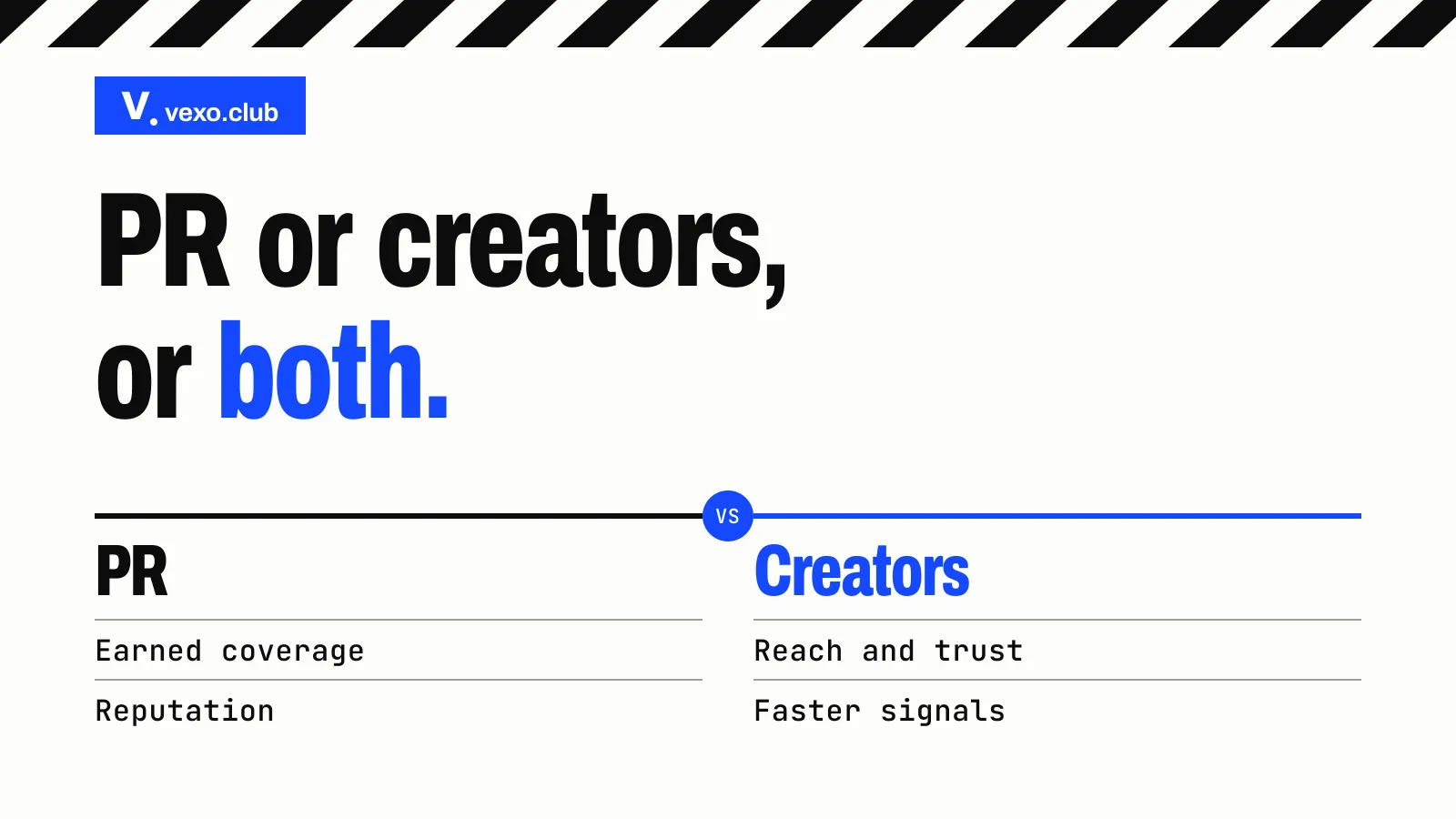
If the people you need to move would buy but do not know you yet, or know you and have not tried you, you need influencer marketing. If the people you need to move do not yet trust you, or are not consumers at all (journalists, investors, retail buyers, future hires), you need PR. Most brands that ask which to hire have a reach problem dressed up as a credibility problem. For them a creator brief is cheaper and faster than a press retainer. The rest of this post sets out the difference in deliverables, KPIs, timelines and relationships, when it is right to run both, and how to brief each so the agency can be judged against something.
What to take from this article
In short
- If people who would buy do not know you or have not tried you, the problem is reach and conversion, and creators answer it. If people who matter do not yet trust you, the problem is credibility, and PR answers it.
- In PR an editor decides what runs and you pay nothing for the space. In influencer marketing you commission a creator, agree a deliverable and a date, and disclose the tie.
- PR is judged on outcomes over months: coverage quality, message pull-through, share of voice. Creators are judged on signals within weeks: views, saves, link taps, redemptions.
- Do not accept an advertising value equivalent as proof of PR value. Do not accept a creator follower total as proof of a campaign.
- Run both when there is real news and a consumer to move. Agree one claims sheet, let the story land first, let creators carry it second, and report each side on its own numbers.
What is the real difference between PR and influencer marketing?
Who decides, and who is paid. In PR you pitch a journalist, an editor or a podcast host. They decide whether to cover you and at what angle. You pay them nothing for the space, which is why readers believe it, and also why you cannot script it or schedule it. In influencer marketing you commission a creator. You agree a format, a date and a price (or a product), you approve the work, and you disclose the tie. You keep control of the message and give up the independence.
That one difference produces the rest. PR gives you borrowed credibility that lasts: an article about you on a trusted site is still there next year when an investor or a buyer searches your name. Creator content gives you a trusted voice with a guaranteed date and a link to a purchase, and the effect fades as the post slips down the feed. A creator cannot make a business editor take you seriously, and a news story cannot be pointed at a sale that ends on Sunday.
PR agency and influencer agency, side by side
| PR agency | Influencer agency | |
|---|---|---|
| The audience it works | Journalists, editors, podcast hosts, analysts, event organisers | Creators and their followers, one creator at a time |
| Who decides what is published | The outlet, never you | You and the creator, through a brief and approvals |
| What is paid for | The agency’s effort and relationships, not the coverage | A creator fee or a product, plus the agency’s own fee |
| What is guaranteed | Pitches sent and reports delivered, not a story running | A post, in a format, on a date, if the contract says so |
| How it is read | Quality of coverage, message pull-through, share of voice, sentiment | Views, saves, link taps, code redemptions, cost per result |
| Where it fits | Credibility, reputation, investors, trade and retail, a crisis | Awareness, trial and sales, a dated launch or festive window |
The two blur at the edges, and the blur is where buyers get confused. Influencer outreach began inside PR departments as gifting to bloggers, and Influencer Intelligence notes that the UK’s CIPR now counts influencer relations as a PR discipline. Paid creator work is transactional and sits outside traditional PR, which is mostly unpaid. So a PR firm may well run creator work, and an influencer agency may well offer PR. What matters is which of the two jobs the vendor is genuinely set up to do.
There is also a vocabulary trap. In creator circles a “PR package” or “PR gifting” means a box of product sent to creators. That is seeding. It is not earned media, and under Indian rules it is not free of strings either. ASCI’s guidelines count free products, including unsolicited ones, as a connection that needs a label when the creator posts, and the guidelines name coverage and media barters in the same sentence.
What ASCI counts as a connection that needs a label
“Material connection could include but is not limited to benefits and incentives, such as monetary or other compensation, free products with or without any conditions attached including those received unsolicited, discounts, gifts, contest and sweepstakes entries, trips or hotel stays, media barters, coverage, awards or any family or employment relationship, etc.”
Advertising Standards Council of India, Guidelines for influencer advertising in digital media,
Source: ascionline.in (PDF)
How much control do you have over each?
Less than you think over PR, and more than you think over a sponsored article. The scale below puts the common formats in order. Notice the labelled sponsored article near the left. If an outlet offers coverage for a fee, you are buying advertising, and it should be labelled and priced as media buying, not counted as PR.
How much of the message you control
You set the message The third party decides
- Paid creator post with a brief and approvals At You set the message
- Labelled sponsored article in a publication This is advertising bought from a publisher, not PR. Leans You set the message
- Gifted product with no deliverable The creator decides whether and how to post. In the middle
- Press event with journalists invited Leans The third party decides
- Pitched news story or founder comment The editor can change the angle or not run it. At The third party decides
Which problem are you actually trying to solve?
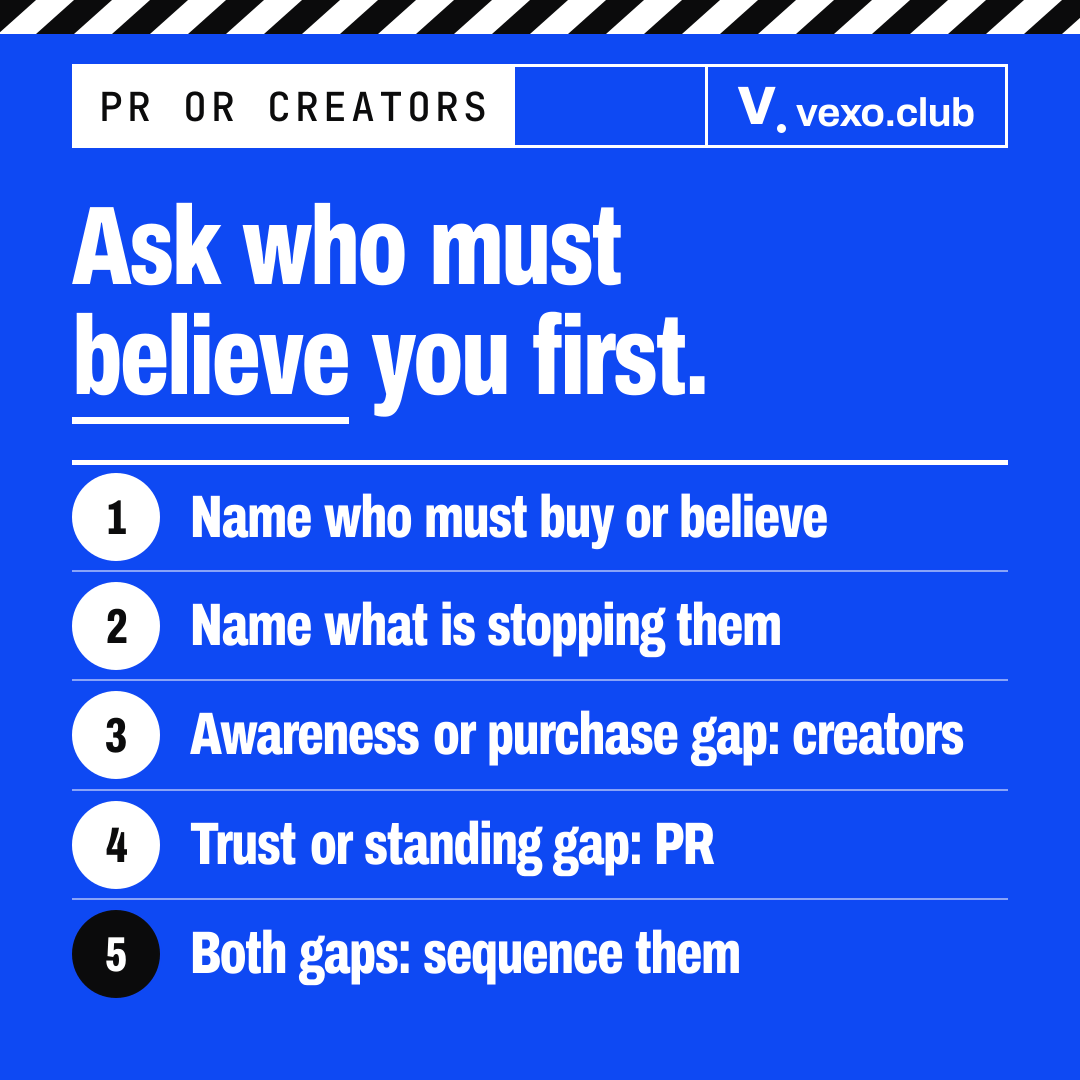
Start from the buyer, not from the service name. Five rules cover most cases.
- If strangers who would buy do not know you exist, or know you and have not tried you: creators. Reach and a path to purchase are what a creator sells.
- If the goal has a date (a festive window, a sale, a launch day) and a post must exist on that day: creators. Only a contract can promise a date.
- If a retailer, a distributor, an investor, a regulator or a hiring pool must take you seriously: PR. Those people read the press and ask peers, not feeds.
- If a search for your brand name shows nothing written by anyone but you: PR. Earned articles are what fill that gap.
- If there is a complaint, a recall or a controversy: comms and PR lead, and scheduled creator posts get paused until you know what you can say. Creators cannot repair a reputation question that is not theirs.
Which discipline to reach for first, by situation
| Creators first | PR first | |
|---|---|---|
| A consumer product launching to people who do not know it | High | Medium |
| A sale or festive window with a fixed date | High | Low |
| A funding round or acquisition to announce | Low | High |
| A retailer or distributor to win over | Medium | High |
| A complaint, recall or controversy to answer | Low | High |
| A founder who needs standing in a trade | Low | High |
| A new language or regional market | High | Medium |
Two illustrative cases. A skincare brand with a new serum, a small team and a launch in two months has a reach and trial problem. Put the money into a seeded shortlist plus a handful of paid creators, and let the founder pitch a few beauty editors and newsletter writers directly with the one real angle the product has. A consumer app approaching a funding announcement has two problems at once: investors and business press need to see the news, and users need a reason to install. Those are two briefs, two budgets and two sets of numbers. Merging them into one campaign is how both get a weak result.
The decision in five steps
What do you actually get from each one?
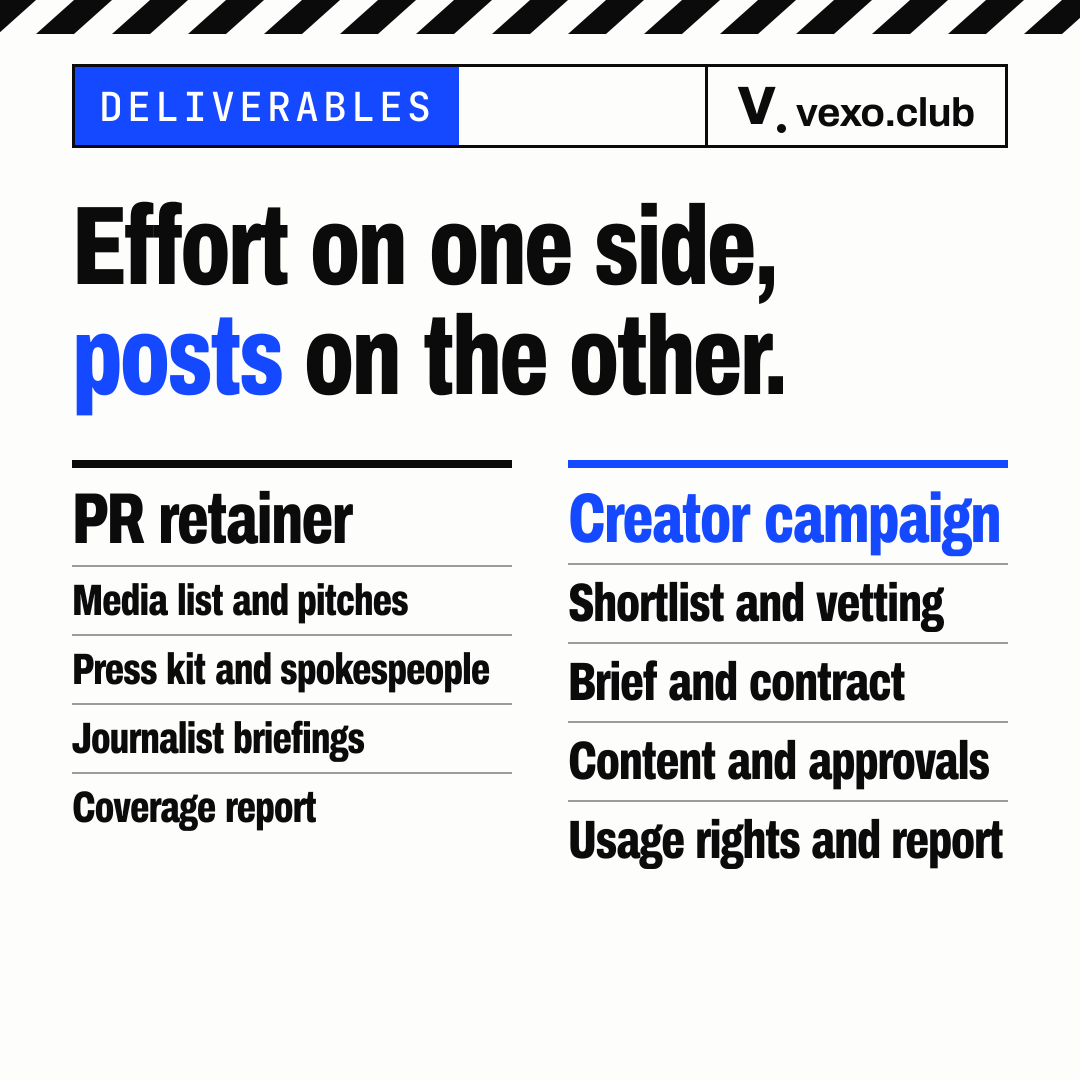
A PR retainer buys effort aimed at editors. The usual outputs are a media list built for your category, a story angle and a press kit, pitches and follow-ups, briefings between your spokespeople and journalists, comment on stories already running, a founder byline or podcast slot where it fits, and a coverage report. A creator campaign buys work you can see: a shortlist that has been checked, a brief, a contract, content that goes through your approval, usage rights where you pay for them, and a results report per creator.
The difference to watch is effort against output. A pitch sent is a PR deliverable. A story published is an outcome, and no honest agency can sell it to you in advance. A creator post is both: the post exists or it does not, on the date or not. So a PR scope must say how many pitches go to whom and what the agency will do when a pitch is ignored, and a creator scope must say format, date, approvals, disclosure and rights.
What each one delivers
How is each one measured?
PR is measured in outputs, outcomes and impact. The PRCA’s agency KPI list.pdf) names the ones worth asking for: share of voice against competitors, message pull-through (how often your key lines appear in the coverage), sentiment, the quality of the outlets that ran you and the ratio of pitches to placements. Creator work is measured closer to the sale: views, saves, shares, link taps, code redemptions and cost per result. Measuring influencer marketing ROI goes through that side.
Watch one number in particular. Advertising value equivalent, sold under names like earned media value, converts a column of coverage into the price of an advert of the same size. The PRCA list still includes earned media value. The measurement body AMEC, in its Barcelona Principles 4.0, says plainly that invalid measures such as AVEs should not be used and that communication should be judged on outcome and impact. It also warns that many PR-driven impacts show up over a long time, not a short one. Ask your agency to report without it. If the report collapses without that number, you have learnt something.
Be honest about attribution too. A creator link or code gives you a trail. A news story rarely does, and any agency promising clean last-click attribution for PR is overselling. Judge PR on a handful of things you agreed in advance: which outlets, which messages, which rivals to beat on share of voice, and whether sales or enquiries moved afterwards in a way you can see even if you cannot prove it.
What to ask each side to report
Do
Ask the PR agency for a coverage list: outlet, date, link, whether the key message ran, and the tone
Don’t
Accept one impressions total with no outlet names behind it
Do
Judge PR on share of voice against named rivals and on message pull-through
Don’t
Judge PR on an advertising value equivalent or earned media value
Do
Ask for creator results per post: views, saves, link taps, code redemptions
Don’t
Report the creators’ follower totals as if they were results
Do
Keep a PR report and a creator report apart, each with its own definitions
Don’t
Add them into one reach figure that no one can check
How long before either shows anything?
Creators show a signal soon after the posts go live. Most of the time goes on what happens before: shortlisting, contracting, shooting, approvals, and the festive calendar if you are booking in October. PR builds slowly. Journalists have to learn that you are a reliable source, and a pitch depends on the news cycle on the day. Practitioners on both sides say consistent coverage takes months, and AMEC’s warning about long time horizons points the same way. The desk cannot point you to a measured benchmark for any of this, so treat it as practitioner consensus.
Two rules follow. If you need a result by a date inside the month, PR cannot promise it and a creator contract can. And if you hire PR, write the review point into the contract before the first invoice: a full quarter of work, judged on the KPIs you agreed. A retainer reviewed at the end of week six will look like a failure and may be one, but you will not know which.
Who owns the relationships, and what happens when the person leaves?
In PR the relationships are personal. They sit with the account lead and the two or three people who actually pitch, not with the logo on the pitch deck. Ask who will pitch your story, which journalists in your category they have worked with, and whether the senior person in the meeting stays on the account. You own the press kit, your statements and the coverage record. The agency’s media list is generally theirs, so do not expect to take it with you. Check for conflicts too: an agency that also represents a direct competitor will either pitch you both the same editor or hold something back.
In influencer work the relationship can sit with the creator, with a manager, or with the agency’s roster. That matters because an agency that earns from the creators it recommends has a reason to recommend them. Ask how it is paid, who signs the creator contract (you or the agency), who holds the raw files, and who holds usage rights and for how long. Influencer agency fee models and usage rights cover those clauses.
When one vendor claims both, find out which it is built for. A PR firm with an influencer desk usually means gifting, events and creators attending launches. That suits awareness and goodwill, and it does not suit a dated conversion deliverable. An influencer shop with a PR offer often means sponsored articles, which as above is advertising. Ask these verbatim:
- Which journalists or outlets have covered your last three clients in my category, and who pitched them?
- What do you do when a pitch is ignored, and what do you report?
- Do you ever pay or offer a fee for a placement, and would you tell me before you did?
- Who contracts the creators, and are you paid by me, by the creator, or both?
- Who in your team is on the account every week, and who leaves the account if they leave you?
- Which of my competitors do you or your creators work with right now?
When should a brand run both, and in what order?
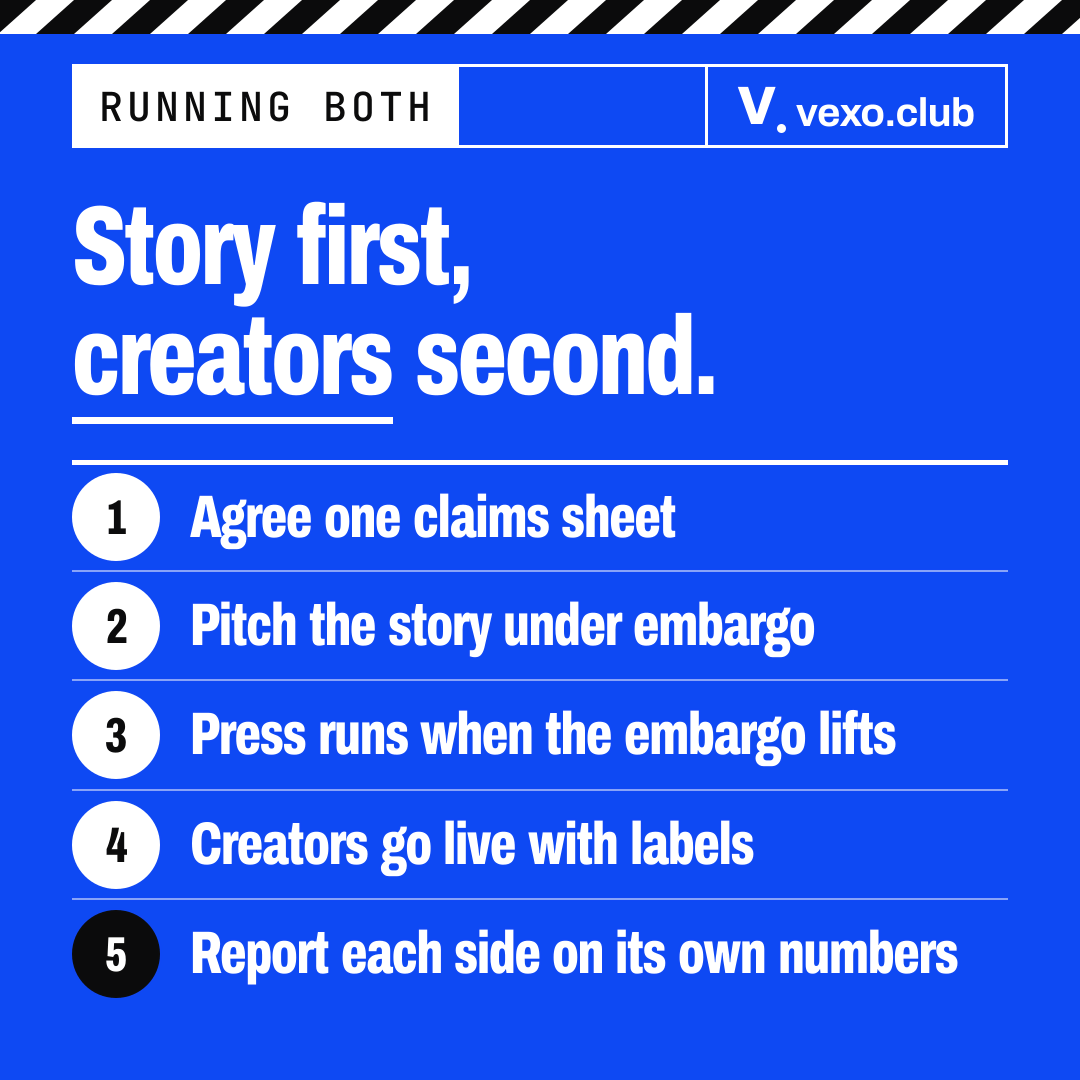
Run both when there is real news and a consumer to move: a launch with a story behind it, a first of its kind, a funding event with an app behind it. The order matters. Agree a claims sheet first, one page listing what you can say about the product and the proof for each line, because journalists and creators who hear different versions of the story will print different ones. Pitch the story to journalists under an embargo. Brief creators to go live after it lifts, so no creator pre-empts the exclusive you offered an editor. Then amplify: creators carry it to consumers, and where you have bought usage rights the best posts can run as ads (creator whitelisting explains how).
Keep the paperwork separate. Everything a creator posts under a connection needs a label, and you are answerable for it as the advertiser. ASCI’s influencer guidelines put disclosure on both advertiser and influencer, and the Department of Consumer Affairs’ endorsement know-hows warn that non-disclosure can attract action under the Consumer Protection Act, 2019. The 2022 CCPA guidelines also allow an endorser of a misleading advertisement to be barred from endorsing for a period. ASCI disclosure rules for brands has the practical version. ASCI’s rules are written for influencer advertising. How a journalist treats a free sample is up to the publication’s own policy, so send nothing with strings attached and ask the outlet if unsure.
If a creator controversy hits during a joint campaign, the morality clause playbook covers the creator side. The PR side is to have one named person at the brand who speaks for it, and one holding statement drafted before it is needed.
The order for running PR and creators together
When the right answer is neither
Before product proof, a PR retainer pays someone to send press releases that no one runs. If you have no real news, the agency will manufacture some, and editors can tell. If your product is out of stock, your landing page does not convert or your support is slow, creators will send people to a leak. In both cases hold the retainer.
Cheaper first steps work. A founder can send a short, specific email to a few journalists who cover the category, naming the news in the first line and offering a sample or an interview. On the creator side, a small seeding programme run by you tells you which niches and formats respond before you pay anyone. Hire an agency when the volume or the stakes have passed what you can handle between other jobs.
How do you brief a PR agency?
Give it the news, the audience and the limits, and the KPIs before the proposal rather than after. A paste-ready version: “We are [brand], a [category] company. The news is [one sentence of actual news]. The people who need to believe it are [named audience: retail buyers, a trade, investors, shoppers in a region]. Proof we can show is [documents, data, people]. Spokespeople are [names] and are available [days]. Outlets we read and respect, by type, are [list]. Topics off limits are [list]. We want a monthly report listing every piece of coverage with outlet, date, link, whether our key message ran and the tone, plus share of voice against [named rivals]. We do not accept any paid placement unless we have approved it in writing, and anything paid must be labelled as advertising.”
How do you brief the creator side?
Different brief, different job: a goal, a date and a deliverable. “Goal: [one of trial, sales, installs] by [date]. Audience: [who, where, which language]. Deliverables: [format, count, platform]. What the creator may and may not claim: [list, with proof]. Disclosure: each post carries the platform’s paid partnership tag and a clear ‘Ad’ label in the language of the post. Usage rights: [where, how long, paid or not]. Approval: [who, how many rounds, turnaround]. Tracking: a unique link or code per creator. Report: per creator and per post, views, saves, link taps and redemptions.” How to brief an influencer marketing agency takes this further.
What does each cost, and how is it billed?
This post leaves out rupee figures on purpose: they depend on the category, the city and the team, and published ranges mostly come from vendors. What you can compare is the shape. One Indian PR firm’s pricing explainer (Public Media Solution, read 24 October 2026) describes three models: a monthly retainer for ongoing visibility, a project fee for a launch or announcement, and a performance model tied to agreed outcomes. A project is a clean way to test an agency before a retainer. A performance fee works only if the outcome is defined precisely. The same page lists the lines that surprise buyers: paid distribution or wire fees on top, content production billed separately, out-of-scope crisis work, and junior people doing the work while senior names sit on the pitch.
Creator work bills as a fee per deliverable, plus usage rights, plus the agency’s own fee under whichever model it uses. Both kinds of vendor invoice with GST, and the TDS treatment of a PR retainer and a creator payment may not be the same, so ask your CA before the first payment. TDS on influencer payments covers the creator side.
What to do this week
You can settle the question without a pitch meeting. Work through the list, then decide.
What to do this week
- Write one sentence naming who must believe or buy, and what is stopping them
- Check whether you have real news: a launch, a funding event, a first, a study, a person with a story
- List the three outlets or newsletters your buyer or investor reads and see whether any journalist there has covered your category
- Write one goal for a creator campaign: trial, sales or installs, with a date
- Draft the claims sheet: what you can say about the product, with the proof for each line
- Decide whose budget each discipline sits on and who at the brand owns the decision
- Ask each shortlisted agency the verbatim questions in this post before a pitch meeting
Questions brands ask
Is influencer marketing a type of PR? Partly. Influencer outreach began inside PR as gifting to bloggers, and some bodies now count influencer relations as a PR discipline. Paid creator campaigns are a commercial arrangement with a fee, a deliverable and a disclosure. That is closer to advertising than to earned media.
Can a PR agency run influencer campaigns? Yes, if it has a creator team that contracts, briefs and tracks. A PR firm that only gifts products and invites creators to events is doing seeding, which is not the same as a dated paid deliverable. Ask who signs the creator contract and what the report shows per post.
Can influencer marketing replace PR for a consumer brand? For awareness and sales, often. For credibility with journalists, investors, retailers and recruits, no. A creator cannot give you an editor’s independent decision to cover you. If those audiences do not matter yet, you can leave PR for later.
Which should a new D2C brand start with on a small budget? Usually creators, starting with seeding and a few paid posts, because they give a signal and usable content quickly. Add a few direct emails to journalists if you have real news. Move to a PR retainer when you have a story that repeats, a retailer to win or an investor conversation coming.
How long does PR take to show results compared with influencer marketing? Creator posts show signals soon after going live, though booking and approvals take weeks before that. PR usually takes months to build coverage. This is practitioner consensus, not a measured benchmark, so set the review point in the contract.
Can a PR agency guarantee coverage? Not honestly. The outlet decides. An agency that guarantees a story running is usually selling a paid placement, which should be labelled as advertising and priced as media. Ask what it will do when a pitch is ignored.
Do I have to disclose when I send a free product to a journalist or a creator? For creators, ASCI counts free products, including unsolicited ones, as a material connection that needs a label if they post about the product. The guidelines were written for influencer advertising. A journalist’s handling of a free sample is governed by their publication’s policy, so ask the outlet and do not attach conditions.
Should I measure PR by earned media value? AMEC’s Barcelona Principles 4.0 say advertising value equivalents are invalid and should not be used. Ask for outlet-by-outlet coverage, message pull-through, sentiment and share of voice against named rivals, and judge on outcomes over a period you set at the start.
vexo.club is an influencer-marketing desk in Delhi NCR. If the answer above is creators, the contact page takes a brief with the goal, the market and the date. If the answer is PR, take the questions above to your PR shortlist.
Sources
- Influencer Intelligence notes (opens in a new tab) influencerintelligence.com
- Advertising Standards Council of India, Guidelines for influencer advertising in digital media (opens in a new tab) ascionline.in
- agency KPI list (opens in a new tab) prca.global
- endorsement know-hows (opens in a new tab) consumeraffairs.gov.in
- 2022 CCPA guidelines (opens in a new tab) pib.gov.in
Cite this page
PR or influencer marketing: which one does your brand need. vexo.club, published 22 Nov 2026. https://vexo.club/blog/influencer-marketing-agency-vs-pr-agency-who-to-hire
Send the desk a brief: it comes back as a shortlist and a directional band, never a public price.
Brief the desk