Exclusive or non-exclusive: when a creator exclusivity clause earns its premium
An exclusive influencer partnership costs more than the line on the invoice — it narrows the roster and bets a campaign on one creator. A decision framework for when a creator exclusivity clause in India is worth paying for, by campaign goal and by brand maturity.
Playbooks 12 min read The vexo.club desk
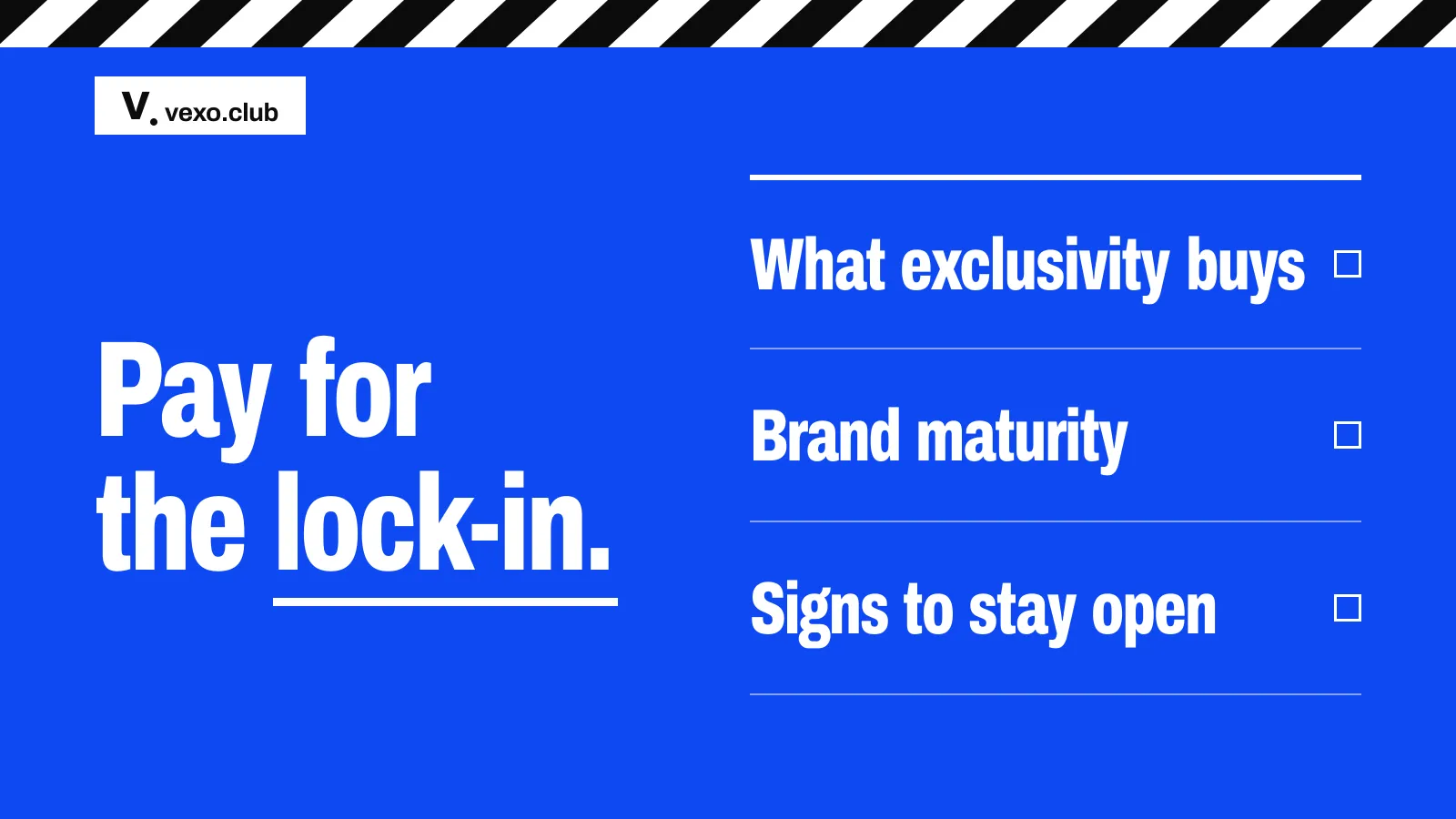
In this article8 sections
A brief that asks for an exclusive influencer partnership is really asking two questions at once: how much is a closed category worth, and who is the brand willing to bet that value on. The paperwork for a category-exclusivity clause looks the same whichever answer a brand reaches — a named category, a start date, an end date, a fee tied to the lockout. What differs is whether the premium is worth paying at all, and that turns on the campaign’s goal and on how settled the brand already is in its category, not on a clause template.
This is a decision framework, not a case for or against exclusivity. The contract clauses that change the price and influencer contract red flags cover what a lockout clause should say and where a badly written one goes wrong; this is the question that comes before either one — whether to ask for exclusivity at all, and what it should buy back for the premium attached to it.
Exclusive or non-exclusive, in short
- A creator exclusivity clause is a cost decision before it is a legal one — it buys a closed category and a head start, and it costs a narrower shortlist and a slower negotiation.
- The premium earns its keep on a launch or an always-on, category-defining push. It earns less on a one-off campaign or a seeding model built on volume.
- Brand maturity changes what exclusivity can justify. An unproven category fit is a reason to spread the bet across a shortlist, not narrow it to one creator.
- A category named narrowly, with a dated window and a reviewed renewal, is cheaper to walk away from than an open-ended lockout.
What exclusivity actually buys
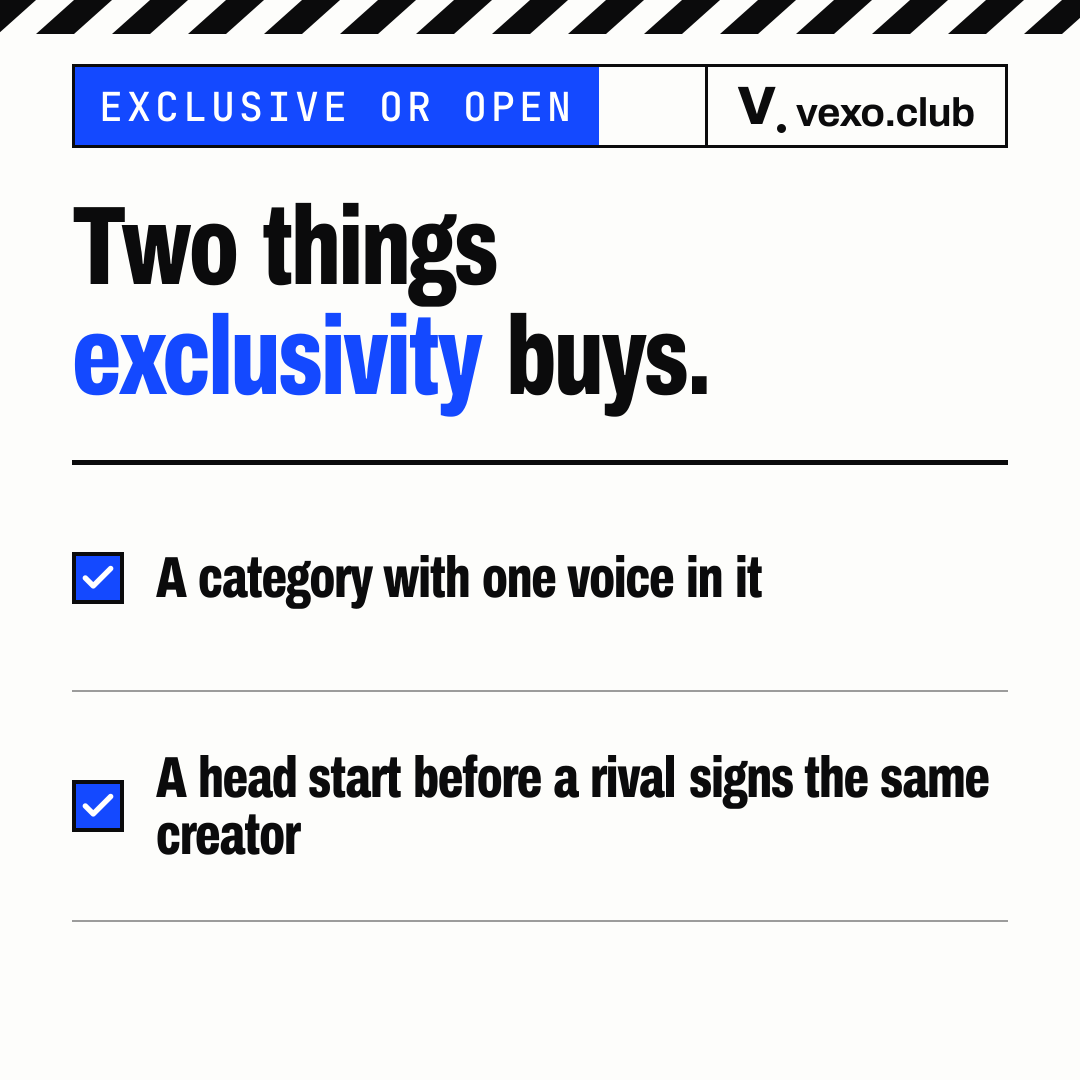
A category-exclusivity clause buys two things, and only two. The first is a closed category: for the window agreed, no competing brand appears in that creator’s feed, so a campaign is not sitting next to a rival’s post on the same handle a few weeks later. The second is a head start — signing the obvious name in a category before a competitor gets the chance to.
Two things an exclusive creator deal buys
Nothing else is included by default. Exclusivity does not buy more effort on the brief, a better rate on deliverables, or protection against the creator underperforming — those are separate lines, negotiated separately whether the deal is exclusive or not. A brand that asks for exclusivity expecting it to also fix an uncertain creative brief is paying a premium for the wrong problem.
What it costs beyond the fee
The fee on an exclusive deal is the visible cost. The ones that show up later are the ones that decide whether the clause was worth it: a shortlist that narrows to whoever is willing to give up other brands in the category, a negotiation that runs longer because exclusivity is a term both sides have to price rather than simply agree to, and a single point of failure if the one creator the brand committed to underperforms or exits mid-campaign. None of this argues against exclusivity. It is a reason to know what else the premium is paying for before agreeing to it.
What an exclusive creator clause costs beyond the fee
What it buys
- A category with one voice in it No rival brand in the same feed for the window agreed
- A creator with a stake in the result The exclusivity fee is also a bet on how well the push lands
- A cleaner story for the brand’s own audience One face, one narrative, no split loyalty to explain
What it asks
- A narrower shortlist Fewer creators will give up other brands in the category for one deal
- A slower negotiation Exclusivity is a term both sides have to price, not just accept
- A single point of failure If the creator exits early, there is no second voice already in motion
- Diligence the fee does not cover Someone still has to check the creator is not already contracted to a competitor
Verdict The premium buys a closed category and a creator with a stake in the result. It asks for a narrower pool, a longer negotiation and a bet on one voice instead of several.
By campaign goal: when the premium earns its keep
A launch, or a push meant to own a category, benefits most from exclusivity, because what the clause buys — a closed category, a head start — matters most when a brand is trying to be first and only in a customer’s mind. An always-on programme built to define a category the same way works for the same reason, stretched over a longer window. A one-off campaign, a seasonal push, or a programme built on seeding across many creators gets less from the same clause: a closed category matters less when the campaign does not depend on owning the category, and a seeding or affiliate model that works by volume pulls directly against a narrowing roster.
Exclusive and non-exclusive, by what a campaign needs
| Exclusive | Non-exclusive | |
|---|---|---|
| Best campaign stage | A launch or a category-defining push | Awareness, seeding or a performance push |
| Creator pool | Narrows to whoever will sign the lockout | Stays open to the full shortlist |
| Bargaining power | Sits with the creator, who is giving something up | Stays closer to even |
| Competitor risk | Closed for the window agreed | A rival can sign the same face next week |
| Time to get to market | Slower — fewer creators will agree to it | Faster — most will take the brief as is |
| Fit for a seeding or affiliate model | Poor — exclusivity and volume pull against each other | Good — many creators, no lockout to negotiate |
| Best for | A brand that needs one face owning a category | A brand that needs reach across many creators |
The table is a starting read, not an answer on its own. A brand running several decisions like this at once — a seeding programme in one tier and a flagship launch in another — can run both at the same time: exclusive where the campaign calls for it, open everywhere else. Running a micro-influencer seeding programme and allocating a budget by goal both assume a roster that stays open by default.
By brand maturity: how much to lock in
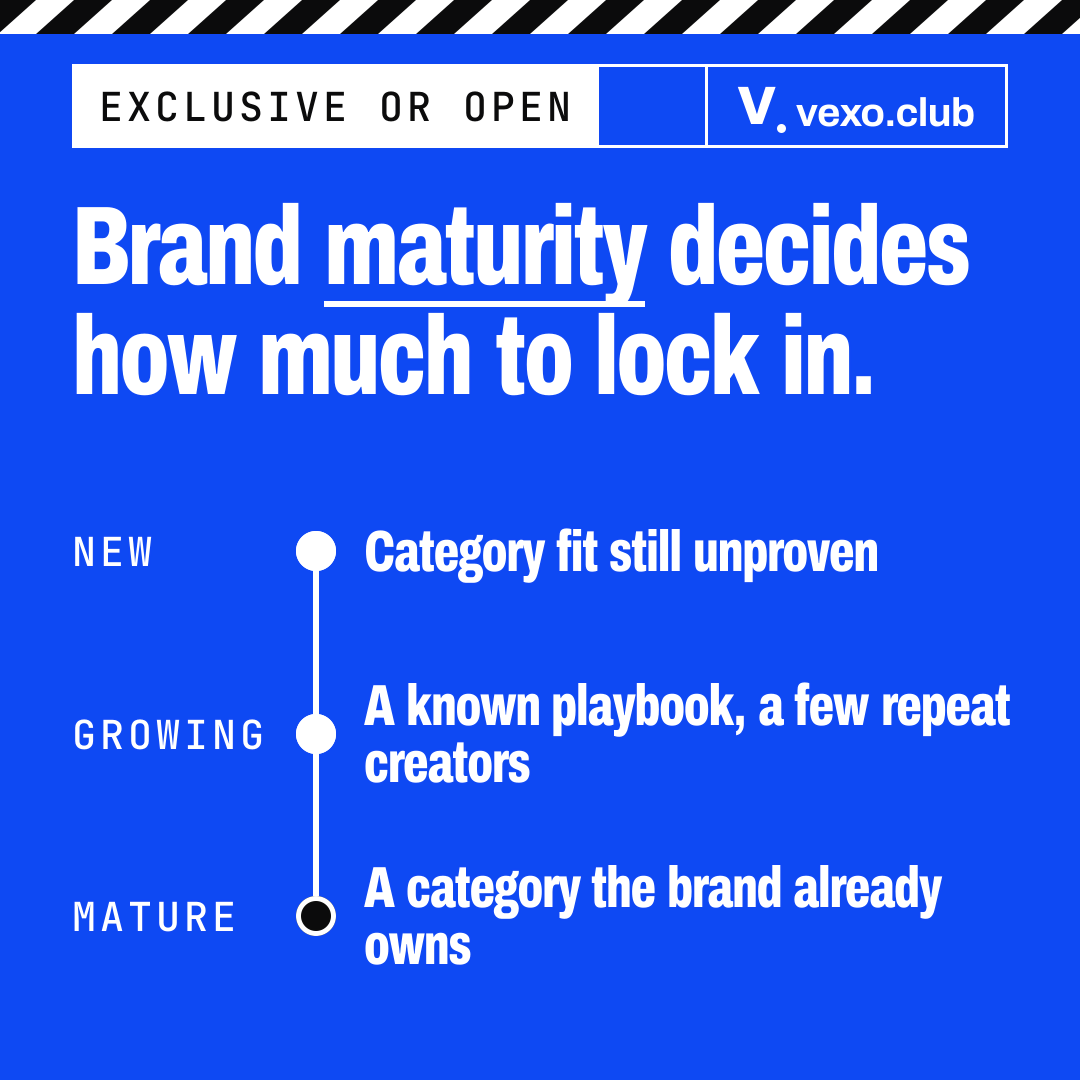
The same campaign goal reads differently depending on how settled the brand already is in its category. A new entrant with no track record is betting the exclusivity fee on a category fit it has not yet proven — if the product does not land with that creator’s audience, the brand has also spent the premium on a lockout nobody else could have used either. A brand with a known playbook and a few creators who already work well for it has less uncertainty to price into the same bet. An established brand that already owns its category in the customer’s mind often gets less marginal value from exclusivity than a brand still trying to get there, because the category was never really in contest to begin with.
How brand maturity changes the exclusivity decision
None of this scales neatly with company size. A funded new entrant can afford to test a category-defining bet and absorb the loss if it does not land; an established brand entering an adjacent category is, for that category, a new entrant again, and should price the exclusivity decision the same way.
Where goal and maturity meet
Putting the two axes together narrows the decision instead of answering it outright. An always-on, category-defining push from an established brand is where the premium earns the most — one face, no rival in the same feed, for as long as the category stays worth owning. The same push attempted by a new entrant still testing its fit is worth structuring narrower rather than skipping entirely: a smaller category, a shorter window, a decision to renew only once the push proves out. A one-off campaign from an established brand rarely needs the clause at all, since the brand already holds the ground exclusivity would otherwise buy. And a new entrant running a one-off campaign is the clearest case for staying open — there is no settled category to defend yet, and the budget is better spread across a shortlist than staked on one creator.
Where the premium is worth paying
Exclusivity is optional
An established brand with a known category fit, A one-off or seasonal campaign
- The brand already owns the category without it
- Save the fee for the next always-on push
Exclusivity earns its premium
An established brand with a known category fit, An always-on, category-defining push
- One face, no rival in the same feed
- Worth the narrower pool and the slower sign
Stay non-exclusive
A new entrant, category fit still unproven, A one-off or seasonal campaign
- Too early to bet a budget on one creator
- Spread the risk across a shortlist
A narrow, time-boxed exclusivity
A new entrant, category fit still unproven, An always-on, category-defining push
- Lock the category, not the whole relationship
- Review the window once the push proves out
Across A one-off or seasonal campaign An always-on, category-defining push
Up A new entrant, category fit still unproven An established brand with a known category fit
Structuring exclusivity so it does not overpay
Once the decision is to pay for exclusivity, the clause itself decides how much of the premium is well spent. A category named narrowly — the product line, not the industry it sits in — costs less and is easier for a creator to agree to than a blanket lockout across a whole sector. A dated window, with a start and an end written down rather than left to run with “the relationship,” is cheaper to walk away from if the campaign does not perform. And a fee that scales with the reach actually being locked out keeps a brand from paying a category-defining price for a creator whose audience does not justify it.
Structuring exclusivity so it does not overpay
Do
Name the category narrowly — the product line, not the industry
Don’t
Lock out a whole industry for one product’s campaign
Do
Put a start date and an end date on the window
Don’t
Leave the window open-ended or tied to “the relationship”
Do
Scale the fee to the reach actually being locked out
Don’t
Pay the same premium for a nano creator as for the category’s biggest name
Do
Review the window once the campaign proves out
Don’t
Renew by default because cancelling feels like a step backward
Four signs to stay non-exclusive
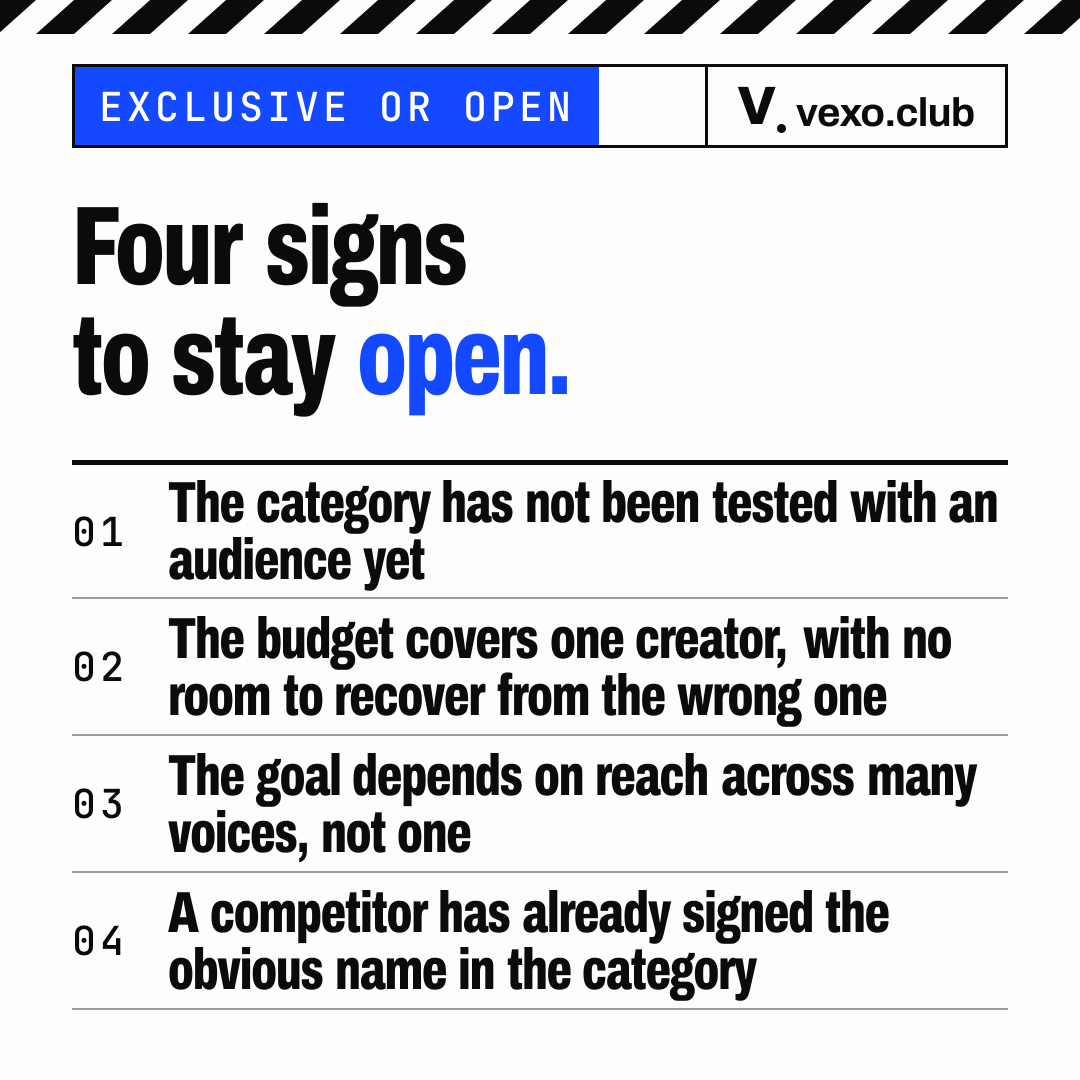
Some briefs ask for exclusivity out of habit rather than need. A category that has not been tested with a creator’s audience yet, a budget sized for one creator with no room to recover if that creator turns out wrong, a goal that depends on reach across many voices rather than one, or a competitor that has already signed the obvious name in the category — each of these is a reason to keep the roster open rather than negotiate a lockout the campaign does not need.
Four signs a brand should stay non-exclusive
A brief still deciding between the two can be sent to the desk with the campaign’s goal and where the brand sits in its category — the exclusivity decision follows from both, not from the clause on its own.
Questions brands ask
Is an exclusive influencer partnership always more expensive than a non-exclusive one? In the fee, yes — the creator is giving up other income in the category for the window agreed, and a fair rate prices that in. What varies is whether the campaign gets back enough value from the closed category to justify the difference, not whether the fee itself is higher.
What makes a creator exclusivity clause in India enforceable? Specificity first: a category defined narrowly, a start date and an end date, and a fee attached to the right being given up. Indian law adds a limit drafting cannot fix: Section 27 of the Indian Contract Act, 1872 makes an agreement that restrains anyone from exercising a lawful profession, trade or business void to that extent, so keep the lockout inside the contract’s own term. The contract clauses that change the price covers how to write the clause itself. This is a practical framework, not legal advice — a brand or a creator should have counsel read the actual agreement.
Can a brand ask for exclusivity without paying extra for it? It can ask. Most creators who already have standing in a category will decline, or will price the request in anyway, because exclusivity is lost income on other brands in the same space. A brief that wants exclusivity at a non-exclusive rate is asking the creator to absorb the cost instead of the brand.
Does exclusivity make sense for a seeding or micro-influencer programme? Rarely. A seeding model works by spreading product and a brief across many creators, and a lockout on any one of them narrows the roster for a goal that depends on volume rather than on one voice. Running a micro-influencer seeding programme assumes the roster stays open.
Should an established brand still ask for exclusivity in a category it already owns? Less often than a brand still building its position in that category. Exclusivity buys a closed category and a head start, and an established brand often already has the second without paying for the first. It makes most sense there for an always-on relationship the brand wants to keep from drifting to a competitor, not as a default term on every brief.
Cite this page
Exclusive or non-exclusive: when a creator exclusivity clause earns its premium. vexo.club, published 08 Nov 2026. https://vexo.club/blog/exclusive-vs-non-exclusive-creator-partnerships
Send the desk a brief: it comes back as a shortlist and a directional band, never a public price.
Brief the desk