How to read an agency proposal for influencer marketing: a scorecard, the lines that end the meeting, and how fees should be shown
A scorecard for an influencer marketing agency proposal: the lines that should be there, the lines that end the meeting, and how fees are shown. Twelve lines to find, six to stop at, and an RFP list to send as written.
Pricing Updated 16 min read The operators’ desk
In this article9 sections
Read an agency proposal for influencer marketing line by line, not slide by slide. It should name the operator who will run the brief, show creator fees and the agency’s fee separately, and say who checks the paid label and how results are measured. Score every proposal on the same twelve lines. Six more should end the meeting.
This guide comes from vexo.club, an influencer marketing agency run from one desk in Delhi NCR, which may be one of the agencies you are comparing, so it is written to be used on the desk’s own proposal as much as on anyone else’s. It names no other agency and ranks none. Each outside source is linked and dated.
Reading a proposal, in short
- A proposal is a document to score, not a pitch to admire: twelve lines to find on the page, and six that should end the meeting.
- Fees belong on separate lines: each creator at the creator’s own quote, the agency’s fee, production, paid media, and usage with any exclusivity. One blended number hides what a creator is paid.
- Before scoring, ask for the master services agreement, a sample weekly report, one creator’s audience export and the name of the person who will run the brief.
- Use the same lines, in the same order, with the same weights for every agency, including the one you already know and the desk that wrote this guide.
What should an influencer marketing agency proposal contain?
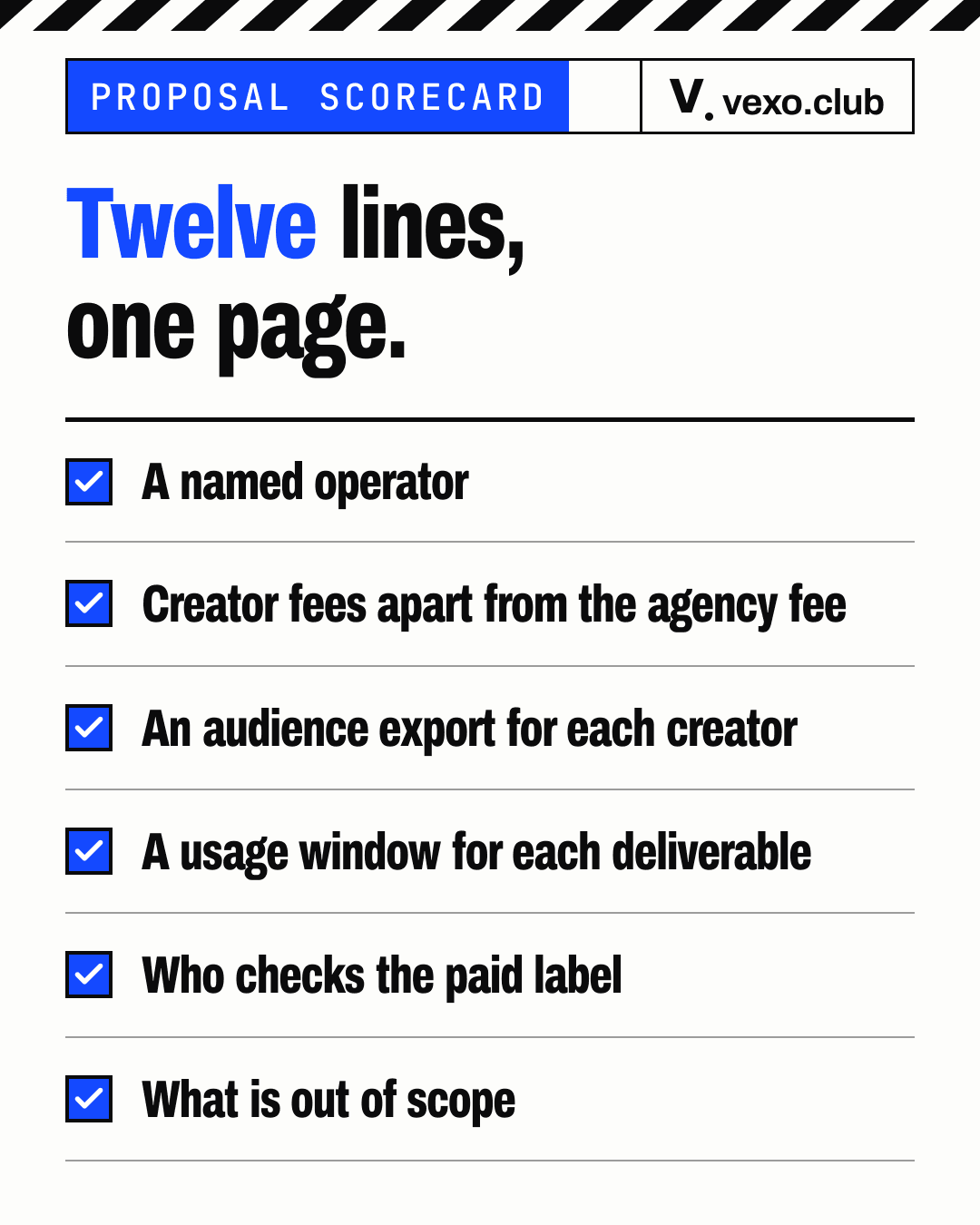
Twelve lines you can point to on a page: who runs the brief, creator fees apart from the agency’s, audience data, usage, the paid label, drop-outs, creator payment, the report, attribution, exclusivity, exit terms and what is out of scope. A missing line is a question to put to the agency in writing, not a gap to fill with trust. Each, with what to look for:
- A named operator. Who runs the brief, and how many briefs that person runs at once.
- Creator fees apart from the agency fee. Each creator at their own quote, the agency’s fee on its own line.
- An audience export for each creator. Their own platform insights, read before a rate is agreed.
- A usage window for each deliverable. Platforms, dates, and whether it may run as an ad.
- Who checks the paid label. A named checker, on the draft and again once the post is live.
- What happens when a creator drops out. A replacement, a refund or a new date, in writing.
- When creators are paid. The term in days, and what starts the clock.
- The report and when it arrives. The columns, the day, and a sample with the numbers removed.
- The attribution method. A tracked link, creator code, whitelisted ad or survey, agreed before launch.
- Exclusivity. The category, the dates and its fee, as its own line.
- Exit terms. Notice, what happens to the content and its rights, and the final report.
- What is out of scope. Production, ad spend, extra revisions and travel, and who pays for each.
Before scoring the lines, read how much of the work the proposal commits to: finding creators, contracting them, getting the content made and posted, and reporting. “End-to-end” on a cover slide can mean any position below. Whether a brand needs an agency at all is the question in influencer marketing platform or agency.
How much of the work a proposal commits to
Discovery only Accountable for the four jobs
- A list of creators and their rates At Discovery only
- A list and the contracts Leans Discovery only
- Contracts, briefing and posting Reporting is still the brand’s Leans Accountable for the four jobs
- Finding, contracting, making and posting, and a report against the objective At Accountable for the four jobs
The label line is the advertiser’s risk as well as the creator’s. ASCI’s Guidelines for Influencer Advertising in Digital Media (guideline 1.5) say responsibility for disclosure and for the content of the advertisement “is upon the Advertiser for whose product or service the advertisement is, and also upon the Influencer”. ASCI’s half-yearly complaints report for April to September 2025, uploaded in November 2025, says 76% of Forbes India’s “Top 100 Digital Stars 2024” list failed to meet disclosure norms, against 69% the previous year, in posts “published between March 1, 2025 till July 15, 2025”. Both were read in October 2026.
“Compliance handled” does not say who looks, or when; ASCI disclosure for brands sets out who labels what. This is a reading of ASCI’s self-regulatory code, not legal advice; the MSA and creator contracts are for your counsel.
Six of the twelve lines to find in a proposal
How should fees be shown in an influencer marketing proposal?
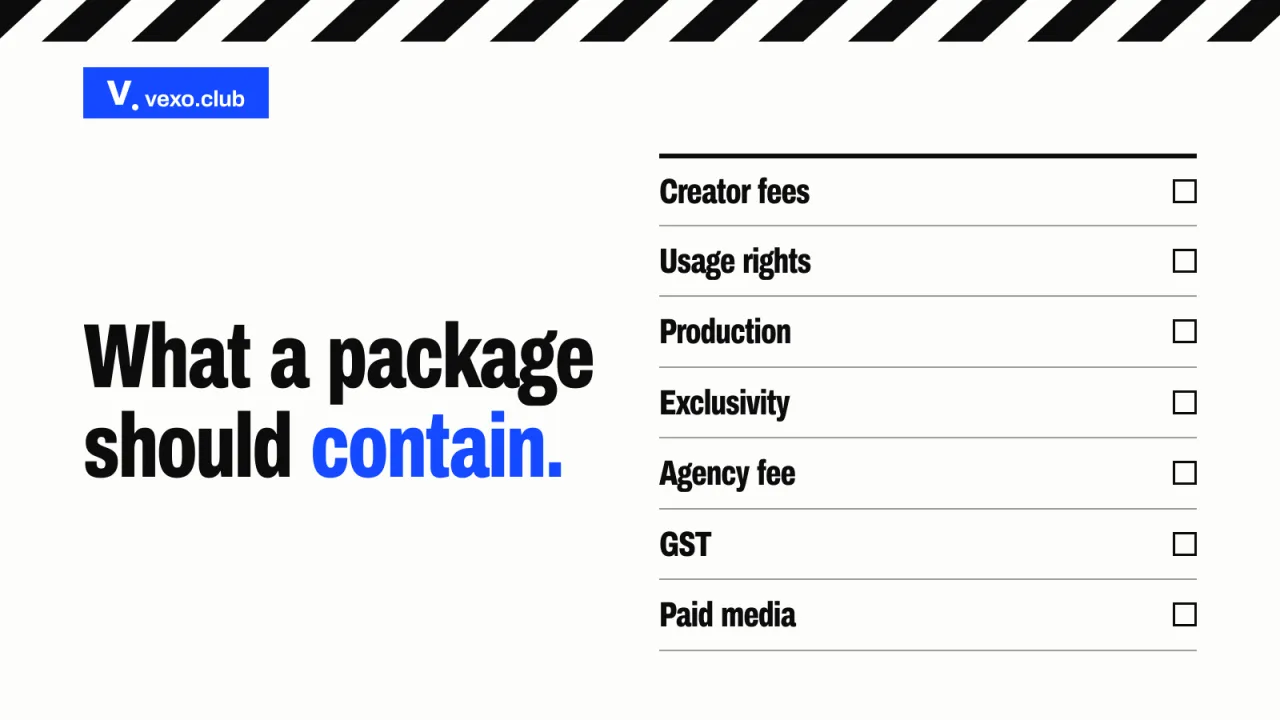
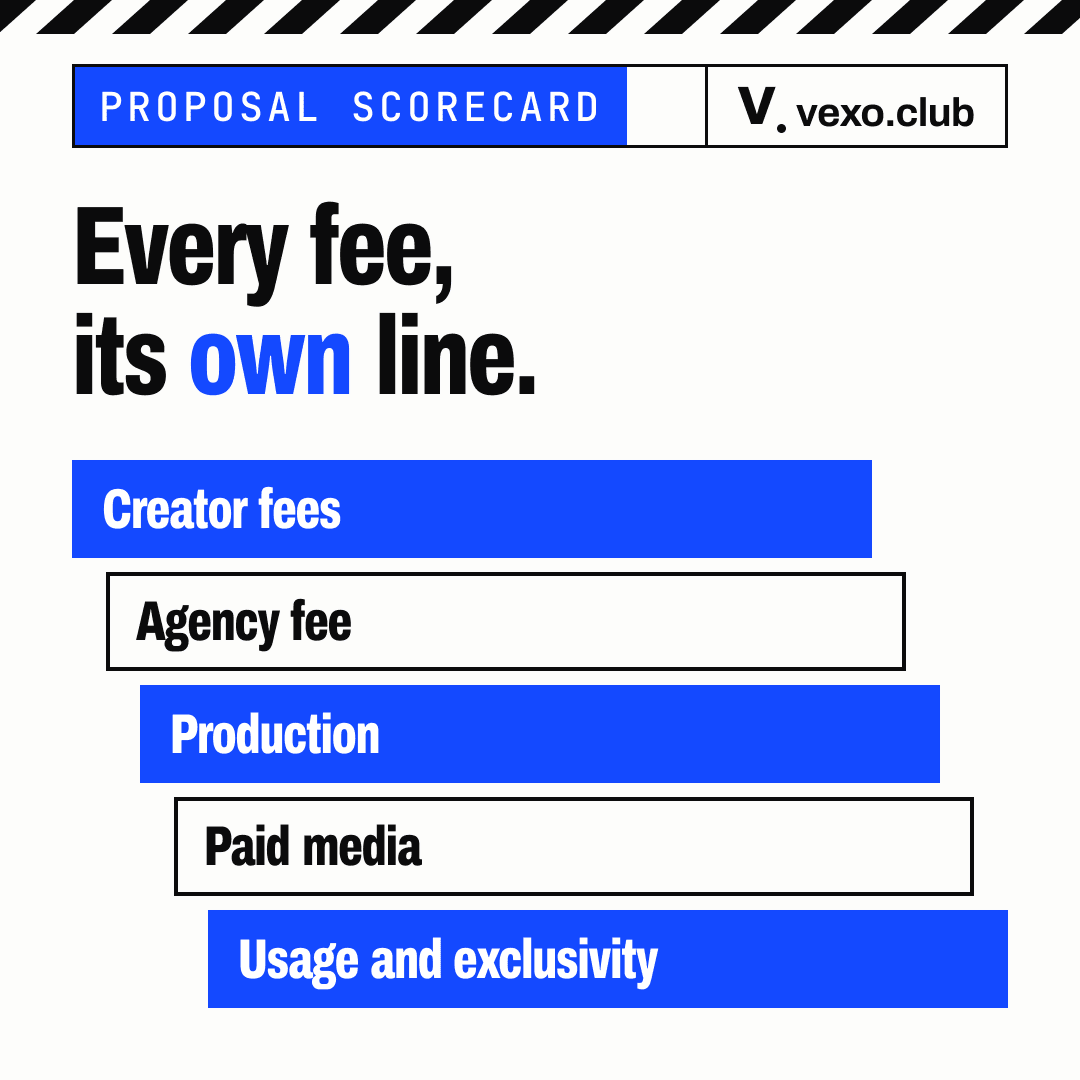
As separate lines: each creator at the creator’s own quote, the agency’s fee, production, paid media, and usage and exclusivity, each with what it covers. One blended number per deliverable hides what the creator is paid and what the agency keeps, and it cannot be checked against a creator’s invoice.
A quote with every line visible
- Creator fees Each creator and deliverable, at the creator’s own quote
- Agency fee Stated as what it is: a retainer, a percentage or a fixed fee
- Production Anything the creator does not make or own
- Paid media Ad spend, where the content runs as an ad
- Usage and exclusivity Each right, its platforms and dates, and any category exclusivity with its fee
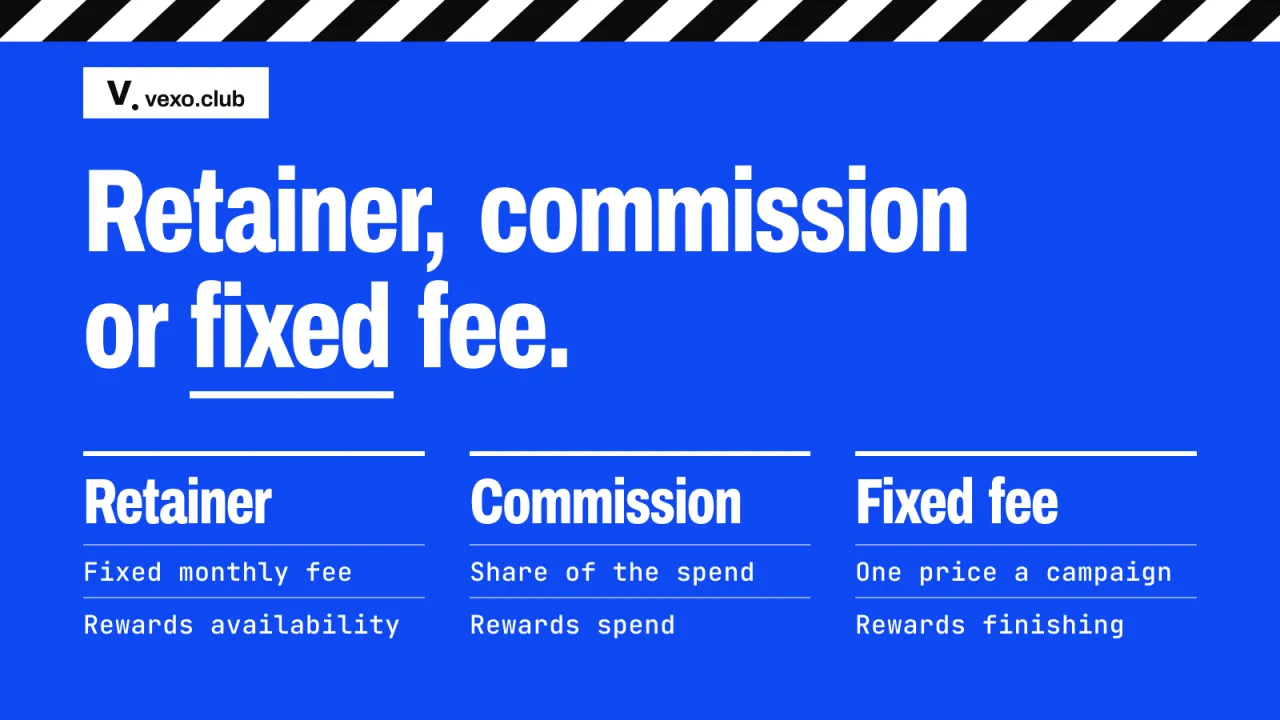
How an agency is paid decides what it is rewarded for, so its own line is the one to read hardest. Retainer, commission or fixed fee sets out the three models. The proposal should say which one it uses, and the table shows what each looks like on the page.
Three ways an agency fee is shown
| Retainer | Commission | Fixed fee | |
|---|---|---|---|
| On the page | A monthly amount for a named scope | A percentage of creator fees, as its own line | One amount for a named campaign |
| What to check | What the month buys, in writing | What the agency earns if it recommends a smaller plan | What counts as a change, and what a change costs |
| When it fits | Steady work across the year | Casting and contracting on a changing list of creators | One launch with a date that cannot move |
Which lines should end the meeting?
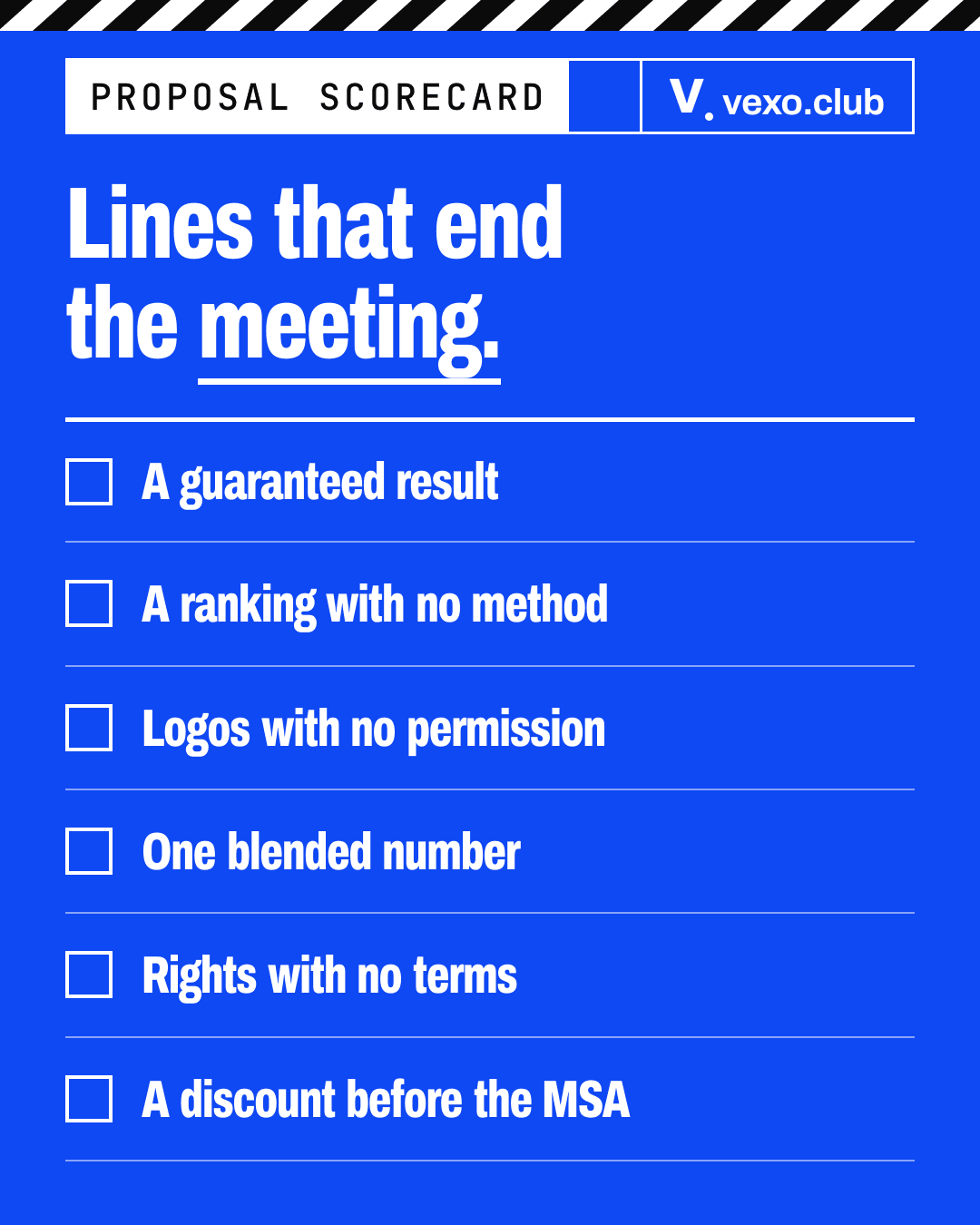
Six: a guaranteed result, a ranking with no method, client logos with no permission, one blended number, “rights included” with no terms, and a discount that expires before legal has read the master services agreement (MSA). Each is a line on the page, so each can be pointed at. Any one stops the scoring until the agency answers it in writing.
The buyer’s guide to hiring an agency lists the red flags in an agency’s answers; each of these six is also on that list. Here each is a line you can mark on the page of a proposal, with the reply that fits it:
- A guaranteed result. A promised count of views, installs or sales. Nobody controls how an audience responds, so ask for the method behind any forecast.
- A ranking with no method. A badge or award with no publisher, criteria or date. Ask who compiled it and whether anyone paid to be listed.
- Client logos with no permission. A logo wall with no line saying each client agreed. A category in place of a name is an honest answer.
- One blended number. A single total with creator fees, the agency’s fee, production and usage folded together. Ask for the lines, with the creator’s own quote beside each.
- “Rights included” with no terms. Usage with no platforms, no dates and no word on paid use. The usage rights post names the three rights a term should cover.
- A discount that expires before legal reads the MSA. An offer open until a date the contract cannot meet. Ask for the MSA first, and let the offer lapse if it must.
Six lines that should end the meeting
What should you ask for before you score?
Four things, in writing, from every agency: the MSA, a sample weekly report with the numbers removed, one creator’s audience export, and the name of the person who will run the brief. A proposal shows what an agency wants to say; these four show how it works.
Read the MSA first: the contract clauses that change the price (usage, exclusivity, approvals, takedown and payment) are in it, or in a contract it points to. The sample report should look like the weekly report, column by column; the desk’s own is the sample Monday sheet.
The audience export is the creator’s own platform insights: where the audience lives, its age, and the reach of recent posts. How to check an influencer’s audience before you pay goes through it. Reelax, a creator platform, says its audit data shows “roughly one in four profiles pitched to brands fails a basic audience-authenticity screen”, as PTI reported on 14 July 2026. That is a vendor’s figure, not an independent count.
The name matters because the person in the pitch is not always the person on the account. Send every agency the same two-paragraph brief, so the replies compare line for line.
Reading a proposal
Do
Ask for the MSA, a sample report and an audience export before you score
Don’t
Score on the pitch, and ask for the documents after you have chosen
Do
Put every question in writing and keep the replies
Don’t
Settle usage and exclusivity on a call
Do
Send every agency the same two-paragraph brief
Don’t
Brief each agency in its own words, then compare the plans
Do
Write the weights down before the proposals arrive
Don’t
Choose the weights after you have seen which agency you like
Do
Run the agency you already know through the same sheet
Don’t
Skip the scorecard for a familiar name
How do you score three proposals the same way?
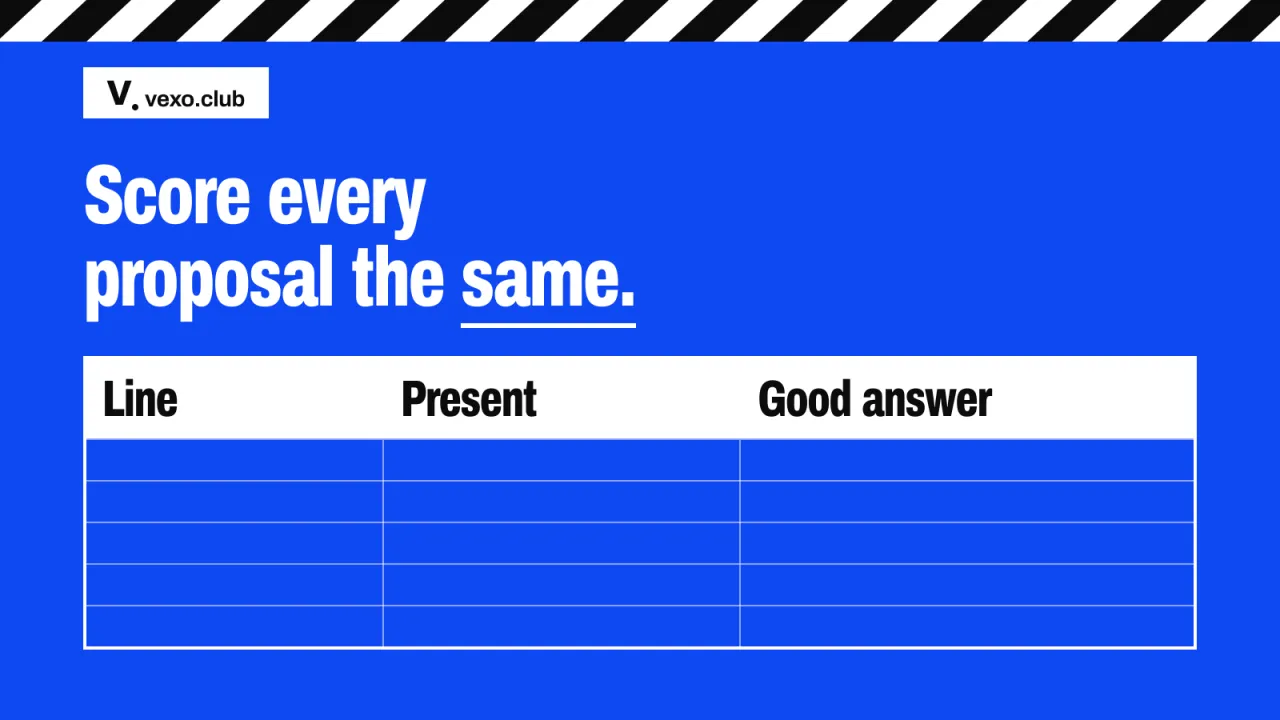
Write the weights down before the first proposal is opened, put the same twelve questions to each, and score every line zero, one or two: absent, vague, or specific enough to check. Add the weighted scores and compare. The sheet below is the one to copy.
Twelve lines to find in any proposal
- Is the person who will run the brief named?
- Are creator fees shown apart from the agency’s fee?
- Is there an audience export for each creator?
- Does each deliverable have its own usage window?
- Is it clear who checks the paid label, and when?
- Does it say what happens if a creator drops out?
- Does it say when creators are paid?
- Does it name the report’s columns and the day it arrives?
- Is the attribution method agreed before launch?
- Are the exclusivity terms stated, with a fee?
- Are the exit terms in the MSA?
- Is it clear what is out of scope?
A weighting that suits most briefs: the five lines marked in the caption count twice, because money and rights are cheapest to settle before signing, and the other seven count once. Double the label line for a category with its own advertising rules, and the drop-out line for a date that cannot move. A zero on a line counted twice sends the proposal back before it is ranked.
What does a good answer look like, line by line?
A good answer can be checked. A weak one repeats the line’s own words and adds nothing. The table sets the two side by side for the lines that carry the most risk after signing.
A proposal line and the answer to look for
| A good answer | A weak answer | |
|---|---|---|
| Named operator | A name, a role and how many briefs run at once | A team name, or “your account manager” |
| Audience export | The creator’s own insights: location, age, reach per post | A screenshot, or a score with no method |
| Usage window | Platforms, dates and a yes or no on paid use, per deliverable | “Rights included” |
| Paid label | A named checker, on the draft and again once live | “Compliance handled” |
| Creator drops out | A replacement, a refund or a new date, written down | Silence until it happens |
| Creator payment | A term in days, and what starts the clock | “Paid promptly” |
| Attribution | One method per figure, agreed before launch | One blended result with no source |
| Exit | Notice, content and usage rights, and a final report | Auto-renewal and no word on leaving |
How does the vexo.club proposal answer these twelve lines?
Ten have at least a partial answer on this site, and two have none. Creator fees are line items at fixed rate-card prices (each creator quoted in four lines: content fee, usage, production and exclusivity, as what a creator rate card contains sets out). The management fee is added as a fixed percentage, not printed here. Marketing, including paid media, and the studio are sold and priced separately.
The senior operator who scoped the brief runs it. Creators are vetted on audience authenticity, delivery record and platform insights, refreshed monthly. Usage, whitelisting and exclusivity are agreed per deliverable, in writing, before the shoot, and creators are paid net 15 from client payment. The weekly sheet carries reach, engagement rate, cost per acquisition, CPM and the next move; attribution is agreed before launch and unverified figures are marked, never totalled.
In part: the site does not say how many briefs one operator runs at once, gives audience-fit data rather than each creator’s export, says every paid post carries the ASCI label, written into the brief and the contract, but not who checks it after a post is live, and lists no fee for exclusivity or what sits outside scope. Ask for each in the proposal. Two lines have none: what happens when a creator drops out, and the exit terms. Ask for both in writing; the MSA and NDA summaries are available on request. The desk’s own ASCI statement is not published yet, and the rules behind every number it prints are on how the desk verifies. Run the desk’s proposal through the same sheet, and mark the same zeros.
The five lines of a quote
What should an influencer marketing RFP ask?
An influencer marketing RFP sends every agency the same two-paragraph brief and asks for the same answers, in the same order, with the documents that prove them. Paste these as they are. Ask each agency to:
- Name the person who will run this brief, and say how many briefs that person runs at once.
- Say which of finding creators, contracting, making and posting, and reporting you do yourselves and which you hand on, and what is out of scope and who pays for it.
- Show the quote as five lines: creator fees, your fee, production, paid media, and usage and exclusivity. Name the fee model, and say whether each line includes GST.
- Attach an audience export for each creator you would propose, before any rate is agreed.
- State the usage window for each deliverable: platforms, dates, and whether it may run as an ad.
- Say who checks the paid label, at which stages, and what happens to a post that fails.
- Say what happens if a creator drops out or misses the date.
- State when creators are paid, and whether that depends on our payment to you.
- Attach a sample weekly report with the numbers removed, and name the attribution method for each figure.
- State the exclusivity you will ask of creators: category, dates and fee.
- Attach the MSA and the NDA, or their summaries, with the exit terms marked.
- Name the category of any competing brand you serve now; a name is not needed if the client has not allowed it.
Fix the order before the replies arrive, and keep it the same for every agency.
From RFP to signed MSA
- Send the same brief Objective, budget band, market and timeline
- Collect answers in writing The twelve lines, in order, by one date
- Ask for the documents The MSA, a sample report, an audience export, the operator’s name
- Score on the written weights Before the replies are compared
- Have legal read the MSA Before any offer expires
- Sign, with usage and exit terms marked Or tell the agencies that lose why
Send any proposal, the desk’s included, through the scorecard. A brief can be sent to the desk, and the proposal comes back with every fee on its own line.
Questions brands ask
How do I compare influencer marketing agency proposals? Score each one on the same twelve lines, with the weights written down before you open the first. Ask every agency for the MSA, a sample weekly report, one audience export and the operator’s name.
What is a red flag in an agency proposal? A guaranteed result, a ranking with no method, client logos with no permission, one blended number, “rights included” with no terms, or a discount that expires before legal reads the MSA. Any one stops the scoring until the agency answers it in writing; an agency that cannot answer is the one to drop.
Should creator fees be shown separately from the agency fee? Yes. Creator fees belong on their own lines at each creator’s quote, with the agency’s fee beside them, so the total can be checked against invoices.
What goes in an influencer marketing RFP? The same two-paragraph brief to every agency (objective, budget band, market and timeline), the twelve lines answered in order, the quote in five lines with usage and exclusivity on one, and the MSA, a sample report and an audience export attached.
Does vexo.club publish its fees? No. There is no public pricing: creator fees are line items at fixed rate-card prices, the management fee is a fixed percentage added to them, and a scoped quote follows the brief.
How does vexo.club answer this scorecard? Ten of the twelve lines have at least a partial answer on this site, and two have none: what happens when a creator drops out, and the exit terms. Ask for those two, and for each partial answer, in writing; the MSA and NDA summaries are available on request, and the desk’s own ASCI statement is not published yet.
Sources
- Guidelines for Influencer Advertising in Digital Media (opens in a new tab) ascionline.in
- half-yearly complaints report for April to September 2025 (opens in a new tab) ascionline.in
- PTI (opens in a new tab) deccanchronicle.com
Cite this page
How to read an agency proposal for influencer marketing: a scorecard, the lines that end the meeting, and how fees should be shown. vexo.club, published 19 Oct 2026, updated 28 Oct 2026. https://vexo.club/blog/influencer-marketing-agency-proposal-scorecard
Influencer marketing across India
Send the desk a brief: it comes back as a shortlist and a directional band, never a public price.
Brief the desk