Instagram vs Moj and Josh: a decision framework for vernacular video
Josh no longer takes creator uploads and no primary source backs the 300 million figure for Moj. Here is what is true in October 2026 and a rule for when a brand should still add a vernacular platform, by category and geography.
Benchmarks 20 min read The vexo.club desk
In this article13 sections
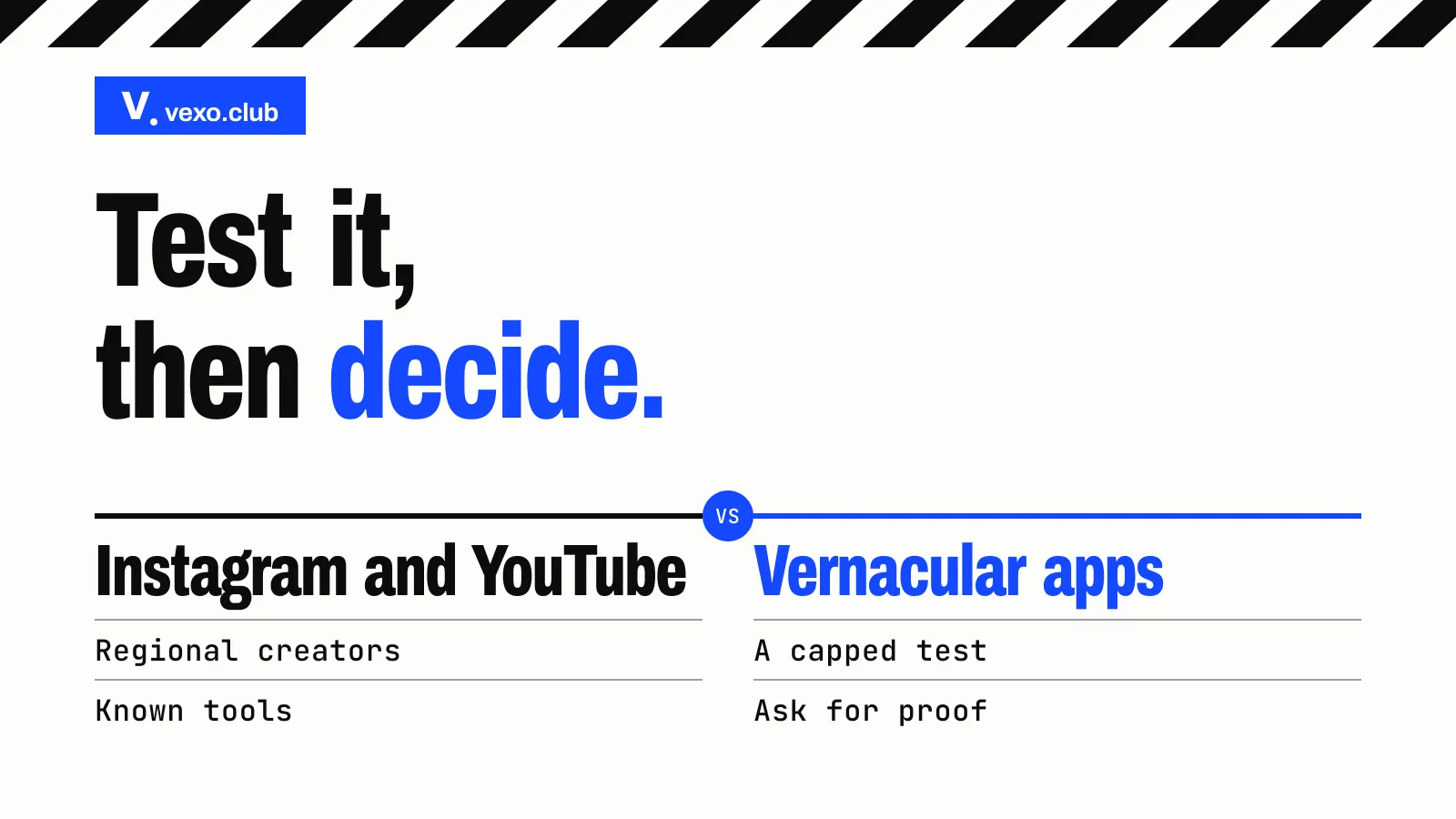
For most brands in 2026 the question is no longer Instagram or Moj and Josh. Josh has stopped accepting creator uploads. Moj is still running but now sells itself as reels plus short drama. The 300 million monthly users figure that still circulates is not one any primary source we read gives for either app. What remains is a smaller decision: whether to buy a capped slice of ShareChat and Moj media beside creator work on Instagram and YouTube in the viewer’s own language. This guide gives the rule for that, by category and by geography.
What is true in October 2026, in short
- Josh told a user in May 2026 that uploads are no longer supported, so there are no Josh creators to book. At most it is a media placement.
- Moj is operating under ShareChat with a self-serve ad tool. ShareChat’s own pages give different user numbers, and the only one for Moj alone is an undated 100 million+ on its about page.
- In the desk’s reading most vernacular reach a brand can book now sits with regional-language creators on Instagram and YouTube. Start there.
- Add Moj or ShareChat media for everyday products in regional-language markets, or for festive and entertainment moments. Run it as a capped test with a stop rule.
- Where the translation tools on Instagram and YouTube skip a language, a native-language creator matters more on any platform.
Every platform fact below was checked on 24 October 2026 against app-store listings, the companies’ own pages and trade press, and each source is linked. Platform pages change often. Treat it as a dated reading and open the page again before you commit money.
Where did the 300 million figure come from, and is it true?
It comes from 2022. When Moj and MX TakaTak announced their merger, the Economic Times reported a combined 300 million monthly active users and said Moj alone had passed 160 million. At its 2022 funding round VerSe Innovation put Josh at about 150 million. Those were company claims made at the peak and during fundraising. We found no 2026 primary source that gives 300 million for a single app or 150 million for Josh. ShareChat’s about page still shows Moj at 160 million monthly active users in its 2023 timeline entry.
What the pages say now is messier. ShareChat’s ad pages print “325 Mn+” monthly active users and “40 crore+” users on the same page. Its about page gives 110 million+ monthly active users for the ShareChat app and 100 million+ for Moj, with no date on either. Its October 2025 press release says more than 200 million “monthly monetizable users” across ShareChat, Moj and its drama app QuickTV. Inc42, citing SimilarWeb, reported in April 2026 that the ShareChat app fell from 104 million monthly users in March 2024 to 79 million in February 2025.
Those figures measure different things. Only the about page’s undated 100 million+ is for Moj alone, and none is audited in anything we read. If a deck quotes you a user count for either app, ask which app, which month and which definition of active. If the answer is a slide with no date, it does not go in your plan.
Why the 300 million figure should not go in a plan
Is Moj still operating, and who owns it?
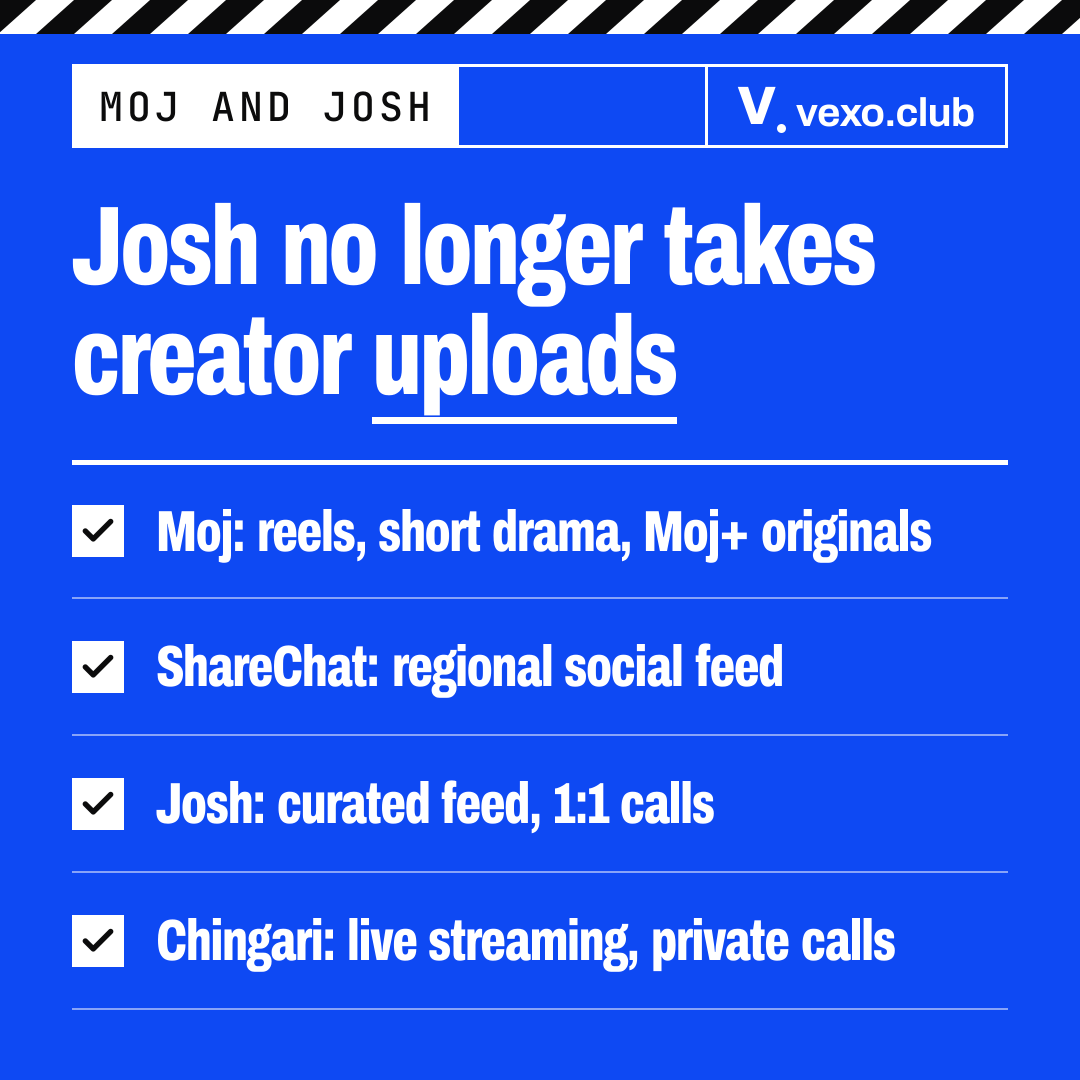
Yes. Moj belongs to Mohalla Tech, the Bengaluru company behind ShareChat. Its Google Play listing was updated on 22 October 2026 and now reads “Free Short Drama & Reels”. It describes 60-second videos, short dramas in episodes of two to five minutes and premium Moj+ originals sold through in-app purchases. The positioning has moved from a TikTok replacement to an entertainment app with drama in it.
The money explains the move. In its FY25 results, as the Economic Times reported, ShareChat’s operating revenue was flat at ₹723 crore. Advertising revenue fell 8.1% to ₹290 crore, which the CFO tied to a GST increase on real-money gaming and a weak ad market. Streaming revenue, which the report links to live streaming, was ₹434 crore. At the time, the company said more than 70% of its investment that year was going to micro drama. A brand is a smaller customer in that business than a viewer who pays for gifts or episodes. That does not make the ad product bad. It tells you where the company’s attention sits when you have a problem.
How the vernacular short-video field narrowed, as the sources date it
- Jul 2020 Moj launches after the TikTok ban, from the company behind ShareChat
- Jun 2023 Chingari moves from short video to paid private live streaming
- Jul 2024 Inc42 reports Josh’s users and downloads falling since mid 2023
- Oct 2025 ShareChat reports flat revenue and says micro drama is its next bet
- Apr 2026 ShareChat’s CFO tells Inc42 the company has stopped trying to replace Instagram
- May 2026 Josh’s own reply on Google Play says content uploads are no longer supported
The CFO is the most useful witness on strategy. He told Inc42 that ShareChat tried the replacement angle and that “you can’t take Meta or Google head on”. He also said that about 95% of ShareChat’s audience overlaps with Meta and YouTube users, so people use ShareChat and Instagram together. That is a company claim and we could not check it. If it is even roughly right it has a plain consequence for a brand. You are mostly not reaching new people on Moj. You are reaching the same people in a different mood and a different language.
Is Josh still a short-video platform brands can use?
Not as a creator platform. The quote below is Josh’s own reply to a user, and it settles the question for anyone planning a creator brief.
What Josh itself says about uploads
“Dear User, Josh has evolved into a curated short video platform. Content uploads are no longer supported, and user-uploaded videos won’t be visible on the feed. You can continue enjoying short videos and access 1:1 private calls & chat on DreamCall.”
Josh Team, reply to a review on the Josh page on Google Play,
The Josh Google Play page is now titled “Josh - Live Calls & Chat”. It lists one-to-one audio calls with broadcasters, chat, audio stories, games and short videos in 12 languages. It shows 10 crore+ downloads, which counts installs since 2020 and says nothing about use today. VerSe’s own site still calls Josh a short video app. Dailyhunt is the audience business it talks about.
How we got here is on the record. Inc42, citing Data.ai, reported in July 2024 that Josh’s monthly users fell from 20 million to 9.4 million in a year and its monthly downloads fell by nearly 80%. Its sources also alleged that bots followed some popular creators. Practical consequence: any follower or view figure for a Josh creator quoted to you in 2026 describes content nobody can newly upload. Ask the seller to open the creator’s live feed on a phone, and to explain what exactly you are buying.
What about Chingari, MX TakaTak, Roposo, Trell and the rest?
MX TakaTak was merged into Moj under the 2022 announcement above. Inc42 lists Josh, MX TakaTak, Roposo and Trell among the apps that have “effectively faded out”, and we did not find a working brand route for any of them. Chingari is still operating, but Entrackr reported in March 2026 that it moved from short video to paid private live streaming in June 2023 and that its FY25 revenue roughly halved. Its Google Play title is “Chingari - Live & Audio Room” and Google Play in India rates it 18+. A live-call app with a mature rating is a brand-safety problem before it is a reach question.
The four named apps, from their own pages
| Moj | ShareChat app | Josh | Chingari | |
|---|---|---|---|---|
| What its store listing calls it | Free Short Drama & Reels | Status, Video & Live | Live Calls & Chat | Live & Audio Room |
| Owner | Mohalla Tech, Bengaluru | Mohalla Tech, Bengaluru | VerSe Innovation, Bengaluru | Tech4Billion Media, Bengaluru |
| Ordinary users can upload videos | Yes | Yes | No | Not the focus: live streaming and chat |
| Creator earning route named on its pages | Gifts, weekly league rewards, a selective creator programme | Not applicable | Gifts to broadcasters on live calls | Gifts redeemed as rewards while live |
| A route for brands that we could find | ShareChat Ads: self-serve manager, agency centre, creator ads, hashtag challenges | The same ShareChat Ads buy as Moj | None for brands | Agencies and brands invited by message; no ad tool found |
| Our reading for a brief | A capped paid test for a named reason | The same, for festive and regional moments | Not bookable as a creator platform | Skip: a live-call model with adjacency risk |
What each named app is now, from its own listing
How do Moj creators earn, and can a brand book them?
The creator side is documented on Moj’s creator site. Creators earn from virtual gifts and weekly Creator League rewards. A selective programme called MFC Select is for creators posting mostly original videos. Moj says plainly that selection does not guarantee money, that earnings are performance-based and that strong content “may lead to brand campaign opportunities”. There is no creator marketplace on that page where a brand browses and books.
The brand side runs through ShareChat Ads. The pages we read describe a self-serve Ads Manager with language targeting in more than 15 languages, a Business Centre for agencies running several brands, creator ads made with creators in-house, hashtag challenges and branded filters. The creator-ads explainer is an old post from 2022 and its case results are the platform’s own claims, so we do not repeat them. The site also advertises bonus ad credits on wallet recharges. Read the conditions and the expiry before you top up, because a credit you cannot spend in time is a discount that costs you something.
We did not find a branded-content label or a whitelisting tool on Moj of the kind Instagram has, in the pages we read. That matters for rights and disclosure, covered below. If you book a Moj creator directly by message, you are doing an ordinary creator deal with no platform tooling behind it, so the contract has to carry everything.
Do Instagram and YouTube reach regional-language audiences without a vernacular app?
Largely yes, in the desk’s reading, because regional-language creators are on both and both platforms now translate. Meta’s translation page lists reel translation, dubbing and lip-sync between English and Hindi, Bengali, Tamil, Telugu, Marathi and Kannada, as updated in July 2026. Every translated reel carries a “Translated with Meta AI” label and viewers can switch it off. YouTube’s automatic dubbing page lists English into Hindi, Bengali, Tamil, Telugu, Malayalam and Punjabi, Hindi into English and Bengali, and Tamil, Telugu, Malayalam and Punjabi originals into English only.
Read those lists for the gaps. Gujarati, Odia, Assamese and Bhojpuri appear on neither. Marathi and Kannada are on Meta’s list but not YouTube’s. A Malayalam or Punjabi video can be dubbed only into English. A translation tool does not make a regional creator. YouTube says automatic dubs cannot be edited and may mistranslate proper nouns, idioms and jargon. For a brand that is a claims risk: a dubbed line that changes what your product promises is still your advertisement under the ASCI rules. Use the tools for reach and have a native speaker listen to every dub before it runs.
The honest limit is that neither Meta nor Google gives us a published India figure for how many regional-language viewers sit inside Reels or Shorts. So we cannot show you a ratio of vernacular reach on each. What we can say is that the audience ShareChat sells is, by its own CFO’s account, mostly also on those platforms. For the format comparison itself see Reels vs YouTube Shorts for brands.
Which categories earn a place on a vernacular platform?
The rule has two questions. Is the product bought without much deliberation, and is the buyer more comfortable in a regional language than in English or Hinglish? Where both answers are yes, a capped test is easy to defend. Where the product is considered and the buyer is in a metro, it is not.
Where a vernacular platform earns a place, by product and audience
Considered purchase, metro buyer
Considered purchase, Metro and English-first
- No case for a vernacular app
- Instagram and long-form YouTube carry the explaining
Considered purchase, regional buyer
Considered purchase, Regional-language-first
- Regional-language YouTube creators first, because the buyer needs time to be convinced
- A vernacular app only as awareness around a festival
Everyday product, metro buyer
Everyday, low-ticket, Metro and English-first
- Reels and Shorts cover it
- A vernacular app adds little here
Everyday product, regional buyer
Everyday, low-ticket, Regional-language-first
- The one box where a capped ShareChat or Moj test is easy to justify
- Run it beside regional-language creators on Instagram and YouTube, not instead of them
Across Metro and English-first Regional-language-first
Up Everyday, low-ticket Considered purchase
Five working rules follow from that, all of them our judgement and none of it platform data:
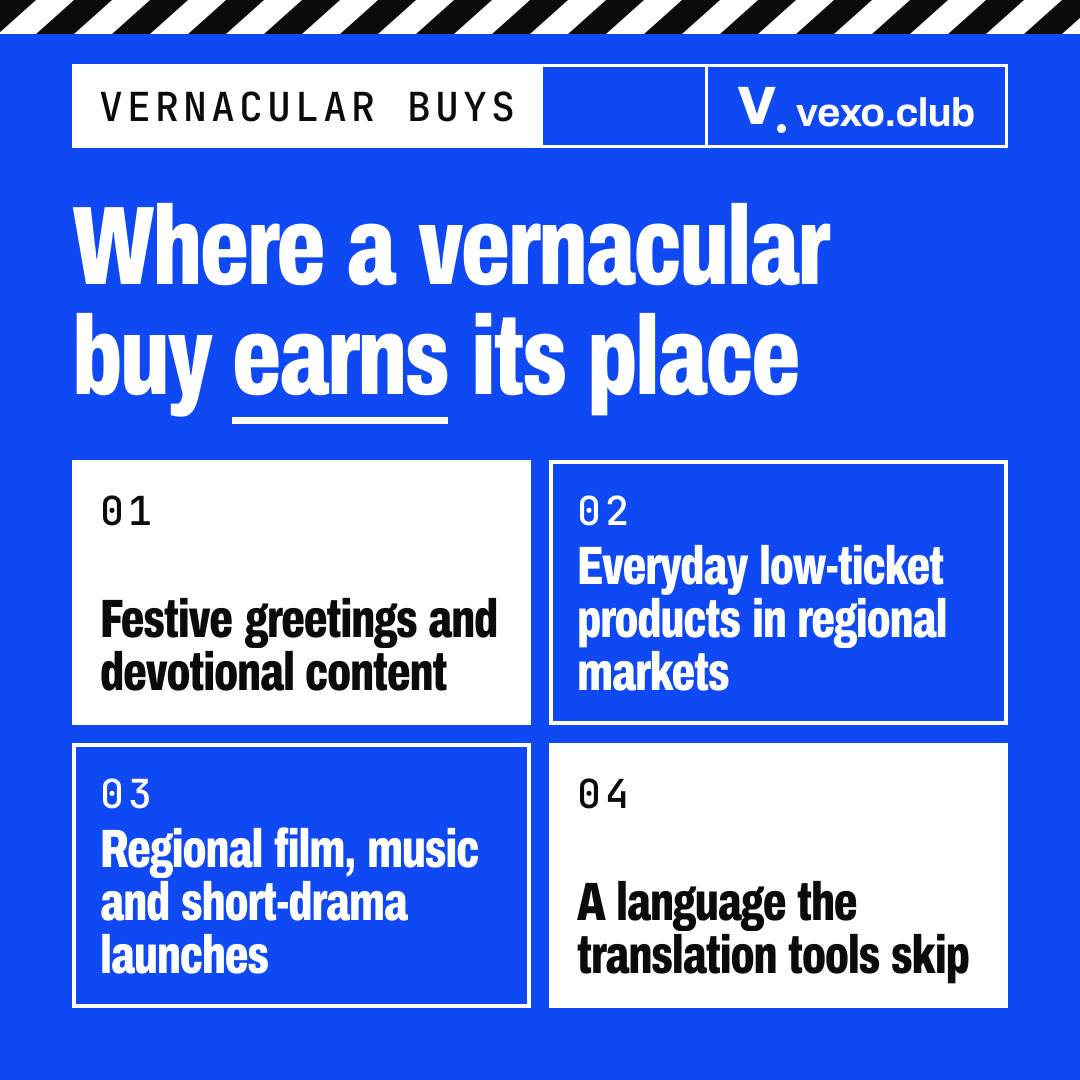
- Everyday low-ticket products sold in regional-language markets, such as packaged food, personal care and household items: test ShareChat or Moj media beside regional creators, because repeat purchase forgives a thin first impression.
- Festive greetings, devotional and community-occasion content: Inc42’s account of the CFO’s view is that people use ShareChat for regional-language content, festive wishes and community, so a festival burst is the cleanest use. See festive season influencer planning.
- Regional film, music, OTT and short-drama launches: the ShareChat Ads pages pitch this directly and the audience is already there to watch short video. Ask to see the placements.
- Considered purchases such as appliances, insurance and courses: use regional-language YouTube creators first, because the buyer needs time and explanation that a short feed does not give.
- Regulated or sensitive categories such as finance, health and anything for children: do not buy a vernacular app placement until you have written adjacency controls and a way to see where the ad ran.
Four cases where a vernacular buy can earn its place
How does geography change the answer?
Treat language as the unit, not the state or the city tier. A rough guide, again our reading:
- Hindi, Marathi, Bengali, Tamil, Telugu and Kannada: Instagram’s translation tool reaches all six and YouTube’s reaches Hindi, Bengali, Tamil and Telugu, and the creator base on both platforms is deep. A vernacular app adds the least here. Start with creators. South Indian influencers covers the four southern languages.
- Gujarati, Punjabi, Odia, Assamese, Malayalam: the tools barely reach them, so a native-language creator matters most. Check who the creators are before you decide the platform.
- Bhojpuri, Haryanvi, Rajasthani and other regional dialects of the Hindi belt: this is where a vernacular feed is most likely to hold content and audience that Instagram does not. It is also where ShareChat’s own numbers are least checkable. Ask for the language split.
- Tier-2 and tier-3 buyers in any language: the ShareChat Ads pages claim strength there, but the tier statistics on those pages are dated to 2022. Test it with a state-level split, not a tier label.
If you are launching in several languages at once, decide the creator mix first and read regional launch in four languages. The platform choice comes after that.
How do you test a vernacular platform without fooling yourself?
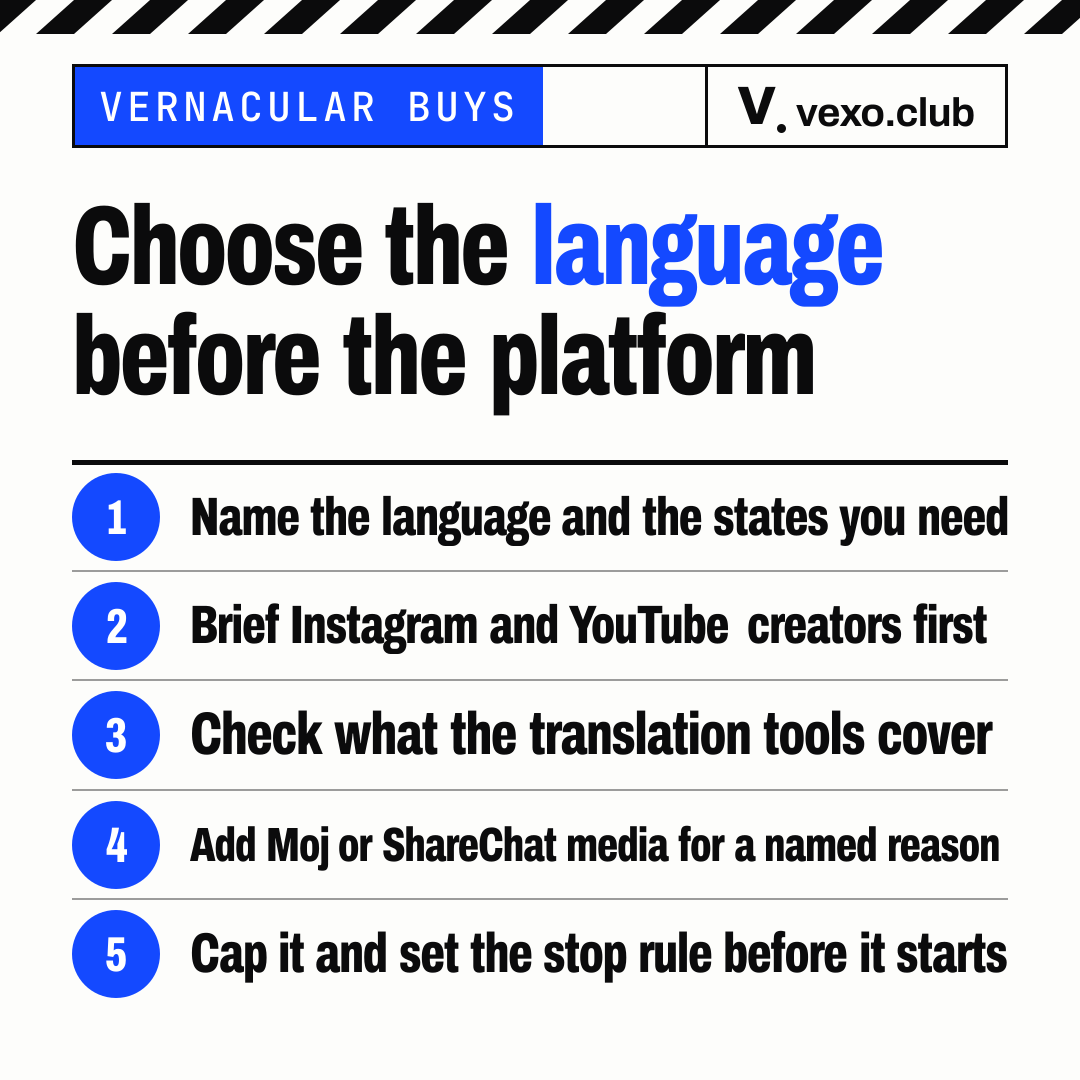
Run it as a capped test that can fail cleanly. The order matters more than the budget.
- Write the reason in one sentence before you spend: for example “reach Bhojpuri-speaking buyers the Instagram creators are not reaching”. A reason like “everyone is there” is not one.
- Brief the same offer and creative through Instagram and YouTube creators in that language first, and note what they deliver. That is your control.
- Put the vernacular test on one language and one set of states, with the same creative, the same offer code or tracked link and the same dates.
- Fix the stop rule in writing before launch: what result you need by what date, and what you will do if you do not get it. Do not recharge a wallet a second time to find out.
- Compare cost per outcome you can trace, such as redemptions or orders. Do not compare views across platforms, because each counts a view differently. See measuring influencer marketing ROI.
The order to decide in
What should you ask ShareChat’s sales team before you spend?
Ask for the answers by email. The checklist below is the version we would send. The first two items are the ones that decide whether the numbers in the deck mean anything.
Ask ShareChat’s sales team, in writing
- Which app and which month does the user number describe: Moj alone, the ShareChat app, or the whole group?
- What counts as an active user, and who audits it?
- What is the language split of the inventory I will buy, in the states I am targeting?
- What counts as a view, and is it a start, a play of some minimum length or a completed watch?
- Can I exclude content categories next to my ad, and can I see the placements afterwards?
- May I use a third party to verify invalid traffic, and how is it refunded?
- If you make a creator ad, who owns the video and what are the usage rights?
- Which disclosure label or tool do you provide for paid creator content?
Here is a paste-ready paragraph for the email: “We are considering a test on ShareChat and Moj in [language] across [states] for [product]. Before we plan spend, please confirm in writing which app and which month your monthly active user figure describes, how an active user is defined, the language split of the inventory we would buy, how a view is counted, which content categories we can exclude next to our ad, and which disclosure label or tool you provide for paid creator content. Please also share the placement report format.” If the reply dodges the first two questions you have your answer.
What changes for disclosure, rights and tax on a platform with no label tool?
The ASCI rules do not depend on the platform. ASCI’s influencer guidelines require a disclosure label on paid or otherwise connected promotion, upfront and prominent, in English or in the language of the advertisement. They list the permitted words and name the “Paid Partnership” tag on Instagram and the “Includes Paid Promotion” tag on YouTube. They say using a platform’s own tool should be considered in addition to the creator’s own disclosure. Moj is not named, so on Moj the label has to be written or superimposed by the creator in a language the viewer understands. The label may be in English but it must be well understood by an average consumer. For a Bhojpuri video aimed at viewers who may not read English, a label in the viewer’s own language is the safer choice. Check the current text and read ASCI disclosure rules for brands.
Rights need the same care. If a creator’s Moj video will be reused as a paid ad on any platform, the contract must say so and for how long. Without a platform tool to carry that permission, it lives only in the paper. Usage rights explains the clauses. Tax follows the payee. A media invoice from ShareChat Ads is one kind of payment and a fee to an individual creator is another, with different deductions, so read TDS on influencer payments before you pay a creator who is not on a platform’s ad system.
What to do this week
Four actions, in this order, none of which costs anything:
- Write down the language and the states you most want to reach and what you sell there.
- Ask your current creators or agency which regional-language creators on Instagram and YouTube they can brief, and how they would label the paid post.
- Send the email above to ShareChat’s sales team and see whether the first two answers arrive.
- Decide now what result would make a Moj test worth a second round, and write it down.
If you do not sell anything in a regional-language market, you can stop reading here. The rest of your budget is better spent on the platforms where your buyers already are. The budget allocation by goal guide helps you decide how much.
Questions brands ask
Is Moj still operating in 2026? Yes. Mohalla Tech, the company behind ShareChat, runs it, and its Google Play listing was updated on 22 October 2026. It now describes itself as a short drama and reels app with premium Moj+ originals. Its core business is not advertising: ShareChat reported flat revenue in FY25 with advertising down.
Does Moj or Josh really have 300 million users? We could not confirm that from any primary source. The figure traces to a 2022 merger announcement and 2022 fundraising claims. ShareChat’s own pages now give 325 million, 40 crore, 110 million and 200 million for different things. The only Moj-alone figure, 100 million+ monthly active users on its about page, carries no date.
Can I still book Josh creators? Not for new content. Josh’s reply on Google Play in May 2026 says content uploads are no longer supported and user videos will not appear on the feed. Anyone selling a Josh creator package in 2026 should be asked to show the creator’s live feed.
Do Moj creators have a brand-deal tool? The pages we read describe creator earnings from gifts, weekly rewards and a selective programme, with brand campaigns as a possible outcome. They describe no marketplace or paid-partnership label. Brands buy through ShareChat Ads or deal with a creator directly, with the contract carrying everything.
Which categories should add a vernacular platform alongside Instagram and YouTube? Everyday low-ticket products sold in regional-language markets, festive and devotional moments, and regional entertainment launches. Considered purchases and metro-first brands usually do better with regional-language creators on YouTube and Instagram alone.
Do ASCI rules apply to creators on Moj or ShareChat? Yes. The guidelines apply to paid or otherwise connected promotion by influencers on digital media. The label must be upfront and prominent in English or in the language of the ad. Moj has no named platform tag in the list we read, so the creator has to add the label on the video.
How do I know if a vernacular test worked? Decide before launch what traceable outcome counts, such as orders or code redemptions in the target states, and compare it with the same offer run through Instagram and YouTube creators. Do not compare view counts across platforms, because each counts a view differently.
vexo.club is an influencer marketing desk in Delhi NCR. If you want a second pair of eyes on a test plan like the one above, send the brief through /contact and say which language and which states you need.
Sources
- the Economic Times (opens in a new tab) economictimes.indiatimes.com
- VerSe Innovation put Josh at about 150 million (opens in a new tab) economictimes.indiatimes.com
- ad pages (opens in a new tab) ads.sharechat.com
- sharechat.com/about (opens in a new tab)
- October 2025 press release (opens in a new tab) sharechat.com
- reported in April 2026 (opens in a new tab) inc42.com
- Google Play listing (opens in a new tab) play.google.com
- as the Economic Times (opens in a new tab) economictimes.indiatimes.com
- Josh Team, reply to a review on the Josh page on Google Play (opens in a new tab) play.google.com
- reported in July 2024 (opens in a new tab) inc42.com
- Entrackr (opens in a new tab) entrackr.com
- Moj’s creator site (opens in a new tab) creators.mojapp.in
- translation page (opens in a new tab) about.fb.com
- automatic dubbing page (opens in a new tab) support.google.com
- ASCI’s influencer guidelines (opens in a new tab) ascionline.in
Cite this page
Instagram vs Moj and Josh: a decision framework for vernacular video. vexo.club, published 19 Nov 2026. https://vexo.club/blog/instagram-vs-moj-josh-vernacular-platforms-for-brands
Influencer marketing across India
Send the desk a brief: it comes back as a shortlist and a directional band, never a public price.
Brief the desk