Instagram Stories vs Reels vs Feed posts for brands: which format for which stage of the funnel
Instagram gives a brand three native formats, each built for a different job. A Reel reaches people who do not follow the creator yet; a Feed post and a Story hold an audience already paying attention. Which format suits a brief depends on where it sits in the funnel, not on habit.
Benchmarks 11 min read The vexo.club desk
In this article7 sections
Instagram gives a brand three places to put a creator’s content, and a brief that treats them as interchangeable is leaving one of them to do a job it was not built for. A Reel is the format Instagram shows widely to people who do not already follow the creator. A Feed post sits on the profile grid and is mostly seen by people who follow, search for, or look the creator up. A Story is seen almost entirely by existing followers and disappears in 24 hours unless the creator saves it. This guide is about that split, and which format answers awareness, consideration or conversion, not about the paid tools that sit on top of any of the three. Instagram Collab posts and sponsored posts and the paid partnership label cover the mechanics of running a post as an ad; this one covers which format to brief in the first place.
None of this comes from an engagement benchmark, because Instagram does not publish one and this desk does not invent one. What follows is read from Instagram’s own help pages and blog, and from how each format is built: who it is shown to first, how long it stays up, and whether it carries a clickable link. A brief that starts from those three facts, rather than from a guess at which format performs better this month, tends to land on the right one without needing a number behind it.
Stories, Reels and Feed posts, for a brand
In short
- Each format is built to reach a different audience: Reels reach people who do not follow yet, Feed posts and Stories mostly reach people who already do.
- Only one of the three carries a clickable link inside the post itself: the link sticker in a Story.
- A Feed post stays on the profile indefinitely; a Reel stays on the profile and in the Reels tab; a Story disappears in 24 hours unless it is saved as a Highlight.
- A brief rarely needs just one format. The common shape is a Reel to open the funnel, a Feed post or a Story to hold it, and a link sticker or a tagged product to close it.
What does each format do first?
The comparison below sets out what each format is built for, read from Instagram’s own help pages and blog.
Instagram Stories, Reels and Feed posts, from Instagram’s own pages
| Stories | Reels | Feed posts | |
|---|---|---|---|
| Who sees it first | Mostly existing followers, at the top of their Feed | Followers and people who do not follow, in the Reels tab, Explore and Search | Mostly people who follow, search or visit the profile, plus some suggested posts |
| How long it stays up | 24 hours, unless saved as a Highlight | Stays on the profile and in the Reels tab until removed | Stays on the profile grid until removed |
| A clickable link inside the post | Yes, the link sticker | No, only the profile bio link | No, only the profile bio link |
| A native way to tag a shoppable product | Yes, where the brand has a Shop | Yes, where the brand has a Shop | Yes, up to 20 tags across one post |
| What it is best suited to | Holding an audience that already follows, and sending it somewhere | Reaching people who have not found the creator yet | A permanent record, found by people who look the creator up |
| Best for | Consideration and conversion | Awareness | Consideration |
Which format carries awareness, reaching people who do not follow yet?
A Reel is Instagram’s own answer to this question. The creators’ pages say a reel is shown first to a small test audience and then more widely as it performs, and Instagram’s own feature page for Search and Explore describes Explore as a discovery surface drawn from accounts a person does not already follow. A Story and a Feed post are not built the same way. A story is seen mainly by people who already follow the creator, and a feed post’s main audience is people who follow, search for the creator by name, or land on the profile from elsewhere, with suggested posts to non-followers as a smaller, secondary path. A brief whose job is to be found by people who have never heard of the brand is a Reels brief first.
Which format carries consideration, holding an audience already paying attention?
Once a brand has an audience’s attention, whether from the creator’s own following or from a Reel that worked, the job changes from being found to being trusted and remembered, and that is where a Feed post and a Story each do something a Reel does not. A Feed post sits on the profile grid permanently, so it is there the next time someone visits the profile to check the brand out, or searches the creator’s name. A Story is temporary by design, which suits it to a narrower job: a reminder, a poll, a countdown, or a behind-the-scenes frame aimed at people who already follow and do not need to be convinced to look. Together they hold the attention a Reel opens, in two different registers: one permanent and findable, one immediate and disappearing.
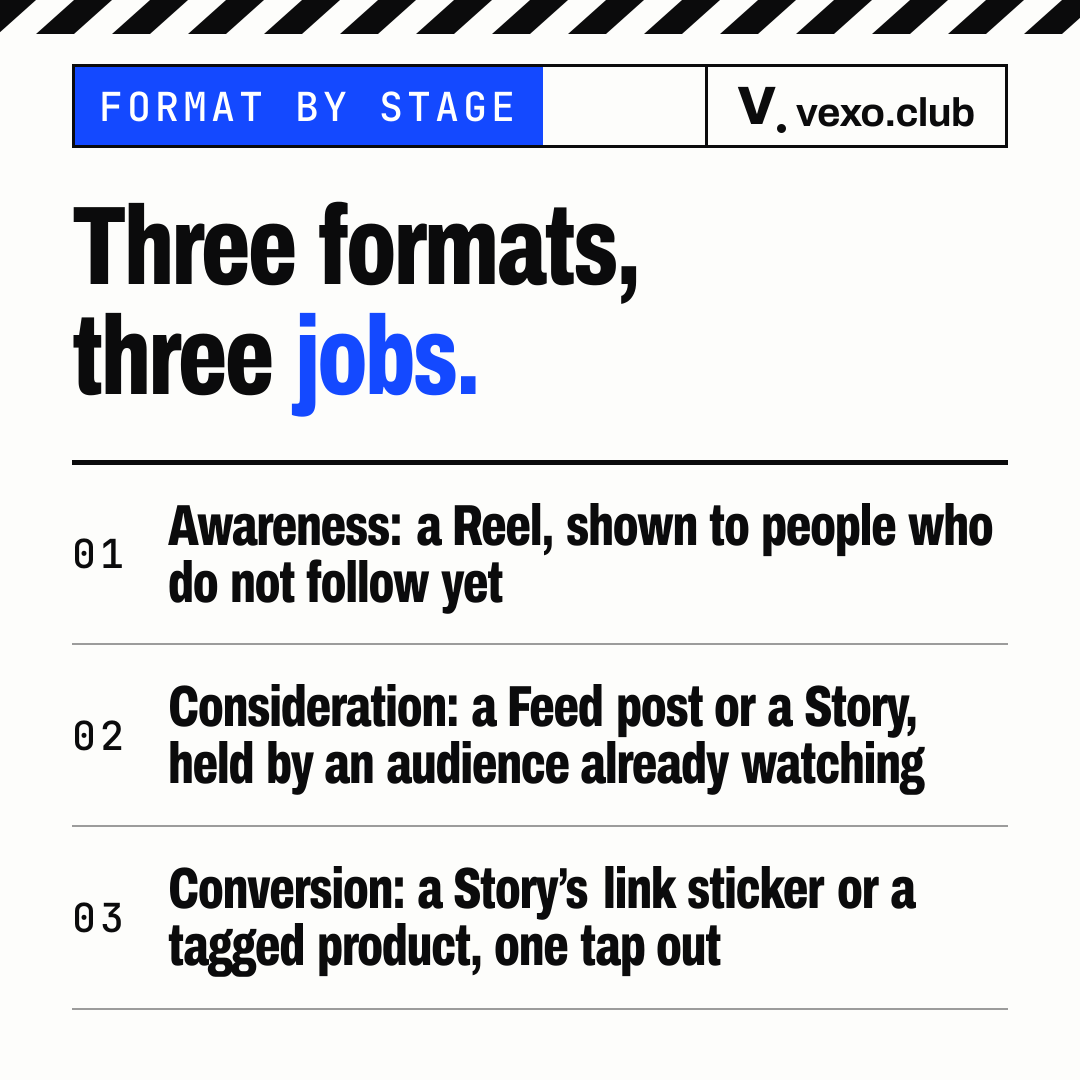
Which format answers which stage of the funnel
Which format carries conversion, the one tap that leaves the app?
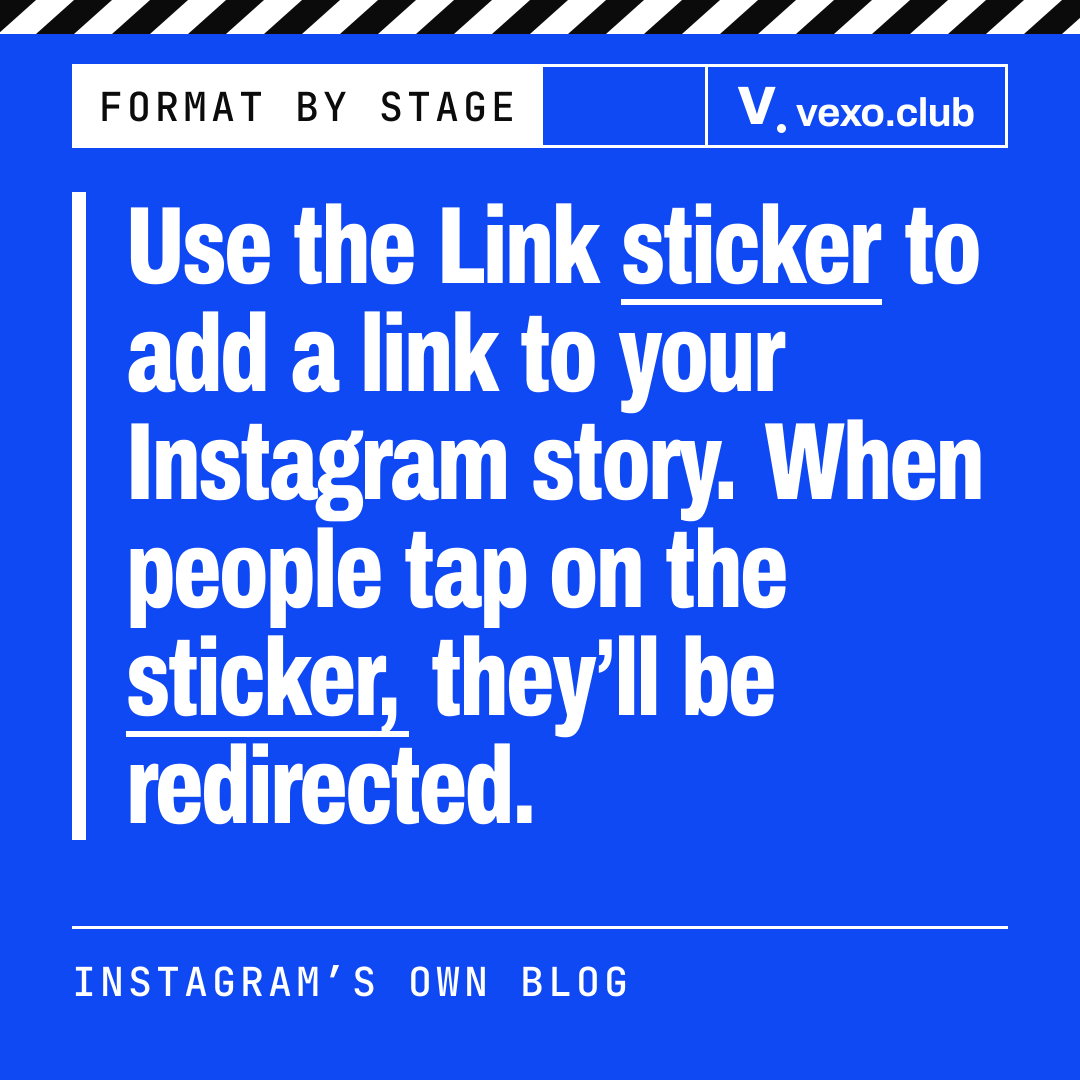
Here the three formats are not close. Instagram’s own blog post Expanding Sharing Links in Stories to Everyone says the link sticker lets any account add a link to a story, and that people who tap the sticker are redirected to it. Neither a Feed post nor a Reel carries a clickable link inside the post itself; both rely on the links in the creator’s bio instead. The other native route to a sale is a tagged product, which Instagram’s shopping pages say can sit on a Reel, a Story or a Feed post wherever the brand has a shop set up, with up to 20 product tags on a single feed post and a tag on a reel taking a viewer to the product page the same way. A brief whose job is a click or a purchase names the link sticker or the product tag, not the format around it, as the thing the content has to carry.
The same brief, across the funnel
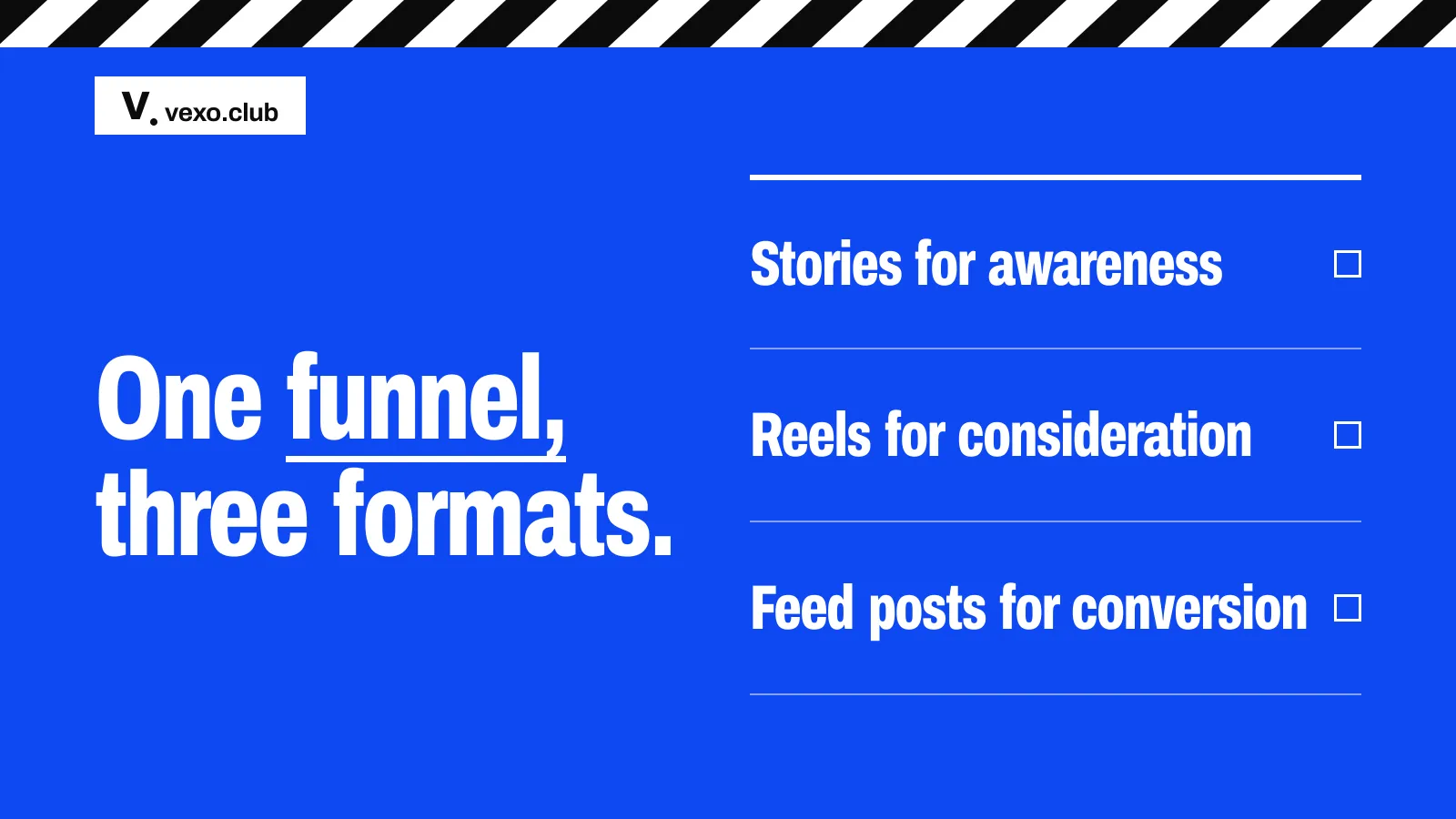
- Awareness A Reel, briefed to stand on its own and reach people who do not follow yet.
- Consideration A Feed post for the permanent record, a Story for the follower reminder.
- Conversion A Story’s link sticker, or a tagged product on whichever format the brief already placed.
Stages in order. The widths are not to scale.
What the link sticker does, in Instagram’s own words
Should a brand shoot one piece and cut it for all three?
Often, and it is the efficient way to brief a creator, but the formats were not built the same way, so one file rarely serves all three without an edit. A Reel built to stand alone, with its own hook in the first seconds and no caption doing the explaining, plays differently as a Story, where a viewer has already chosen to watch the creator and needs less of a hook. A Feed post crops to a grid thumbnail that a Reel or a Story does not have to consider. The content can come from one shoot; the edit, the crop and the call to action should still be set per format rather than copied across.
Briefing one shoot across Stories, Reels and Feed
Do
Name which format carries the link sticker or the product tag before the shoot
Don’t
Assume whichever format gets cut last will carry the call to action
Do
Brief the Reel to work with the sound off and no caption read first
Don’t
Reuse a Story’s casual, already-watching tone as the Reel’s hook
Do
Crop and check the Feed post’s grid thumbnail on its own
Don’t
Judge the Feed post only inside the full-screen preview
Do
Keep the paid partnership label on whichever format runs as a sponsored post
Don’t
Treat the label as a Feed-post-only requirement
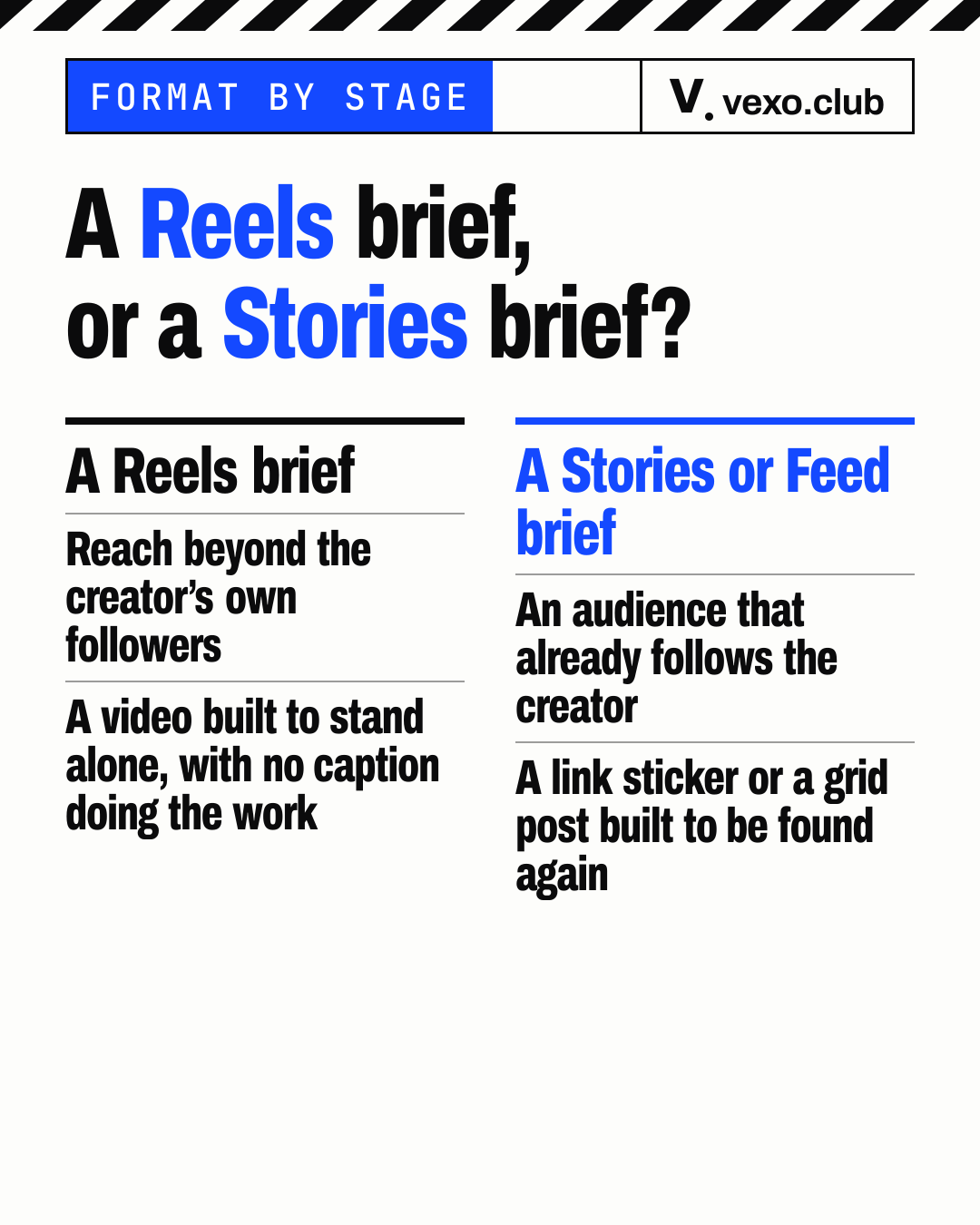
What a Reels brief needs, against what a Stories or Feed brief needs
The reason the edit matters more than the shoot is that each format’s ranking reads different signals. Instagram’s 2023 post Instagram Ranking Explained describes Reels, Feed and Stories as each carrying their own set of signals rather than one shared score, which is why a clip that performs as a Reel does not automatically perform the same way recut as a Story, or shrunk to a grid square in Feed. Briefing the edit per format, rather than briefing the shoot and letting the edit happen afterward, is what keeps that difference from becoming a surprise in the report.
What should a brief settle before it names a format?
The format follows the objective, not the other way round. Influencer marketing budget allocation by goal sets out the same logic for how a budget should shift between awareness, consideration and conversion; this is the format-level version of the same question, and checking an influencer’s audience before you pay is still the step that comes before any of it, whichever format the brief ends up naming.
Before a Stories, Reels or Feed brief goes out
- Which stage this piece is for: awareness, consideration or conversion
- Whether the content needs to reach people who do not already follow the creator, or hold the ones who do
- Whether a clickable link or a tagged product has to sit inside the post, and on which format it will live
- Whether the piece should stand alone, or whether a caption and the creator’s own feed will do part of the work
- Which metric matches the stage, reach and non-follower views for awareness, saves and profile visits for consideration, link taps or tagged-product clicks for conversion
None of this is read from a performance number, because the site publishes none it cannot trace to a record. What we count as reach and influencer marketing KPIs beyond vanity metrics set out how a report should read each platform’s own figures once a campaign is live, kept in the metric’s own name rather than totalled across formats that do not measure the same thing.
The pages on Instagram influencer marketing and Instagram SEO for brands set out how a brief for the platform is run end to end. The vexo.club roster records which creators are active on which formats; the desk reads that against the brief rather than defaulting to whichever format a creator posts most. A brief naming the stage and the format can be sent to the desk.
Questions brands ask
Instagram Stories vs Reels for brands: which is better for awareness? A Reel, because it is the format Instagram shows widely to people who do not already follow the creator, through the Reels tab, Explore and Search. A Story is seen mostly by existing followers, so it holds an audience rather than finding a new one.
Which Instagram format for influencer marketing suits conversion? None of the three formats alone; the link sticker inside a Story or a tagged product on whichever format the brief already placed is what carries a click or a purchase. Neither a Feed post nor a Reel carries a clickable link inside the post itself.
Do Feed posts still matter next to Reels and Stories? Yes, for a different reason than either. A Feed post stays on the profile grid until it is removed, so it is the one of the three still there when someone visits the profile later or searches the creator’s name, which a 24-hour Story and a Reels-tab-first Reel are not built to be.
Can a brand run the same shoot across all three formats? Yes, and it is a common way to brief a creator, but the edit, the crop and the call to action should be set per format. A Reel built to work with no caption read first plays differently as a Story, and a Feed post crops to a grid thumbnail neither of the other two has to consider.
Does a Story being follower-only make it useless for a new audience? Not useless, just the wrong tool for that one job. A Story still does real work holding and reminding an audience the creator already has, including sending that audience somewhere with the link sticker; it is simply not the format Instagram shows to people outside that audience, which is what a Reel is for.
Sources
- Search and Explore (opens in a new tab) about.instagram.com
- Expanding Sharing Links in Stories to Everyone (opens in a new tab) about.instagram.com
- up to 20 product tags on a single feed post (opens in a new tab) facebook.com
- a tag on a reel (opens in a new tab) facebook.com
- Instagram Ranking Explained (opens in a new tab) about.instagram.com
Cite this page
Instagram Stories vs Reels vs Feed posts for brands: which format for which stage of the funnel. vexo.club, published 13 Nov 2026. https://vexo.club/blog/instagram-stories-vs-reels-vs-feed-posts-for-brands
Influencer marketing across India
Send the desk a brief: it comes back as a shortlist and a directional band, never a public price.
Brief the desk