Reels vs YouTube Shorts for brands: format, discovery, usage rights and measurement
Reels are Instagram’s short video and Shorts are YouTube’s, and both reach people who do not follow the creator. For a brand the difference is where each is found, what the ad tools allow and how views are counted.
Playbooks 12 min read The operators’ desk
In this article11 sections
People search for this as “YouTube Reels vs Shorts”, but Reels belong to Instagram and Shorts belong to YouTube: both are vertical short video that can reach people who do not follow the creator. For a brand the choice comes down to four things — where the creator’s audience is, how each format is found, what each platform’s ad tools and music rules allow, and what each one counts as a view.
This guide comes from vexo.club — an influencer marketing agency run from one desk in Delhi NCR. It compares the two from Instagram’s and YouTube’s own help pages, links each one, and prints no reach, no view count and no result, because none can be quoted without a record behind it. Both platforms change their tools often, so the guide dates the pages it reads.
Reels and Shorts, for a brand
In short
- Both are shown to followers and non-followers, and both are three-minute formats: a reel over three minutes is not recommended to new audiences, and a YouTube video over three minutes is not a Short.
- Shorts are found in the Shorts feed and in YouTube search, on the homepage and on the channel; Reels are found in the Reels tab, Explore and Search.
- Each platform has a tool for a brand to run the creator’s video as an ad, and each has a music rule that can stop it.
- A Short’s view counts every start or replay, with no minimum watch time, so a view on one platform is not a view on the other.
What is the difference between Instagram Reels and YouTube Shorts?
The format is close: vertical video, a creator’s own voice, music and text. The difference is in the system around it. The comparison below sets out what each platform’s own pages say, and where the desk has not read a page, the cell says so and does not guess.
Instagram Reels and YouTube Shorts, from each platform’s own pages
| Instagram Reels | YouTube Shorts | |
|---|---|---|
| Shown to people who do not follow the creator | Yes | Yes |
| Length that keeps the short-video format | Up to three minutes to be recommended to new audiences | Up to three minutes to count as a Short |
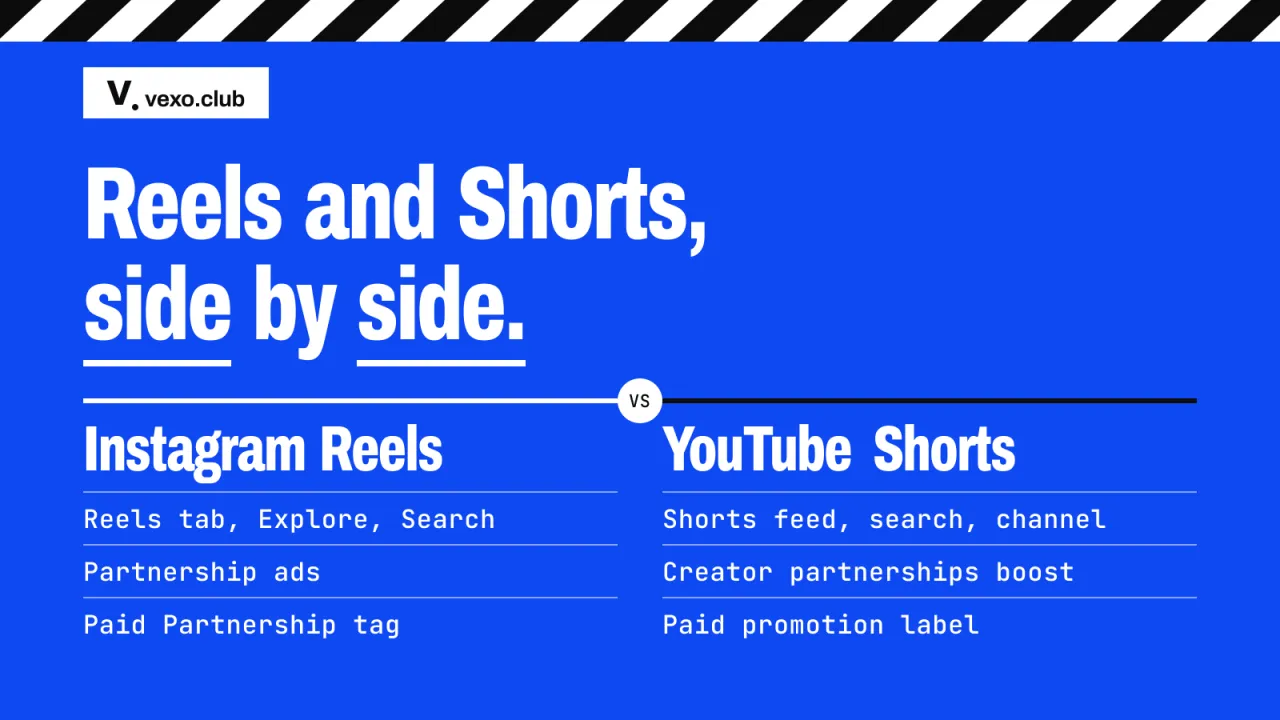
| Where it is found | Reels tab, Explore and Search | Shorts feed, YouTube search, homepage, channel, subscriptions and notifications |
| Brand tool to run the creator’s video as an ad | Partnership ads | Creator partnerships boost, through brand partner access |
| Paid label named in ASCI’s list | “Paid Partnership” tag | “Includes Paid Promotion” tag |
| Music a brand must plan around | Licensed music cannot run as a partnership ad | A Short over one minute with any active copyright claim, including a manual one, is blocked |
| How a view is counted | Not compared here: Instagram defines it on its own help page | A start or replay, no minimum watch time; engaged views reported separately |
| Best for | The creator’s Instagram audience and Meta’s partnership tools | The creator’s YouTube audience, YouTube search and a channel behind the Short |
How are Reels and Shorts discovered?
Instagram’s creator blog post Helping creators of all sizes break through, dated 26 February 2025, says a reel is shown to followers and non-followers, first to a small audience of people Instagram thinks will enjoy it, and then to wider groups when it performs well. It lists signals such as watch time, retention, shares, likes and comments. Reels can also surface through Search, which matches text — names, handles and captions.
YouTube’s help page Get started creating YouTube Shorts says viewers may find Shorts by tapping Shorts in the app and scrolling the Shorts feed, and also in search results across YouTube, on the homepage, featured on the channel homepage, in their subscriptions and in notifications. The practical difference is that a Short has more places to be found again. A Short sits on a channel with a library behind it, while a reel sits on a profile and a grid.
How long can a Reel or a Short be, and what format is allowed?
Both are now three-minute formats for the purposes of recommendation. YouTube’s page Understand three-minute YouTube Shorts says that a video uploaded on or after 15 October 2024, square or vertical and up to three minutes, is categorised as a Short. Instagram’s creators pages say reels over three minutes will not be recommended to new audiences. For quality, Instagram’s reels resolution page asks for a minimum resolution of 720p and a minimum frame rate of 30 frames per second.
What YouTube changed for Shorts, as its pages date it
- 15 October 2024 Square or vertical videos up to three minutes uploaded from this date are Shorts
- 31 March 2025 A Short’s view counts every start or replay, with no minimum watch time; the earlier measure is kept as engaged views
- 8 December 2025 Square or vertical videos up to three minutes from Official Artist Channels are Shorts from this date
Which should a brand book, Reels or Shorts?
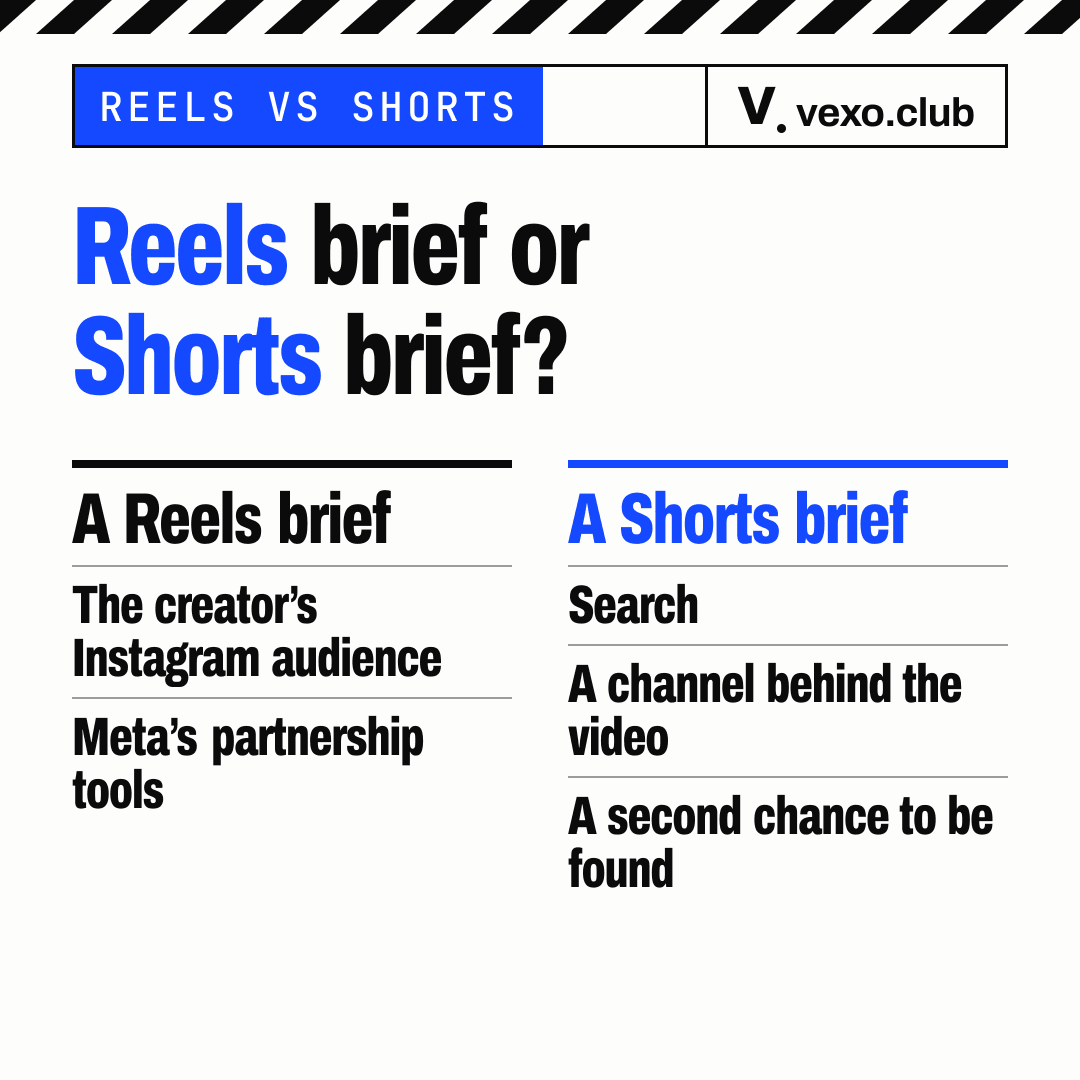
The one on which the creator’s audience already lives, and where the brief’s job is done. A brief that needs the creator’s Instagram audience and Meta’s partnership tools is a Reels brief. A brief that needs search, a channel behind the video and a second chance to be found is a Shorts brief. Many briefs are both, shot once and cut for each.
What a Reels brief needs, and what a Shorts brief needs
The vexo.club roster records the platforms each creator is on, and several are recorded on both Instagram and YouTube. Among them are Nitish Rajput and Ishan Sharma in Tech & Gadgets, Rohit Sachdeva in Beauty & Skincare and Sharan Hegde in Finance & Business, each described on their own profile. The whole list is on the roster. A creator’s record says where they are, not how a format will perform for a brand, so the desk shortlists to the brief and states audience fit per creator.
Who can run a Reel or a Short as an ad, and what about music?
Usage rights decide this, and the platforms say so. Instagram’s Partnership Ads page says partnership ads let a brand run a creator’s content as an ad that reaches beyond both the creator’s and the brand’s existing followers, that reels, stories, static posts and carousels can be run, and that content with licensed music cannot. The creator must grant ad permissions first. YouTube’s brand partner access page says brands can request access to long-form and Shorts videos, to see their organic and paid metrics and to boost them, and it advises creators to discuss usage rights with advertisers and obtain the agreements independently.
Running a creator’s Reel or Short as an ad
Do
Write the right to boost or run the video as an ad, and its length of time, into the contract
Don’t
Assume the platform’s partnership tool is the licence
Do
Ask the creator to grant the platform permission, or share brand partner access, before launch
Don’t
Wait until the week the ad should start
Do
Choose royalty-free or cleared music when the video may run as an ad
Don’t
Use licensed music in a video that is meant to be boosted
Do
Keep the paid label on: the Paid Partnership tag on Instagram, the paid promotion label on YouTube
Don’t
Treat the label as optional because the post is also an ad
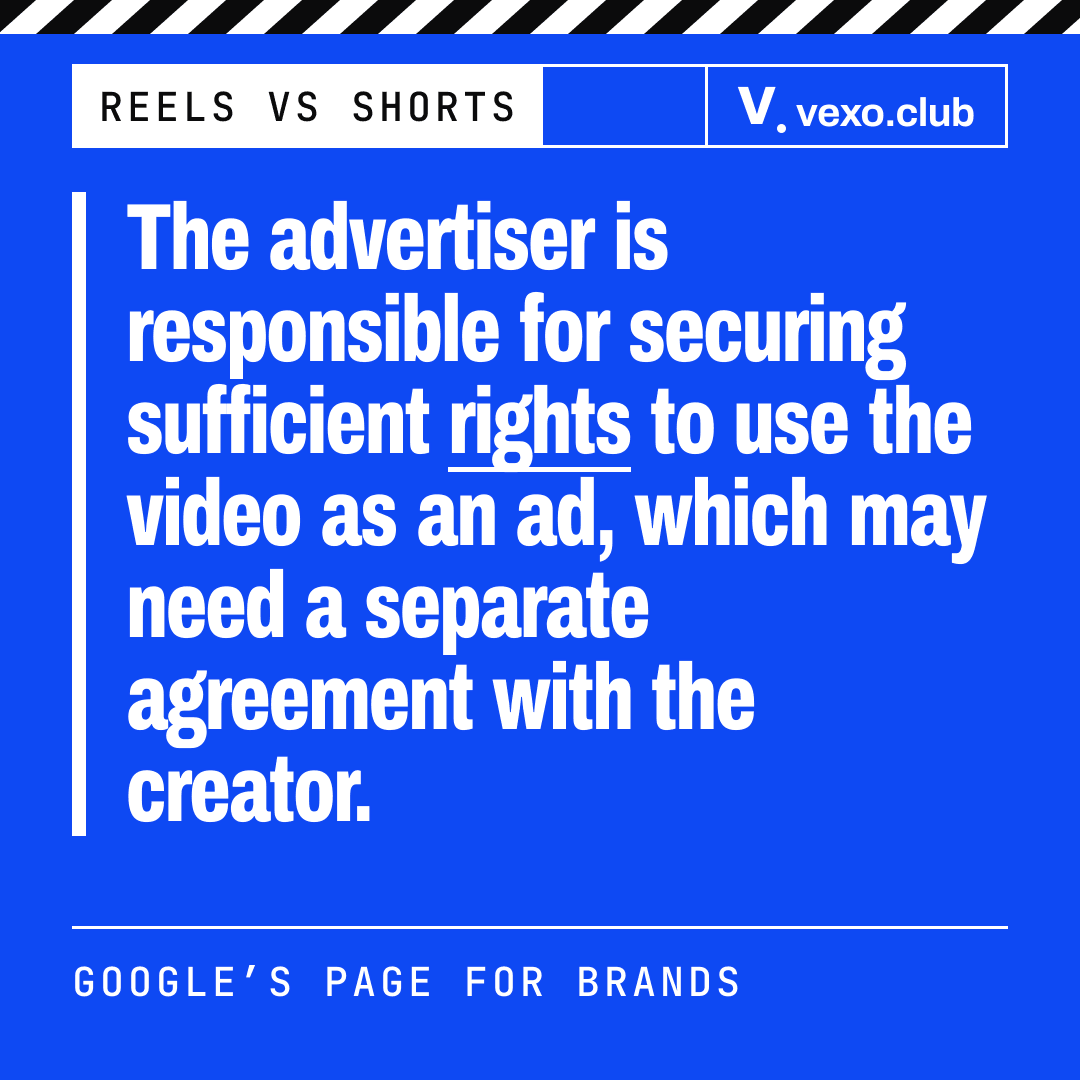
Google’s own page for brands, Creator partnerships boost, says the advertiser is responsible for securing sufficient rights to use the video as an ad, which may need a separate agreement with the creator. That is the same point from the other side. Read usage rights and creator whitelisting explained before the contract, because boosting a post is paid for and written down separately from making it.
Who secures the rights to run a Short as an ad
How do you measure Reels against Shorts?
Carefully, because the two platforms define a view in their own words. YouTube’s page says that from 31 March 2025 a Short’s view counts the number of times it starts to play or replays, with no minimum watch time, and that “engaged views” keeps the earlier measure so a creator can see how many viewers chose to continue watching. A view on a Short is therefore not the same thing as a view on a reel, and Instagram’s own page should be read for its definition of one.
So the report names the metric as the platform names it, and keeps each platform’s figures in their own column. A brand that compares the two asks the creator for each platform’s export over the same dates, and keeps the metric names as they are printed. The brand asks for screenshots that show the metric’s name and the date range. The method for turning platform figures into a brand report is in measuring influencer marketing ROI without inventing it and what we count as reach.
How long must the paid label stay on screen?
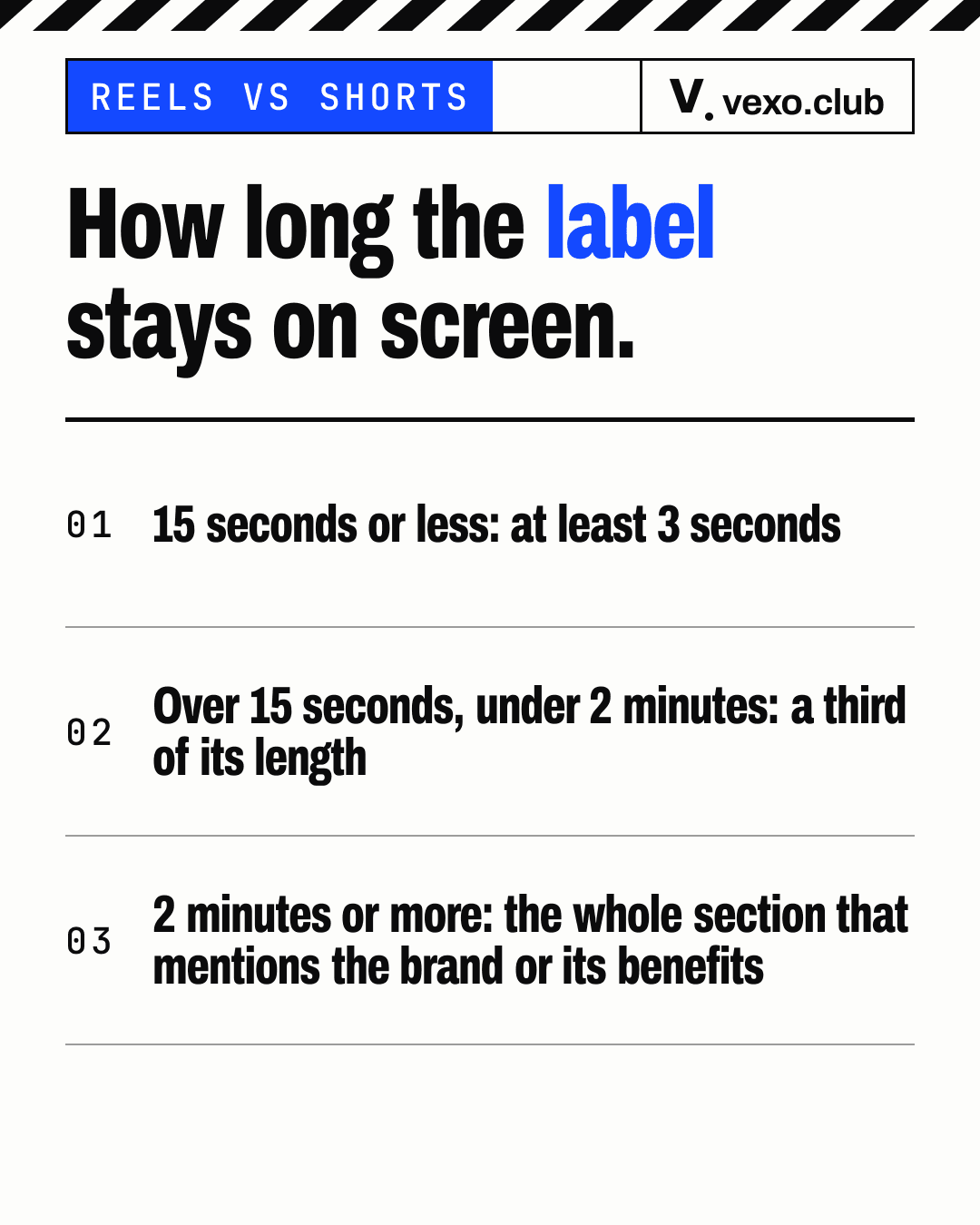
ASCI’s influencer guidelines set the label’s time on screen for a picture or video post that has no accompanying text, with Instagram Stories named as an example. For a video of 15 seconds or less, the label must stay for at least 3 seconds. For a video longer than 15 seconds but under 2 minutes, it should stay for a third of the length of the video. For a video of 2 minutes or more, it must stay for the whole of the section in which the brand or its features and benefits are mentioned. Reels and Shorts can run to three minutes, so the longest ones fall in the third band when the label is superimposed. The brief names the label and its timing, and the review checks both.
How long ASCI’s paid label stays on screen
Where do Stories fit, next to Reels and Shorts?
Stories are a follower format. Instagram’s 2023 post Instagram Ranking Explained says the stories a person sees come from the people they have chosen to follow, as well as ads, so a story is a way to reach an audience the creator already has. Reels and Shorts are the formats Instagram and YouTube recommend to people who do not follow. A brand that wants to reach new people books Reels or Shorts, and one that wants to remind an existing audience can add a story to the same brief.
What are the pros and cons of using one video on both?
Shooting once and publishing twice is the common plan, and it works if the file is prepared for both. Instagram’s 2023 post Instagram Ranking Explained says it may make low-resolution or watermarked reels, and reels already posted on Instagram, less visible, and Instagram’s recommendations guidelines say it avoids recommending unoriginal content repurposed from another source with only minor edits.
One video, published to Reels and Shorts
Advantages
- One shoot and one edit serve two audiences
- The creator’s Instagram and YouTube audiences can both be reached Where the creator is on both.
- A second chance to be found, on a platform with its own search
Drawbacks
- A watermark from another app can make a reel less visible
- Views are counted differently, so the two columns do not add up
- Music that is fine on one platform can block the ad on the other
- Each platform has its own paid label and its own ad permission step
Verdict Shoot once and export clean twice: no watermark, music cleared for both, and each platform’s label in place.
What should a brand check before booking Reels or Shorts?
Settle where the audience is and what the video is for, then the rights, then the label. The audience check comes before any rate, and how to check an influencer’s audience before you pay sets out the method. ASCI disclosure for brands covers the label.
Before a Reels or Shorts brief goes out
- Where the creator’s audience is: Instagram, YouTube or both, from the creator’s own analytics
- What the video is for: reach, search, or a clip the brand will run as an ad
- Whether the contract gives the right to boost it, and for how long
- Whether the music is cleared for the ad, on each platform
- A clean file for each platform, with no other app’s watermark
- The paid label, in the form each platform uses, and ASCI’s wording
- Which metric each platform reports, and its name in the report
The pages on Instagram influencer marketing and YouTube influencer marketing set out how a brief for each platform is run, and a brief for Delhi NCR starts at the Delhi desk page. A brief for either or both can be sent to the desk.
Questions brands ask
Is it YouTube Reels or YouTube Shorts? Shorts. Reels are Instagram’s short video, and Shorts are YouTube’s. People often search for “YouTube Reels vs Shorts” when they mean the two together, and this guide compares them from each platform’s own help pages.
Which is better for brand reach, Reels or Shorts? No source settles it, and it depends on the creator, the category and the month. Both are shown to non-followers. The useful question is where the creator’s audience already is, and the creator’s own analytics answer it.
How long can a Short be? Up to three minutes, for a square or vertical video uploaded on or after 15 October 2024, according to YouTube’s help page. Instagram’s creators pages say reels over three minutes will not be recommended to new audiences.
Can a brand run a creator’s Reel or Short as an ad? Yes, with permission. Instagram has partnership ads, which need the creator’s ad permissions and cannot use licensed music. YouTube has brand partner access and Creator partnerships boost. The right to use the video as an ad is a contract term.
Does the vexo.club roster have creators on both? Yes. The roster records the platforms each creator is on, and several are recorded on both Instagram and YouTube. The desk shortlists to the brief and states audience fit per creator before any rate.
Influencer marketing across India
Send the desk a brief — it comes back as a shortlist and a directional band, never a public price.
Brief the desk