Instagram broadcast channels, WhatsApp channels and communities for brands: limits, consent and the creator brief
A channel is a public, one-way broadcast a creator owns and a brand can book a message in; a WhatsApp Community is a private, capped room nobody sells placements in. What each allows, how a paid channel post is disclosed in India, where consent and the DPDP Act bite, and a brief to paste.
Playbooks 20 min read The vexo.club desk
In this article14 sections
Short answer: a channel is a public one-way broadcast that a creator owns and a brand can book a single message in. A WhatsApp Community is a private room with a cap on its size and nobody sells placements in it. Instagram and WhatsApp both now carry a paid partnership label for channel messages, so the format can be sponsored in the open. What it does not do is hand a brand anyone’s phone number. That has to be earned separately with consent and it is where most of the risk sits.
This is for a brand manager who has been offered a channel post on a creator’s rate card or wants to start a channel. We read Meta’s help centre pages for Instagram and WhatsApp, WhatsApp’s policy pages, the DPDP Act and Rules and ASCI’s influencer guidelines on 24 October 2026, and where an agency blog disagrees with them we followed the pages. It is tempting to treat WhatsApp Communities as a creator format alongside channels. They are different products and the difference changes the advice, so Communities get their own section.
Channels for brands, in short
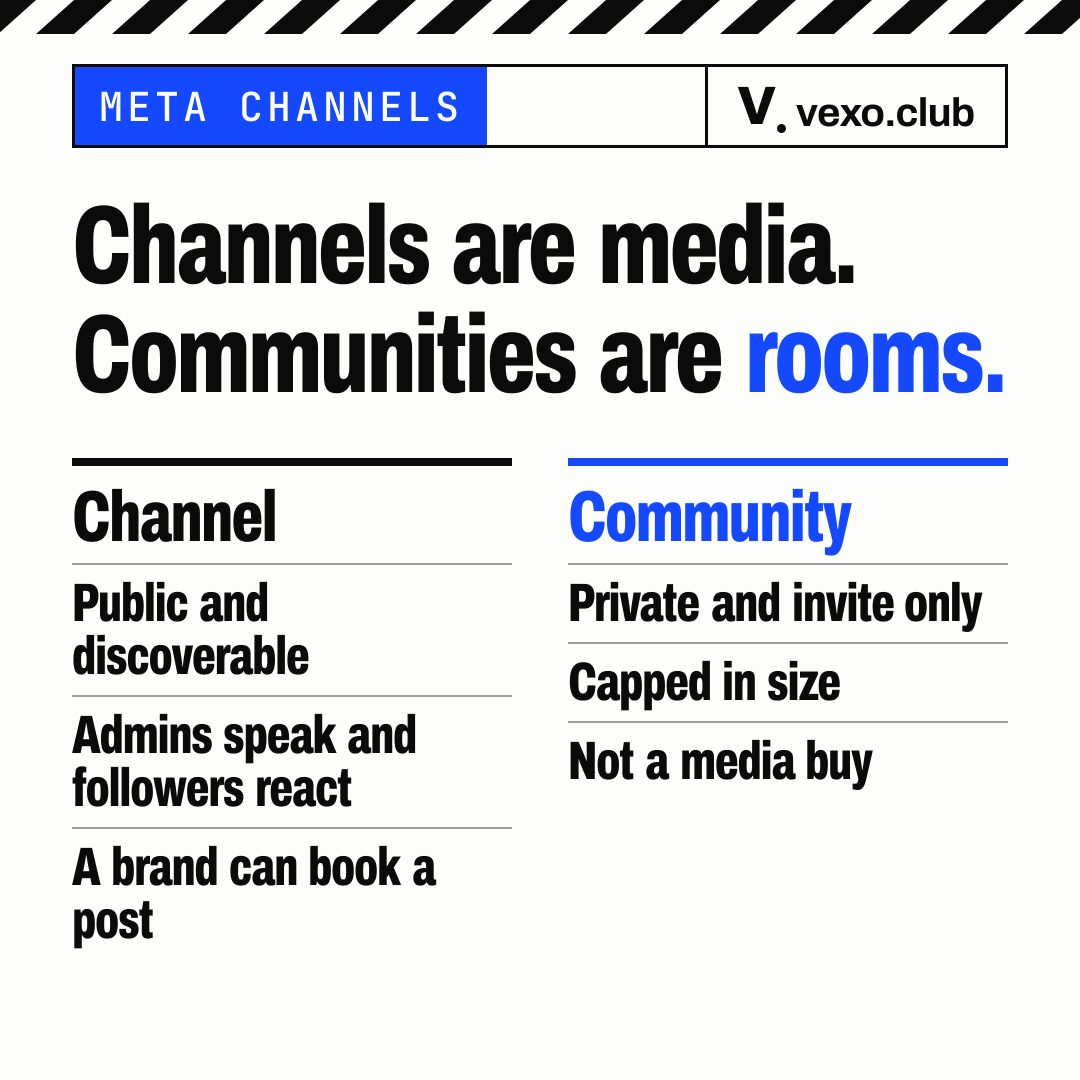
- A channel is public and one-way. Admins speak and followers react or vote. A WhatsApp Community is private and invite-only, and nobody sells placements in it.
- A brand can book a creator’s channel message by contract. Neither platform gives you a booking tool, and neither pays the creator for it.
- Both platforms carry a paid partnership label for channel messages. ASCI still wants the words Ad or Paid partnership up front as well.
- A channel gives the brand no phone numbers. Moving followers onto the brand’s own list needs a named, specific opt-in, and the DPDP consent rules start on the Government’s eighteen-month clock.
- Brief one message with one action and one tracked link. Ask for proof the same day because public history is short.
What is an Instagram broadcast channel, and who can start one?
It is a public one-to-many thread that sits in the creator’s Instagram inbox. Meta’s launch post in February 2023 lists text, photo, video, voice notes and polls. Meta’s help page for creating a channel says members can react, reply and vote in polls but cannot send messages of their own. Because channels are public they are discoverable by anyone on Instagram. When the creator sends the first message every follower gets a notification inviting them to join.
Who can start one is where agency blogs go wrong. Several still say ten thousand followers. Meta’s help page, as of 24 October 2026, says channels can be started by a public account with more than 1,000 followers. It also says channels are slowly being released and are not available to everyone. So a creator over the line may still not see the option. Ask for a screenshot of the live channel, not a promise that one is coming.
Three details change how you brief. Reactions, replies and poll answers are visible to anyone on Instagram. Admins can add collaborators who can also send messages, and Meta warns those messages are discoverable even if the collaborator’s account is private. And the creator can set an end time on a channel, so confirm it will still be open on your date. The admin page also covers moderators. Ask who holds each role.
What is a WhatsApp Channel, and what can an admin send?
A WhatsApp Channel is a one-way broadcast in the Updates tab, away from chats. WhatsApp’s help page lists text, images, video, stickers, links, audio and polls, and the page on sharing an update adds that you cannot send PDFs. Followers cannot reply. They can react with an emoji or vote. WhatsApp describes the audience as unlimited and we found no follower threshold for creating one. Channels are also available through the WhatsApp Business app, so a brand can run its own.
Four limits matter to a buyer. Every channel is public: there is no private channel and an admin cannot remove a follower. Channels are not end-to-end encrypted and followers can save any media. Anyone can see the last 30 days of updates whether they follow or not, which is your window to capture proof. And followers do not see the admin’s number, though an admin can switch on a named admin profile separate from their personal one. See the safety page for admins and the admin controls.
What the creator can see afterwards is thin. Only admins see views on each update, plus reactions and poll results. The insights page says reported numbers may be delayed by about a week and that insights are not available for channels under 100 followers. Your evidence will be the creator’s own screenshots, so agree what they will capture before you book.
Where do WhatsApp Communities fit?
They do not, for a paid placement. WhatsApp’s group-or-community page describes communities as private, join-by-invite and not publicly searchable. A community holds up to 100 groups and the create page says up to 2,000 members in total. Everyone lands in an Announcements group where only admins post. Members can reply and the admin page says replies cannot be turned off.
Two things trip brands. The WhatsApp Business app cannot currently create a community, so a brand-run community has to be started from someone’s personal number, though WhatsApp says ownership can later be transferred to a Business app account. And WhatsApp’s community guidance tells admins never to post invite links on public web pages and to honour anyone who removes themselves. A community is a room you invite people into after they ask. It suits a launch group of existing customers and is no place to buy reach. A broadcast list is a third thing again: individual chats to people who saved your number, and nothing a creator can sell you.
Channel or community: what each one is for
How do the four formats compare?
The creator feed post is the yardstick here because that is what most rate cards price.
Four formats, side by side
| Who can see it | Who can speak | Can a brand book it | Disclosure tool | |
|---|---|---|---|---|
| Instagram broadcast channel | Public, discoverable on Instagram | Admin and collaborators. Members react, reply and vote | Yes, by contract with the creator | Paid partnership tool, required |
| WhatsApp Channel | Public. Anyone can find and view it | Admins only. Followers react and vote | Yes, by contract with the creator | Paid partnership label, rolling out |
| WhatsApp Community | Private. Invite only, not searchable | Admins announce. Members reply | No, not as a media buy | No tool. ASCI rules still apply |
| Creator feed post | Public, ranked by the feed | Creator. Audience comments | Yes, the usual deal | Paid partnership tool, required |
How is a channel message different from a feed post?
A feed post goes out to be found. A channel message goes to people who raised a hand. That makes the audience smaller and warmer and the message an interruption, because it arrives as a notification in a space people use for conversations. So a channel earns its place late in the funnel: a launch day, a restock, a code, an event reminder. It is a poor way to introduce a brand nobody has heard of. If awareness is the goal buy feed or reels, and the comparison of stories, reels and feed posts covers that choice.
You will read claims that channel messages reach everyone at open rates far above a feed post. Meta publishes no such figure for Instagram channels that we could find, and WhatsApp gives admins views per update and reach over 30 days and nothing more. Treat a quoted open rate as a sales line. The honest unit is views and reactions on recent messages, shown as screenshots.
Frequency is the cost. WhatsApp’s Channels Guidelines ask admins to avoid too many or low-quality updates because they lead people to unfollow. One sponsored message per window beats three, and a creator who protects their goodwill is worth listening to.
Can a brand pay a creator for a channel post?
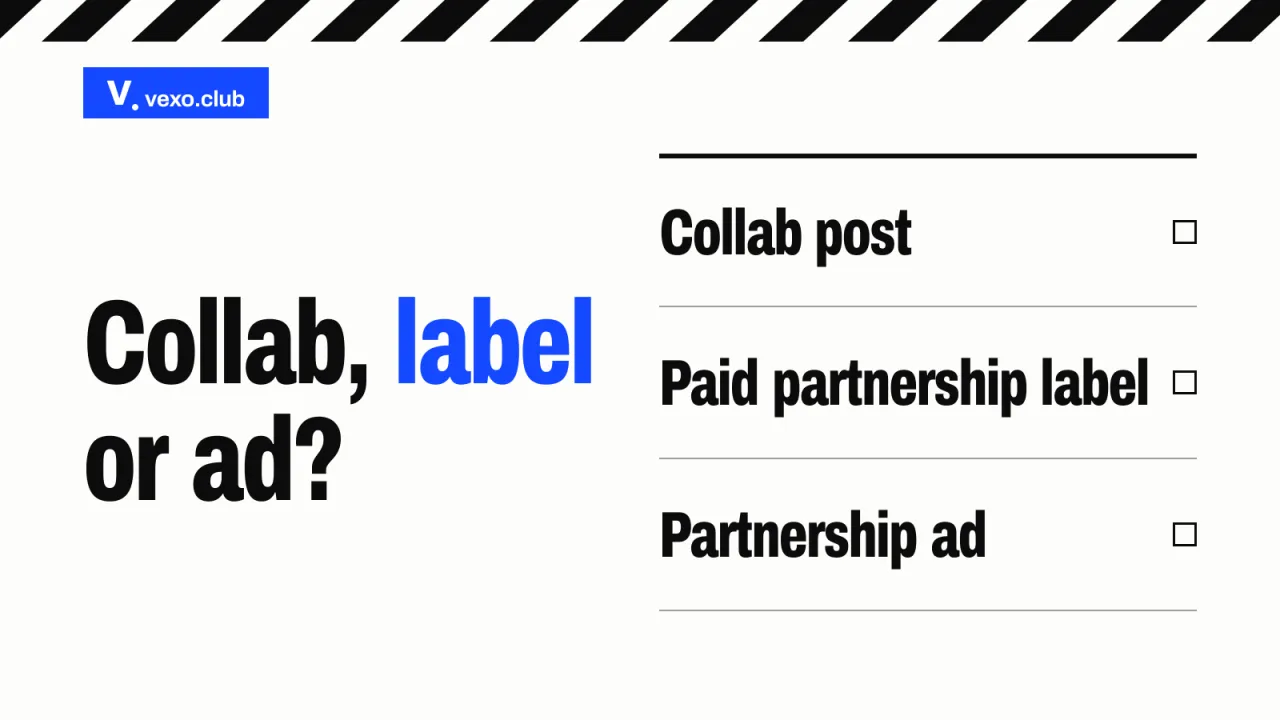
Yes, and the platforms expect it. Meta’s page on the paid partnership label names Broadcast Channels among the places a partnership can be disclosed, and the create-a-channel page says organic branded content in a channel must use the paid partnership tool. WhatsApp has a help page on labelling paid partnerships on channels saying an admin can mark an update to tell the audience they are paid or otherwise compensated. It adds that the feature is rolling out gradually.
What neither platform gives you is a booking tool. We found no WhatsApp feature that lets a brand buy a creator’s channel, and Instagram’s Creator Marketplace project page gives reels, posts, live videos and stories as its examples of requested content. So a channel placement is a contract between you and the creator. They set the price and you pay them directly, with TDS and GST handled as for any other deliverable (TDS on influencer payments has the mechanics). We do not quote a rate because the ranges in circulation cite nothing we could trace. Ask for a line item in the package and compare it with the same creator’s feed post.
One Meta rule shapes the brief. The Branded Content Policies say creators cannot accept anything of value to post content that does not feature themselves or that they were not involved in creating. A message written by your team and pasted in word for word sits badly with that. Give the creator the claims you can substantiate and the link. Let them write it.
Which categories should stay out of a channel?
Start with the platform lists. Meta’s branded content policy prohibits promotion of tobacco and vaping products, drugs, weapons, adult products, payday loans, multilevel marketing and initial coin offerings among others. It allows alcohol, subscription services, financial and insurance products and cosmetic procedures and weight loss only with audience restrictions. We could not confirm that those controls apply to channel messages. If the creator cannot show them to you, do not run a restricted category in a channel.
WhatsApp’s Channels Guidelines say channels should not be used to offer or transact in regulated or restricted goods. The separate Business Messaging Policy bars categories such as real money gaming, alcohol and tobacco, medical products and multilevel marketing from WhatsApp for Business. That governs the brand’s own number and not a creator’s channel, but it shows where WhatsApp’s tolerance ends. Finance creators also carry the qualification duties in finfluencers in India, channel or not.
How must a paid channel post be disclosed in India?
Twice: once with the platform’s tool and once in plain words. ASCI’s influencer guidelines require a disclosure label on any advertisement an influencer publishes where there is a material connection, which covers free products and other benefits as well as payment. The label must be upfront and prominent. It is likely to be missed behind a MORE click or in a block of hashtags. Using a platform’s tool should be considered in addition to the influencer’s own disclosure. The guidelines count sponsored posts and mobile communications content as digital media, so the desk reads a public channel message as in scope. ASCI has published no channel-specific note.
The permitted labels include Ad, Advertisement, Sponsored, Collaboration, Partnership and the Instagram paid partnership tag, in English or the language of the message. For audio the label must be announced at the beginning and the end, which matters for voice notes. Responsibility is shared between advertiser and influencer. For finance and health the 2023 addendum wants qualifications stated up front. The wider rules are in ASCI disclosure rules for brands.
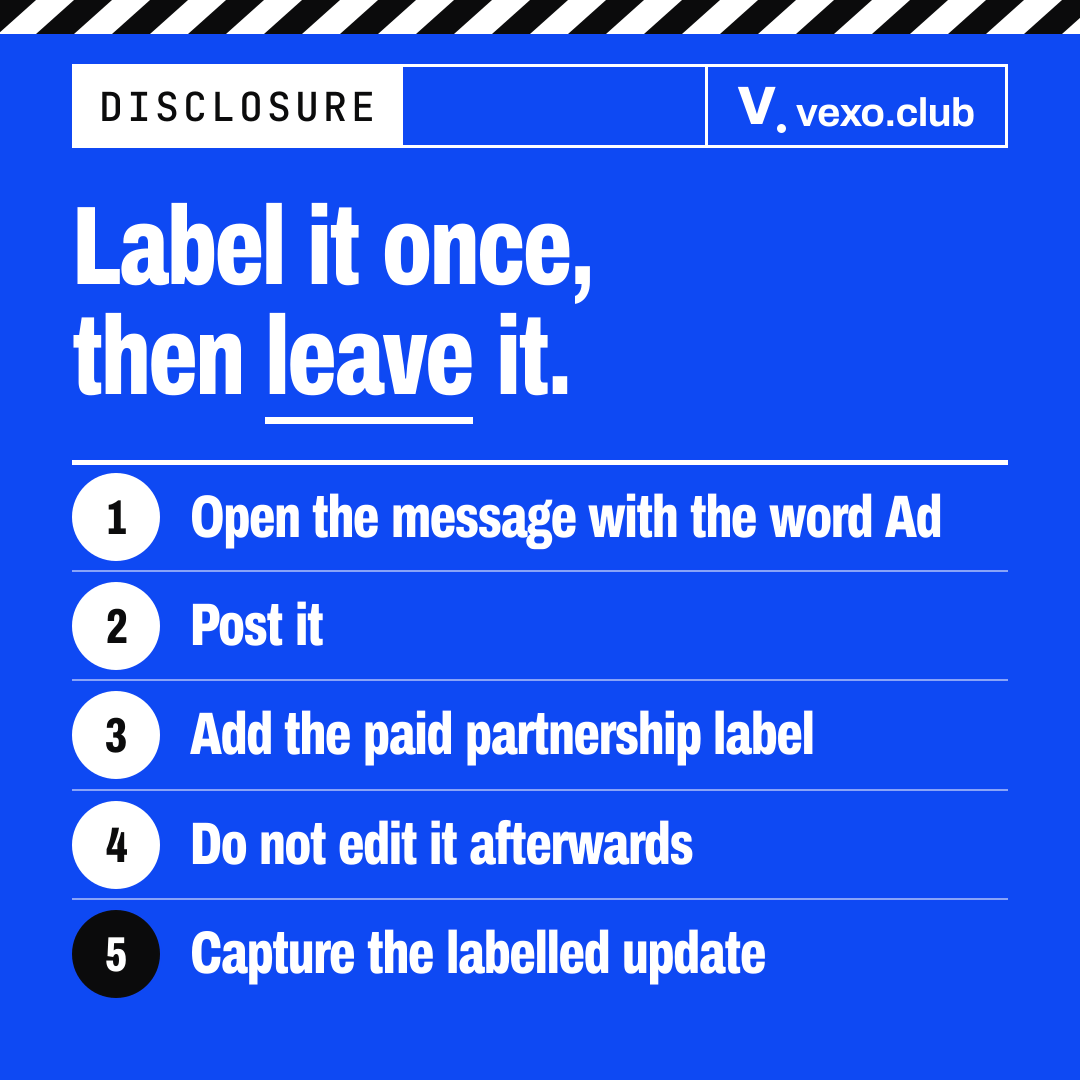
The mechanics differ. On Instagram the creator tags your professional account and you approve the request, and until you do the post carries the label without your name. On WhatsApp there is no approval step. The admin posts the update and then adds the label from its menu. The label cannot be removed once added, so a mistake means deleting the update and sending it again. A forwarded update does not carry the label and an edited one needs it added again. So the word Ad in the text is not a duplicate. It is the only disclosure that survives a forward. The Instagram paid partnership guide covers the feed version.
The order for a labelled channel post
Do consent rules and the DPDP Act apply to a channel?
Separate three situations. The first is a follower joining the creator’s channel. That is their choice and the platform holds the data. The creator sees more than you might expect: on WhatsApp the follower list shows profile names and photos depending on privacy settings, and reaction and poll details show who reacted or voted and when. The brand sees none of that unless the creator passes it on. So the brief says aggregate results only, no names and no screenshots that show who voted. A brand that asks for a voter list has asked for personal data it has no notice or consent for.
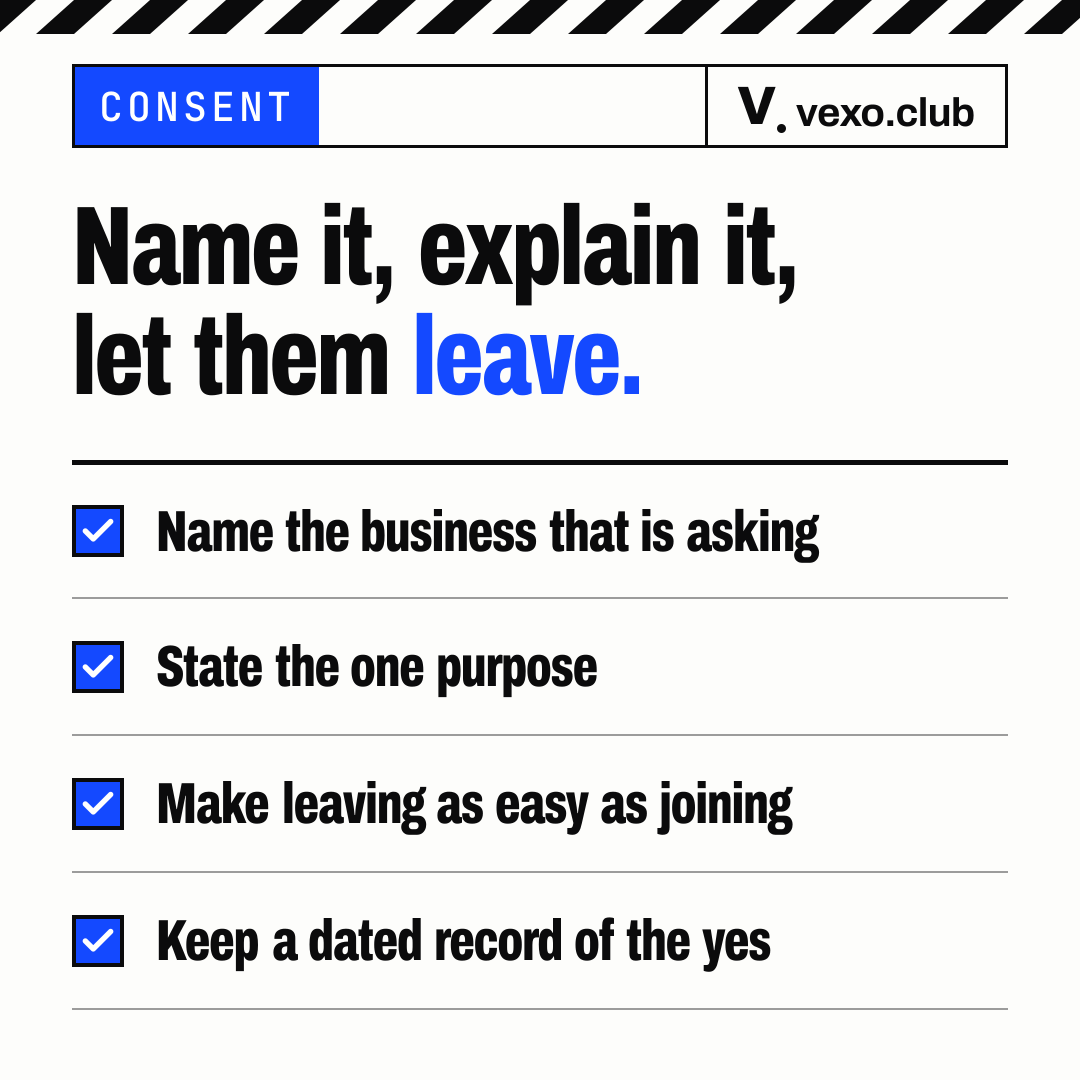
The second is the brand moving followers onto its own list: a WhatsApp Business number, an email list or a page that collects a mobile number. Now the brand is collecting personal data and needs consent. Under the DPDP Act, 2023 section 5 a request for consent must be accompanied or preceded by a notice of what data and what purpose and how to withdraw and complain. Section 6 says consent must be free, specific, informed, unconditional and unambiguous with a clear affirmative action and limited to data necessary for the purpose. Withdrawal must be as easy as giving it, the notice must be offered in English or an Eighth Schedule language and the brand must be able to prove both.
Timing matters. The DPDP Rules, 2025 bring Rule 3, the notice, into force eighteen months after the gazette date of 13 November 2025. The Government’s commencement notification puts sections 3 to 17 of the Act on the same clock. That reading comes from law-firm summaries as well as the Rules, so check the gazette. That is roughly May 2027, so these duties are not yet in force on 24 October 2026. Do not read that as a gap. Section 5(2) says consent given before commencement needs a notice afterwards, so a list built carelessly now gets repaired later.
The third is the brand messaging a person on its own WhatsApp number, and WhatsApp’s policy applies today. The Business Messaging Policy says a business may contact people only if they gave their number and gave opt-in permission confirming they want later messages from that business. The opt-in page adds that the business must say clearly that the person is opting in and name itself. It suggests separate opt-in by message category and clear opt-out instructions, and WhatsApp may limit a business’s sending after significant negative feedback. A follow, a reaction or a poll vote on a creator’s channel is not that opt-in. Neither is a number you were handed.
Moving a creator’s audience toward your own list
Do
Send people to a page that names the brand and the one purpose before it asks for a number
Don’t
Ask the creator for follower names or screenshots of who voted
Do
Take a separate yes for each kind of message the brand will send
Don’t
Treat a follow or a poll vote as consent to be messaged
Do
Make leaving as easy as joining and honour it when someone leaves
Don’t
Add someone back to a community after they removed themselves
Do
Keep a dated record of every yes in the brand’s own files
Don’t
Rely on the creator’s memory that people agreed
One more edge. The Act defines a child as anyone under eighteen and bars tracking, behavioural monitoring and targeted advertising directed at children in section 9, subject to exemptions the Rules set out. A creator with a teenage audience is no safe place for a data-collecting call to action, so ask about the audience first. And if all you want is a repeat touchpoint, a channel of your own gives you that without collecting data. You rent the attention and never see a number. For many brands that is the right trade.
What a usable opt-in carries
What do experienced buyers check before booking a channel post?
Most failures are boring. The member count quoted is the creator’s Instagram follower count, not the channel’s. The label is added and then someone edits the copy, which removes it on WhatsApp. Nobody captures the post before the 30-day window closes. A collaborator posts without telling you. The channel was set to end before your date. Each of those is a line in the brief or the contract. Influencer contract clauses covers the general terms and the brief below adds the channel ones.
How do you brief a creator for a channel post?
Keep it shorter than the message. WhatsApp’s own advice to admins is short written updates focused on one topic. Here is a paste-ready brief to adapt:
- Objective: one action. Say which (join a waitlist, use a code, open a page) and nothing else.
- Message: written by you in your own voice. We send the claims we can substantiate and one link. We review claims only and do not rewrite your tone.
- Disclosure: start the message with the word Ad in the language you write in. Add the platform’s paid partnership tool. Once labelled do not edit the message. For voice notes say it is a paid partnership at the start and the end.
- Link: use only the tracked link we send. Do not shorten it.
- Window: post on the agreed date within the agreed hours IST and tell us when it is live. Keep it up for the agreed period.
- Data: share totals only. No follower names, no voter lists and no screenshots showing who reacted. Do not collect numbers for us.
- Proof: within a day send a screenshot of the live labelled message with the channel name visible. Send views and reactions when they show.
- Roles: tell us who the admins and collaborators are. No one else posts brand content in this channel.
Before you sign ask four questions verbatim. Can you show me the live channel and who has joined? What did your last three messages get in views and reactions? Who else can post? Is the paid partnership option in your app today? The last one matters on WhatsApp where the label is a gradual rollout. If it is missing the plain words carry the whole disclosure, so agree them in advance. The generic version of this brief is in briefing a creator.
Before a channel post is booked
- The channel is live and the creator has shown it to you
- The member count is the channel’s own and not the account’s follower count
- Recent messages show views and reactions
- Admins and collaborators are named
- The paid partnership tool is available in the creator’s app
- The first words of the message say Ad in the message’s own language
- Copy is written by the creator and the brand has checked claims only
- Proof is due within a day
An illustrative scenario with no real figures. A D2C tea brand restocks a sold-out blend and books one message with a creator whose channel is live. The brief names one action: a waitlist page that names the brand and asks for an email address for a stated purpose. The creator writes the message, opens it with Ad, adds the label, posts at an agreed hour and sends a screenshot that evening. The brand sees visits to its tracked link and the sign-ups it asked for with consent. Nobody handed over a follower list.
From brief to proof
- Confirm the channel is live A screenshot of the channel page and who holds each role
- Agree one action and one tracked link Plus the window in IST and how long it stays up
- Creator drafts in their own voice The brand checks claims only
- Disclose then stop editing Ad first, platform label next, no edits afterwards
- Post inside the window The creator says when it is live
- Capture proof the same day Before the public history window closes
When is a channel the wrong buy?
Skip it when the brand is unknown and the goal is awareness. Skip it when you cannot name the one action. Skip it when the category is restricted on the platform or the creator’s audience is young. And skip it when you only want reach: a channel with a few hundred members is a small audience however large the creator’s following. Treat a channel as a small bonus in a package or a single message at a launch. Measuring influencer marketing ROI covers how to read the result without inflating it.
The shape of a channel brief
What to do this week
- Ask the next creator you work with whether they run a channel and ask them to show it live.
- Check the creator’s app for the paid partnership option on the platform you are buying.
- Write the one-action brief above and cut it to half a page.
- Build or fix the opt-in page and have counsel read the DPDP notice text before May 2027.
Questions brands ask
Can a brand run its own Instagram or WhatsApp channel? Yes on both. Meta’s page says a public account with more than 1,000 followers can start an Instagram channel though rollout is gradual. WhatsApp says Channels can be reached through the Business app. Both are public and neither gives you follower phone numbers.
Do channel messages reach every follower and what is the open rate? Neither platform publishes an open rate for channels that we could find. WhatsApp gives admins views per update and reach over 30 days. Anyone quoting an open rate is quoting a guess. Ask for screenshots of recent views and reactions instead.
Is the paid partnership label enough for ASCI? No. ASCI says using the platform’s tool should be considered in addition to the influencer’s own disclosure. Open the message with Ad or Paid partnership in the language of the message. On WhatsApp the label does not survive a forward or an edit so the words matter more.
Can I add customers to a WhatsApp Community or message them without asking? Not safely. WhatsApp’s business policy requires opt-in that names the business. The DPDP consent rules start on the eighteen-month clock from November 2025 and ask for a specific purpose and an easy exit. WhatsApp’s community guidance says to honour anyone who removes themselves.
How much does a channel post cost? The desk has no verified rate and will not invent one. Published ranges cite nothing from Meta that we could trace. Ask the creator to price it as a line in the package with their member count and recent reactions shown, and compare it with their feed post.
What are the size limits? A WhatsApp Community holds up to 2,000 members and up to 100 groups. WhatsApp describes Channels as an unlimited audience and the Instagram help pages we read state no member cap for channels. The eligibility line on Instagram is a public account with more than 1,000 followers. WhatsApp insights are not available for channels under 100 followers.
If you have a channel placement on a rate card and want a second read of the brief, the consent wording or the disclosure order, send it through the contact page. vexo.club is a desk in Delhi NCR and the answer will be plain: book it, trim it or skip it.
Sources
- help page for creating a channel (opens in a new tab) help.instagram.com
- admin page (opens in a new tab) help.instagram.com
- WhatsApp’s help page (opens in a new tab) faq.whatsapp.com
- page on sharing an update (opens in a new tab) faq.whatsapp.com
- safety page for admins (opens in a new tab) faq.whatsapp.com
- admin controls (opens in a new tab) faq.whatsapp.com
- insights page (opens in a new tab) faq.whatsapp.com
- group-or-community page (opens in a new tab) faq.whatsapp.com
- create page (opens in a new tab) faq.whatsapp.com
- admin page (opens in a new tab) faq.whatsapp.com
- broadcast list (opens in a new tab) faq.whatsapp.com
- Channels Guidelines (opens in a new tab) whatsapp.com
- paid partnership label (opens in a new tab) help.instagram.com
- help page on labelling paid partnerships on channels (opens in a new tab) faq.whatsapp.com
- Branded Content Policies (opens in a new tab) help.instagram.com
- Business Messaging Policy (opens in a new tab) whatsappbusiness.com
- influencer guidelines (opens in a new tab) ascionline.in
- DPDP Act, 2023 (opens in a new tab) meity.gov.in
- DPDP Rules, 2025 (opens in a new tab) meity.gov.in
- opt-in page (opens in a new tab) developers.facebook.com
Cite this page
Instagram broadcast channels, WhatsApp channels and communities for brands: limits, consent and the creator brief. vexo.club, published 21 Nov 2026. https://vexo.club/blog/instagram-broadcast-channels-whatsapp-communities-for-brands
Influencer marketing across India
Send the desk a brief: it comes back as a shortlist and a directional band, never a public price.
Brief the desk