FMCG and mass-market creator campaigns in India: trial, shelf and reach
A mass-market FMCG brand is not buying a niche audience’s belief. It is buying trial, in a household’s own language, in districts where the pack is already on the shelf. This playbook covers the platforms, the roster, sampling, the distribution link and an honest way to measure.
Playbooks 19 min read The vexo.club desk
In this article14 sections
A mass-market brand does not buy influence the way a niche brand does. It buys trial: a household, in a district where the pack is already on a shelf, trying it once because someone they recognise showed it in use and said it in their own language. Creators can do that job well. They cannot do it where the pack is not stocked, and they cannot be read as unit sales on their own.
What to take from this article
In short
- A mass-market brief buys trial across many households, not belief inside one niche. That changes the budget, the format, the platforms and the proof.
- Short video in the household’s own language does the reaching. A creator is useful only in districts where the pack is already stocked and replenished.
- Moj is live but now pitches micro dramas to advertisers. Josh no longer takes user uploads, so it is not a creator roster. Check both before they go in a plan.
- A big roster is a coordination and compliance job first: claims, labels, invoices and one approval path for every post.
- Creators cannot be read as sales on their own. A matched-district test, trial signals and a plain report of what the method cannot see is the honest way to measure.
This is the mass-reach version of a creator plan, for food, home care, personal care and similar low-price repeat categories. It does not repeat the calendar in planning festive-season influencer campaigns or the launch-then-scale sequence in the D2C creator mix. Both assume a sale you can see on your own checkout. A mass brand’s sale happens at a counter you do not own, and everything below follows from that.
Is a mass-market brief different from a niche one?
Yes, in four places: what the money buys, the format, the platform mix and the proof. A niche category such as skincare or fitness buys an audience that already cares and wants a believable voice. A mass FMCG pack is a habit purchase. It is small, repeated, bought in a shop and often chosen by someone other than the person using it. The audience mostly does not follow category creators at all. The job is to make a household try the pack once and find it again.
The same brief written for a niche category and for a mass FMCG pack
| Niche category brief | Mass FMCG brief | |
|---|---|---|
| What the money buys | An audience that already cares | Trial across households that do not follow the category |
| Creators | A few chosen voices | Many voices across districts |
| Format | Reviews and routines | Demonstrations and everyday use |
| Platform mix | Instagram and YouTube first | Wider, in the household’s language |
| Where the sale happens | Brand site or marketplace | A kirana counter or a supermarket shelf |
| What counts as proof | Codes and tracked links | A designed test plus trial signals |
The money behaves differently too. In a niche brief the creator fee is the main line. In a mass brief the larger cost is running many small deliverables, each needing a brief, an approval, a label check and an invoice. Why nano creators are not cheap sets out that arithmetic.
Which platforms reach tier-2, tier-3 and rural households?
The reach is real, and it is on short video. The IAMAI and Kantar Internet in India report 2025, launched on 29 January 2026, counts 958 million active internet users, 57 per cent of them rural. It says 588 million users (61 per cent) watched short video in 2025, with rural users marginally outnumbering urban ones.
Two limits matter. First, “rural reach” is not a platform. The same viewer is on YouTube, Instagram and WhatsApp in one evening, so the brief should name the language and district before the app. Second, the same report says 18 per cent of internet users go online through someone else’s phone, and nearly 80 per cent of those are rural. A shared family phone breaks the idea of one viewer and one code, which is one reason last-click tracking fails here.
Are Moj and Josh still the answer for vernacular reach?
Not in the way the older advice says. The figure that circulates, 300 million-plus, is not a Moj or Josh audience. VerSe’s homepage attaches it to its technology platform. ShareChat’s release of 13 October 2026 gives Moj 500 million Google Play downloads, which counts installs and not people, plus a creator community of over 3 million. It says daily time spent more than doubled after ad-supported micro dramas launched last year, and that advertisers are taking up micro-drama formats and commerce integrations.
Moj’s Play listing now describes reels and short dramas in one app, in Hindi, Tamil, Telugu, Kannada, Malayalam and more. Whether ShareChat sells a creator-led brand brief on Moj is a question for ShareChat, not an assumption for a plan. Josh is clearer. Its Play listing is titled Josh - Live Calls & Chat, and on 4 May 2026 the Josh team told a user that Josh “has evolved into a curated short video platform”, that content uploads are no longer supported and that user-uploaded videos will not be visible on the feed. You cannot seed an open roster of Josh creators. If a vendor offers one, ask what exactly is being bought.
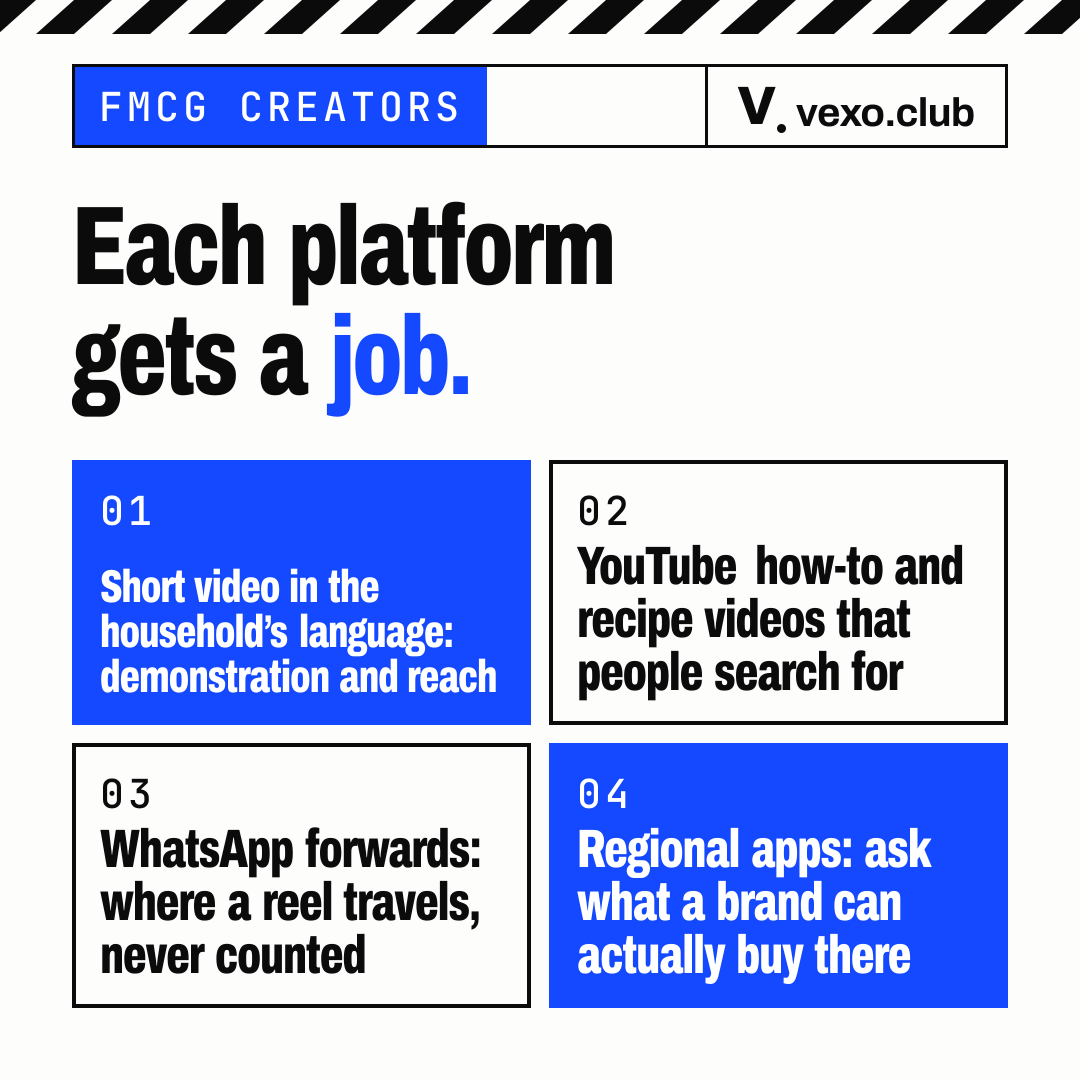
So the working mix is simpler. Instagram Reels and YouTube Shorts carry most of the creator supply a brand can verify and contract, and YouTube long-form carries recipe and how-to content people search for. Regional apps deserve a direct question to the platform, with the answer written into the plan.
What each platform is for in a mass-market plan
How does language change a mass-market brief?
It changes the unit of casting. Regional launch in four languages makes the core case: cast for the language the comments are in, and translate the claim and not the script. A mass brand adds that “Hindi” is not one market. Clusters in eastern Uttar Pradesh, Haryana and Rajasthan can each want a different register and a different creator, so decide clusters by the comment language on a creator’s last few posts, not by their city.
The second is price and pack. A creator who rounds a price in their own words has made a claim you now own. Put the pack size and the printed MRP in the claim sheet, and tell creators to show the pack and quote it as printed.
How many creators does a mass-reach roster need?
More than a niche plan, in layers, but not “as many as possible”. Reach voices put the pack in front of many households in one language. Trial voices are smaller creators in stocked districts who show the pack in use and say where to buy it. Retailer voices speak to the shopkeeper, which sounds odd until you ask who decides what sits at eye level.
Three layers of a mass-market creator roster
- Reach voices Larger creators who put the pack in front of many households in one language
- Trial voices Smaller creators in stocked districts who show the pack in use and say where to buy it
- Retailer voices Creators or retailer-community accounts who tell shopkeepers why the pack is worth the shelf
Summed follower counts mean nothing here. Creators in one language and district share audiences, and only part of any following sees a given post. Count districts covered, language clusters covered and posts live near stocked outlets. Always-on usually beats a single burst for a repeat pack, because a product mentioned every week is the one a shopkeeper hears about every week. That is a judgement and not a measured fact, so test it in your own districts.
A big roster is mostly administration, and that is where mass campaigns quietly fail. A few hundred deliverables means a few hundred contracts, PAN checks, GST invoices where a creator is registered and TDS deductions where they apply, so name a finance owner before launch. One claim sheet, one approval path and one person who can pause every post when a district runs out of stock will save more than a better rate card. Settle reuse early too. Shop-front screens, distributor WhatsApp groups and vans are a different right from reposting online, and usage rights shows how to write it before the shoot.
Why is sampling and trial the real job?
Because in a habit category nobody changes brand without trying. Mass FMCG has always known this. A 2008 account of Hindustan Unilever’s Project Shakti, written by Unilever executives and hosted by the World Bank describes villages with poor transport, villagers who could spend only a few rupees at a time, and no practical reach through broadcast media or press. The company’s answer was affordable small sizes and a network of local women selling door to door. The pack was small enough to risk, the seller was someone the buyer knew, and the product was in the village.
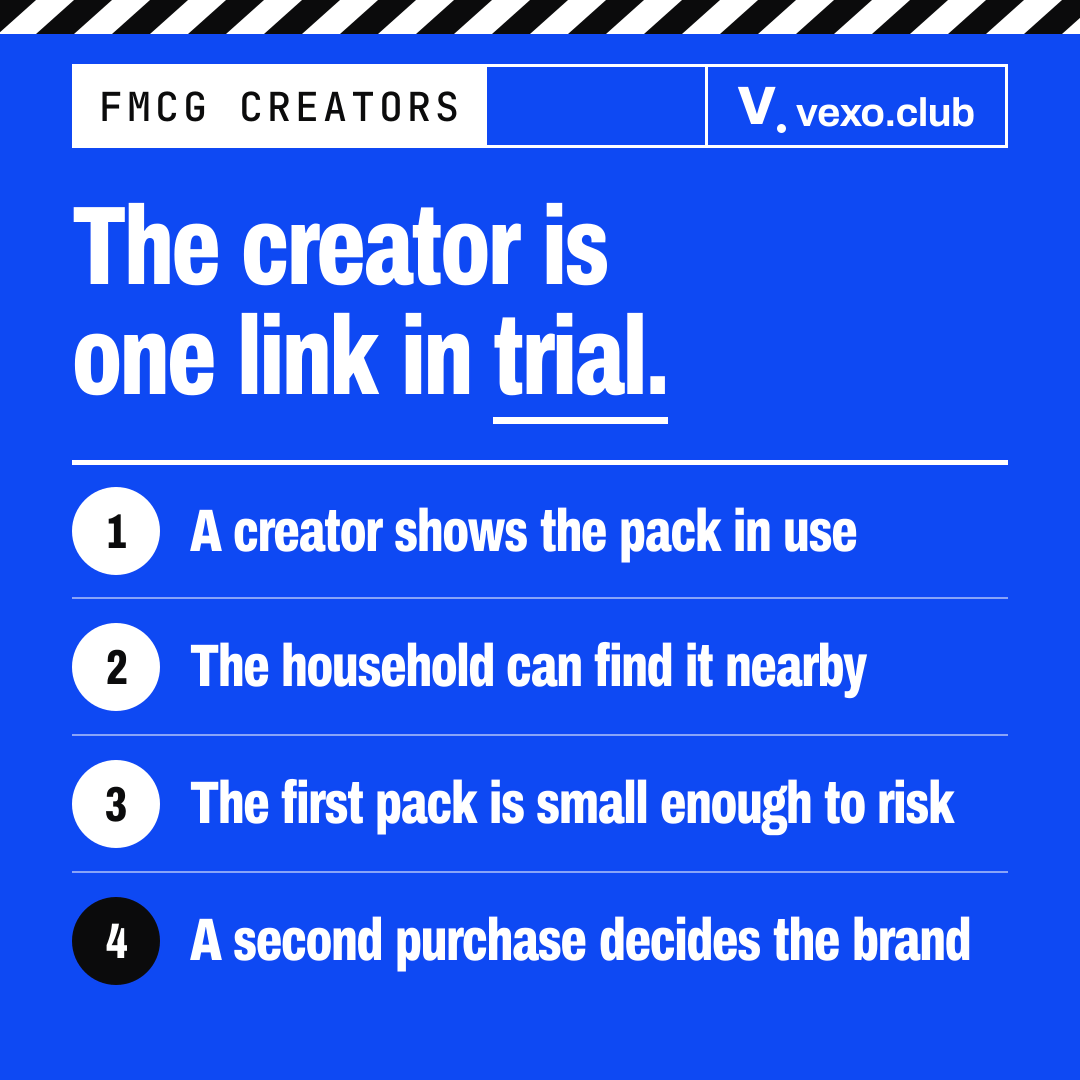
A creator is the newest version of that trusted local seller. What a creator adds is demonstration and recognition. What a creator cannot add is the small pack, the nearby shop or a reason to buy a second one. A good trial brief asks for four things: show the pack in ordinary use, name the occasion (the tiffin, the chai, the wash day), name the kind of shop that stocks it and say what a first pack costs in the words people use. It never asks for a verdict on health.
Where a creator sits in the journey to a repeat purchase
Physical sampling still belongs to the brand’s field team and its van or door-to-door partners. If you send packs to creators, running a micro-influencer seeding program covers the mechanics, and the disclosure rule applies. ASCI’s influencer guidelines count free products, with or without conditions and including unsolicited ones, as a material connection. A seeded creator who mentions the pack needs a label.
If you ask households for an address or phone number to send a sample, you are collecting personal data. The Digital Personal Data Protection Rules were notified in the Gazette on 13 November 2025, and most duties, including the notice in Rule 3, start eighteen months after publication. That is around May 2027, and a sample list built now will still exist then. Collect the least you need, say what it is for, delete it once the sample has gone out and read the Gazette for the exact dates. Check any “free sample” wording against the CCPA’s 2022 guidelines, which define a free claim advertisement.
How do creators link to the shelf and the distributor?
Start with where the sale is. NIQ’s April to June 2026 snapshot puts traditional trade at 82 per cent of FMCG value on its moving annual total, modern trade at 11 per cent and e-commerce at 6 per cent. For most mass packs the creator’s audience ends up at a kirana counter, not a checkout.
Where India’s FMCG value is sold, by channel
| Item | Value (per cent of FMCG value) |
|---|---|
| Traditional trade Kirana and general stores | |
| Modern trade | |
| E-commerce |
Source: nielseniq.com (PDF)
The same deck is a caution against treating rural as a safe growth story. For April to June 2026 it reports all-India FMCG volume down 2.0 per cent on a year earlier, rural volume down 5.0 per cent and urban volume up 0.1 per cent. Traditional trade volume fell 6.0 per cent while modern trade and e-commerce grew. NIQ ties the quarter to a cost shock, a June rain deficit and weak consumer confidence, and one quarter is not a trend. Still, spend only where stock exists and moves. NIQ also says most e-commerce contribution still comes from metros, so sending a small-town audience to a quick-commerce link that does not deliver there wastes the click.
Four habits follow from this.
- Make the stocked-district list the first input. Ask the sales team for districts with live distribution and a replenishment rhythm, and cast against that list. Brief by pin code or district, not by state.
- Time posts to stock and not only to the calendar. A festive pack has to reach the distributor before the posts go live. The festive plan’s calendar ends at the brief. For FMCG, the stock calendar ends earlier.
- Give the field team a stop button. If a district runs out of the pack, creators in it should be paused or redirected the same day.
- Treat the retailer as a second audience. A vendor’s own Kirana Club case study describes using kirana influencers to explain a new category to shopkeepers and to put margins and schemes in front of them. Its outcome figures are self-reported and the desk does not use them. The idea is sound.
How does a mass brand measure creators without pretending they equal sales?
By saying up front what each method can and cannot see, and by designing one real test. Codes and tracked links work on your own checkout, as measuring influencer marketing ROI explains. Here the purchase is cash at a counter. A shared phone, a forwarded reel and a shopkeeper who never logs a code all vanish from a link report. Crediting creators only with what a code saw will under-count. Crediting them with every extra pack sold will over-count.
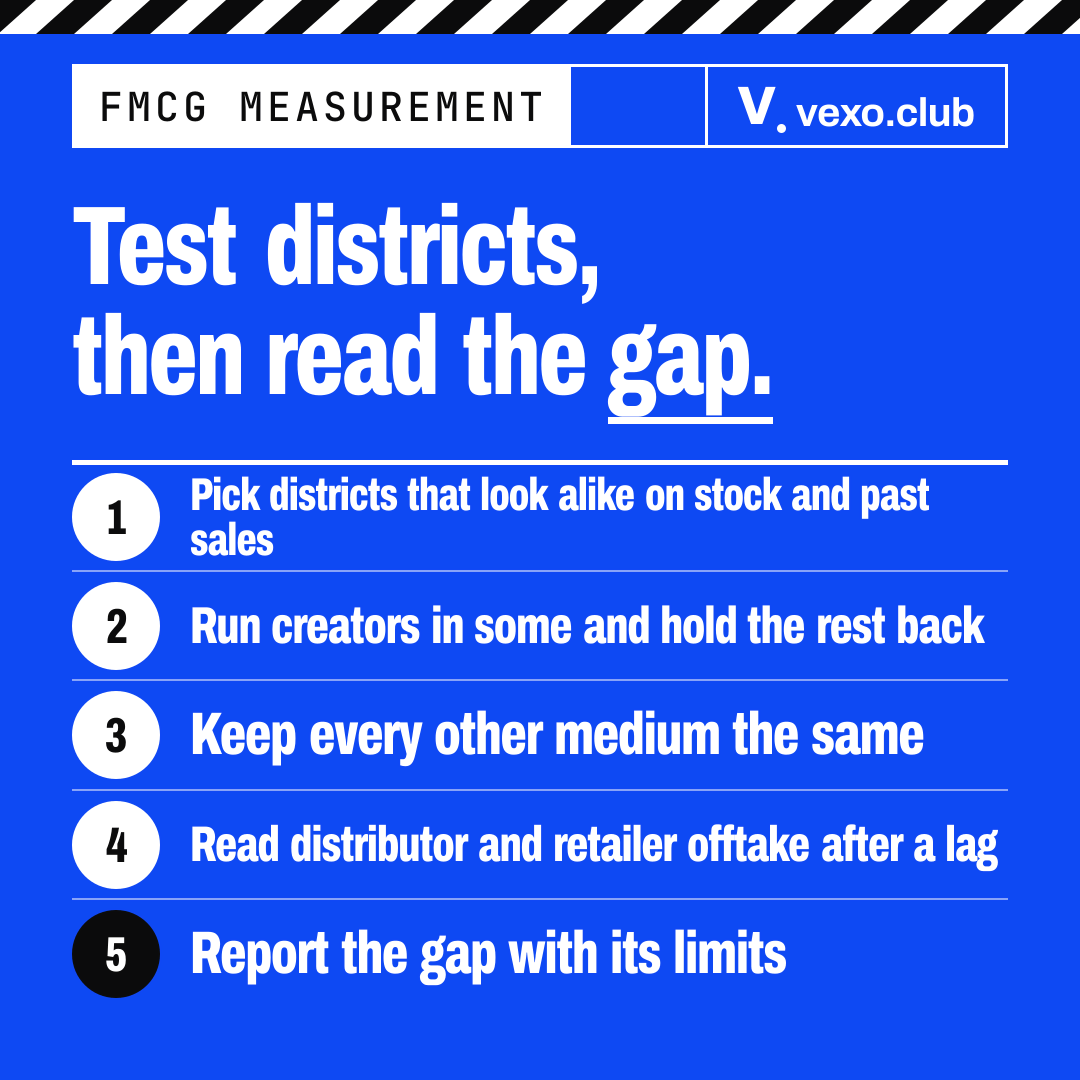
Three things work together. The first is exposure and quality: reach as reported, labelled as reach, plus a read of the comments in the language of the district. The second is trial signals: sample requests, where-to-buy lookups and enquiries from retailers. They are hard counts of intent and should be reported as that. The third is a designed test for sales, because no dashboard supplies one. Choose districts that look alike on stock and past sales. Run creators in some and hold the others back. Keep every other medium the same. Read distributor sales or retailer offtake after a lag, and write the threshold you would call a result before the campaign starts.
A matched-district test for creator spend on a mass-market pack
This is noisy. Districts are never identical, a promotion in one can swamp the signal and a lag can hide a real effect. Say so, and note anything that ran in the same weeks, including stock-outs. If a media agency runs marketing-mix modelling, give it creator spend as its own line with dates and districts, and accept a wide range. None of this proves that creators sold a given number of packs. It shows whether creator districts moved differently from comparable ones, and roughly by how much.
Measuring a mass-market creator campaign
Do
Report reach and in-language comments as exposure, labelled as exposure
Don’t
Present reach as households that bought
Do
Count sample requests and where-to-buy lookups as trial signals
Don’t
Call a trial signal a sale
Do
Compare similar districts with and without creators, then say how noisy the gap is
Don’t
Credit creators with every extra pack sold during the campaign
Do
Keep a note of stock-outs and promotions that ran in the same weeks
Don’t
Read a sales dip or jump without checking the shelf
Which rules bite hardest on food and everyday packs?
Three sets apply, and the brand carries all of them even when the creator speaks. The FSSAI’s Advertising and Claims Regulations, 2018 restrict words such as natural, fresh, original and traditional, and per FSSAI’s press release a fine of up to ₹10 lakh under Section 53 of the Food Safety and Standards Act reaches “any person, including a third party” who is party to publishing a misleading advertisement. ASCI’s food and beverage guidelines say claims must not be inconsistent with the label. ASCI’s influencer guidelines add that advice on health and nutrition prevention or treatment needs relevant qualifications, and an unqualified creator can share generic information only.
The CCPA’s 2022 guidelines require an endorsement to reflect the endorser’s genuine and reasonably current opinion. PIB’s release says the authority may fine manufacturers, advertisers and endorsers up to ₹10 lakh, up to ₹50 lakh for repeats, and bar an endorser for up to a year. On disclosure, short video is where labels fail. ASCI says that on a video of 15 seconds or less the label must stay up for at least 3 seconds, and on one between 15 seconds and 2 minutes for a third of its length, and not buried in hashtags. ASCI disclosure for brands covers who labels what. Check every current text before you sign.
When is this the wrong move?
If the pack is not stocked where the creators reach, spend on distribution first, because creators will create demand the shelf cannot meet. If the margin on one pack cannot carry the cost, divide the fee by that margin and ask whether the campaign could plausibly cause that many extra packs in stocked outlets. If not, a van, a stall or a retailer scheme probably reaches the same households for less. If you cannot test, treat the spend as reach and not as sales. And if the sales team is not told when posts go live, the brief is not ready. Creators amplify a working shelf. They do not substitute for one.
What does a first quarter look like?
An illustrative path for a regional food brand entering a neighbouring state, with no outcome claimed:
- Month one: the distribution team lists stocked districts. Pick two or three language clusters from them, write the claim sheet and choose test and holdout districts.
- Month two: brief reach and trial voices per cluster, and send a retailer-facing piece to shopkeepers in the same districts. Open a sample request route with a clear notice.
- Month three: keep creators who produce usable in-language trial content and drop the rest. Read the matched-district gap beside the stock notes. Decide whether to widen the roster, change the packs or move spend to field sampling.
What should you ask a vendor or agency?
Ask these in writing, before the quote:
- How do you decide which districts the creators serve, and do you take that list from our sales team?
- What do you count as reach, and how do you check that the audience is in the districts we stock?
- Who handles invoices, PAN checks and TDS for a roster this size, and what does it add to the fee?
- What do you report when a creator’s audience buys at a counter, and how do you design a test for that?
- Who checks the disclosure label and the claim against our label on every post?
What to do this week
- Get the list of districts where the pack is stocked and replenished from the distribution team
- Write one claim sheet from the label and the approved claims, with the words that cannot change marked
- Decide the language of each district cluster by the comments on creators’ posts
- Agree who tells the creators if a district runs out of stock
- Choose test districts and holdout districts before any creator is briefed
- Set where the disclosure label sits and for how long on a short video
- Decide what personal data a sample request collects and how long it is kept
A paste-ready line for the brief: “We are driving first trial of [pack] in [district cluster] in [language]. Show the pack in ordinary use, name the occasion, say where it is sold and quote the printed pack size and MRP only. Make no health or comparative claim beyond the attached claim sheet. Add the paid-partnership label and a clear disclosure for the stated duration. We will pause posts if stock runs out and will tell you the same day.”
Where the desk fits in
vexo.club runs briefs from one desk in Delhi NCR and casts from Micro creators upward, so it does not run a thousand-household nano roster. What it does is regional-language micro and mid creators beside a media agency, with the claim and label checked on every post. The category page for FMCG influencer marketing sets out how the desk runs this.
Questions brands ask
Does influencer marketing work for FMCG? It can, for the job it is suited to: showing a pack in use to households that would not otherwise try it, in a language they speak, where the pack is stocked. It does not replace distribution or a brand’s mass media, and its effect on sales has to be tested rather than assumed.
Which platform is right for FMCG influencer marketing in India? There is no single one. Instagram Reels and YouTube Shorts carry most of the creator supply a brand can contract and check, YouTube long-form suits recipes and how-to, and WhatsApp is where reels travel. Decide the language and district first and the platform second.
Are Moj and Josh worth using for brands? Check before you plan on them. In ShareChat’s release of 13 October 2026 Moj is pitching micro-drama ads and commerce integrations to advertisers. Josh’s team said on 4 May 2026 that user uploads are no longer supported, so it cannot host an open creator roster.
How many influencers does an FMCG campaign need? Enough to cover the language clusters and stocked districts you are targeting, in layers, and not so many that nobody can brief, approve and pay them properly. Count districts and languages covered. Do not sum follower counts.
Can influencer marketing drive trial for a low-priced product? Yes, if the fee is recoverable over packs sold. Divide the fee by the margin on one pack and ask whether that many extra packs in stocked outlets is plausible. If not, a stall or a retailer scheme may do it for less, with a creator pointing to it.
How do FMCG brands measure creators when the sale is in a shop? Not with codes alone. Use exposure, trial signals such as sample requests and where-to-buy lookups, and a matched-district test read from distributor or retailer offtake. Report what the method cannot see.
Do creators have to disclose free product samples? Yes if they mention the product. ASCI’s guidelines count free products, with or without conditions and including unsolicited ones, as a material connection, and the label has to be upfront and prominent.
If you are planning a mass-market creator brief and want a second view on districts, languages or how to test it, send the desk a note with the pack, where it is stocked and what you want to learn. If the honest answer is that distribution or field sampling should come first, we will say so.
Sources
- IAMAI and Kantar Internet in India report 2025 (opens in a new tab) thehindu.com
- VerSe’s homepage (opens in a new tab) verse.in
- release of 13 October 2026 (opens in a new tab) sharechat.com
- Play listing (opens in a new tab) play.google.com
- Play listing (opens in a new tab) play.google.com
- written by Unilever executives and hosted by the World Bank (opens in a new tab) openknowledge.worldbank.org
- ASCI’s influencer guidelines (opens in a new tab) ascionline.in
- notified in the Gazette on 13 November 2025 (opens in a new tab) meity.gov.in
- CCPA’s 2022 guidelines (opens in a new tab) pib.gov.in
- April to June 2026 snapshot (opens in a new tab) nielseniq.com
- Kirana Club case study (opens in a new tab) kirana.club
- Advertising and Claims Regulations, 2018 (opens in a new tab) fssai.gov.in
- ASCI’s food and beverage guidelines (opens in a new tab) ascionline.in
Cite this page
FMCG and mass-market creator campaigns in India: trial, shelf and reach. vexo.club, published 19 Nov 2026. https://vexo.club/blog/influencer-marketing-fmcg-mass-market-brands-india
Influencer marketing across India
Send the desk a brief: it comes back as a shortlist and a directional band, never a public price.
Brief the desk