Influencer marketing trends 2026 in India: five qualitative shifts in how brands are briefing, paying and measuring creators
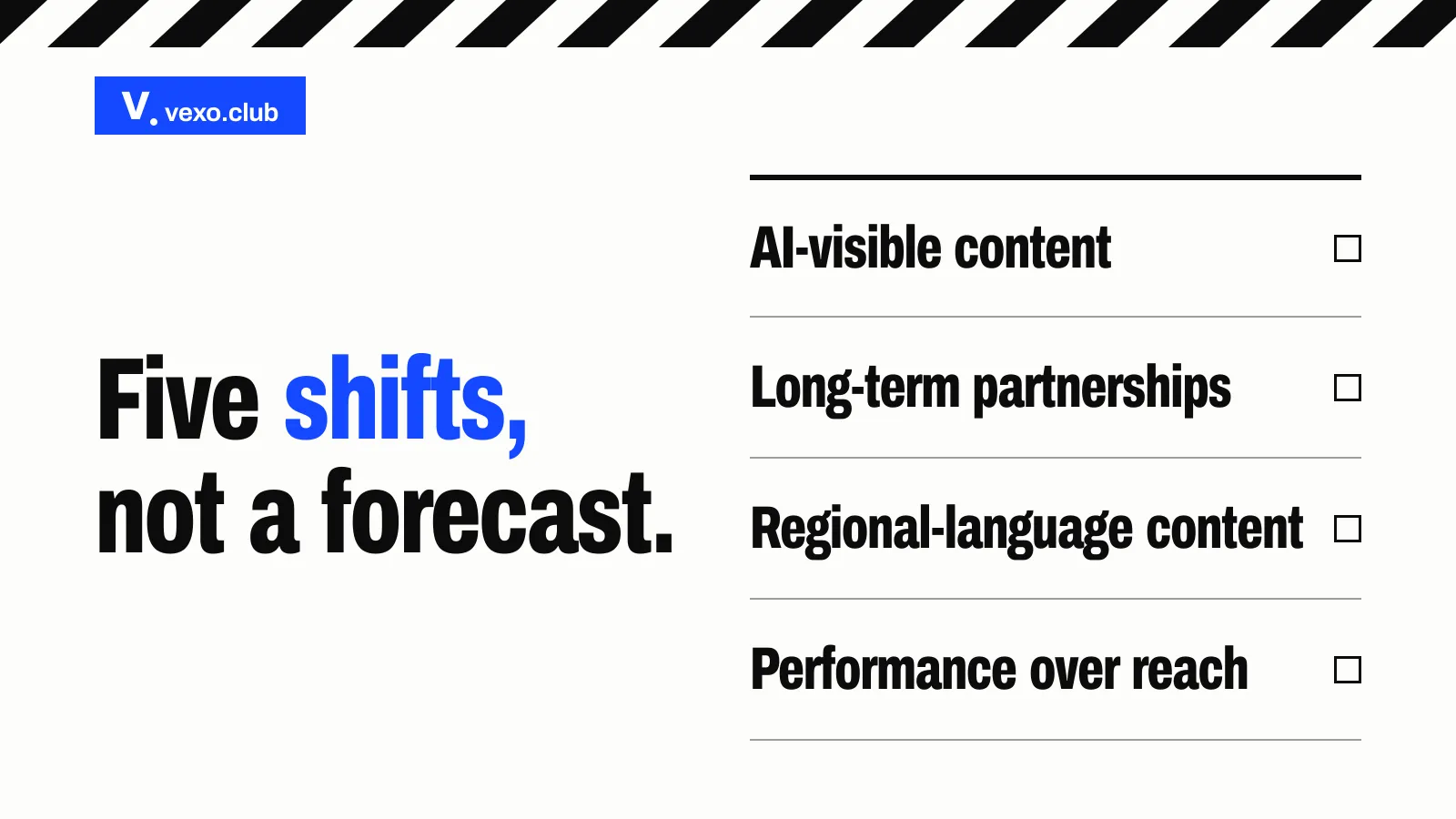
Not a statistics round-up: the published figures sit on their own page. This is a reading of five shifts shaping Indian brand strategy for 2026: AI-search-visible content, longer creator relationships, regional-language briefs, performance over reach, and rising disclosure scrutiny.
Playbooks 11 min read The vexo.club desk
In this article7 sections
Most influencer marketing trend pieces are a list of percentages borrowed from somebody else’s survey. The published figures for India sit on a separate page, each one sourced and dated. This one does not repeat them. It sets out five shifts in how Indian brands are briefing, paying and measuring creators through 2026, not as numbers to cite but as changes worth planning a brief around. None of what follows is a forecast of a market size. It is a reading of where the work itself is moving.
This guide comes from vexo.club: an influencer marketing agency run from one desk in Delhi NCR. It reads from the trend reports, platform announcements and regulatory guidelines already in print, and turns what they describe into qualitative shifts rather than figures this page cannot verify on its own.
Influencer marketing trends for 2026, in short
- Content written to be lifted by an AI answer engine is becoming a planning input, not an afterthought, alongside content written for a feed.
- Brands are moving from one-off posts toward retainers and longer creator relationships, trading campaign bursts for a consistent voice.
- Briefs are asking for regional-language content earlier in the process, rather than treating it as a translated afterthought of an English-first plan.
- Whitelisting and paid amplification are becoming the test of a creative, with reach treated as a shortlist criterion rather than the result.
- Disclosure and compliance checks are moving earlier in the brief, as scrutiny from the advertising self-regulator and from platforms keeps rising.
Content is being written for a model as well as for a feed
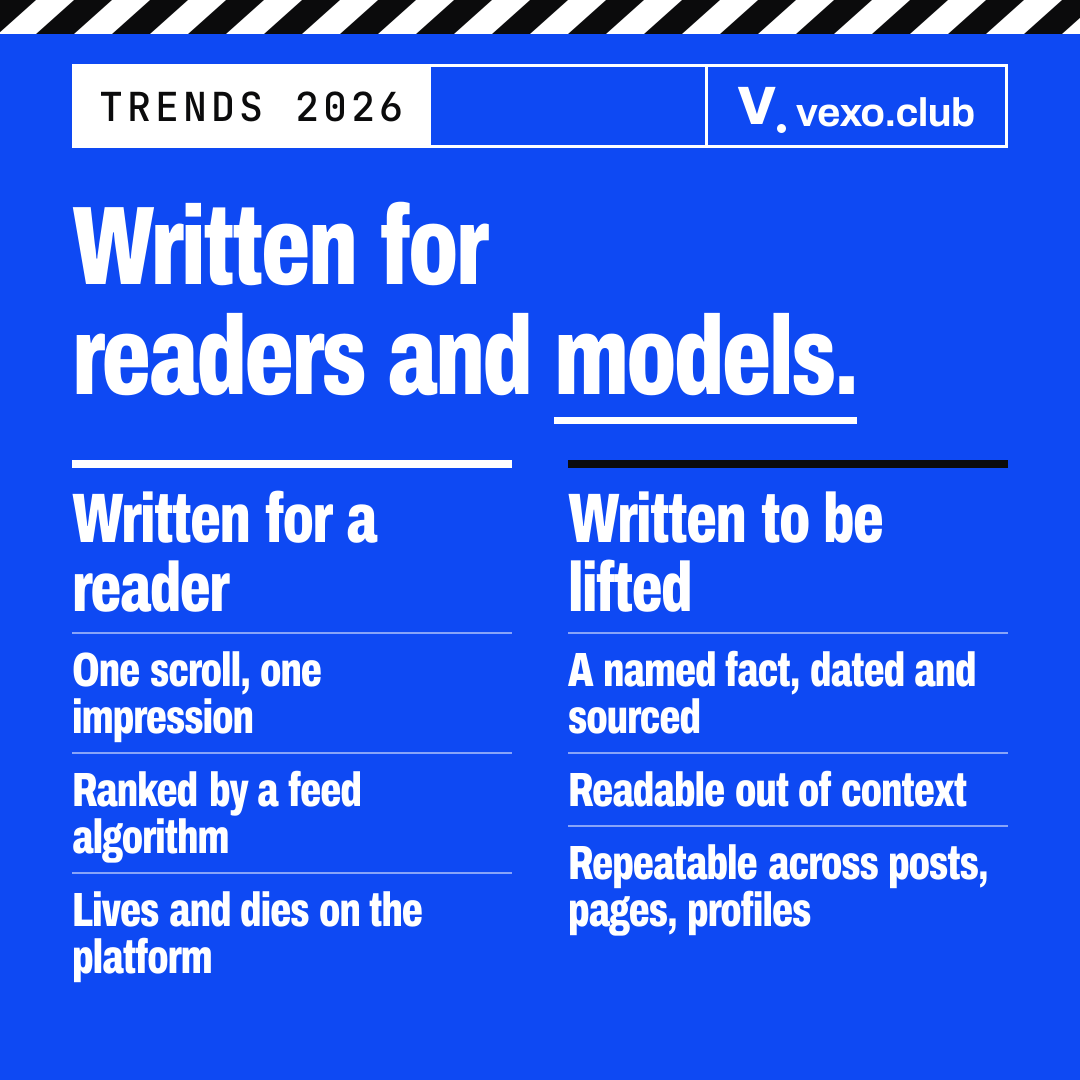
A brief used to end once the post went live and the feed decided what happened next. That is no longer where the attention stops. A growing share of what a brand or an agency publishes now has to survive being read by an AI answer engine before it is read by a person. How those engines choose what to repeat is its own discipline, and earning a citation is becoming part of the same brief that used to end at the post.
What changes in practice is not the platform a post goes out on. It is whether the brand’s own pages, the creator’s own bio and any press mention say the same thing about the same fact, closely enough for a model to repeat one of them with confidence. A caption written only to catch a scroll gives a model nothing to extract. A caption, a case study or a creator bio that names a specific fact, dated and checkable, gives it something to quote. A brief that still measures a post only by its first-week reach is writing for half the audience it now has.
Content written for a reader against content written to be lifted
One-off posts are giving way to longer creator relationships
A single sponsored reel still has its place for a launch or a flash sale. For an always-on brand a one-off collaboration is becoming the exception rather than the default booking. Brands are moving toward retainers, ambassador-style rosters and repeat bookings with the same small set of creators across a year of moments, rather than a fresh casting call for every brief. A roster built to carry a brand through a wedding season and a festive quarter on the same few faces is a different kind of planning from a calendar of separate, unconnected bookings.
The reasoning is not sentimental. A creator who has represented a product across several cycles tends to know its claims, its competitors and its customer better than one meeting a brief for the first time, and an audience that has seen the same person return to a brand more than once reads the relationship differently from a single paid post. None of this guarantees a better outcome. It is a reason more brands are choosing to test it, and a reason a rate card is starting to carry a retainer line next to a per-post one.
A one-off collaboration against a long-term creator partnership
| One-off collaboration | Long-term partnership | |
|---|---|---|
| Creator’s product knowledge by the time of posting | Limited to the brief document | Built up over several cycles |
| How the endorsement reads to the audience | A single sponsored post | A running recommendation |
| Negotiation and onboarding overhead | Repeated for every post | Settled once, then renewed |
| Usage rights and whitelisting terms | Narrow, tied to one deliverable | Broader, set for the relationship |
| What the brand is actually buying | A single piece of content | A consistent voice on an ongoing roster |
Regional-language content is moving earlier in the brief
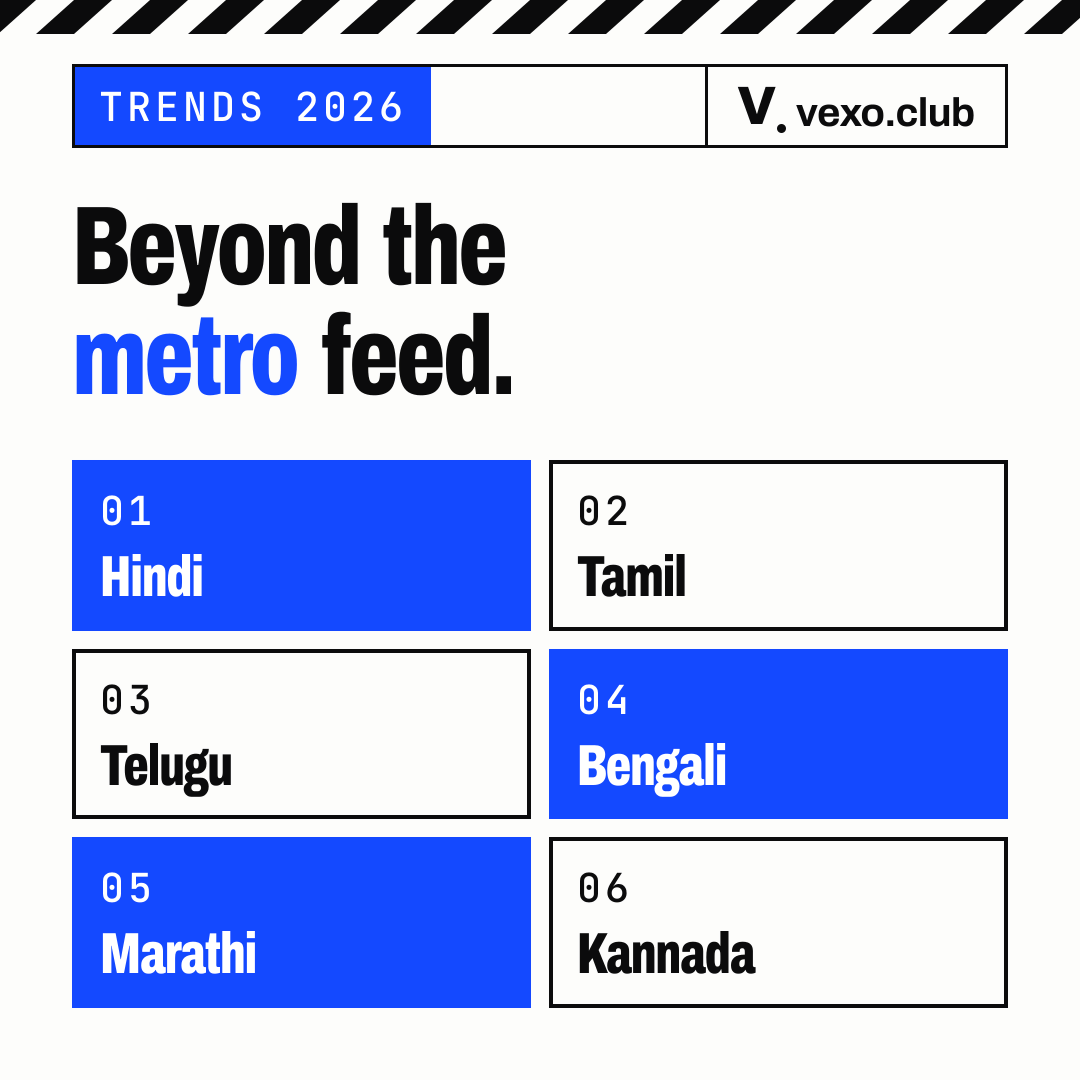
A brief used to default to English or Hindi, with a regional-language version treated as a translation pass once the hero content was signed off. That order is reversing for brands that actually sell outside the metros. Casting for the language a comment section already speaks is becoming a first step rather than a localisation afterthought, and the southern languages are no longer read as one undifferentiated market.
The practical effect is a shortlist that starts with language and geography before it starts with follower count, because a creator whose audience comments in the wrong language reaches the wrong households regardless of reach. Tier 2 and tier 3 cities are not treated as a discount version of a metro campaign under this approach. They are where a growing share of the brief is written to begin with. Faster dubbing and captioning tools are making it cheaper to carry one idea across several languages in the same cycle, which is part of why a regional cut is turning up earlier in production rather than after the main edit is locked.
Languages brands are briefing creators to post in
Reach is losing ground to performance and whitelisting
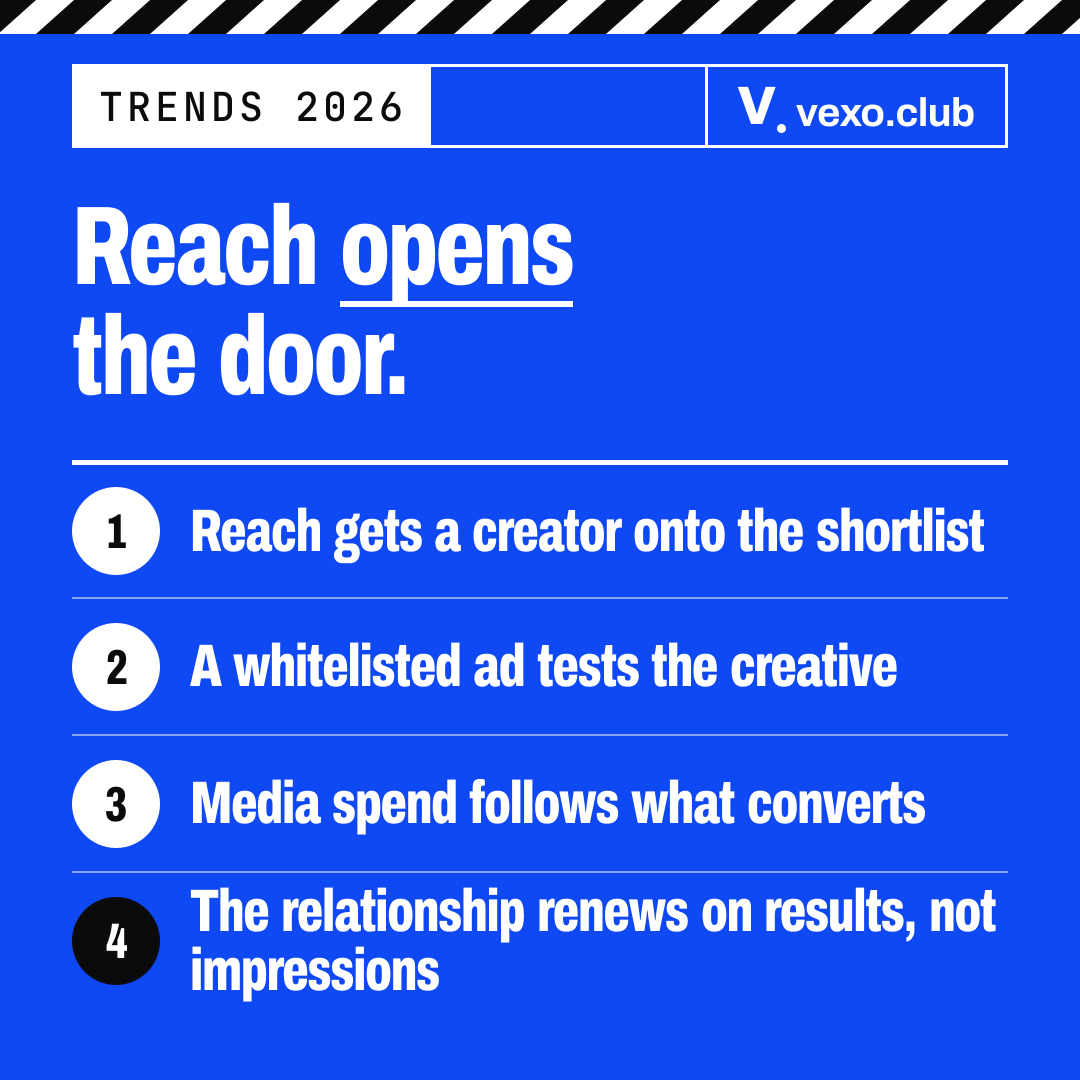
A creator’s follower count still opens a conversation. It is deciding fewer briefs on its own. Brands are asking earlier in the process whether a piece of creative can be whitelisted and tested with paid spend behind the creator’s own handle, and treating the organic post as a casting call for that test rather than as the campaign’s result.
What that does to a brief is push the decision point later and make it cheaper to reverse. A reel that performs only needs a brand’s media budget to find out before anyone commits to a bigger retainer or a renewed relationship with that creator. What whitelisting actually involves, and what should and should not be counted as reach, are both worth reading before a brief is written on the assumption that a large audience is the same thing as a result. A report that used to stop at reach and engagement is starting to carry a line for what the whitelisted version of the same creative did on its own.
Where a brief sits between reach and performance
A brief built around reach A brief built around performance
- A single sponsored reel for awareness At A brief built around reach
- A boosted post on a recognisable face Leans A brief built around reach
- Whitelisted creative tested across a few creators In the middle
- A retainer renewed on conversion, not impressions Leans A brief built around performance
- An arrangement paid on results alone At A brief built around performance
Reach opens the door; performance decides the renewal
Disclosure and compliance scrutiny keeps rising
None of the shifts above are happening in a space free of oversight. As influencer marketing moves from an experimental line item to a standing part of the media plan, the governance question is moving with it rather than trailing behind it, in the words of one platform that tracks the shift directly.
What one platform says is driving the governance shift
“AI has done what most technology promises and rarely delivers: it has compressed the production overhead that was preventing India’s creator class from operating at business scale. The governance question is now the defining one. ASCI disclosures, SEBI scrutiny, DPDP compliance: these are not obstacles. They are the structural filters that will separate the durable from the disposable.”
Ritesh Ujjwal, Co-founder, Kofluence, in the release of its Decoding Influence 2026 report,
Source: theweek.in
ASCI’s disclosure rules, the regulator’s scrutiny of financial influencers and the arrival of labelling rules for AI-generated and synthetic content are not separate stories. They read as the same shift from three different desks: a disclosure label, a verified claim and a flagged AI-made asset are all becoming checks that happen before a post goes live rather than after a complaint arrives. What ASCI requires of a brand, and what the newer rules on synthetic content cover, are both worth building into a brief from the first draft rather than bolting them on at approval.
This is also turning compliance from a legal afterthought into a question the brand’s own marketing team is expected to answer before a campaign starts, not only when a complaint arrives. A brand running influencer work through an agency is increasingly asking who checks the label before a post goes live, and in whose name the answer is recorded.
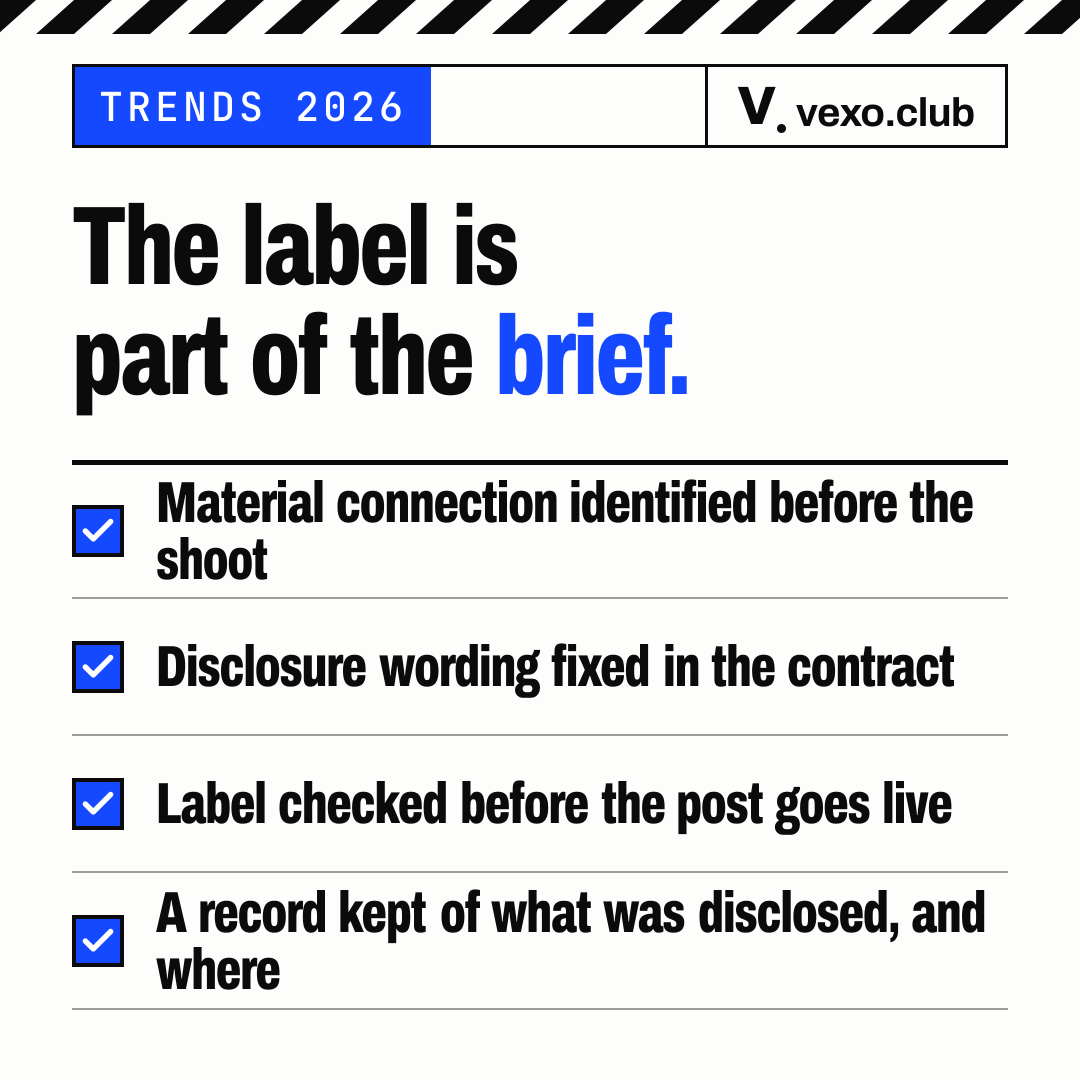
Disclosure discipline in a 2026 brief: do and don’t
Do
Settle the material connection and the label wording before the shoot
Don’t
Leave disclosure to whatever the creator adds at the end
Do
Check the label is visible before a post goes live, not after a complaint
Don’t
Treat a complaint as the first quality check
Do
Keep a dated record of what was disclosed, where and in which language
Don’t
Rely on memory or a screenshot taken too late
Do
Agree with regional-language creators whether the label goes in English or in the post’s own language
Don’t
Use a label the post’s own audience may not understand
Why disclosure is moving earlier in the brief
What this means for a brief written in 2026
None of the five shifts above replace the fundamentals of a brief: a clear claim, an audience that matches the product and a usage window settled before the shoot. What changes is the order some of that work happens in.
- A whitelisting test now sits earlier than a renewal decision.
- A disclosure label now sits earlier than a publish button.
- Language and audience match now sit earlier in casting than they used to.
- A citable, source-linked page now sits alongside the campaign brief, not after it.
The brands adjusting fastest are not the ones chasing a new platform feature. They are the ones rewriting the order of their own checklist.
A brief that wants to test any of this against a real roster, rather than against a trend piece, can be sent to the desk.
Questions brands ask
What are the biggest influencer marketing trends in India for 2026? Five shifts stand out: content written to be read by AI answer engines as well as by a feed, longer creator relationships replacing one-off posts, regional-language briefs moving earlier in the process, performance and whitelisting carrying more weight than reach alone, and disclosure checks moving earlier in the brief as compliance scrutiny keeps rising.
Does writing for AI search replace ordinary SEO or good creative? No. A page or a post still has to be specific and well made to rank or to perform. What changes is whether the same fact is checkable in more than one independent place, which is what lets an answer engine repeat it with confidence.
Is follower count still useful for choosing a creator? As a first filter, yes. As the deciding factor, less so than it used to be. Brands are increasingly treating an organic post as a test of the creative before deciding whether to put media spend behind it through whitelisting.
Why are brands moving toward long-term creator partnerships instead of one-off posts? A creator who has represented a brand across several cycles tends to know the product and its customer better, and a repeated relationship reads differently to an audience than a single sponsored post. Neither is a guarantee of a better result, which is why brands are testing the shift rather than assuming it.
Does regional-language content mean English-language creators matter less? Not necessarily. It means a brief increasingly starts by matching a creator’s language and audience to the market being sold into, rather than defaulting to English or Hindi and treating other languages as an afterthought.
Should a brand expect more compliance questions in a 2026 brief than it did before? Yes. Disclosure checks, scrutiny of financial claims and the newer rules on labelling AI-generated content are all moving earlier in the process, closer to the brief itself rather than sitting only with legal review at the end.
Sources
Cite this page
Influencer marketing trends 2026 in India: five qualitative shifts in how brands are briefing, paying and measuring creators. vexo.club, published 02 Nov 2026. https://vexo.club/blog/influencer-marketing-trends-2026
Send the desk a brief: it comes back as a shortlist and a directional band, never a public price.
Brief the desk