Influencer marketing trends 2027: four shifts the desk sees ahead for India
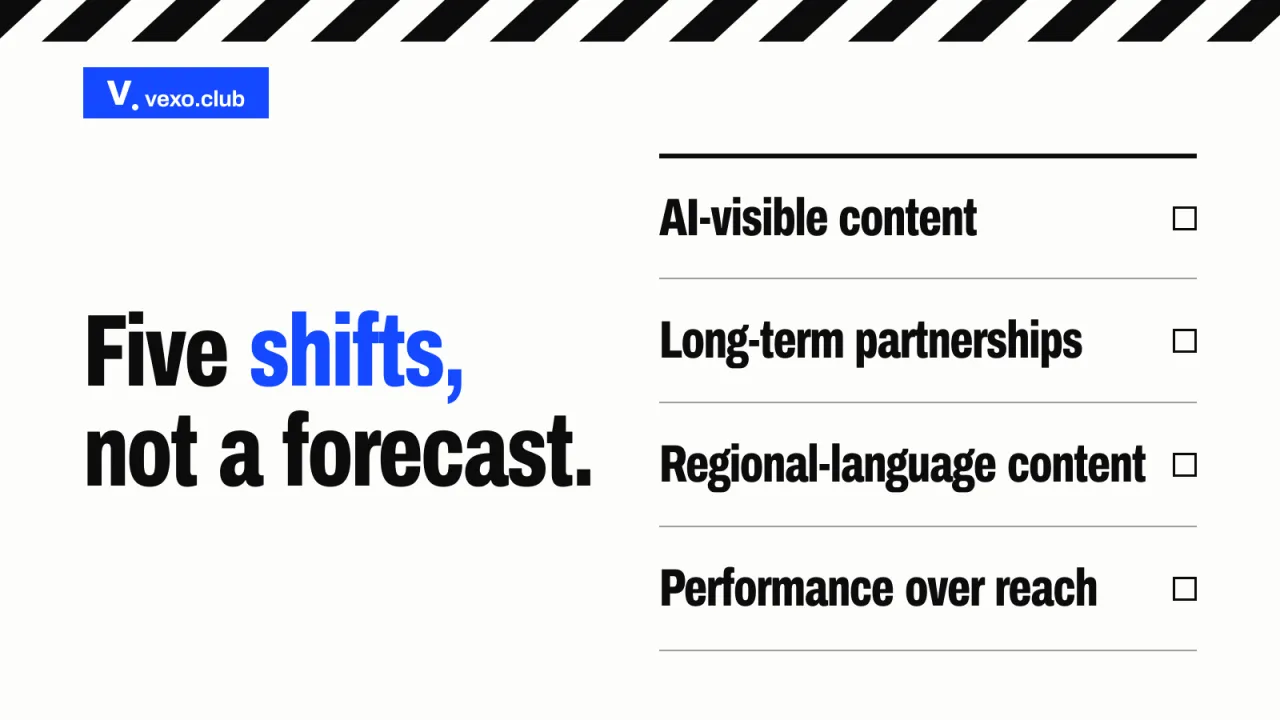
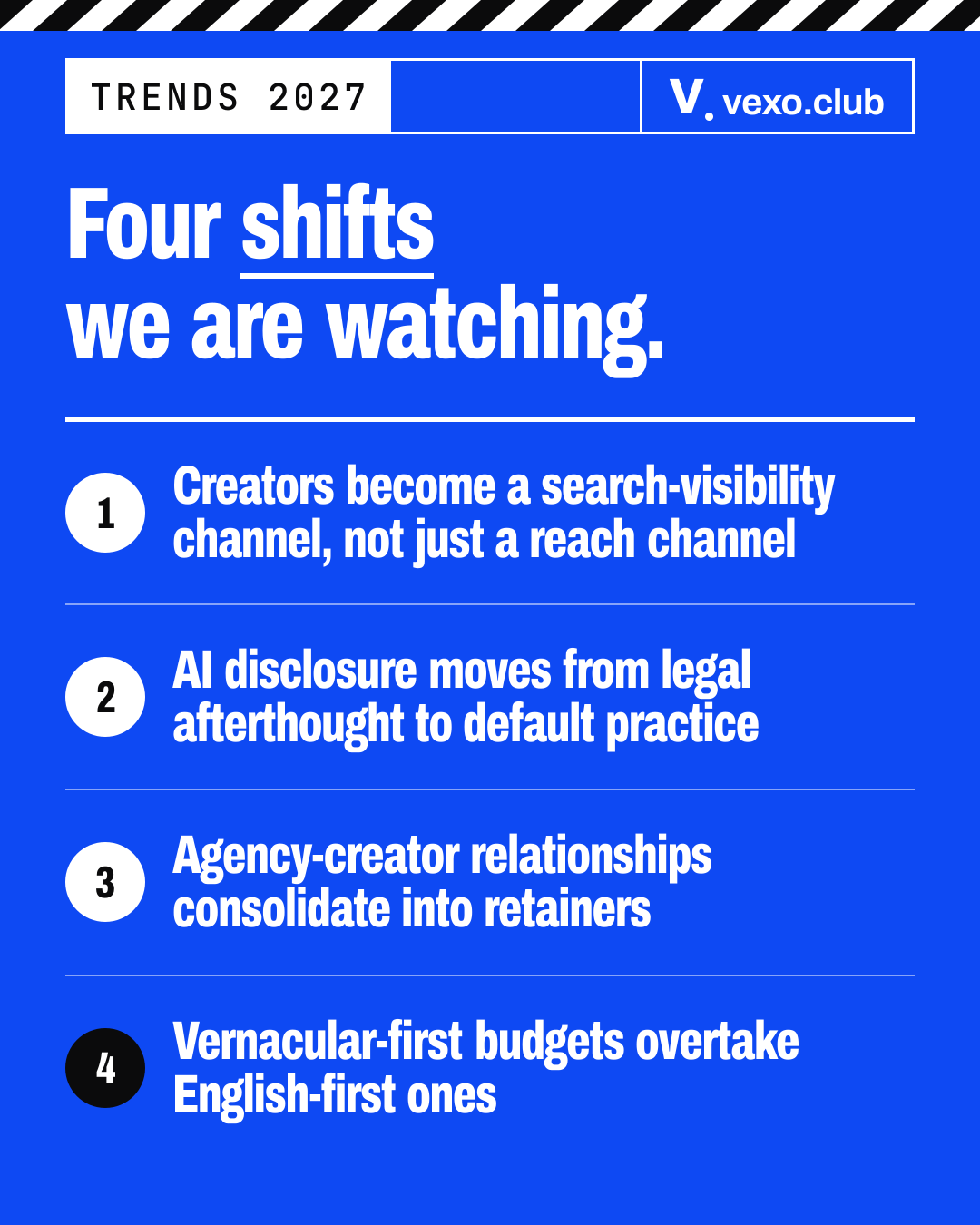
Our own forward read on influencer marketing trends 2027: creators as search-visibility channels, AI disclosure as default, retainers over one-off briefs, vernacular budgets overtaking English-first ones.
Playbooks 11 min read The vexo.club desk
In this article6 sections
This is a forecast, not a report. Everything below is the desk’s own read of where influencer marketing in India is headed by 2027, built from briefs it is writing today and signals already visible on platforms and in creator contracts, not from a survey, a study, or a number anyone else published. Where a date or a rule is already settled (the AI labelling timeline, for one), it is linked rather than restated as new. Where it is a direction rather than a fact, it is written as one.
Influencer marketing trends 2027, in short
The desk’s own forward read
- Creators start carrying weight as a search-visibility channel (cited by AI answer engines and ranked for buyer queries) on top of the reach they already deliver.
- Disclosing AI-made or AI-altered content stops being a legal afterthought and becomes a line item every brief writes in by default.
- The agency-creator relationship consolidates: fewer one-off collabs, more retainers that carry a creator across a quarter rather than a single post.
- Vernacular-first campaigns take a larger share of budget than English-first ones, as unsaturated audience and platform ranking both favour the shift.
- None of this is measured yet. It is the direction the desk is briefing toward, not a number anyone can cite.
Four shifts the desk is watching toward 2027
Creators as a search-visibility channel, not just a reach channel
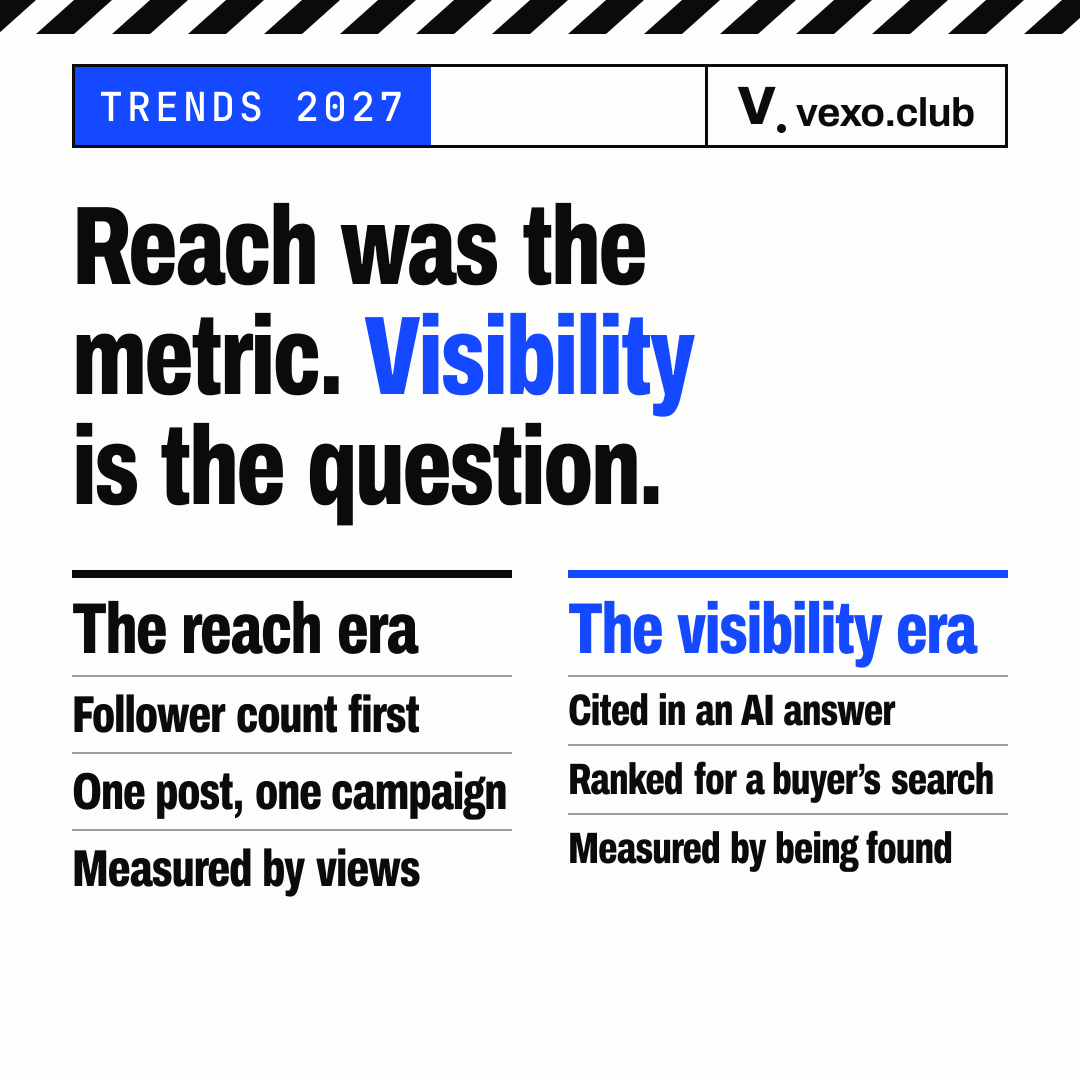
For most of the last decade, a creator was bought for reach: a follower count, an audience shape, a post that ran once and was measured by its own views. The desk’s read is that by 2027 a second reason to cast a creator sits beside the first: whether that creator’s content gets a brand found when someone searches, whether on Google, on a platform’s own search bar, or inside an AI answer engine’s response.
The shift is already visible in two places the desk briefs against today. AI answer engines pull from pages and posts that read as a specific, citable answer rather than a vague pitch: a difference the desk has written up in how AI search engines choose sources to cite and what it takes to get cited by one. And Instagram’s own documentation, read in this desk’s notes on Instagram SEO, is explicit that captions and bios are matched against search text: a creator’s wording is already doing search work, whether or not a brief asks for it.
What the desk expects to change by 2027 is not the mechanism but the brief. A 2026 brief casts a creator and asks for reach. A 2027 brief, on this reading, adds a second question: does this creator’s content, written the way it is written, stand a chance of being the thing an AI answer or a platform search surfaces when the buyer actually asks? That is a qualitative shift in what “good creator content” means, not a number the desk can put behind it yet.
Where creator content sits between reach and search visibility, as the desk reads it heading into 2027
Built for reach Built for search visibility
- A single sponsored reel, no caption copy Measured by views on the day it runs At Built for reach
- A creator’s recurring explainer series Leans Built for reach
- A long, keyword-aware caption or pinned comment In the middle
- A YouTube video that answers one buyer question directly Leans Built for search visibility
- A creator named and quoted in an AI answer engine’s response The direction the desk expects more briefs to chase by 2027 At Built for search visibility
From reach to search visibility, as the desk reads it
AI disclosure becomes default practice, not a compliance afterthought
One piece of this is already settled rather than forecast: from 29 December 2026, ASCI’s guidelines require a label on AI-made or AI-altered content that could mislead a buyer, and MeitY’s IT Rules have required platforms to label synthetic content since February 2026. The full detail (which content needs a label, which is barred outright, who answers for it) is in this desk’s guide to the AI labelling rules. That part is fact, with its own sources and dates.
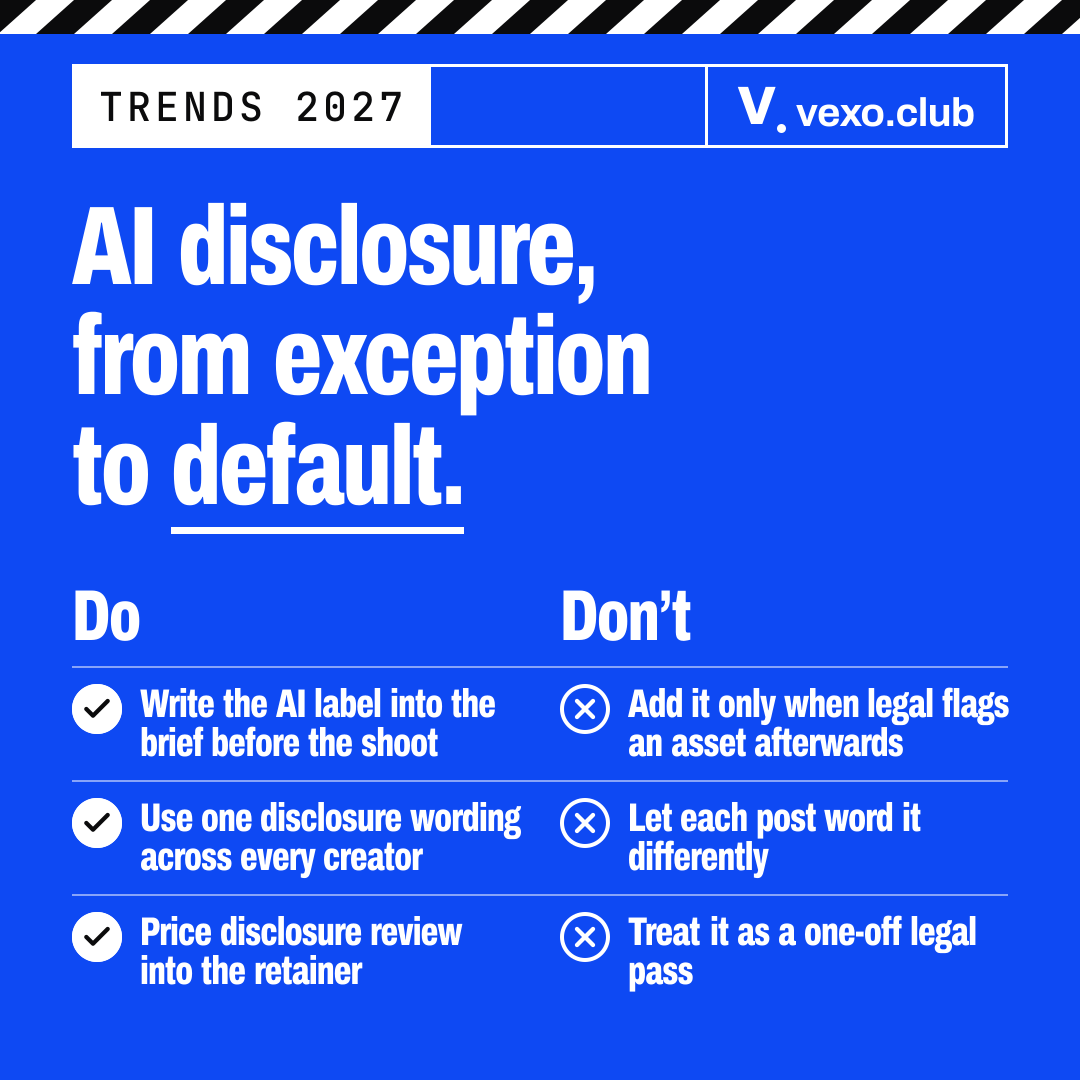
What is forecast is how the industry sits with that rule a year on. The desk’s read is that a requirement that arrives in December 2026 as a compliance deadline, a thing legal checks before a post goes live, settles by 2027 into something closer to habit: a line a creator fills in without being asked, a wording the agency standardises across every account rather than negotiating post by post. Rules that start as friction tend to flatten into default practice once the first few creative cycles have run under them, and the desk expects AI disclosure to follow that pattern rather than stay a late-stage legal gate.
The brief-level consequence, on this reading, is that the AI asset list stops being a special section added for campaigns that happen to use AI, and becomes a standing field in every brief: empty when nothing is AI-made, filled in by habit when something is. That is a prediction about process, not a number: the desk is not claiming a share of campaigns will use AI by any date, only that where AI is used, disclosing it stops being exceptional.
How AI disclosure moves from exception to default
Agency-creator relationships consolidate into retainers
The desk’s current roster is still mostly briefed campaign by campaign: a brand comes with a launch, a shortlist goes out, a handful of creators are booked for that one push. The desk’s read is that by 2027 more of that work moves to a retainer shape: a creator or a small group kept on an ongoing scope, planned a quarter at a time, rather than re-sourced for every brief.
The reasoning is structural rather than statistical. A one-off collab resets everything each time: the brief, the rate conversation, the disclosure wording, the usage-rights negotiation, the trust between brand and creator. A retainer carries all of that forward, which is cheaper to administer and faster to brief against once it is set up: the kind of efficiency that tends to win out once enough brands have felt the friction of starting over every time. None of that is a forecast the desk can put a number on; it is the direction the administrative cost of one-off work points.
One-off collab against retainer, as the desk expects the balance to shift by 2027
| One-off collab (the 2026 default) | Retainer (where the desk sees 2027 heading) | |
|---|---|---|
| How the relationship starts | A single brief, scoped and closed | An ongoing scope, revisited each month |
| Who plans the calendar | The brand, brief by brief | The agency and creator together, ahead of time |
| How disclosure is handled | Negotiated fresh on each post | Set once, in the retainer’s own terms |
| How vernacular work fits in | Added as an extra line item | Built into the retainer’s scope from the start |
| Where campaign risk sits | Resets with every new brief | Carried forward, so the agency manages it, not re-learns it |
| Best for | A single launch or a seasonal push | A brand building an ongoing presence with a creator |
This is not a claim that one-off work disappears. A seasonal launch or a single product drop will still want a shortlist assembled for that moment. The forecast is about where the balance of new business sits by 2027: more of it, on the desk’s read, arriving already shaped as a retainer conversation rather than a single-brief one.
Vernacular-first campaigns overtake English-first ones in budget share
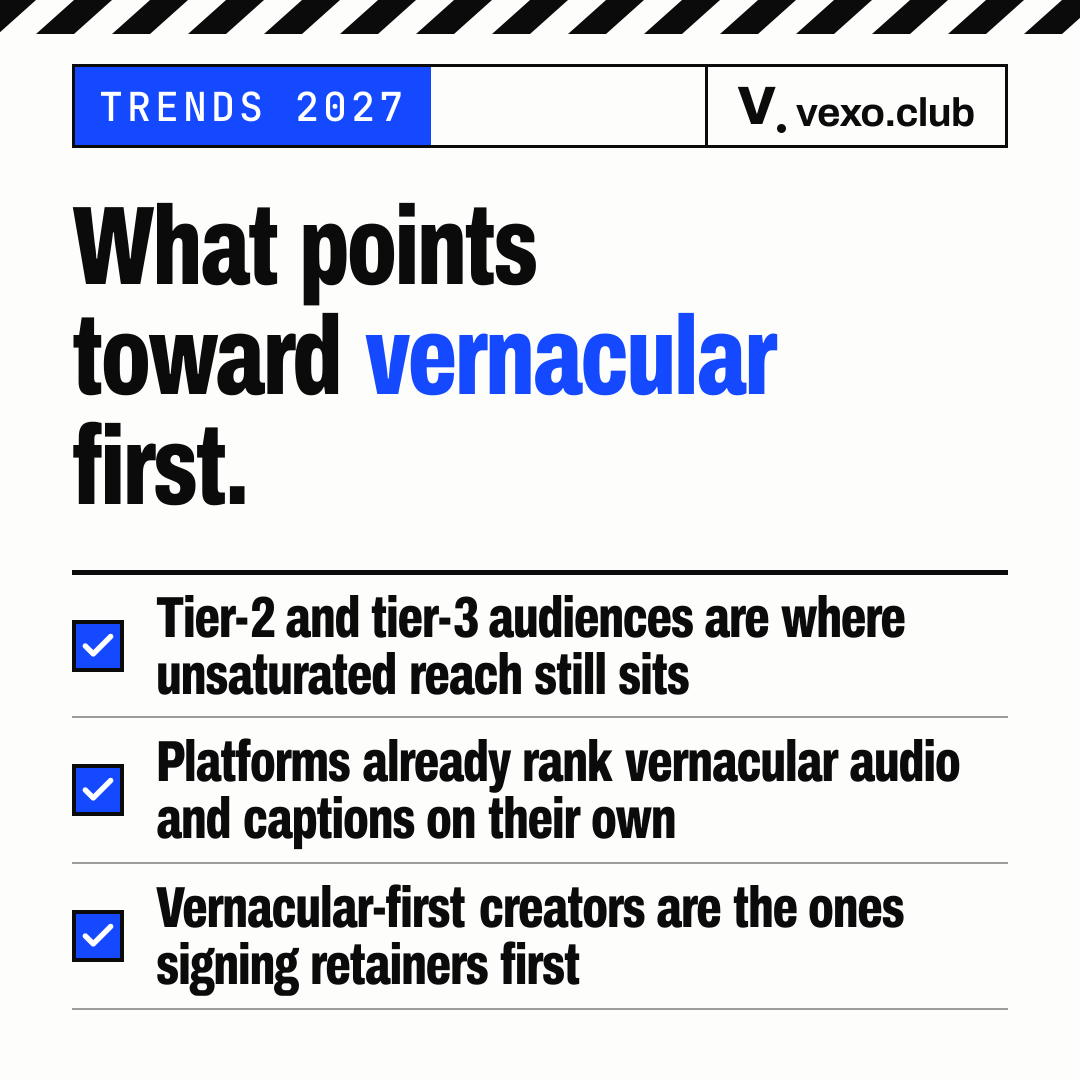
The fourth shift is the one the desk is most confident reads as a direction rather than a guess, because it follows from where unclaimed audience still sits. English-first creator content in India’s major metros is already a crowded, well-priced market. Tier-2 and tier-3 audiences, and the vernacular creators who speak to them directly, are not, and a market that has not yet been bid up is where a brand’s next rupee tends to go first.
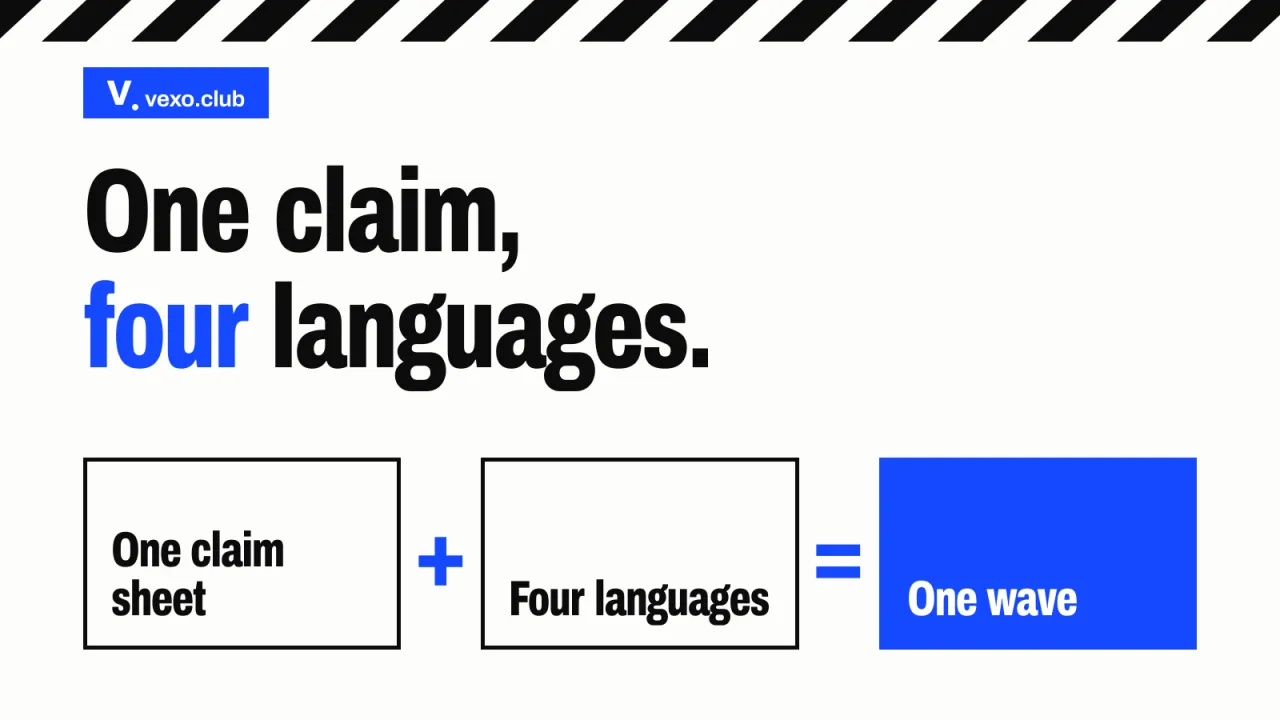
Platform behaviour points the same way. Search and recommendation systems that already rank vernacular audio, captions and regional hashtags on their own terms (rather than treating them as a translated afterthought of an English original) make vernacular content easier to be found in, not just cheaper to produce. The desk has written the production side of this in a regional launch run across four languages; the 2027 forecast is that the budget logic behind that kind of brief becomes the default logic, not the exception brands reach for only when a campaign is explicitly regional.
The desk also reads a leading signal in its own retainer conversations: creators who publish vernacular-first are, anecdotally, the ones being asked for ongoing arrangements first, ahead of English-first peers with comparable reach. That is one desk’s observation, not a measured trend across the industry, and it is offered here as exactly that.
Three signals behind a vernacular-first budget shift
What changes in a brief written for 2027
None of the four shifts above change what a brief needs today. They change what a brief should leave room for as it is written now, so that the campaign is not rebuilt from scratch when the direction the desk is describing becomes the norm rather than the edge case.
What a brief can leave room for now, ahead of 2027
- A line asking whether the creator’s content is written to be found, not only watched: captions, pinned comments, on-screen text a search system can read
- A standing field for AI-made or AI-altered assets, filled in by habit, empty when nothing applies
- A retainer option alongside the one-off rate, even for a brand not ready to commit to one yet
- A vernacular-first version considered before an English-first one is treated as the default and vernacular as the add-on
- A note on who owns the relationship history (the agency, the brand, or the creator) once a retainer outlives any single campaign
A brief that leaves these gaps open costs nothing extra to write today. What it buys, on the desk’s read, is a campaign that does not need re-briefing from zero when a shift that is directional in 2026 becomes the way the industry actually works in 2027. A brand that wants to talk through what that looks like for its own category can send the desk a brief and the shortlist comes back in 18 hours, built against today’s rules, with room for where the desk expects them to move.
Questions brands ask
Are these influencer marketing trends for 2027 backed by data? No, and the post says so throughout: these are the desk’s own qualitative read of where current signals point, not findings from a survey or a study. The dated facts in the piece, ASCI’s AI labelling guidelines taking effect 29 December 2026 and MeitY’s IT Rules requiring platforms to label synthetic content since 20 February 2026, are already settled and are linked to their own sourced guide rather than restated as a forecast.
Will creators really replace SEO as a brand’s main search channel by 2027? The desk is not forecasting a replacement. The read is that creator content becomes a second, additional route into search visibility (cited by AI answer engines, ranked by platform search) alongside a brand’s existing SEO work, not instead of it.
Does AI disclosure becoming “default practice” mean the rules change again? No. The rules referenced here (ASCI’s guidelines, MeitY’s IT Rules) are already fixed and dated; nothing in this post forecasts a rule change. The forecast is about habit: that following an already-fixed rule becomes routine rather than a late-stage legal check, the way most compliance requirements eventually do.
Should a brand move to a retainer now, or wait? That depends on the brand’s own calendar, not on this forecast. A single launch or seasonal push still suits a one-off brief. The desk’s point is narrower: that a brand planning more than one campaign with the same creator over a year will likely find a retainer cheaper to administer than re-briefing each time, and that the direction of new business is moving that way.
Does “vernacular-first” mean dropping English-language creators? No. The forecast is about where the next rupee of budget is more likely to go (toward audiences and creators that are not yet as competitively priced), not about English-first work disappearing. A brand with a national English-speaking audience still has reason to brief for it.
How did the desk arrive at these four shifts specifically? From briefs it is writing today: questions brands are already starting to ask about AI assets, search visibility and retainers, read against where audience and platform ranking are not yet saturated. That is a working desk’s observation of its own pipeline, offered as a forward read, not a market-wide study, and the post does not claim to be one.
Cite this page
Influencer marketing trends 2027: four shifts the desk sees ahead for India. vexo.club, published 02 Nov 2026. https://vexo.club/blog/influencer-marketing-trends-2027
Influencer marketing across India
Send the desk a brief: it comes back as a shortlist and a directional band, never a public price.
Brief the desk