Influencer marketing for wellness, nutrition and supplement brands in India: the doctor, the creator and the claim
Influencer marketing for wellness brands in India runs on two different creators, not one: a doctor bound by the NMC, and a lifestyle or fitness creator bound by ASCI. A nutrition brand’s playbook for casting each, the claims a brief can carry, and how to keep a campaign credible.
Playbooks 10 min read The operators’ desk
In this article9 sections
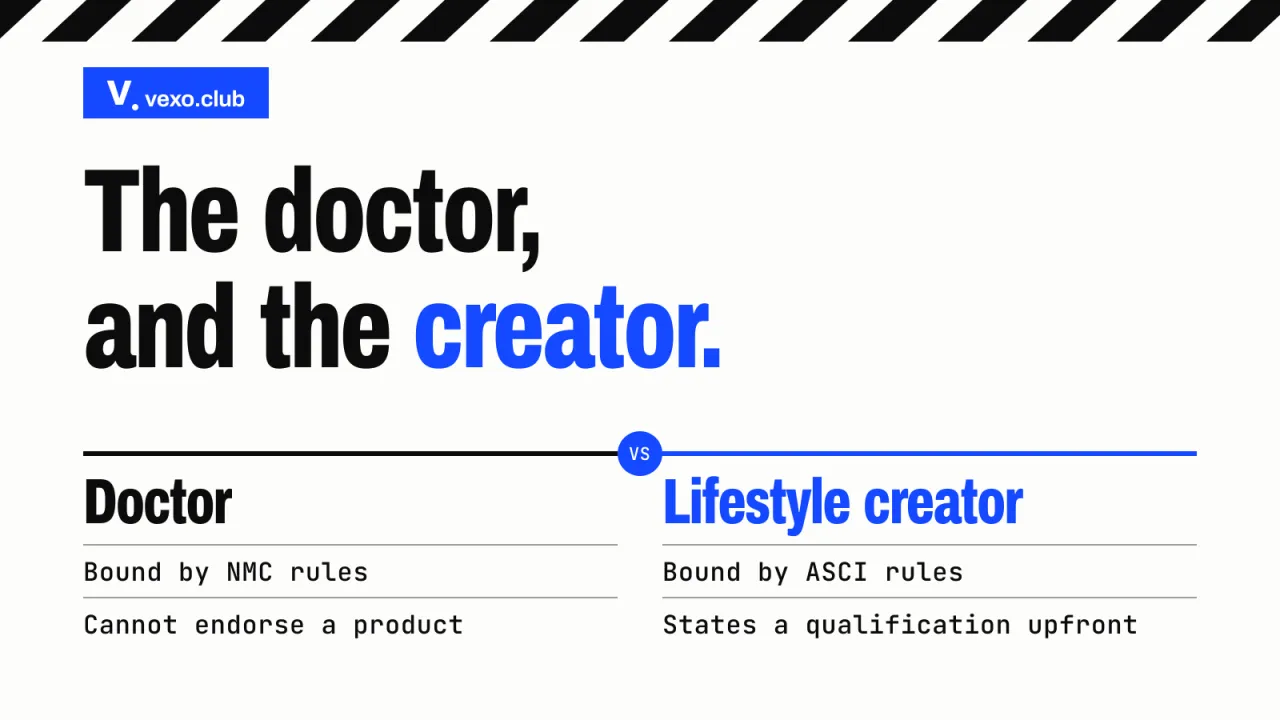
A wellness, nutrition or supplement brand casting influencers in India is really casting two kinds of creator under two sets of rules: a doctor or other clinical professional, bound by the National Medical Commission and their profession’s ethics code, and a lifestyle, fitness or nutrition creator with no medical registration, bound by the Advertising Standards Council of India instead. Treating them as one casting decision is where most wellness briefs go wrong.
This guide comes from vexo.club, an influencer marketing agency run from one desk in Delhi NCR. It sets out the distinction a brief has to make, the claims each creator can and cannot carry, and how to structure a campaign that stays credible without resting on a benefit the brand cannot show. It is a brand playbook, not legal advice, and a live claim should go past counsel first.
Influencer marketing for wellness brands, in short
- A registered doctor cannot endorse a product in advertising, paid or unpaid, however the post is framed.
- A lifestyle or fitness creator with no medical registration answers to ASCI, which asks for a relevant qualification before any health claim.
- A claim needs the brand’s own substantiation on file before it reaches a creator.
- A supplement sold as food is still regulated as food: claims follow the FSSAI’s rules even with no doctor involved.
- Credibility comes from the claim matching the evidence and the creator matching the claim, not from reach.
Why a wellness brand needs two different creator playbooks
The split is not about reach or content quality. It is about who is allowed to say what. A doctor filming a supplement review is bound by medical ethics rules that apply regardless of payment; a nutrition creator with no medical degree filming the same review is bound by advertising rules instead, which turn on the claim made and the qualification behind it. A brief mixing both without separating the rules ends up asking the doctor for something the NMC forbids, or the lifestyle creator for a claim ASCI would flag.
The two creators a wellness brief has to tell apart
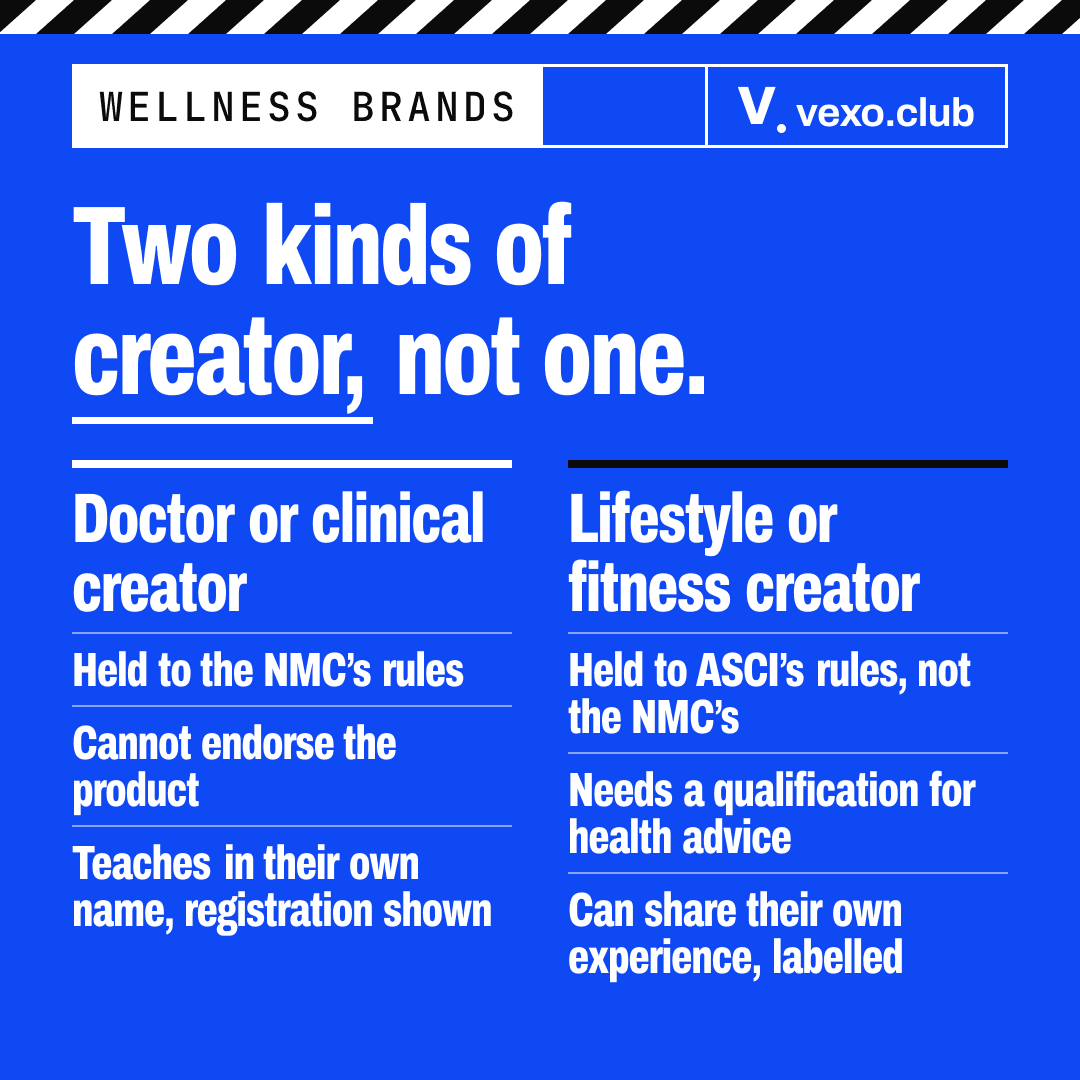
What can a doctor or clinical creator do for a wellness brand?
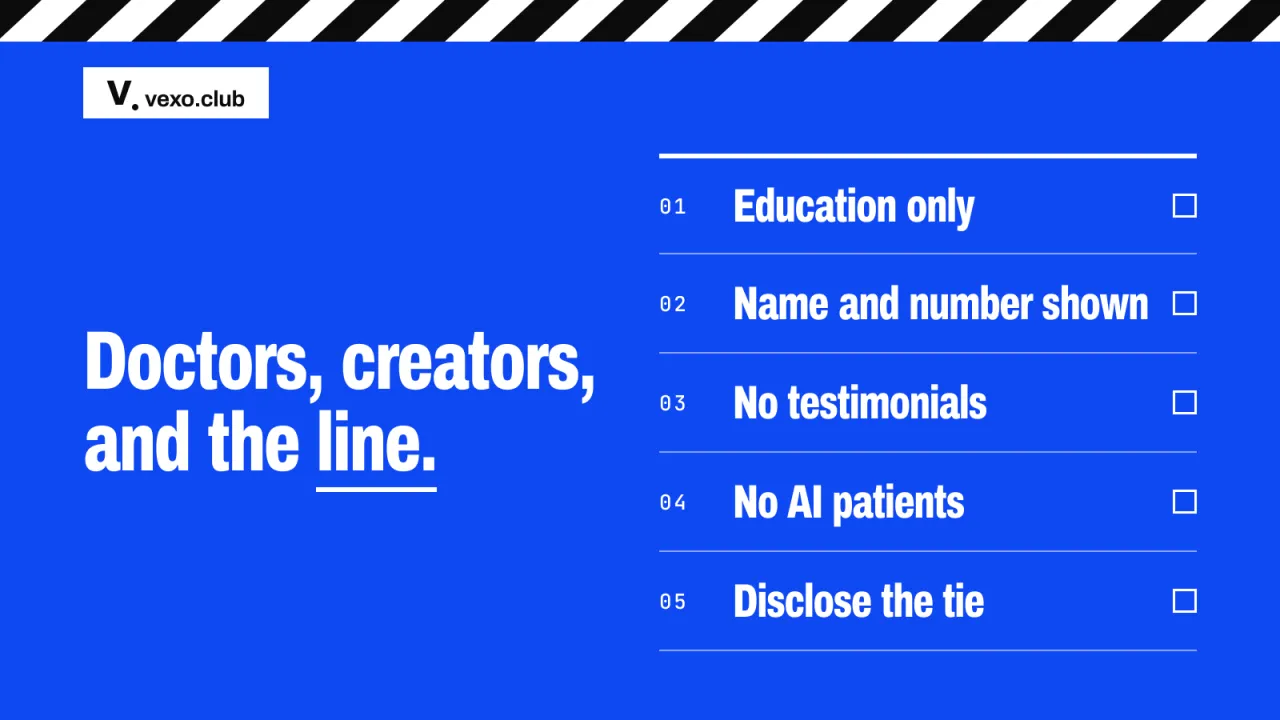
The short answer is: teach, not endorse. The NMC’s advertising guidelines of 6 October 2026 bar a registered doctor from endorsing any drug, device, health product or commercial product in advertising, paid or unpaid: a bar the Medical Council of India’s 2002 ethics regulations already set. A doctor who names, holds or recommends a wellness or supplement product on camera is on the wrong side of that line regardless of the fee, or the absence of one.
What is still open is education in the doctor’s own name: explaining a nutrient, discussing a dietary pattern, answering a common question, none tied to a named product or monetised as promotional marketing. A brand can fund that kind of series if the product stays out of frame and the commercial tie is disclosed. The clause-by-clause reading of what a doctor’s post can show is in the sibling post linked above; this guide does not repeat it.
What can a lifestyle or fitness creator do instead?
A lifestyle, fitness or nutrition creator who is not a doctor sits outside the NMC’s rules and inside ASCI’s. Addendum 2 to ASCI’s influencer guidelines, dated 17 August 2023, asks a creator commenting on health and nutrition to hold a relevant qualification and state it upfront: on the visuals, early in a video, before the text in a written post, at the start of audio. A creator with none can still post generic information about a product, but not advice that reads as technical or medical.
The practical effect is a second casting question beyond reach: does the creator hold the qualification the claim needs. A protein-powder taste test needs none of that. A dosage recommendation for muscle recovery does.
What claims can a wellness, nutrition or supplement brand make through a creator?
A claim briefed to any creator, doctor or otherwise, still has to clear the rules that govern the product. Most wellness and nutrition products sold in India are food, so claims answer to the FSSAI’s Advertising and Claims Regulations, 2018, which ask for claims that are truthful, unambiguous and evidenced. A health supplement or nutraceutical is regulated again under the FSSAI’s 2022 regulations for health supplements and nutraceuticals. Where a claim touches a named disease, the Drugs and Magic Remedies (Objectionable Advertisements) Act, 1954 bars advertising a cure, a prevention or a remedy for the conditions it lists, whoever makes the claim.
That leaves a narrow line for a brief to hold: a wellness product can be described by what it is, how it is used and the creator’s own experience of it, but not by what disease it treats, cures or prevents, and not by a result the brand has not measured.
What a wellness or nutrition brief can and cannot carry
Claims a brief can use
- What the product contains and how it is meant to be used
- The creator’s own experience, told as theirs and labelled as paid
- A nutrient’s known physiological role, worded as the label allows
- How the product tastes, mixes or fits into a routine
Claims that need a hard stop
- Treating, curing or preventing a named condition
- A dosage or clinical recommendation from a non-clinical creator
- “Doctor recommended” with no named, consenting doctor
- A before-and-after result the brand has not measured
Doctor, qualified creator or neither: who can say what
Put the two creator types and a third, unqualified one side by side against the claims a wellness brief most often wants, and the casting decision reads off directly.
Who may carry which wellness claim
| Endorse the product | Advise on dosage or treat a condition | Share labelled personal experience | General wellness content | |
|---|---|---|---|---|
| A registered doctor | No, paid or unpaid | No, barred regardless | No, not as an endorsement | Yes, own name, no product |
| A qualified non-doctor creator | Yes, ASCI rules, qualification shown | Yes, inside qualification, evidence on file | Yes | Yes |
| A creator with no clinical qualification | Yes, no cure or treatment claim | No, outside the qualification | Yes | Yes |
How to structure a credible wellness campaign without overstating benefits
Credibility here is built the same way the claims are cleared: the claim comes first, in writing, before any creator is approached. A brand that writes “contains vitamin C, supports normal immune function” and briefs that line is in a different position from one that tells a creator to “talk about immunity” and leaves the wording to improvisation on set.
The second discipline is matching the creator to the claim rather than the claim to reach, never asking for more than the row above allows. The third is visual honesty: a creator styled to look clinical, a white coat, a stethoscope, a clinic backdrop, reads as a doctor’s endorsement even with no registration behind it, and the CCPA’s 2022 guidelines on misleading advertisements treat a misleading impression the same as a misleading sentence.
Five phrases a wellness or supplement brief should strike
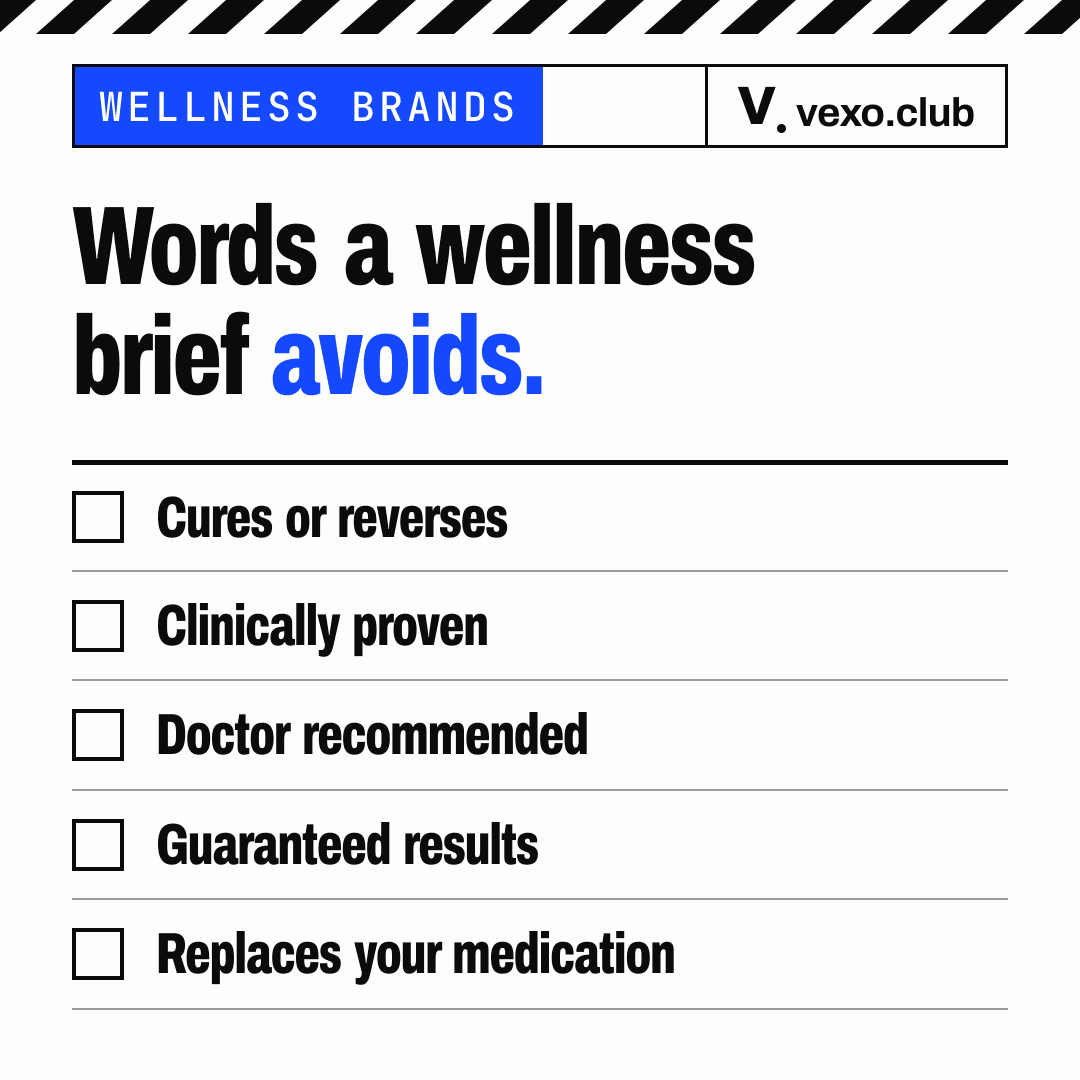
What should the brief and the approval process carry?
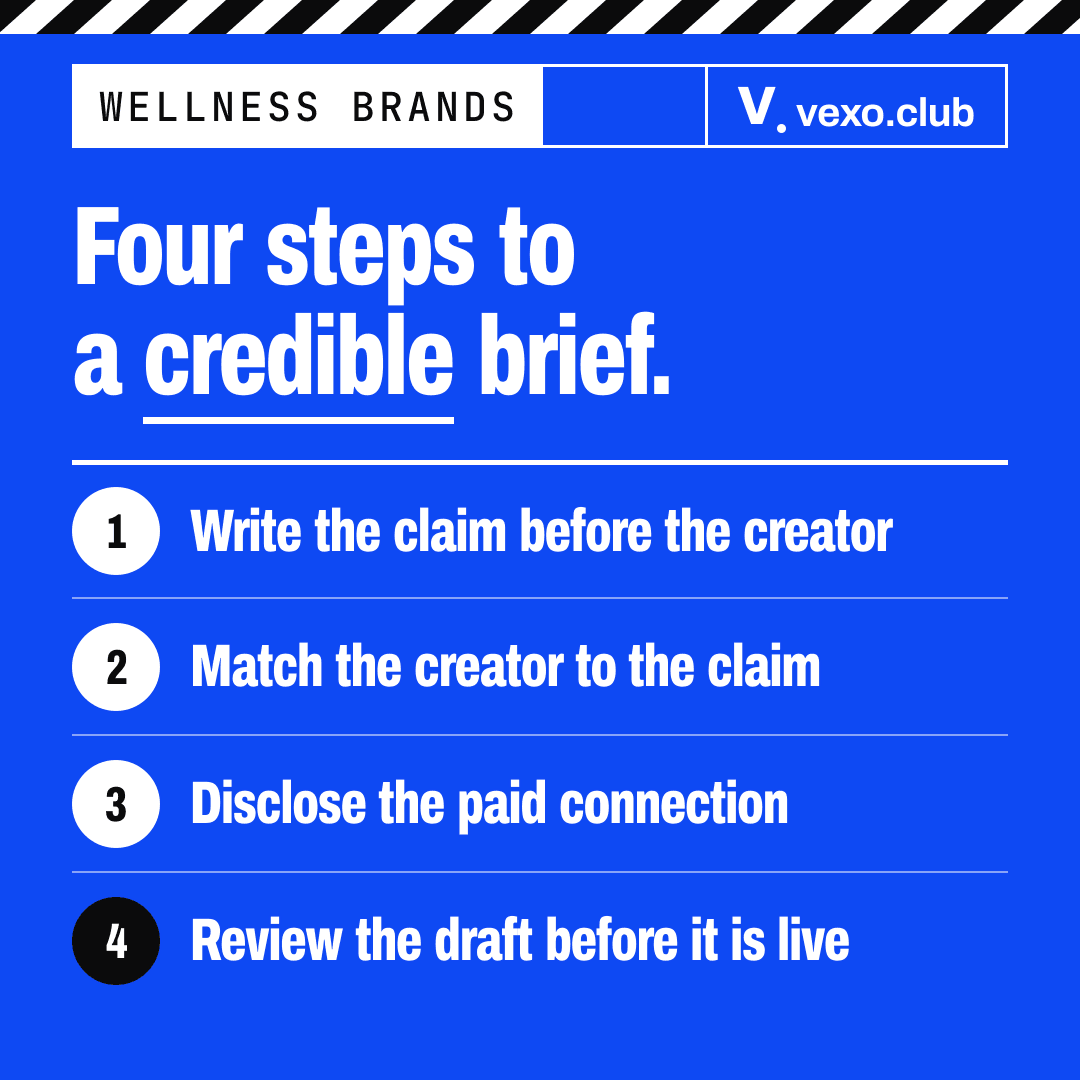
The claim and the creator check happen before a draft exists, not after. A brief that approves wording only once it sees the finished Reel has already let the creator write the claim.
How a wellness claim reaches a live post
- Approved claim Written by the brand, substantiation on file
- Creator check Qualification matched to the claim
- Draft Disclosure and qualification visible early
- Approval Signed off once claim, creator and disclosure are seen together
- Live review Claim and label read again after posting
The same discipline applies to the mix across one campaign: a doctor-led education piece with no product in frame, a qualified nutritionist who discusses the product by name, and a wider roster of lifestyle creators who carry their own experience of it. Each voice sits in a different row of the matrix above, and the brief should say which, rather than issue one script to everyone.
Before a wellness, nutrition or supplement brief goes out
- Is every claim in the brief written down, with evidence on file?
- Does any line claim to treat, cure or prevent a named condition?
- Is anyone on screen a registered doctor, and is the product out of frame?
- Does a non-doctor creator hold the qualification the claim needs?
- Is any before-and-after result real and measured by the brand?
- Does the visual styling imply a clinical setting the creator does not hold?
- Is the paid connection disclosed upfront, on the frame and in the caption?
- Is usage in paid ads covered by a written licence?
The order a credible wellness brief runs in
Usage rights and creator whitelisting belong in that same brief, not a later negotiation, and influencer contract clauses covers the takedown term that matters most once a claim is challenged. Checking an influencer’s audience sets out how the desk reads an audience before casting: a wellness product sold on a clinical-sounding claim to a mostly entertainment audience is a mismatch no disclosure label fixes.
Should a wellness brand book creators directly or through an agency?
A brand can brief doctors and lifestyle creators directly, through a manager, or through an agency. What an agency adds is a second reader on every claim, checking it against the brand’s evidence and the creator’s qualification, and a disclosure check before a draft goes live. The desk is in Delhi NCR; the Fitness & Wellness roster lists creators cast to a brief with consent on file, and a doctor-led piece or a mix of voices is cast the same way.
For the clause-by-clause reading of what a doctor’s post can carry, see the NMC guidelines explainer. To start a wellness brief, send it to the desk.
Questions brands ask
Can a wellness brand use a doctor in its influencer marketing? Only for education in the doctor’s own name, with the product kept out of the post. The NMC’s guidelines bar a registered doctor from endorsing any product in advertising, paid or unpaid.
Does a nutrition creator need a qualification to promote a supplement? For claims that touch health or nutrition, ASCI’s August 2023 addendum says yes: a relevant qualification, shown upfront. A creator without one can still share generic, personal-experience content, but not technical or medical advice.
What claims can a supplement brand’s influencer marketing make? Claims about what the product contains and how it is used, worded to match the label, are open to any creator. Claims to treat, cure or prevent a disease are barred for products sold as food under the FSSAI’s claims rules, and the Drugs and Magic Remedies Act, 1954 bars them for the conditions it lists, regardless of who makes them.
Is nutrition brand influencer marketing regulated differently from fitness or beauty influencer marketing? The rules overlap heavily: ASCI’s Addendum 2 covers health and nutrition claims across all three, and the FSSAI’s advertising rules apply wherever the product is sold as food. What changes is which creator types are common and which claims a brand is tempted to overreach on.
What does vexo.club check on a wellness or nutrition brief? The same two checks on every brief: that the claim matches the brand’s substantiation, and that the creator’s qualification matches the claim, before a draft is approved.
Sources
- ethics regulations (opens in a new tab) nmc.org.in
- influencer guidelines (opens in a new tab) ascionline.in
- Advertising and Claims Regulations, 2018 (opens in a new tab) fssai.gov.in
- 2022 regulations for health supplements and nutraceuticals (opens in a new tab) fssai.gov.in
- Drugs and Magic Remedies (Objectionable Advertisements) Act, 1954 (opens in a new tab) indiacode.nic.in
- 2022 guidelines on misleading advertisements (opens in a new tab) ccpa.doca.gov.in
Cite this page
Influencer marketing for wellness, nutrition and supplement brands in India: the doctor, the creator and the claim. vexo.club, published 29 Oct 2026. https://vexo.club/blog/influencer-marketing-wellness-nutrition-brands-india
Send the desk a brief: it comes back as a shortlist and a directional band, never a public price.
Brief the desk