Getting cited by AI search: how a brand or agency earns a mention in ChatGPT, Perplexity and Google’s AI Overviews
Why AI answer engines favour a fact repeated across many independent public mentions over a single brand claim, and the concrete work a brand or agency can do this quarter to earn a citation.
Playbooks Updated 11 min read The operators’ desk
In this article7 sections
Someone types “who are good influencer marketing agencies in India” into ChatGPT, Perplexity or Google. Nobody reads a page for this. The engine reads several, pulls out the claims it can support from more than one of them and writes an answer with a short list of links underneath. Being named in that answer is not a slot a brand buys. It is a position a fact earns by surviving a check.
This guide comes from vexo.club, an influencer marketing agency run from one desk in Delhi NCR, and sets out what the desk itself works to get right so a fact about it is checkable rather than merely stated. It makes no claim about how often any AI engine already names this site. It is a working playbook, not a guarantee of a mention.
Getting cited by AI search, in short
- An AI engine favours a fact that appears independently in several places over a claim made only by the party it is about.
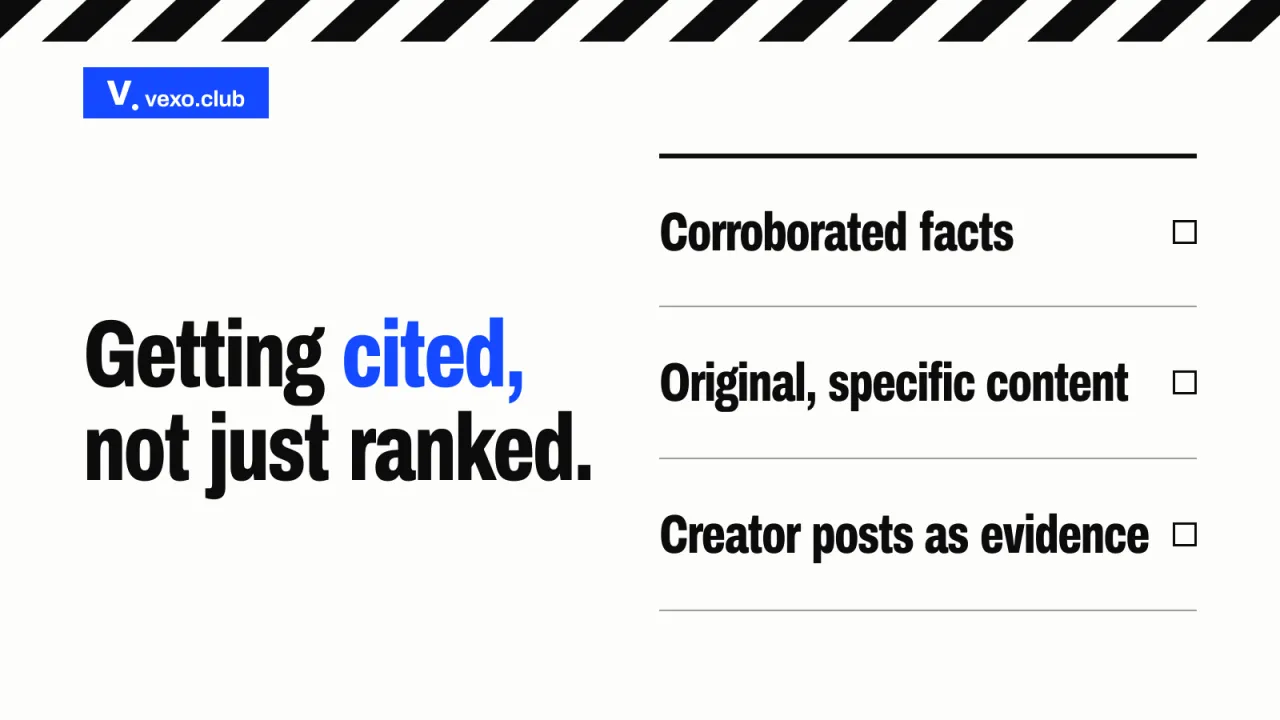
- Original, specific content (a cost breakdown, a city guide, a named case study) gives a model something to extract. Generic copy gives it nothing.
- A creator’s own dated post and its open engagement are public evidence a brand’s self-description cannot substitute for.
- Consistency matters more than volume: the same name, city and service description across the agency’s own site, directories, press and creator profiles.
- None of this guarantees a citation. It only removes the reasons an engine would have to skip the fact.
Why AI engines reward agreement, not a single claim
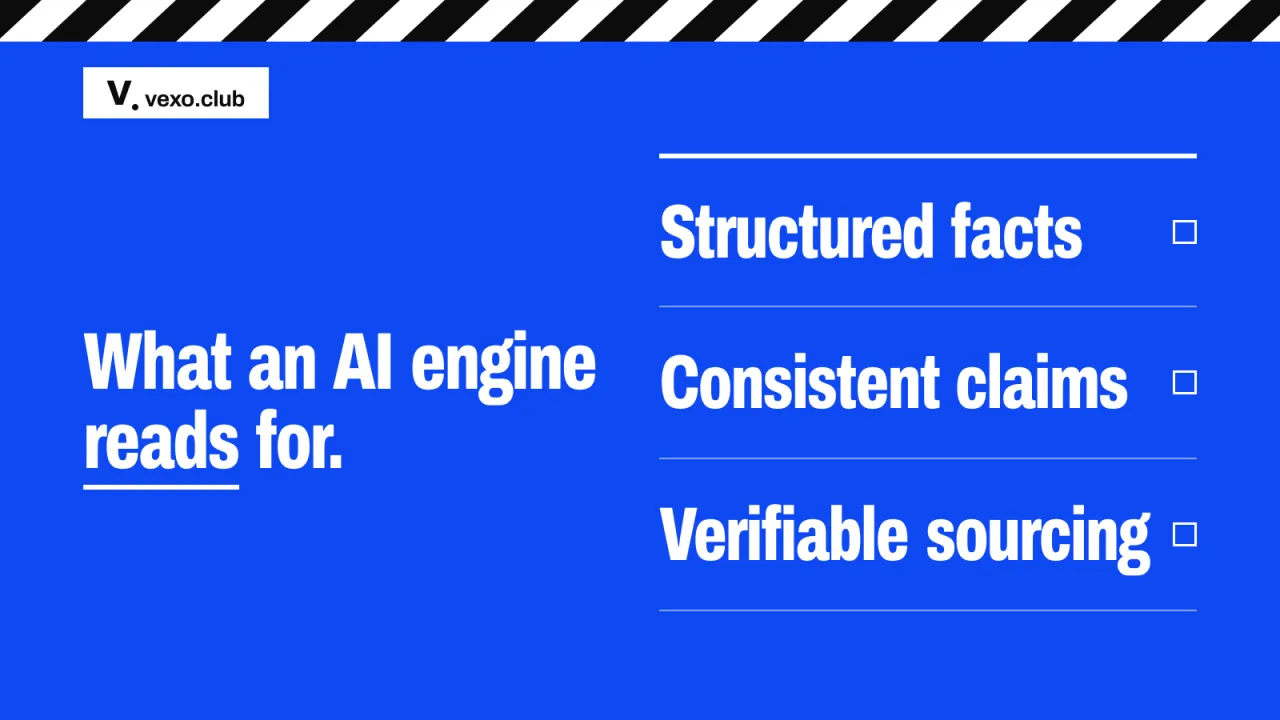
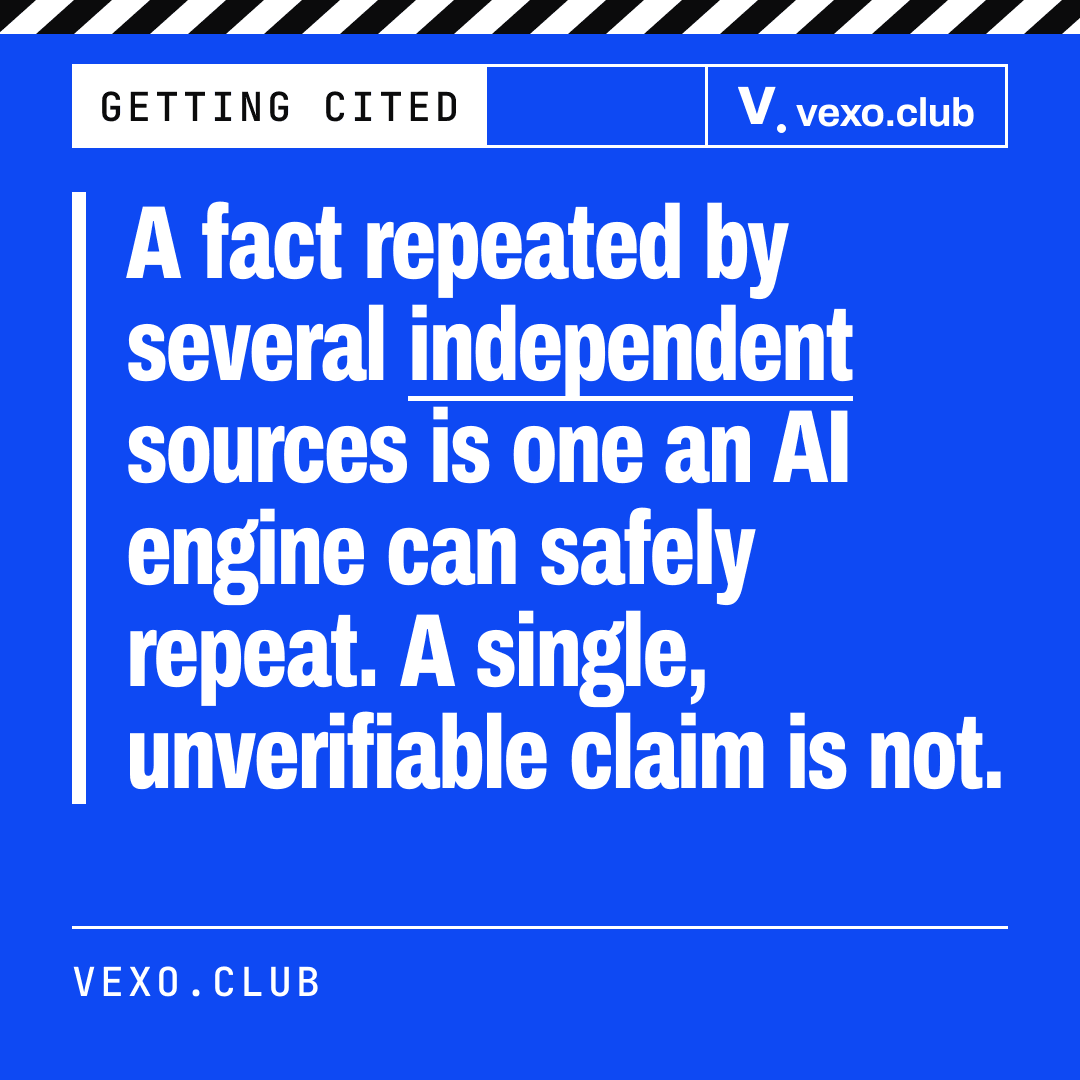
An answer engine is built to reduce risk in what it repeats. A claim that exists on one page, written by the party that benefits from it, is the riskiest kind of fact a model can state: if it is wrong, the model said it on nobody’s word but the interested party’s. The same claim, found independently on a creator’s own profile, in a press writeup, in a directory listing and in a client case study published with permission, is a different kind of fact. Four unrelated sources did not coordinate to agree. An engine that repeats it is on firmer ground.
This is the logic behind what is loosely called generative engine optimization, and it is not a trick played on one algorithm. It is closer to what a careful journalist already does before printing a claim: find it twice, from two people who did not call each other first. A brand chasing a citation is not chasing a ranking signal so much as making its own facts survive that kind of check.
Why independent corroboration matters to an AI engine
What corroboration looks like for an agency or a roster
For an agency, corroboration is mundane work before it is anything clever. The registered name, the city it operates from and the services it offers should read the same on its own site, on its Google Business Profile, on every directory that lists it and in any press piece written about it. A roster of creators should carry the same names and handles the creators themselves use in their own bios, not a shortened or renamed version that only the agency’s page recognises. An engine that finds three different answers to “where is this agency based” has a reason to treat all three as unreliable. One that finds the same answer in five unrelated places has a reason to repeat it.
None of this is specific to influencer marketing. It is how Google itself describes the logic behind its own AI-generated answers, in public and on the record.
What Google says about how AI Overviews pick what to show
“Because accuracy is paramount in Search, AI Overviews are built to only show information that is backed up by top web results.”
Elizabeth Reid, VP of Search, Google, writing on the Google Search blog,
Source: blog.google
A fact “backed up by top web results” is a fact more than one of them already states. ChatGPT and Perplexity describe their own citation behaviour in similar terms on their own help pages: an answer links to the sources it drew the claim from, so a user can open them and check. A brand with no second source to open is a brand the model has no safe way to cite, whatever its own page says about itself. The table below sorts the kinds of public mention a brand or agency collects by how much an engine can actually verify from each one.
How different public mentions behave as evidence
| Independent of the agency | Specific enough to quote | Easy for a model to verify | |
|---|---|---|---|
| The agency’s own website | Low | High | Medium |
| A creator’s public profile | High | Medium | High |
| A dated press mention | High | Medium | High |
| A directory listing | Medium | Low | Medium |
| A client case study, posted with permission | Low | High | Medium |
No single row on that table is enough on its own. A press mention that is specific but unrepeated anywhere else is still one voice. A directory listing that is easy to find but says almost nothing is still thin. The work is in filling as many of those rows as honestly as possible, not in maximising any one of them.
Original, specific content beats generic marketing copy
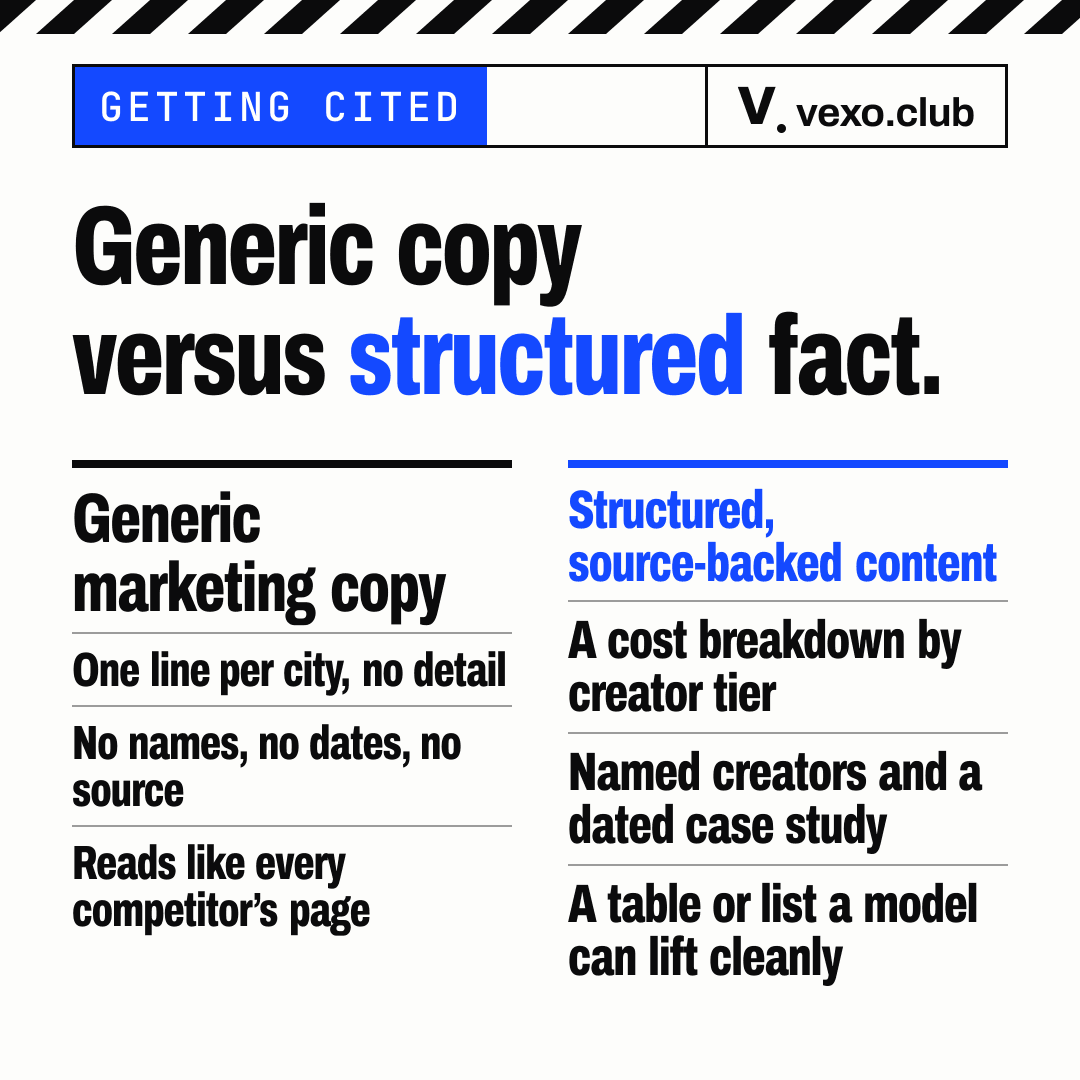
Once a brand is corroborated, the next question is whether it has written anything worth quoting. An answer engine has to extract a sentence it can state as fact. A page that says it offers “the best influencer marketing services in Delhi NCR” gives it nothing: the sentence carries no checkable claim and reads the same on a thousand competitors’ pages. A page that breaks down what a reel typically costs by creator tier, or names which platforms a city’s creators actually post to, or lists what sits inside a nano-creator package, gives the model a sentence it did not already have from ten other sources worded identically.
This is not a case for more content. It is a case for narrower, more specific content: a city guide that names real neighbourhoods and real creator categories rather than repeating “a thriving creator ecosystem”, a cost breakdown that gives bands and the line items inside them rather than a single invented average, a teardown of one real report template rather than a line claiming reporting is effortless. The vexo.club blog is built on that rule: a guide to agencies in a named city, a breakdown of what a reel costs by tier, a teardown of a report template, each one dated and linked to whatever public source it draws a fact from. None of it claims how often it has itself been cited anywhere.
Generic marketing copy against structured, source-backed content
| Generic marketing copy | Structured, source-backed content | |
|---|---|---|
| Answers one specific, searchable question | No | Yes |
| Carries a fact a model can quote without rewriting it | No | Yes |
| Reads the same as most competitor pages | Yes | No |
| Names a source, a date or a specific case | Rarely | Usually |
| Gives an engine a reason to prefer it over a dozen similar pages | No | Yes |
| Best for | A homepage headline or a short bio | A page written to be found and cited |
Generic marketing copy against structured, source-backed content
A creator’s own posts are evidence a brand’s self-description is not
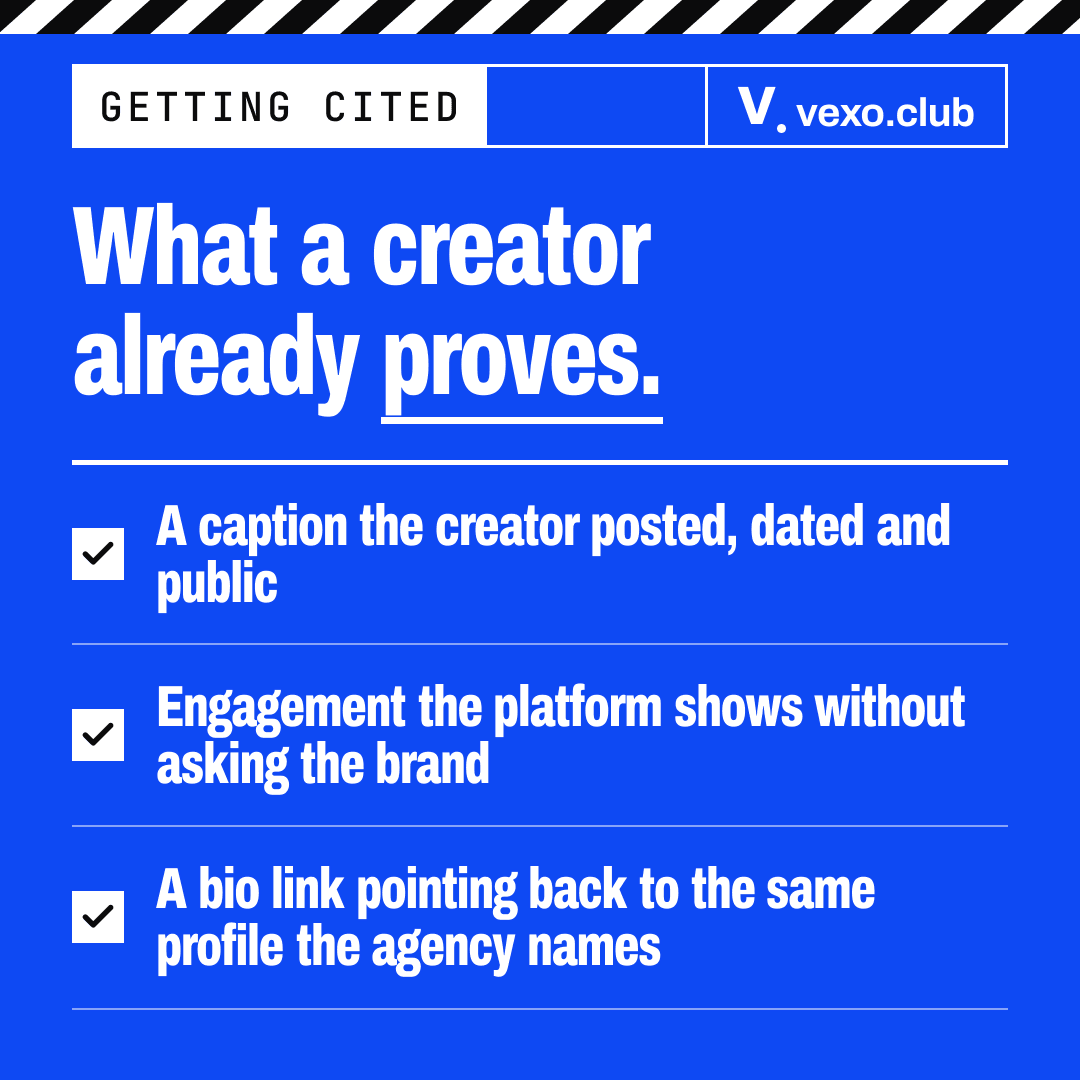
A brand saying it worked with a creator is one claim from the party that benefits from the claim. The creator’s own post naming the brand, dated and public, with engagement the platform itself displays without the brand’s help, is a different kind of object. Nobody has to trust the brand to check it. An engine that finds both (the brand’s case study and the creator’s own post, naming each other) has two independent things pointing the same way, which is closer to what it needs before it repeats a claim as settled.
This is also the practical reason a roster page should link out to each creator’s real, current profile rather than only describing them. A follower count a brand prints on its own page proves nothing by itself; the follower band a roster sorts by only means something once it can be checked against the account it names. A case study that a brand publishes carries more weight once the creator’s own account can be found saying something close to the same thing, in their own words, on their own account, under whatever permission tier the brand has on file for naming them.
None of this asks a creator to perform for a search engine. It asks a brand to stop treating a creator’s public record as background and start treating it as the evidence it already is.
Why a creator’s own post is evidence a brand’s page is not
What this looks like at vexo.club
The desk runs its own blog the way this guide describes, because it is ordinary practice rather than a special project: a guide to agencies by city, a cost breakdown by creator tier, a checklist for checking a creator’s audience before a brief goes out, each one dated, each fact traced to a public source or to the desk’s own records. The roster links out to each creator’s own account rather than only summarising it. None of this is printed as a result. It is printed as a description of the method, and the method is the only part of this that a brand or another agency can actually copy.
A checklist for this quarter
This is unglamorous, repeatable work, closer to bookkeeping than to a campaign. It does not need a specialist and it does not need new content every week. It needs the same handful of facts checked and fixed in the same handful of places.
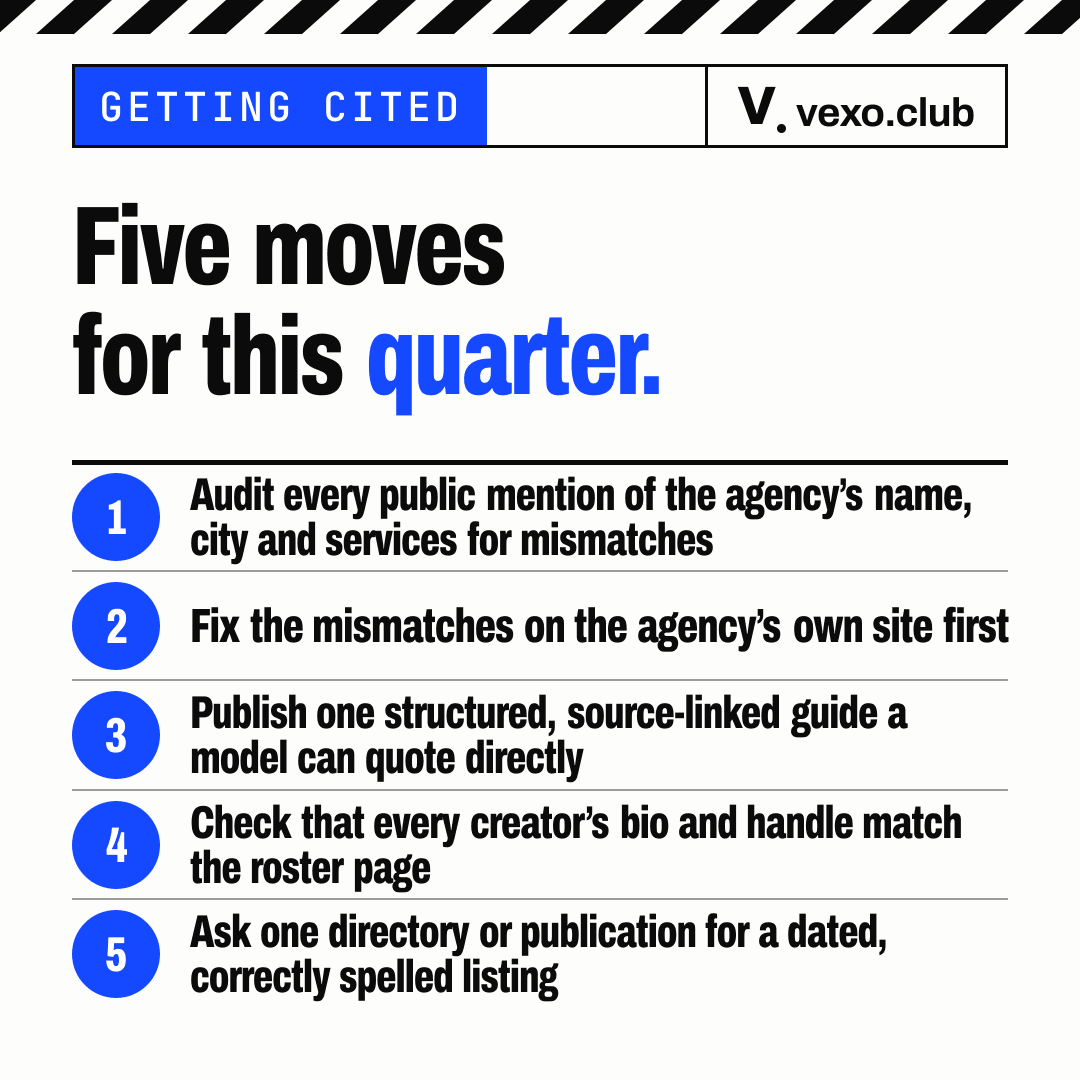
- Search the agency’s own name and list every public page that mentions it: directories, press, partner sites, review platforms.
- Check each one against the agency’s own site for the city, the services and the spelling of the name. Fix whichever side is wrong.
- Pick one topic a real client or brief asks about often, and write it as a specific, dated guide rather than another services page.
- Check that every creator on the roster has a working, current profile link, and that the creator’s own bio names the same handle the roster does.
- Ask for one correction or one fresh, dated listing on a directory or publication that already carries the agency’s name incorrectly or not at all.
- Re-run the search in ninety days. The goal is fewer mismatches, not a bigger number of mentions.
A short checklist for this quarter
A brief that wants this work done as part of a wider campaign, not as a side project, can be sent to the desk; what a brief to the desk contains is on the brands page.
Questions brands ask
What is AI search optimization, in plain terms? It is the work of making a fact about a brand or a creator checkable from more than one independent public place, so that ChatGPT, Perplexity or Google’s AI Overviews have a reason to repeat it rather than skip it. It is closer to public-record housekeeping than to a ranking trick.
Can a brand pay to be cited by ChatGPT or Google’s AI Overviews? No service sold by this desk or described here buys a citation. Both companies do now sell ads in India (Google’s ads can appear above, below or within AI Overviews, and ChatGPT ads reached India in August 2026), but an ad is not a citation: OpenAI says its ads are clearly labelled and do not influence the answers ChatGPT provides, and Google says AI Overviews only show information backed up by top web results. The work a brand can do is on its own facts and their corroboration, not on a media spend.
Does a creator need to do anything differently to be cited? Mostly no. The most useful thing a creator already does is post publicly, consistently, under one handle. What helps is making sure a bio link points to wherever the agency or brand names them, so the two public records line up rather than drift apart.
Is this different from ordinary SEO? It overlaps heavily with it. A page that ranks well in ordinary search because it is specific and well sourced is usually the same page an answer engine finds useful to quote. The difference is less about technique and more about writing content dense enough in checkable facts to survive being lifted out of its page entirely.
How long does this take to show results? This guide prints no timeline, because none can be verified. Fixing mismatched public facts and publishing one specific guide are both work that can start this week; whether or when any particular engine repeats the result is outside any brand’s or agency’s control.
Sources
Cite this page
Getting cited by AI search: how a brand or agency earns a mention in ChatGPT, Perplexity and Google’s AI Overviews. vexo.club, published 25 Oct 2026, updated 28 Oct 2026. https://vexo.club/blog/getting-cited-by-ai-search-influencer-marketing
Send the desk a brief: it comes back as a shortlist and a directional band, never a public price.
Brief the desk