Influencer marketing for D2C brands in India: structuring the creator mix
A D2C influencer strategy seeds with nano and micro creators, captures UGC rights for ad reuse, and sets codes and links before macro amplification.
Playbooks 10 min read The vexo.club desk
In this article8 sections
A D2C influencer strategy is a sequence, not a single buy. A brand that casts its whole budget into one wave of creators learns what worked only after the spend is gone. The alternative is to split the program into a launch phase that is cheap to get wrong and a scale phase that is expensive to get wrong, and to move creators, rights and attribution between the two on purpose rather than by accident.
This playbook comes from vexo.club, an influencer marketing agency run from one desk in Delhi NCR, and sets out how the desk sequences a D2C creator mix: which tier does which job, what a brief must capture for the content to be reused as an ad, and which proof answers which question. It states no rate, no campaign result and no market size, because a public playbook has no record behind any of the three.
A D2C influencer strategy, in short
- A D2C creator mix is sequenced, not cast all at once: nano and micro seed the launch, macro and celebrity amplify what proves out.
- Nano and micro seeding tests a hook and a claim cheaply across several voices; macro buys reach behind the voice that already worked.
- A brief should capture UGC rights for ad reuse before the shoot, not after a post happens to perform.
- A code, a tracked link and a whitelisted ad prove different things, and the brief should name which applies to which tier.
What a D2C influencer strategy has to decide before the first brief
Three decisions come before a creator is chosen. First, what the launch phase is meant to learn (which hook, which claim, which creator voice a cold audience responds to) because a campaign with no stated question cannot tell a result from noise. Second, where the sale is counted: the brand’s own site, a marketplace or quick commerce, each with its own attribution trail, as social commerce in India sets out for a sale that closes on a platform rather than the brand’s own checkout. Third, which rights the brief buys alongside the post, since a right asked for after a creative performs is a right renegotiated with nothing left to bargain with.
The creator mix: three jobs, not three sizes
Nano, micro, macro and celebrity creators are not cheaper and costlier versions of the same job. Each does something the other cannot. Nano and micro accounts carry a close, believable voice into a niche, a city or a language, at a cost per deliverable that lets a brand run the same claim through several different voices at once and see which one a cold audience actually responds to. Macro and celebrity accounts carry reach: once a hook, a claim and a creator style have already proved out, a single larger voice puts that same proof in front of far more people than coordinating many smaller ones ever could. Running the mix in the wrong order spends the expensive reach before anyone has checked it is reach behind something that converts.
Three tiers, three jobs in a D2C mix
- Nano and micro creators A close, believable voice in a niche, a city or a language: used to test a hook or a claim, not to scale one
- Macro creators Reach, once a hook or a claim has already proved out on a smaller scale
- Celebrity creators Mass awareness, usually layered on top of a mix that is already working rather than used to find out what works
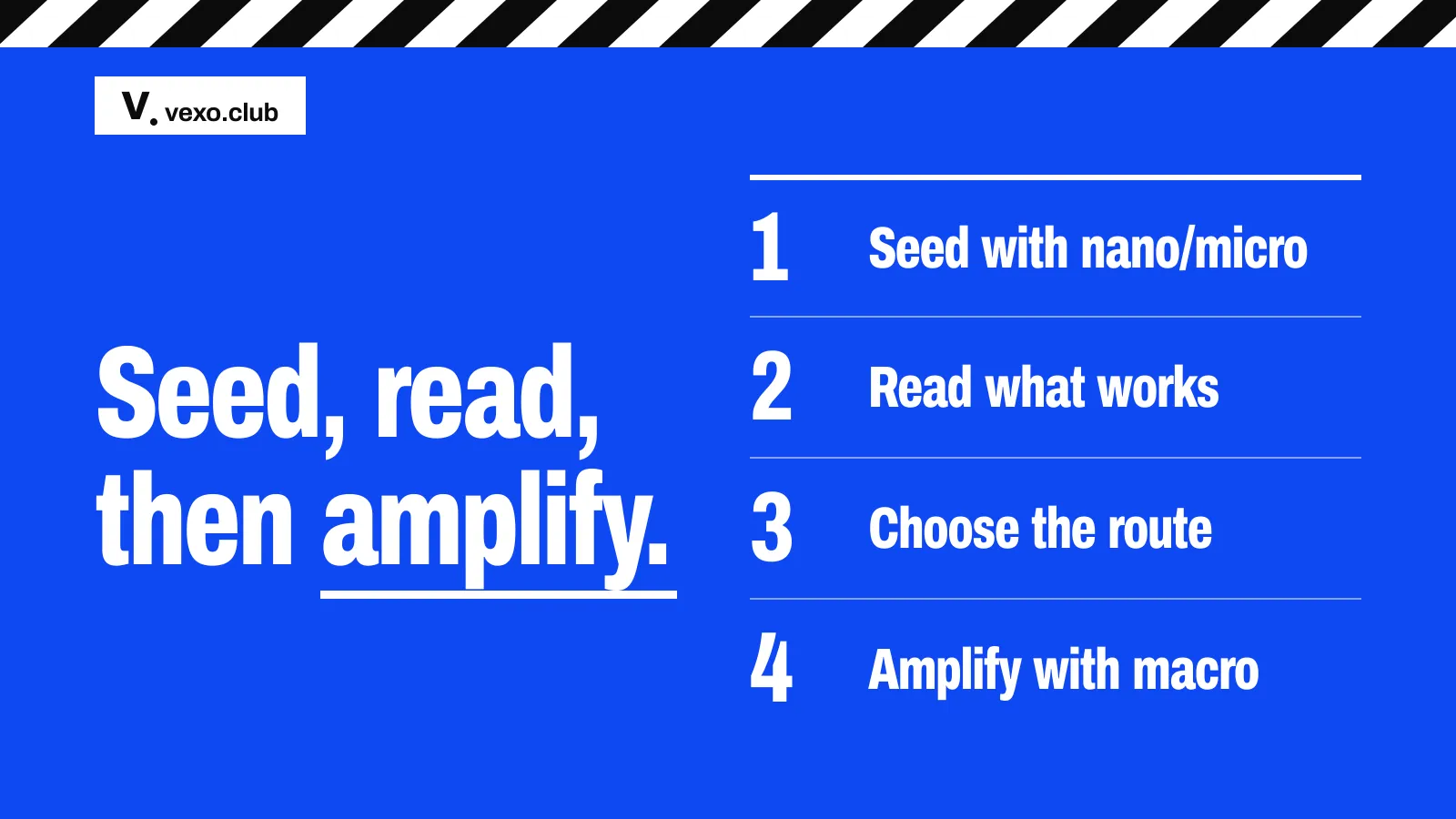
Sequencing: seed with nano and micro, amplify with macro
The sequence runs in one direction. A launch phase seeds several nano and micro creators across the hooks and claims under test, each carrying a code or a link of its own, so the brand can read which voice and which claim moved an order rather than a like. Once a route pulls ahead (on orders, on saves, on repeat purchase, on whatever the brand decided to watch before launch), the scale phase narrows the mix: fewer creators, larger ones, and the winning content either whitelisted as an ad under the creator’s own handle or rebuilt from the UGC rights already captured during seeding. Reversing the order, buying a macro voice before anything has been tested, spends the budget that should have paid for proof on a guess instead.
From seeding to amplification
- Seed Nano and micro creators run several hooks and claims at once, each with its own code or link
- Read Orders, saves and repeat purchase, against what the brief set out to watch before launch
- Choose One route pulls ahead; the rest are not wasted, their strongest lines become hooks for the winner
- Amplify Macro and celebrity creators, or whitelisted ads on the winning creator’s handle, carry the proven route further
Launch seeds the mix, scale amplifies the winner
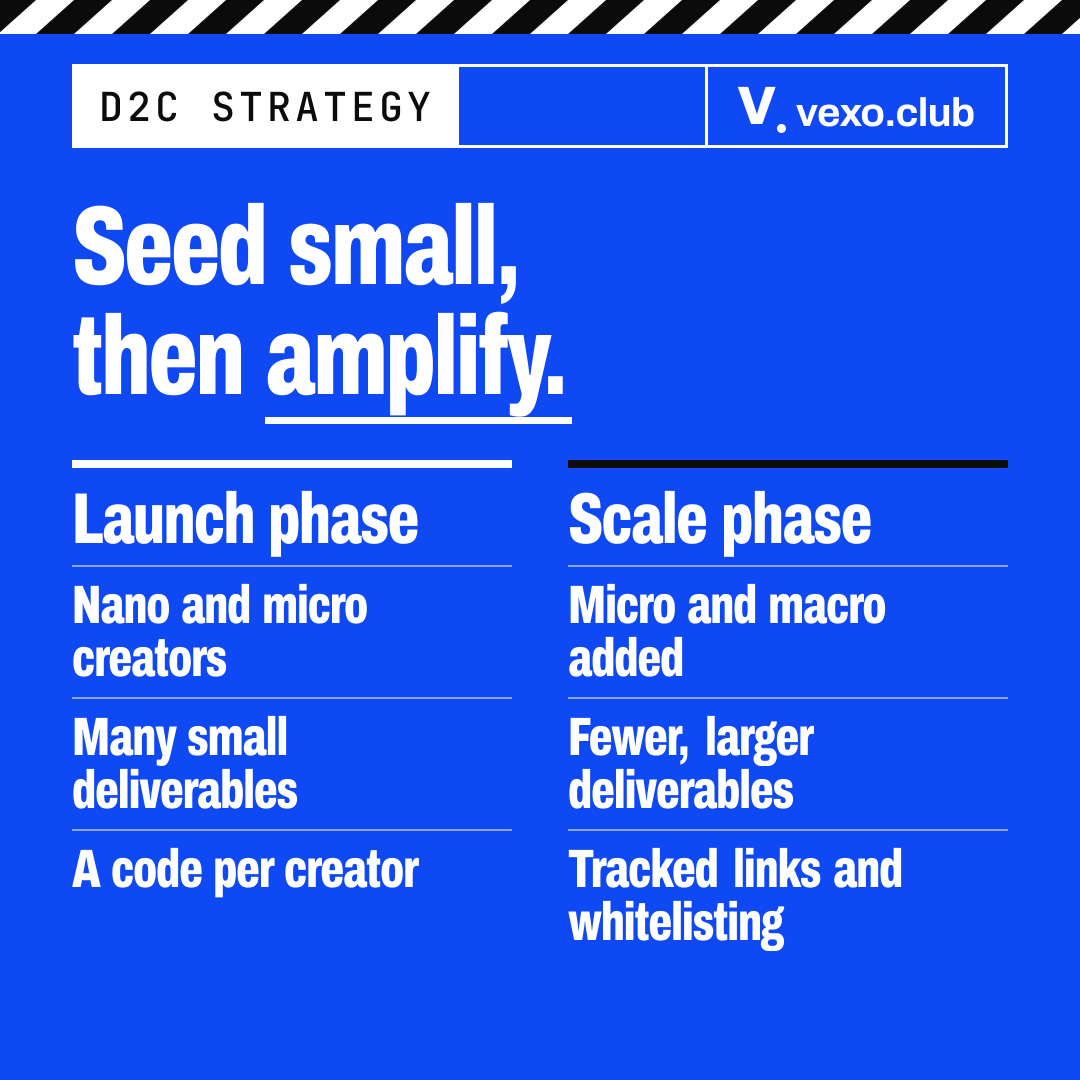
Launch phase and scale phase, side by side
The two phases differ on more than creator size. Budget logic, the proof a brief asks for and the rights a contract needs all move together, and a brand that keeps one phase’s habits in the other phase misreads its own results.
Launch and scale, set against each other
| Launch phase | Scale phase | |
|---|---|---|
| Primary creator tier | Nano and micro, seeded across several hooks | Micro and macro, added behind what already proved out |
| What it is for | Finding which hook, claim and voice a cold audience responds to | Putting the proven route in front of more of that audience |
| Deliverable shape | Many small deliverables, spread across many accounts | Fewer, larger deliverables behind the winning route |
| Primary proof | A code per creator, read for which voice moved an order | A tracked link or a whitelisted ad, read for cost per acquisition |
| UGC rights to capture | A short usage window, written before the shoot | A paid-media usage right and whitelisting terms, renewed as the route keeps working |
| Risk if the order is reversed | Spend concentrates on a voice or a claim nobody has tested | Reach is bought behind creative nobody has checked converts |
| Best for | Proving which voice and claim work | Buying reach behind what already converts |
Capturing UGC rights before the shoot, not after a post works
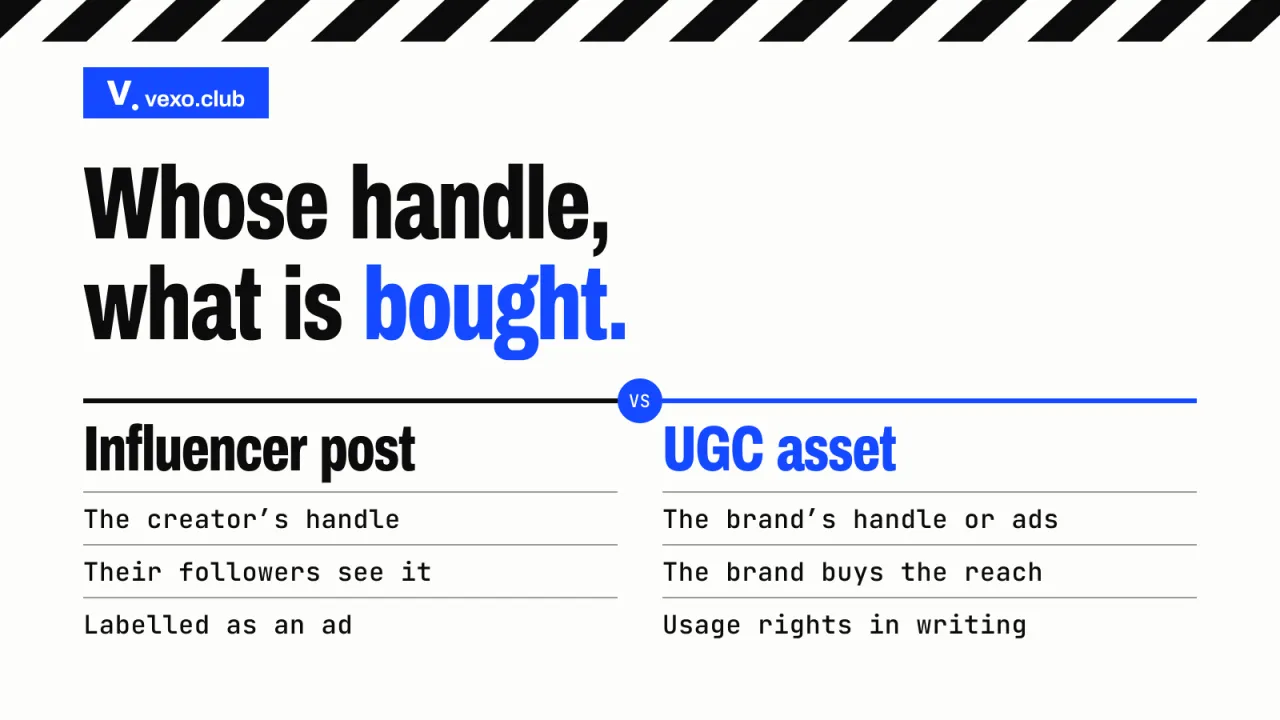
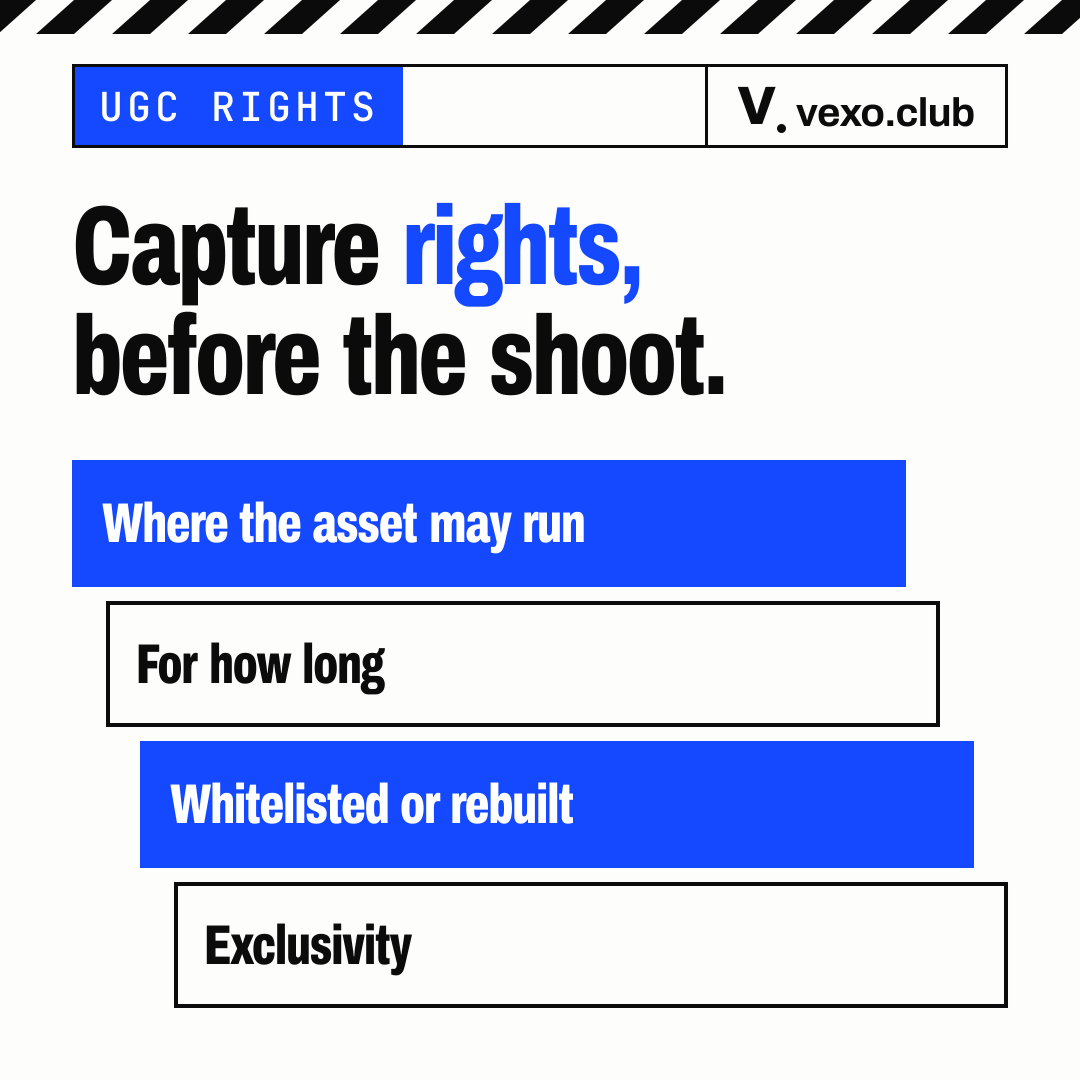
A launch brief that only buys a post buys nothing to reuse if that post turns out to be the one that works. The fix is cheap, and it has to happen before filming: every deliverable, even a nano or micro seeding post, carries a written right to reuse the footage as an ad. Usage rights splits any such grant into the same four lines regardless of the tier that shot it: where it may run, for how long, with or without paid media behind it, and whether the creator may make the same kind of content for a competitor in the meantime. UGC vs influencer marketing sets out why the right has to be named per deliverable rather than assumed, and creator whitelisting, explained covers the version of it that keeps the content on the creator’s own handle.
What a D2C brief should capture for ad reuse
- Where the asset may run Organic only, the brand’s own ads, or both
- For how long A window with a start and an end, renewed in writing or taken down
- Whitelisted or rebuilt Run as an ad from the creator’s own handle, or cut down and reused from the brand’s
- Exclusivity Whether the creator may make the same kind of content for a competitor in the meantime
What to capture for ad reuse, before the shoot
Codes and links: proof for each tier, not one report for all of them
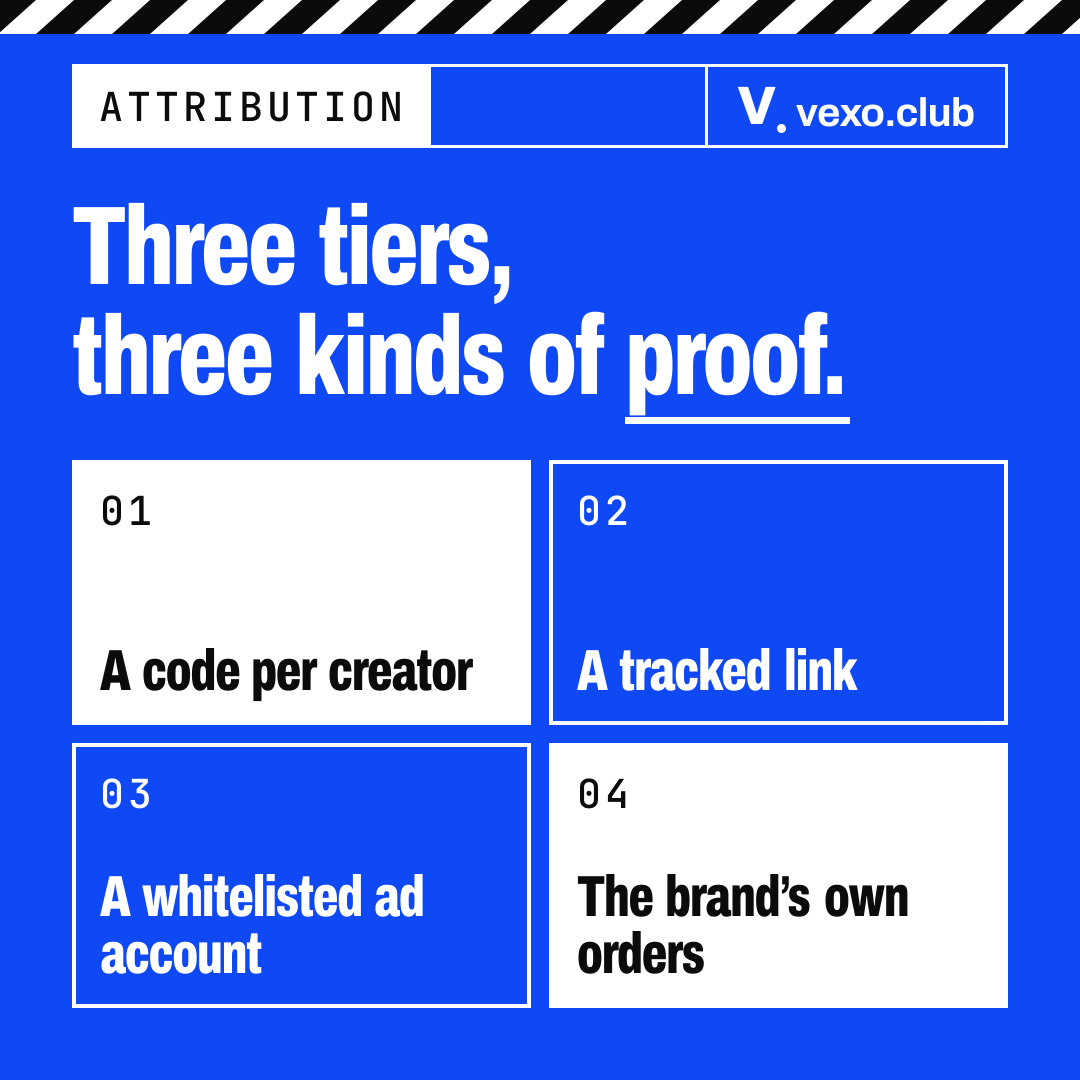
A nano or micro seeding post is read for which voice moved an order, so it needs a code of its own: something a viewer can type at checkout and a brand can trace back to one account, even through a screenshot or a forwarded message. A tracked link does a different job: it survives inside an ad, carries source and campaign into the brand’s own analytics, and is the right tool once a route is being amplified rather than tested. A whitelisted ad reports inside the platform’s own ad account, against cost per acquisition and the brand’s other creative, not against the creator’s own page. None of the three replaces the other two, and a brief that asks for a single proof across every tier of the mix is reading the wrong report for most of what it bought.
Which proof fits which phase
Launch: seeding
- A code per creator, read for which voice moved an order
- Saves and repeat purchase, read against what the brief set out to test
Scale: amplification
- A tracked link, carrying source and campaign into the brand’s own analytics
- A whitelisted ad, read against cost per acquisition in the platform’s own ad account
A code, a link and a whitelisted ad prove different things
Where vexo.club fits
The vexo.club roster starts at Micro (there is no nano tier on it, as nano creators are not cheap sets out), so where a launch calls for the cheapest, most local seeding voices, the desk casts micro creators for that job rather than nano accounts off the roster. From there the desk runs the sequencing above: a shortlist with audience-fit data inside 18 hours, by the method in how to check an influencer’s audience before you pay; usage rights and whitelisting terms written into every contract before a shoot, not after a post performs; and a weekly report that reads each tier against the proof it was actually bought to produce.
What a quote for the mix is built from is on what a creator rate card contains, and a D2C brief for any budget band starts at influencer marketing for D2C brands or can be sent to the desk directly.
Questions brands ask
What is a D2C influencer strategy? A sequence rather than a single buy: a launch phase that seeds nano and micro creators across several hooks and claims, and a scale phase that amplifies whichever route proves out with macro or celebrity creators and whitelisted ads.
Why seed with nano and micro creators before going to macro? Because they let a brand test a hook, a claim and a creator voice across several accounts at a cost per deliverable that a single macro or celebrity creator cannot match. Macro reach is then spent on a route that has already shown it converts, not on a guess.
What should a UGC rights clause capture for ad reuse? Four lines, written before the shoot: where the asset may run, for how long, whether it is whitelisted from the creator’s handle or rebuilt for the brand’s own ads, and whether the creator may make the same kind of content for a competitor meanwhile.
What is the difference between a promo code and a tracked link for attribution? A code survives a screenshot or a forwarded message and credits a creator by name, which suits a seeding post read for which voice moved an order. A tracked link carries source and campaign into the brand’s own analytics and suits a route already being amplified in ads.
Does vexo.club cast nano creators? No. The roster starts at Micro, so a brief that needs hyperlocal or regional-language seeding voices is cast from micro creators rather than nano accounts, as nano creators are not cheap sets out.
How does the creator mix change between launch and scale? Launch runs many small deliverables across nano and micro creators, each with its own code. Scale narrows to fewer, larger deliverables from micro and macro creators, read by tracked links and whitelisted ads against cost per acquisition.
Cite this page
Influencer marketing for D2C brands in India: structuring the creator mix. vexo.club, published 04 Nov 2026. https://vexo.club/blog/influencer-marketing-d2c-ecommerce-brands-india
Influencer marketing across India
Send the desk a brief: it comes back as a shortlist and a directional band, never a public price.
Brief the desk