Meta AI in WhatsApp and Instagram: how brands get described, and what to fix first
Meta AI sits in the search bar and chats of WhatsApp and Instagram, and shoppers can ask it about brands and creators. Meta has not published how it chooses who to mention. This is what Meta does say, what it leaves unknown, and the plain profile work that holds up either way.
Playbooks 20 min read The vexo.club desk
In this article14 sections
Yes, Meta AI answers shopping and creator questions inside WhatsApp and Instagram in India, and Meta says it can cite public posts from Instagram, Facebook and Threads when it does. No, Meta has not published how it chooses which brand or creator to mention. So the useful move is not to chase a ranking. It is to make your brand easy to describe correctly: one set of facts, written once and repeated on every profile and page a person or a machine might read.
The short version
In short
- Meta AI is live inside WhatsApp and Instagram, and Meta says it can cite public Instagram, Facebook and Threads posts. Meta has not published how it orders or chooses brands, so nobody outside Meta can promise a ranking.
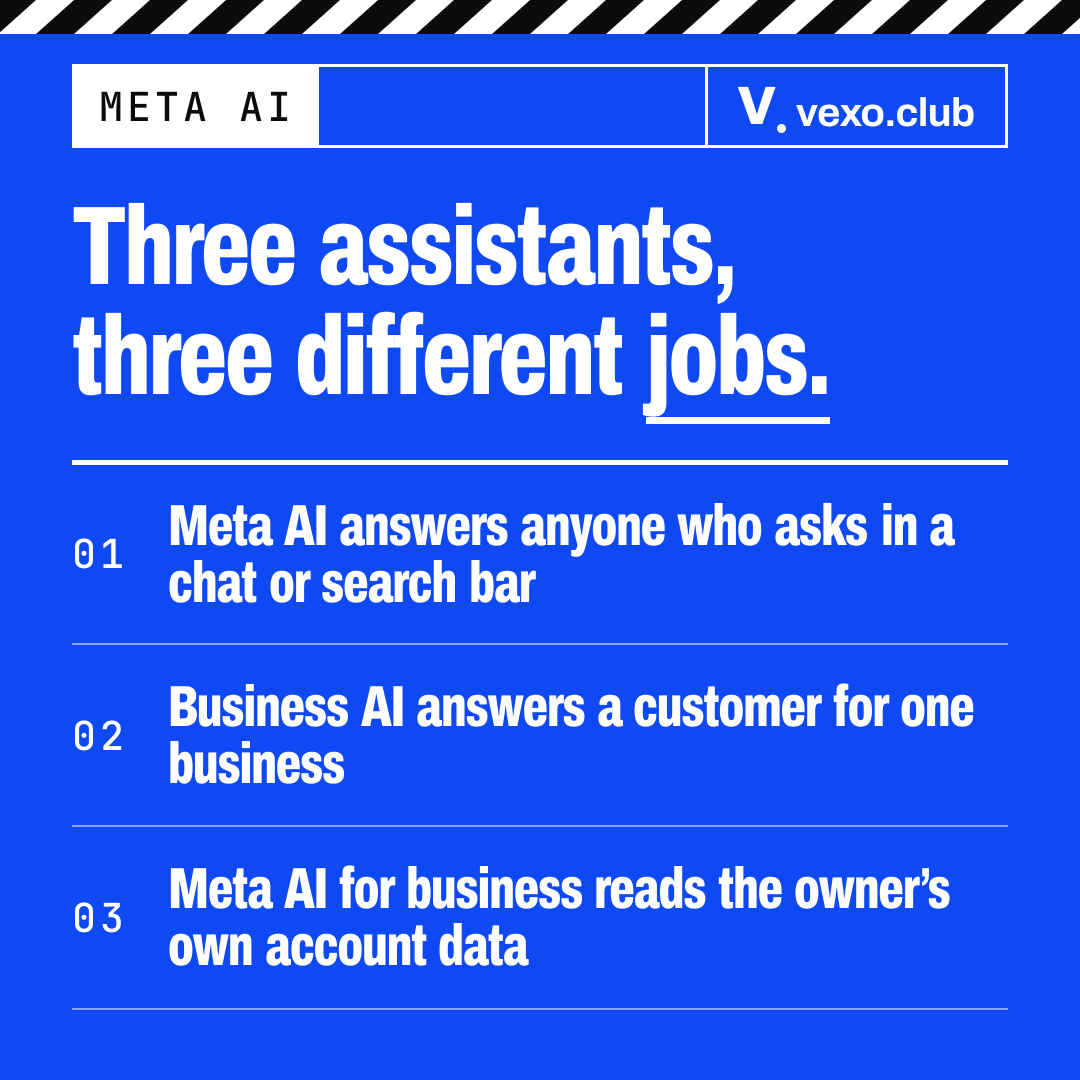
- Three different assistants get confused: the consumer Meta AI, Business AI that answers customers for one business on WhatsApp, and Meta AI for business, which reads your own account data with permission.
- The business-side controls that exist are about Business AI, audience settings and search-engine indexing. There is no published switch that stops Meta AI mentioning a public brand.
- The work that holds up whatever Meta does: one set of facts, written the same way on Instagram, WhatsApp Business, the website and public listings.
- Test with a repeatable prompt list from several phones, and read the result as a sample, not a rank.
We read Meta’s own pages for this on 24 October 2026: the Meta AI assistant page, the Meta Help Center articles on Meta AI for business, the Privacy Center pages on how generative AI uses information, the Meta AI Terms, the WhatsApp Help Center, and Meta’s newsroom post on Business AI in India. Where Meta is silent or a point comes from news reports instead, the text says so. Meta changes these pages often, so check the live text before acting on any line.
Is Meta AI really available for brand questions in India?
The premise holds, with caveats. Meta’s assistant page says Meta AI is a free assistant available at meta.ai, in the Meta AI app, and across WhatsApp, Instagram, Messenger and Facebook. It says that on WhatsApp you tap the Meta AI icon or start a chat with it, and that on Instagram you tap the Meta AI icon in DMs or use it in search. Indian news coverage of Meta’s June 2024 announcement describes the rollout here as starting in English across those apps. Meta’s newer pages are less specific by country.
The WhatsApp Help Center says Meta AI and some of its experiences are available only in limited countries and may not be available to you yet, even if others in your country have access. It also says you can chat with Meta AI in any language, though in some markets access depends on the device language. Meta’s help pages for the Meta AI app and for Meta AI for business carry a similar line: the apps are not yet available everywhere, and some features may be missing in your area. Two accounts in the same city can therefore see different things. Treat any screenshot of Meta AI, including yours, as one account on one day.
Meta’s assistant page also lists features such as shopping help that draws on Instagram, Facebook and Threads, and local recommendations that show ratings, photos and what locals are buzzing about. That page is global marketing copy. It does not say which of those features are switched on for Indian accounts. Do not assume they are, and do not assume they are not. The only way to know is to test on real phones, which is covered below.
Where does a shopper actually meet it?
Three places matter for brand discovery. In WhatsApp it appears as a chat you can start, and Indian coverage of the 2024 launch says it also sits in the search bar. In Instagram it appears in search, where the bar reads Ask Meta AI or similar depending on version, and in DMs, where a user can chat with it or mention it inside a thread. In a group chat a user can ask it a question that everyone in the chat sees, so a question like “which brand should we order cakes from” can be answered in front of the whole group.
The business side shows up in two more places. Business AI answers customers on behalf of a business inside its own WhatsApp chat. Meta AI for business is a separate tool where the owner asks about their own content and ads. Mixing these up is the commonest mistake in agency decks, so the table sets them apart.
Three Meta assistants a brand meets, side by side
| Who asks it | What Meta says it draws on | What the business controls | |
|---|---|---|---|
| Meta AI in WhatsApp and Instagram | Any user, in chats or the search bar | Public information, real-time web information, public Instagram, Facebook and Threads posts it can cite, plus location and profile interests | Mostly audience settings and indexing. No published way to opt a public brand out of being mentioned |
| Business AI on WhatsApp Business | A customer messaging one business | The business profile, catalog, past chats, website and documents the owner provides | What it answers, who it talks to, which topics hand off to a human, and an off switch |
| Meta AI for business | The business owner, in the Meta AI app or meta.ai | The owner’s linked Instagram, Facebook and ad data plus public information about similar businesses | Permission is asked per asset and can be revoked by asking Meta AI |
Three Meta assistants, three different jobs
What does Meta say it draws on?
Meta’s Privacy Center says it uses public information on Meta products, including profile information, comments and posts, to train the generative AI models behind these features, and that it does not use information with an audience other than Public for that purpose. It also says interactions with AI features, such as questions you ask and images you request, can be used to train models. Meta’s help page for the Meta AI app adds that Meta AI uses your location for more relevant answers, and that your age, gender and interests, inferred from activity across its products, help personalise the interaction.
The assistant page says Meta AI is integrated with real-time web information, and the Meta AI Terms say Meta may share certain information with select partners, such as search engines, to give relevant answers. Read together, that suggests an answer about a brand can include material from the open web, not only from Instagram. That is an inference from those two lines. Meta does not say which sites, and it does not say how a web result and an Instagram post are weighed against each other.
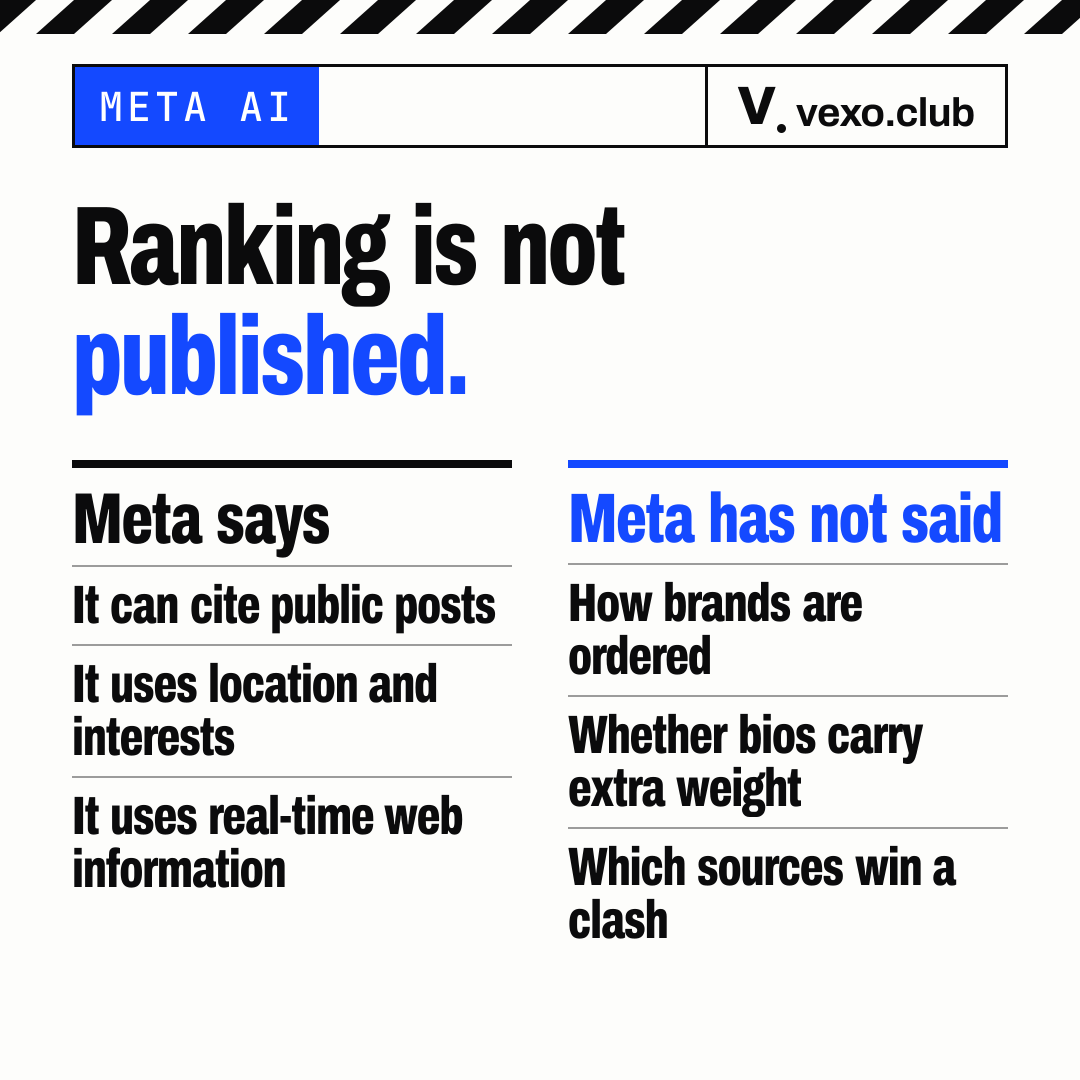
What has Meta not published?
A lot, and this is where most agency pitches overreach. We found no Meta page that explains how Meta AI orders or selects brands or creators in an answer. We found nothing on whether bio text carries more weight than captions, whether follower count or verification matters, whether Meta Verified changes anything, whether paid ads can influence the answer, or how Meta AI resolves a clash between your Instagram and your website. Anyone who sells you a rule for any of these is guessing or selling.
What can be said honestly is narrower. Meta says it cites public posts. Meta says it uses web information. Meta’s tools for businesses read the profile, catalog and website a business supplies. So clear, consistent, public information is the one input every route shares. That is a reasonable bet, not a proven lever, and it costs a few hours.
What Meta has and has not published
Business AI on WhatsApp is a different assistant
On 15 May 2026 Meta announced Business AI on the WhatsApp Business app in India. Meta says it is available in all native languages in India, answers customers 24/7, captures leads, books appointments and recommends products, and that eligible businesses set it up from the Tools tab under Your Business AI. Meta also says Indian small and medium businesses must meet certain criteria to be eligible, and it does not list them in that post. Meta’s business pages call a closely related product Meta Business Agent and describe it as available to eligible businesses in select markets. We could not confirm from Meta that these are two products rather than one under two names, though the Help Center link in Meta’s India announcement now opens a page titled Meta Business Agent on WhatsApp. Check which label your account shows.
This matters for discovery for a simple reason. When a shopper messages your WhatsApp number, the assistant that answers is built from what you gave it. Meta’s help page says the agent learns from your Facebook Page, Instagram profile, past chats and website where you have them, plus catalogs, price lists and documents you add. Meta’s pages say AI messages are marked with an AI label, and customers can ask to reach a person. Wrong prices in an old catalog become wrong answers said in your name.
What Meta says the business keeps control of
“Businesses remain in control at all times […] they can step in to respond to customers directly whenever needed, adjust how Business AI on WhatsApp works, or turn the feature off entirely.”
Meta, Introducing Business AI on WhatsApp for Small Businesses in India,
Source: about.fb.com
Meta’s page lists four controls. Knowledge control sets what it learns from. Personality control sets the voice. Audience control lets you choose everyone, only new customers, or customers who come from your ads. Handoff control lets you flag topics that must go to a human. For an Indian brand the handoff list should usually include refund disputes, medical or health claims, delivery complaints with a deadline, bulk or custom orders, and anything involving money outside the catalog price. Customer chats also hold personal data, so ask counsel what the DPDP Act means for an assistant that reads old chats before you switch that on.
Can a brand opt out of Meta AI mentioning it, or steer it?
On the consumer Meta AI, we found no published control that lets a public business stop Meta AI mentioning it. What exists is indirect. You can set an account or post audience to non-public, which keeps it out of the public material Meta says it trains on. It also takes it out of discovery. That is a poor trade for a brand that wants to be found. On Instagram, professional accounts that are public and run by an adult can have photos and videos indexed by search engines such as Google and Bing, and Meta’s help page says you can turn that off in privacy settings. It also notes that username, profile picture and bio may still appear in search results either way.
Reports say Meta offers a right-to-object route for AI training in some regions. We did not find an India route in the Privacy Center pages we read, and an analysis in The Wire argues that Indian users have none. If your counsel needs a firm answer, ask Meta in writing. For steering, the real levers are on your side: the quality and consistency of what you publish, and the Business AI controls above. For the owner-facing tool, Meta says it asks permission before reading business assets, and you can revoke by asking Meta AI to stop. Meta also says that tool can compare your performance with public information about similar businesses, so a competitor’s assistant may read your public profile too.
How should the Instagram bio and business profile read?
Write the bio for a stranger who has never seen your product and will repeat it to a friend. The first line says what you sell and to whom. The second says where you ship or serve. The third carries one proof point you can defend, such as a licence, a certification, or a founding year, not a superlative. Instagram’s help centre lets a professional account choose a business category, add contact information, and show or hide each on the profile. Show both. A category that matches the product is machine-readable context you do not have to word yourself.
Name and username matter more than people admit. If the brand is sold as one name on the packaging, a second on the website and a third on Instagram, an assistant has three entities to merge. Pick one spelling and use it everywhere. Then check the bio link: a page of old offers contradicts the bio, and a page that restates the same facts supports it.
Writing the Instagram bio and business fields
Do
Open the bio with what you sell, to whom and where you ship, in plain words
Don’t
Open with a slogan or a string of emojis that says nothing a stranger could repeat
Do
Pick the business category that matches the product and show it on the profile
Don’t
Hide the category and contact details, then wonder why nobody can describe you
Do
Name the city or service area if customers are local
Don’t
Leave location to an old post that nobody can find
Do
Link to one page that states the same facts as the bio
Don’t
Link to a page of offers that has changed since the bio was written
Do
Describe the product again in captions and alt text, in the words a customer would use
Don’t
Stuff keywords on the theory that Meta AI counts them, because Meta has not said it does
Captions and alt text carry the rest. Meta’s own caption guide shows Meta AI drafting captions inside Instagram, which tells you the platform works with caption text, though not how it uses it for discovery. Describe the product in the words a customer types: the product type, the use, the city, the occasion. This is the same discipline set out in Instagram SEO for brands, now with a second reader. Do not write captions for an assistant at the expense of the customer. If a caption reads oddly aloud, rewrite it.
What belongs in the WhatsApp Business profile?
The profile is the public fact sheet a customer sees when they tap your name. WhatsApp’s help centre lists business name and address, username, category, description, email and website, and says you can add catalog items, business hours and a service area. You can select up to three categories, and there is no custom category, so use the nearest honest one. The description and About fields have short character limits listed in Meta’s Cloud API reference. Check the current numbers there before you draft.
For a tier-2 or tier-3 business the service area field often does more work than the description. A customer in Indore asking whether you deliver there wants a yes or no, and so does an assistant answering for you. State delivery cities, cash-on-delivery or UPI terms, and return rules in one place, then copy those exact words into the catalog description and the website. If Business AI is on, the same sheet is your knowledge control: upload it as the document the agent learns from, rather than letting it infer rules from old chats.
One fact, repeated word for word
What should the About page and the rest of the public web say?
Because Meta says Meta AI uses real-time web information, the website and the public listings around it are part of the input, even though Meta does not say how they are weighed. Start with an About page that states the plain facts in sentences: legal name, what the company makes, where it is based, since when, how to reach it, and how orders, returns and complaints work. Put the same facts in the footer. Add a contact page with the same address and hours as the WhatsApp profile. Leave out claims you cannot show, since an assistant will repeat them as fact and a customer will quote them back.
Then look outward. Check the Google Business Profile, marketplace storefronts, directory listings and any press mention for the same name, address, category and hours. One stale listing that says closed on Sundays can cancel a clean Instagram bio. If you can add structured data to the site, schema markup for influencer marketing websites sets out the types. The same logic for Google’s answers is in Google AI Overviews and influencer marketing searches, and how AI search engines choose sources covers the wider reasoning. None of it is proven for Meta AI.
What changes when the question is about creators?
A shopper might ask Meta AI who to follow for budget skincare, or which creators review phones in Hindi. Meta’s business help page gives a sample prompt asking Meta AI to identify emerging brands or creators in an industry using public data. So that kind of question is an intended use. What Meta does not say is how it picks names.
For a creator, the plain advice mirrors the brand advice: a bio that states the niche, language and city in a sentence, a business category if the account is professional, and captions that say what the content covers. For a brand, two things help. First, public collaboration posts tie your name to creators in a visible way, which is covered in Instagram collab posts for brands. Second, if the creator work is paid, disclosure rules still apply to anything that reads as an ad, as set out in ASCI disclosure rules for brands. Do not ask creators to repeat your brand name in comments to nudge an assistant. Nothing Meta has published says it works, and it reads as spam to the customer.
How do you test Meta AI without fooling yourself?
Build a fixed prompt list and rerun it on a schedule. Include your brand name alone, your category plus your city, a price-sensitive question, and a creator question in your niche. Write each in English, Hindi and Hinglish. Run them from the Instagram search bar and from WhatsApp on at least three phones belonging to different people in different cities, since Meta says location and interests personalise the answer. Save the prompt, the phone, the date and a screenshot every time.
A repeatable Meta AI test, run once a month
- Write a fixed prompt list: a brand-name question, a category question, a city question and a creator question
- Write each one in English, in Hindi and in Hinglish, because shoppers do not type one way
- Run the list from the WhatsApp search bar and from Instagram search, on at least three phones with different cities and histories
- Record what is said about you: name, category, city, price words, shipping, and any wrong claim
- Record which sources or posts it cites, where it cites at all
- Log wrong facts against the page or profile that likely caused them, then fix the source and rerun next month
Read the results as samples. If your brand appears on two phones out of three, that is a sample of three and nothing more. What you can reliably extract is error: a wrong city, a wrong price word, a competitor’s product credited to you, a stale hour. Each error points to a source you control. Fix the source, note the date, and look again next month. Keep a separate note for anything that changes without you touching a profile, because that is the evidence that Meta changed something.
When is all this not worth doing?
If you run a single local shop whose customers already find you through a map listing and a WhatsApp number, the basics above are enough and a test programme is overkill. If your Instagram account is private by design, none of the public-content points apply and you are choosing that trade on purpose. If a vendor offers a guaranteed Meta AI placement, walk away: Meta publishes no mechanism that could support the guarantee. And if you are an early brand with thin public content, the first fix is to publish plainly and consistently for a few months, not to tune bio wording.
What to do this week
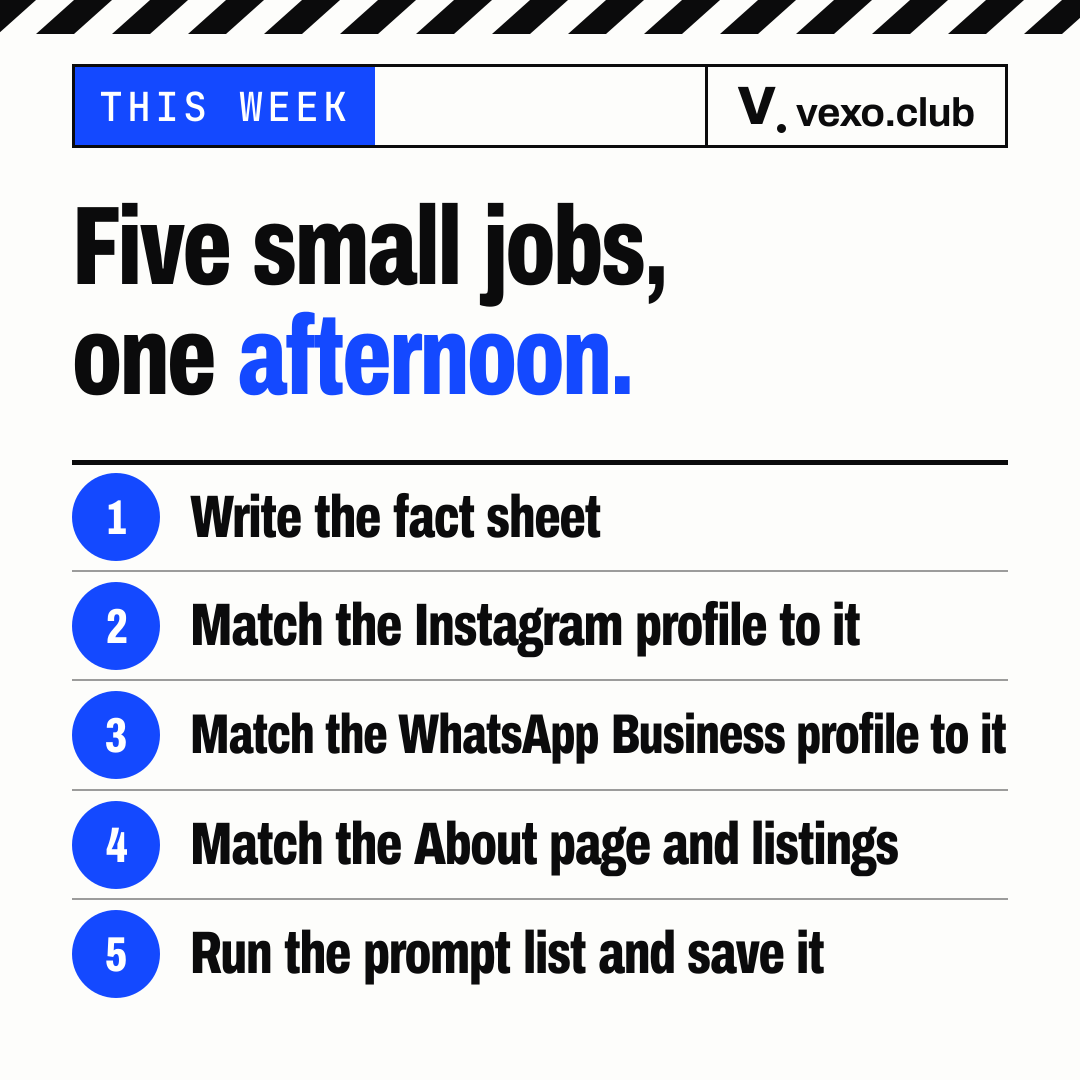
Spend one afternoon, in this order. Write a one-page fact sheet: legal name, product line, cities served, delivery and return terms, price words you will honour, contact details and hours. Make the Instagram bio, category and link match it. Make the WhatsApp Business profile, service area and catalog match it, and if you turn on Business AI, upload the sheet and set the handoff topics first. Update the About page and listings. Then run the prompt list and save the results as your baseline.
The five jobs for this week
Questions brands ask
Is Meta AI available in WhatsApp and Instagram in India? Meta says it is available across its apps, and Indian coverage of the 2024 launch describes it arriving here in English. Meta’s own help pages also say availability varies by account and that features may not be available in your area, so check on your own phone.
Can a brand rank higher in Meta AI answers? Nobody outside Meta can say, because Meta has not published how it orders or selects brands. Clear, consistent public information is the input every Meta route shares, which makes it a sensible bet and not a proven lever. Treat any agency that promises a rank as a red flag.
What data does Meta AI use to answer questions about businesses? Meta says it uses public information, including public Instagram and Facebook posts, comments and profile information, plus your interactions with AI features, location and interests. It also says Meta AI is integrated with real-time web information. Content shared with an audience other than Public is not used for training, per Meta.
Can I stop Meta AI mentioning my brand? We found no published control for that on the consumer assistant. You can make content non-public, which also removes it from discovery. Instagram search-engine indexing can be switched off in privacy settings, though Meta notes profile details may still appear in search results.
What is Business AI on WhatsApp and who is it for? It is an AI agent inside the WhatsApp Business app that answers customers for a business, launched in India in May 2026 for eligible small and medium businesses. Meta says it works in all native Indian languages and the business can step in, change its behaviour or turn it off. Meta does not list the eligibility criteria in the launch post.
Does Meta AI read my WhatsApp messages? Meta has said it does not use the content of private messages between friends and family to train its AI unless you or someone in the chat chooses to share them with it. Its privacy pages also describe a Private Processing design for some WhatsApp AI features. Read the current terms, since Meta changes them.
Should I rewrite my Instagram bio for Meta AI? Rewrite it so a stranger can repeat what you sell, to whom and where, and so it matches your website and WhatsApp profile. Skip keyword stuffing, since Meta has not said bio text is weighted. It helps the customer first.
vexo.club runs creator campaigns from Delhi NCR and does not sell Meta AI visibility, because no one can honestly promise it. If you want a second opinion on your profile sheet or on how creator work should be briefed around it, write to us through the contact page and say what you sell and where.
Sources
Cite this page
Meta AI in WhatsApp and Instagram: how brands get described, and what to fix first. vexo.club, published 25 Nov 2026. https://vexo.club/blog/meta-ai-whatsapp-instagram-brand-discovery
Influencer marketing across India
Send the desk a brief: it comes back as a shortlist and a directional band, never a public price.
Brief the desk