Instagram SEO for brands: how search works on Instagram, from handle to caption
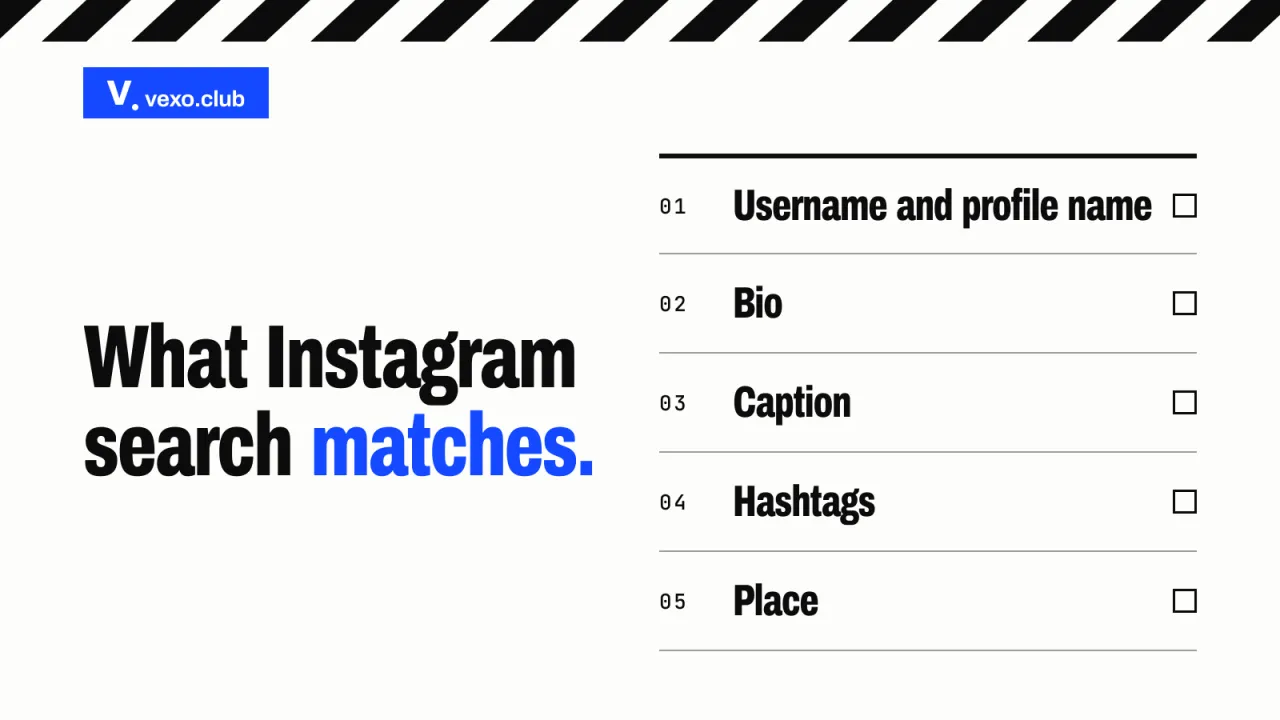
Instagram SEO is writing the words people search for into the fields Instagram matches. Its own documentation names usernames, profile names, bios, captions, hashtags and places, and says text is the strongest signal.
Playbooks Updated 12 min read The operators’ desk
In this article9 sections
Instagram SEO is making an account and its posts easy to find when someone searches on Instagram, by putting the words people search for into the fields Instagram matches them against. Instagram’s own documentation says Search is matched by text (usernames, profile names, bios, captions, hashtags and places), so a brand writes those fields for the reader’s query before it posts anything.
This guide comes from vexo.club: an influencer marketing agency run from one desk in Delhi NCR. It uses only what Instagram and Meta have published, links each page, dates them, and says plainly where their documentation is silent. Instagram does not call any of this SEO, and no document the desk read promises a rank, so the guide promises none.
Instagram search, from Instagram’s own pages
In short
- The text typed into the search bar is, in Instagram’s words, by far the most important signal for Search, matched against usernames, bios, captions, hashtags and places.
- A fitting handle and profile name, keywords in the bio, and keywords and hashtags in the caption (not the comments) are the three practices Instagram itself names.
- No Instagram or Meta page the desk read lists alt text as a search signal; alt text is written for people who cannot see the image.
- A private account’s posts appear in Search and Explore only to approved followers, so a brand account and a creator account that should be found are public.
How does search work on Instagram?
Instagram’s Search and Explore page invites people to search by keyword to find topics, content and creators. Adam Mosseri’s post Breaking Down How Instagram Search Works, dated 25 August 2021, sets out the order of the signals: first, the text typed into the search bar, matched to usernames, bios, captions, hashtags and places; second, the searcher’s own activity, such as accounts followed and posts viewed; third, popularity, meaning clicks, likes, shares and follows for an account, hashtag or place.
Meta’s Instagram Search AI system page in the Transparency Center describes the same process in four steps, and lists the signals for accounts, suggested keywords and hashtags. For an account, one signal is the similarity between the words in the search and those in the account’s username or profile name. That is the documented reason a name matters, and it is also why the same name used everywhere is easier to find.
How Instagram Search ranks, step by step
- Gather inventory Collect the eligible results to rank
- Score results By the type of content and how well it matches the searcher’s query intent
- Apply additional filters Narrow the results, including integrity processes
- Rank results by score Order the results by that score
Two practical readings follow. The first is that the text comes first: Mosseri’s post says popularity signals come into play when there are a lot of potential results, so words that match the query are what a new account has to work with. The second is that the searcher’s own activity ranks accounts they follow or visit higher, so a brand that is already followed by its customers is found more easily by them than by strangers.
The order of Instagram’s search signals

Which fields does Instagram match when someone searches?
Instagram’s 2021 post names the fields in a single sentence, and Meta’s Transparency Center page names the username and the profile name for accounts. Both are the page’s own words, not the desk’s inference. The table below sets each field against what Instagram’s pages say. Where a field is not named in them, it is marked as not listed, which is not the same as saying it does nothing.
What Instagram’s own pages say Search matches
| Named as matched in Search | What the pages say | |
|---|---|---|
| Username (handle) | Yes | Matched by text; a handle related to the posts is how an account shows up in relevant searches |
| Profile name | Yes | Matched by text; a signal for accounts is the similarity to the search words |
| Bio | Yes | Include keywords about who you are and what the profile is about |
| Caption | Yes | Put keywords and hashtags in the caption, not the comments |
| Hashtags | Yes | Matched by text; a hashtag has its own signals |
| Place | Yes | Matched by text; a location in the bio helps a local business |
| Comments | No | Instagram says keywords go in the caption, not the comments |
| Alt text | Not applicable | Not listed in either page |
How should a brand name its Instagram account for search?
Instagram’s advice is to use a handle or profile name related to the content of the posts, and, if friends or fans know the account by a certain name, to include that name in the username or profile so the account shows up when they search for it. For a brand, that means the name people already use for it, and not a clever variant. For a creator, it means the name their audience types.
One name across platforms helps a searcher check they have the right account. The vexo.club roster record for Sharan Hegde, for instance, lists the handle @financewithsharan on both Instagram and YouTube, and every roster profile lists the creator’s official accounts side by side. A brand briefing a creator can ask for the same: one name, one handle where the platform allows it, and the official accounts named in the brief.
Naming an account so it can be found
Do
Use the name people already search for in the username or the profile name
Don’t
Choose a handle that has nothing to do with the account’s content
Do
Keep the name the same on every platform where the account exists
Don’t
Run a different spelling on each platform and hope a searcher finds the right one
Do
Say in the bio who you are and what the account is about, with a location if the business is local
Don’t
Leave the bio to a slogan with none of the words a customer would type
What should go in an Instagram bio and caption?
The bio carries the words about who the account is and what it posts, and a location where the account is location-specific. The caption carries the words about the post: Instagram says that for a post to be found in Search, keywords and hashtags belong in the caption and not in the comments. Mosseri’s 2021 post also asks for relevant keywords and hashtags there.
Fields to write before the first post
- A handle and profile name related to what the account posts, and the name people already use
- A bio that says who the account is and what it is about, in the words a customer would type
- A location in the bio, if the business is local
- Keywords and hashtags in the caption of each post, not in the comments
- Hashtags that are relevant to the post
- A public account, so the post can appear in Search and Explore for everyone
Language matters in India. Mosseri’s 2021 post said Instagram was focused on getting keyword search right in English first and would add other languages later. The post is five years old, and the desk has not found a current Instagram page that lists which languages work. The practical test is to search the words in the language the audience uses, on a plain account, and read what comes back.
A test for search in your audience’s language

Does alt text help Instagram SEO?
Not by any Instagram document the desk read. Instagram’s Help Centre page Edit the alternative text for a post on Instagram describes automatic alt text as using object recognition to give a visual description of photos for people with visual impairments, and lets an account edit it. Neither the 2021 post nor the Transparency Center page lists alt text as a signal for Search. Write alt text because someone who cannot see the picture should be told what is in it, and treat any search benefit as unconfirmed.
Documented as matched, and not documented
Named as matched in Search
- Usernames and profile names
- Bios
- Captions
- Hashtags and places
Not named as a Search signal
- Alt text
- Text inside an image or a video
- Comments
Do Instagram posts appear in Google?
For some accounts, according to trade reporting. Storyboard18 reported that from 10 July 2025 public content from professional accounts, meaning Business and Creator profiles run by users over 18, would appear in search engines such as Google and Bing, with a setting to opt out. The desk has not opened Instagram’s own page on this, so treat the detail as reported and check the setting in the account’s privacy controls. The practical consequence is small and clear: a public professional account is the only kind that can be found outside Instagram, and a private one cannot.
What Instagram has said about search, in date order
- 25 August 2021 Mosseri’s post on how Search works: text first, then activity, then popularity
- 31 May 2023 Instagram Ranking Explained: each part of the app has its own ranking, and Account Status shows whether an account can appear in Search
- 10 July 2025 Public content from professional accounts reported as eligible for search engines Reported by Storyboard18.
- 23 June 2026 Meta’s Transparency Center page describes Instagram Search in four steps and lists its signals The page’s last update.
Instagram’s 2023 post adds one control worth knowing. Account Status lets an account see whether it is eligible to appear in Search or as a suggested account, and to appeal if it is not. The 2021 post adds the reverse: accounts that post spam or break the guidelines may appear lower in Search, so an account’s standing is part of whether it is found. How to check an influencer’s audience before you pay sets out the audience check.
Is Instagram SEO the same as getting reels recommended?
No. Instagram says it has no single algorithm: Feed, Stories, Explore, Reels and Search each use their own, tailored to how people use that part of the app. Search answers a query. Reels recommendations answer what a viewer is likely to watch next. Instagram’s creator blog post Helping creators of all sizes break through, dated 26 February 2025, says a reel is shown to followers and non-followers, first to a small audience of people Instagram thinks will enjoy it, and then to wider groups for the reels that perform well. It also lists signals such as watch time, retention, shares, likes and comments.
So caption keywords serve Search, and the first seconds of a reel serve recommendations. A brief that wants reach asks for both: a reel worth watching, and a caption, a bio and a name that a searcher can match. The formats are compared in Reels vs YouTube Shorts for brands.
Search and reels recommendations answer different questions

What should a brand check on a creator’s account before booking?
Check that the account is public and professional, that its name matches the name the audience knows, that the bio says what the creator makes, and that the creator’s captions use the words of the category. A creator whose posts are written for the reader’s query is easier to find and easier to vet. The desk’s roster lists each creator’s official accounts on their own profile, and a brief for Delhi NCR starts at the Delhi desk page.
Search inside Instagram is one channel, and search outside it is another. The desk’s services page lists search and paid media under Marketing, sold and priced separately from influencer work. The Instagram influencer marketing page sets out how an Instagram brief is run, and a brief can be sent to the desk.
Questions brands ask
What is Instagram SEO? Writing the words people search for into the fields Instagram matches: the username and profile name, the bio, the caption, hashtags and places. Instagram does not use the term, and its documentation promises no rank. It says text is the most important signal for Search.
Does Instagram use keywords for search? Yes. Instagram’s 2021 post says the text typed into the search bar is by far the most important signal for Search, and that Instagram tries to match it with usernames, bios, captions, hashtags and places. It advises putting keywords and hashtags in the caption, not in the comments.
Do hashtags still help? Instagram’s pages still list hashtags among the things Search matches, and Mosseri’s 2021 post advises relevant keywords and hashtags in the caption. The guide does not say how many to use, because no Instagram page the desk read does.
Does alt text affect Instagram search? No Instagram or Meta page the desk read says so. Alt text is documented as an accessibility feature, with an automatic description that an account can edit. Write it for people who cannot see the image.
Can Instagram posts show up on Google? Trade reporting says public content from professional accounts became eligible for search engines from 10 July 2025, with an opt-out. Check the setting in the account’s own privacy controls. Posts from a private account are not public.
Does vexo.club do Instagram SEO? The desk lists search and paid media under Marketing on its services page, sold and priced separately from influencer work. For a creator brief, the desk reads the account’s handle, bio and captions as part of the audience check and says what it finds.
Sources
- Search and Explore page (opens in a new tab) about.instagram.com
- Breaking Down How Instagram Search Works (opens in a new tab) about.instagram.com
- Instagram Search AI system (opens in a new tab) transparency.meta.com
- Edit the alternative text for a post on Instagram (opens in a new tab) help.instagram.com
- Storyboard18 (opens in a new tab) storyboard18.com
- Helping creators of all sizes break through (opens in a new tab) creators.instagram.com
Cite this page
Instagram SEO for brands: how search works on Instagram, from handle to caption. vexo.club, published 14 Oct 2026, updated 28 Oct 2026. https://vexo.club/blog/instagram-seo-for-brands
Influencer marketing across India
Send the desk a brief: it comes back as a shortlist and a directional band, never a public price.
Brief the desk