Instagram’s algorithm for brands: original content, watch time and shares over likes
Instagram’s own posts say two things plainly: an original post now replaces a repost in recommendations, and watch time, likes and sends outrank comments. For brand and influencer marketing content, both change what a brief should ask a creator to make.
Playbooks 11 min read The vexo.club desk
In this article6 sections
Instagram has published two separate things about its ranking since 2024, and both point the same way for a brand’s content. One is about origin: since April 2024 for reels, and since April 2026 for photos and carousels too, an account that mostly reposts other people’s work loses its place in recommendations, and an identical repost is replaced there by the original. The other is about which interaction counts most: in January 2025 Instagram’s head, Adam Mosseri, named watch time, likes and sends as the three signals carrying the most weight, not comments, and not a like count that ignores how a post reached someone. Read together, they say plainly what a brief should ask a creator to make, and what it should stop asking for.
This guide comes from vexo.club: an influencer marketing agency run from one desk in Delhi NCR. It reads Instagram’s own creators blog and Adam Mosseri’s own statements, links each one, and dates them. Where Instagram has described a behaviour without a number (that original content is favoured, that a repost is deprioritised), the guide keeps that qualitative language rather than attaching a weighting Instagram has not itself published.
Instagram’s ranking, from its own posts
In short
- Instagram’s creators blog says that when it finds two or more identical posts it recommends only the original, and that an account which mostly reposts other people’s work loses eligibility for recommendations: a rule applied to reels from April 2024 and extended to photos and carousels from April 2026.
- Adam Mosseri, in a January 2025 video reported by Social Media Today, named watch time, likes and sends as the three signals that matter most for ranking, and said sends weigh slightly more for reaching people who do not already follow the account.
- Instagram’s creator blog lists watch time, retention, shares, likes and comments as the signals behind reels recommendations, and says a reel is shown to a small test audience before a wider one.
- None of this is a published percentage or a weighting formula. The desk describes what Instagram has said it favours and deprioritises, and invents no figure beyond that.
What has Instagram said about original content versus reposts?
Instagram’s creators blog post Helping Creators Find New Audiences, dated 30 April 2024, announced two changes aimed at reels: when Instagram finds two or more identical pieces of content, it recommends only the original, and an account that repeatedly posts other people’s content without creating or materially editing it drops out of the surfaces where Instagram recommends content. The post’s own reasoning is that original content takes time and effort to make, so the account that made it should get the credit and the distribution, even when the post is copied elsewhere.
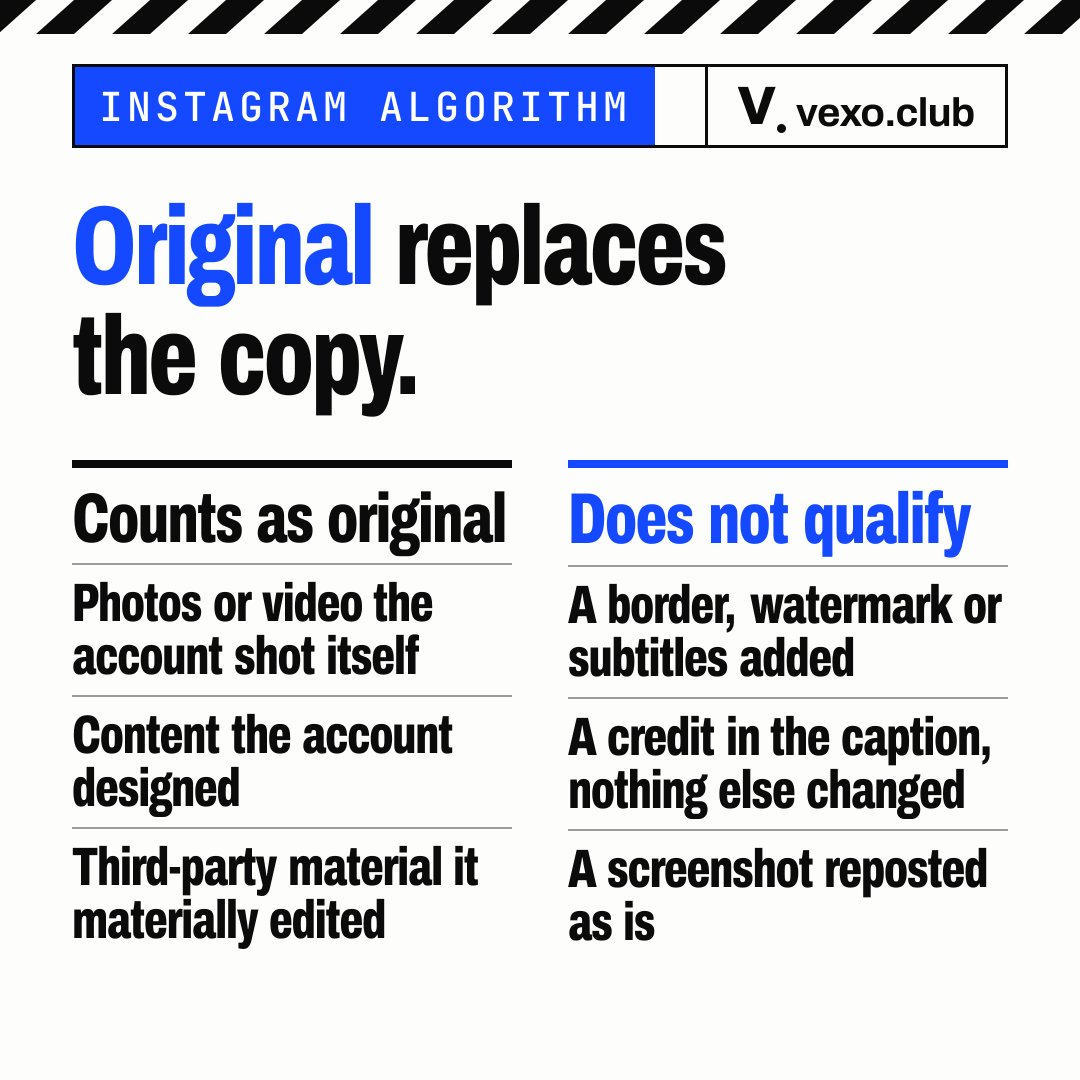
The rule applied to reels first. Instagram’s creators blog post Rewarding original creators on Instagram, dated 30 April 2026, extended the same originality guidelines to photos and carousels: an account that mainly posts unoriginal content in any of the three formats is no longer shown where Instagram recommends content, though its existing followers keep seeing its posts. Instagram’s own distinction is between an account that posts photos or video it shot itself, content it designed, or third-party material it materially edited, and an account that adds only a border, a watermark, subtitles or a credit in the caption and calls that original.
What Instagram has said about ranking and originality, in date order
- 31 May 2023 Instagram Ranking Explained: no single algorithm; each part of the app ranks on its own signals
- 30 April 2024 Helping Creators Find New Audiences: an original replaces an identical repost in recommendations; repeat reposters lose recommendation eligibility
- 22 January 2025 Adam Mosseri names the top three ranking signals as watch time, likes and sends Reported by Social Media Today.
- 26 February 2025 Helping creators of all sizes break through: reels ranked on watch time, retention, shares, likes and comments, tested on a small audience first
- 30 April 2026 Rewarding original creators on Instagram: the originality rule extends from reels to photos and carousels
For a brand, the two posts together mean a reposted screenshot carousel, or a clip re-exported from another platform, is not a free second use of a creator’s work. It is a post Instagram can replace with the original in its own recommendations, or one that can drop the whole account out of them if it happens often enough. A brief that asks a creator to repost the brand’s own campaign video, cropped and watermarked, is asking for the version of that post Instagram is least likely to show anyone who does not already follow the account.
What Instagram counts as original content
What counts as original, in Instagram’s own words?
Instagram’s April 2026 post sets out a test rather than a list: do the edits add real value beyond restating or referencing the third-party content, or is the viewer looking at the same clip with a logo laid over it. What it gives as qualifying includes unique on-image text that adds context, a creative graphic offering information the original clip did not carry, and its own Remix feature used to transform the source. What it gives as not qualifying includes a border, a watermark, subtitles, or a credit in the caption with nothing else changed.
Posting content Instagram counts as original
Do
Add a voiceover, on-image text with context, or use Remix to transform a clip
Don’t
Add only a watermark, subtitles or a caption credit and call it original
Do
Film the vertical video for Instagram in the first place
Don’t
Export a file made for another app and repost it as a new Instagram post
Do
Use Instagram’s own repost or collab tools when sharing someone else’s content
Don’t
Re-upload another creator’s video as the account’s own post
Do
Check Account Status when reach on recommendations drops
Don’t
Treat a drop in reach as random with nothing worth checking
What has Instagram said about watch time and shares against likes?
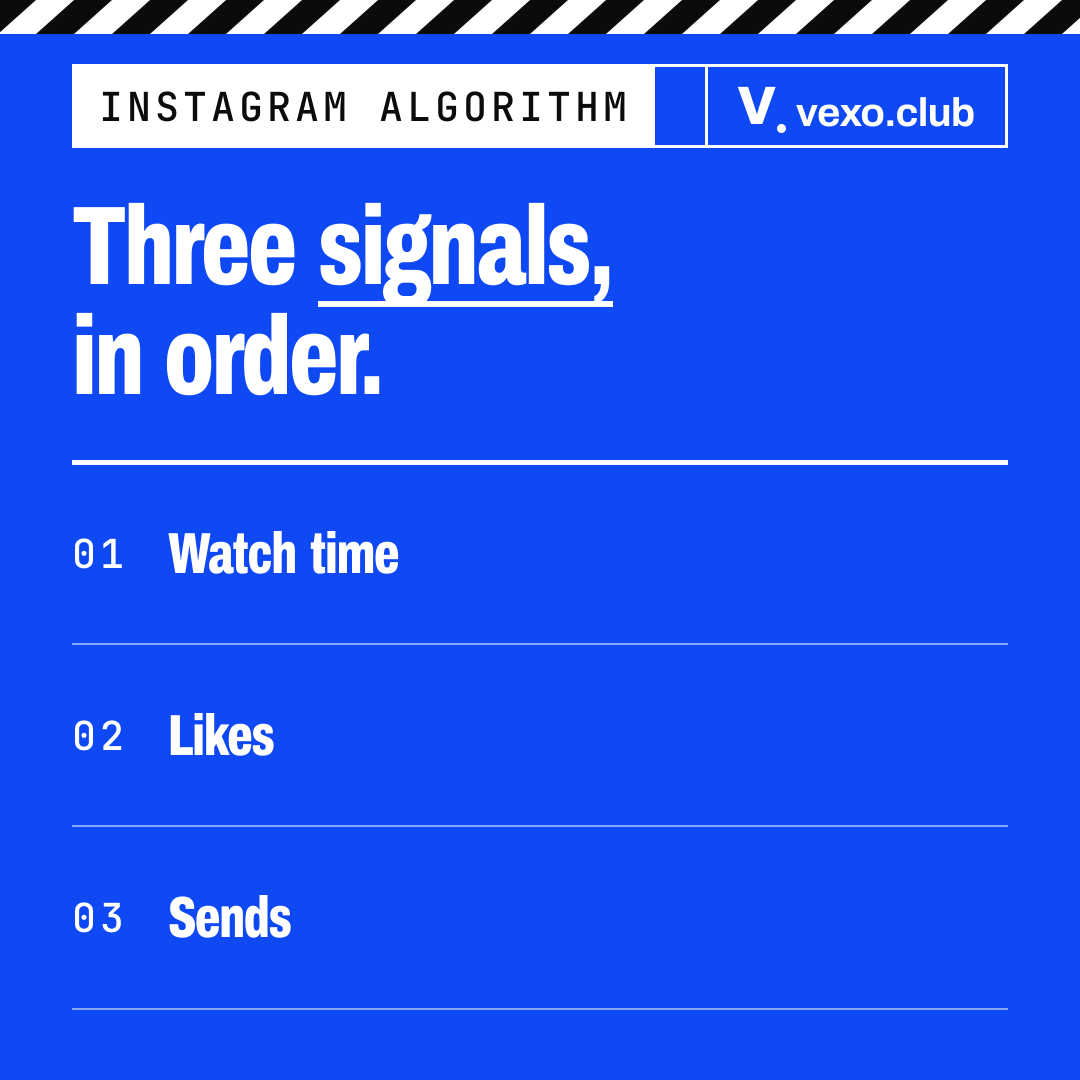
Separately from originality, Instagram has said which interactions it weighs most. In a January 2025 video, reported by Social Media Today, Mosseri named the top three ranking signals outright: watch time, likes and sends, adding that likes carry slightly more weight for content shown to an account’s own followers, and sends carry slightly more weight for content shown to people who do not follow the account yet.
What Adam Mosseri has said about Instagram’s top ranking signals
“The top three signals that matter most for ranking are watch time, likes and sends. So when looking at your insights, pay close attention to average watch time, likes per reach, and sends per reach.”
Adam Mosseri, Head of Instagram, quoted by Social Media Today,
Source: socialmediatoday.com
Instagram’s creator blog post Helping creators of all sizes break through, dated 26 February 2025, adds the mechanism behind this for reels: a reel is shown first to a small test audience of people Instagram thinks will enjoy it, and the reels that hold that audience are shown to a wider one, then wider again. The signals it names behind that test are watch time, retention, shares, likes and comments, listed as activity rather than ranked by weight. Comments appear there, but Mosseri’s own list of the top three a month earlier does not include them.
The three signals Instagram’s Adam Mosseri named
What should this change in how a brand briefs a creator’s format?
The practical shift is from a brief written for a single still frame and a caption that earns a tap of the heart, to a brief written for a format that holds attention and gets forwarded. A brand that keeps asking for a static post built around a striking image is briefing for the signal Instagram itself says carries less weight outside an account’s existing followers.
Briefing for likes against briefing for watch time and sends
| A brief written for likes | A brief written for watch time and sends | |
|---|---|---|
| What it asks the creator to make | A striking still frame and a caption | A hook built to hold attention past the first seconds |
| What a strong result looks like | An easy tap of the heart | A reason to keep watching, or to send the post on |
| What the file should be | Whatever was shot, exported and reused | Native to Instagram, filmed vertical, no other app’s watermark |
| What happens if the file is a repost | Counted as a posted deliverable either way | Replaced by the original in recommendations, or the account drops out of them |
| What the brief measures afterwards | Likes against follower count | Average watch time, likes per reach and sends per reach, as Instagram itself names them |
| Best for | An account reaching mostly its own followers | An account whose brief wants people who do not follow it yet |
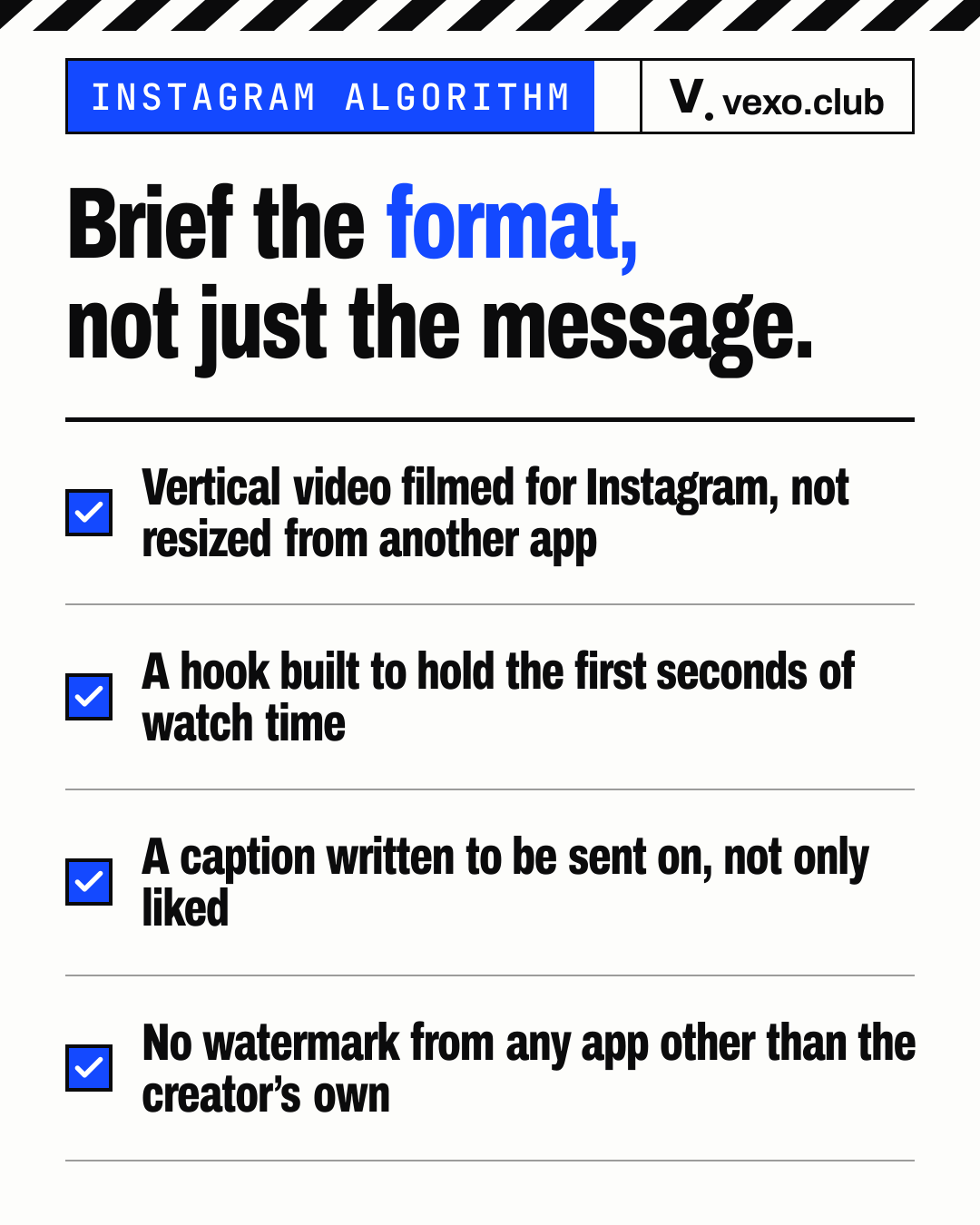
None of this means likes stop mattering, or that one send that travels guarantees reach: Instagram has not published a formula, only the order of what it weighs. What it does mean is that the instructions a brief gives a creator (vertical or square and filmed for Instagram rather than resized from another app, a hook built to hold the first seconds, a caption worth forwarding) are no longer a style preference. They are the format the signals Instagram has named respond to.
What a format-first Instagram brief asks a creator for
What should a brand check before the brief goes out?
Two checks come before any rate is discussed. The first is originality: whether the file a creator plans to post is native to Instagram or a repost of something already circulating, and whether any third-party material in it is materially edited rather than bordered or watermarked. The second is format: whether the brief names watch time and sends, not only likes, as what the deliverable is measured against, so the creator knows what to build toward. Reels vs YouTube Shorts for brands sets out the format choice between the two platforms, and Instagram SEO for brands covers the separate question of how a post or account is found by search rather than recommended by ranking.
The credit side of reusing someone else’s footage honestly is covered in usage rights and in the Instagram collab post for brands. A brief that names format and originality up front is also easier to vet afterwards: how to check an influencer’s audience before you pay sets out the audience side, and the desk’s roster lists each creator’s platforms and formats on their own profile. The Instagram influencer marketing page sets out how a brief for the platform is run end to end, and a brief can be sent to the desk.
Questions brands ask
Has Instagram confirmed it ranks reposted content lower? Yes, for a specific behaviour: when it finds two or more identical posts, it recommends only the original, and an account that mainly reposts other people’s work loses eligibility for recommendations. Instagram announced this for reels on 30 April 2024, rolling it out over the following months, and extended it to photos and carousels from 30 April 2026.
What are Instagram’s top ranking signals? In a January 2025 video reported by Social Media Today, Adam Mosseri named watch time, likes and sends as the three that matter most, with likes weighing slightly more for an account’s own followers and sends weighing slightly more for reaching people who do not follow it yet.
Does adding a watermark protect a creator’s reach? No. Instagram’s April 2024 post lists having no visible watermarks among the conditions for content to be eligible for the small test audience it first recommends to, and its April 2026 post says adding only a watermark, subtitles or a caption credit to someone else’s work does not make it original.
Should a brand stop asking for static posts? No: Instagram has not said likes carry no weight, and a static post still works for an audience a brand already has. The change is that a brief aimed at people who do not yet follow the creator should name watch time and sends as what it is building toward, because those are the signals Instagram has said matter more outside an account’s existing followers.
Does vexo.club write these checks into its briefs? The desk checks originality and the format instructions against what the deliverable needs to do (reach an existing audience or a new one) before any rate is set, and states what it finds.
Sources
- Helping Creators Find New Audiences (opens in a new tab) creators.instagram.com
- Rewarding original creators on Instagram (opens in a new tab) creators.instagram.com
- Social Media Today (opens in a new tab) socialmediatoday.com
- Helping creators of all sizes break through (opens in a new tab) creators.instagram.com
Cite this page
Instagram’s algorithm for brands: original content, watch time and shares over likes. vexo.club, published 01 Nov 2026. https://vexo.club/blog/instagram-algorithm-changes-brand-content
Influencer marketing across India
Send the desk a brief: it comes back as a shortlist and a directional band, never a public price.
Brief the desk