Schema markup for influencer marketing websites: what to hand a developer
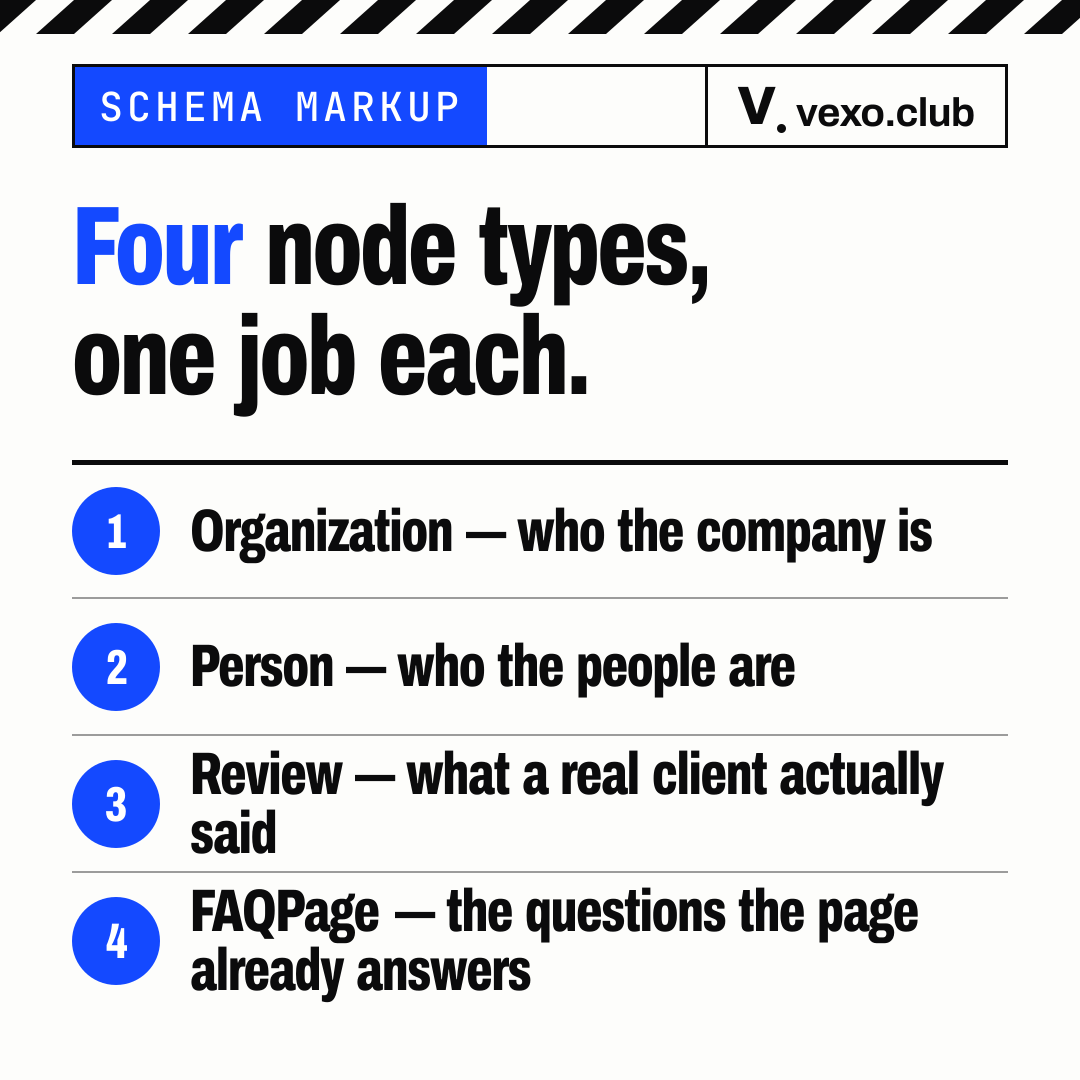
Structured data for an SEO agency website or an influencer marketing site is not a ranking trick. It is a set of facts, written once in a form a machine can parse, about the company, its people, its reviews and the questions its own page already answers.
Playbooks 13 min read The vexo.club desk
In this article8 sections
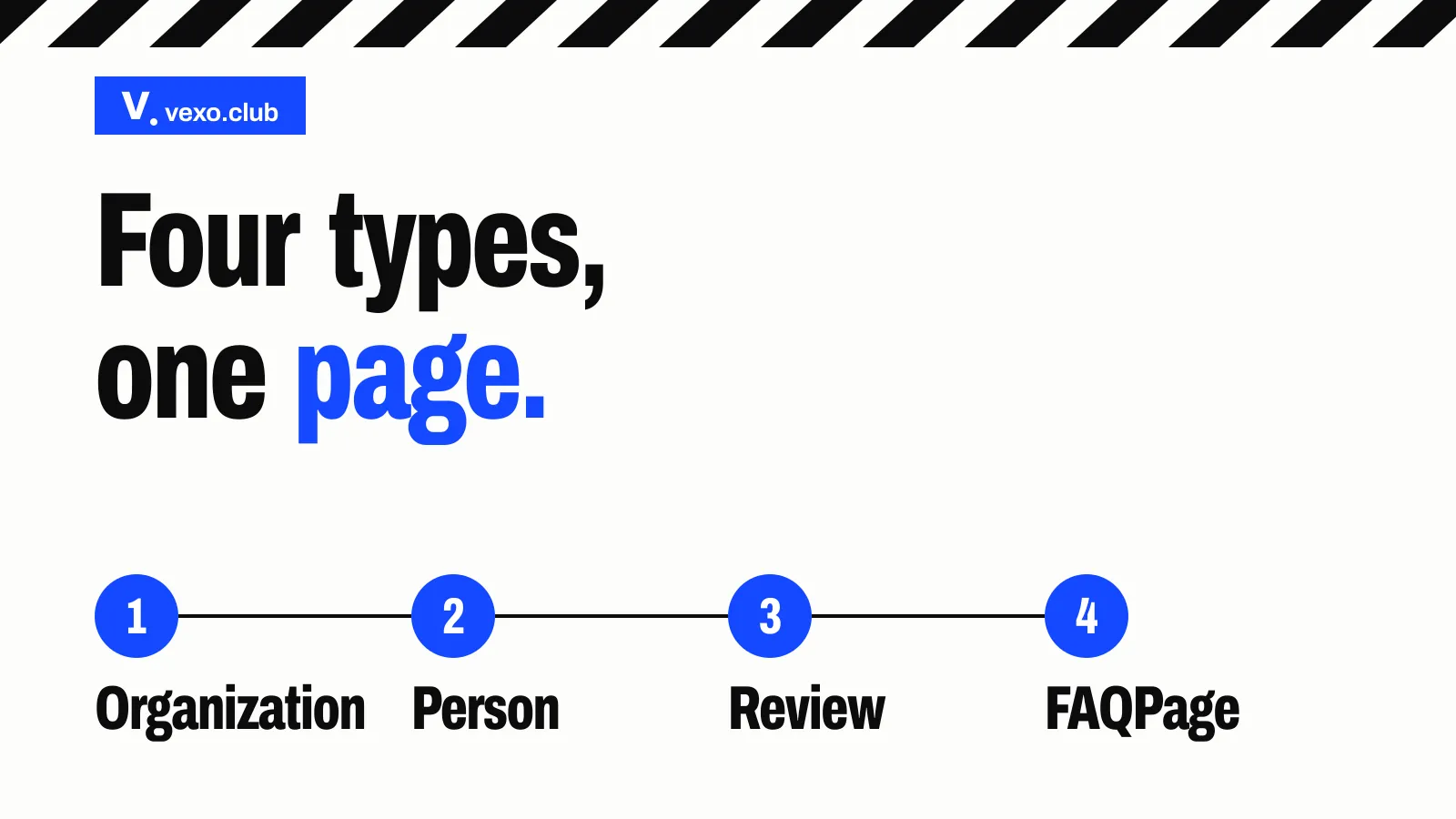
Schema markup is the part of a web page written for the reader that cannot parse prose: a search engine’s crawler, or the model behind an AI answer engine. It is a block of structured data, in a form schema.org defines, that states facts a page already carries in sentences (who the company is, who the person is, what a client actually said, which question the page answers), so a machine does not have to infer them from paragraphs written for a person. An influencer marketing agency carries all four facts on an ordinary day: a company record, a roster of named people, client reviews it is proud of, and a founder answering the same five questions somewhere on the site. A search engine or an AI assistant has to infer each of these facts from prose unless it is also written as schema markup for influencer marketing: the term founders search for once a competitor’s page starts carrying a result theirs does not.
What structured data does and does not do
In short
- Schema markup does not move a ranking by itself. It changes whether a search engine or an AI model can read a page’s facts with confidence instead of guessing at them from unstructured text.
- Organization schema is the block every influencer marketing website should ship across the whole site: legal name, logo, service area, the way to reach the desk.
- Person schema belongs on a creator or founder profile only once the subject has agreed to be named there: a Person node is a public claim about a real individual.
- Review schema is where agency sites most often go wrong. Google’s own structured data guidelines rule out a business marking up reviews about itself for a star rich result.
- FAQPage schema is a copy of the visible question-and-answer section on the page, never an addition to it.
Why does an influencer marketing website need structured data at all?
A page has two readers now, not one. A person scrolling the site reads the headline, the paragraph, the client logo. A search engine and, increasingly, an AI answer engine read the same page for a narrower purpose: to lift a fact and place it elsewhere (a knowledge panel, a rich result, a sentence in a chat answer). That second reader does not parse tone or implication. It looks for a block of structured data it recognises, and absent one, it is left to guess the company’s name from a logo image, a founder’s role from a bio paragraph, or whether a five-star claim is real. Structured data SEO for an agency website is writing those facts down twice: once in the prose a visitor reads, once as schema.org JSON-LD a machine can parse directly.
This is the same reasoning behind generative engine optimisation, usually shortened to GEO: an AI assistant answering “who runs influencer marketing in Delhi” or “what does this creator post” states a fact more reliably when the page hands it that fact in a structured block than when it has to extract one from a hero section written to persuade a person. vexo.club’s own structured data lives in two files worth knowing the shape of: one script-tag component that escapes the single character that could ever break it, and a library of plain functions that build each node from the site’s own records rather than from typed-in copy. A page can carry an Organization node, Person nodes on consenting creator profiles, and an FAQPage node built from the same visible questions a reader already sees, and none of the three repeats a claim the page itself does not make.
The four schema types an influencer marketing website carries
Organization schema: the agency’s facts, stated once
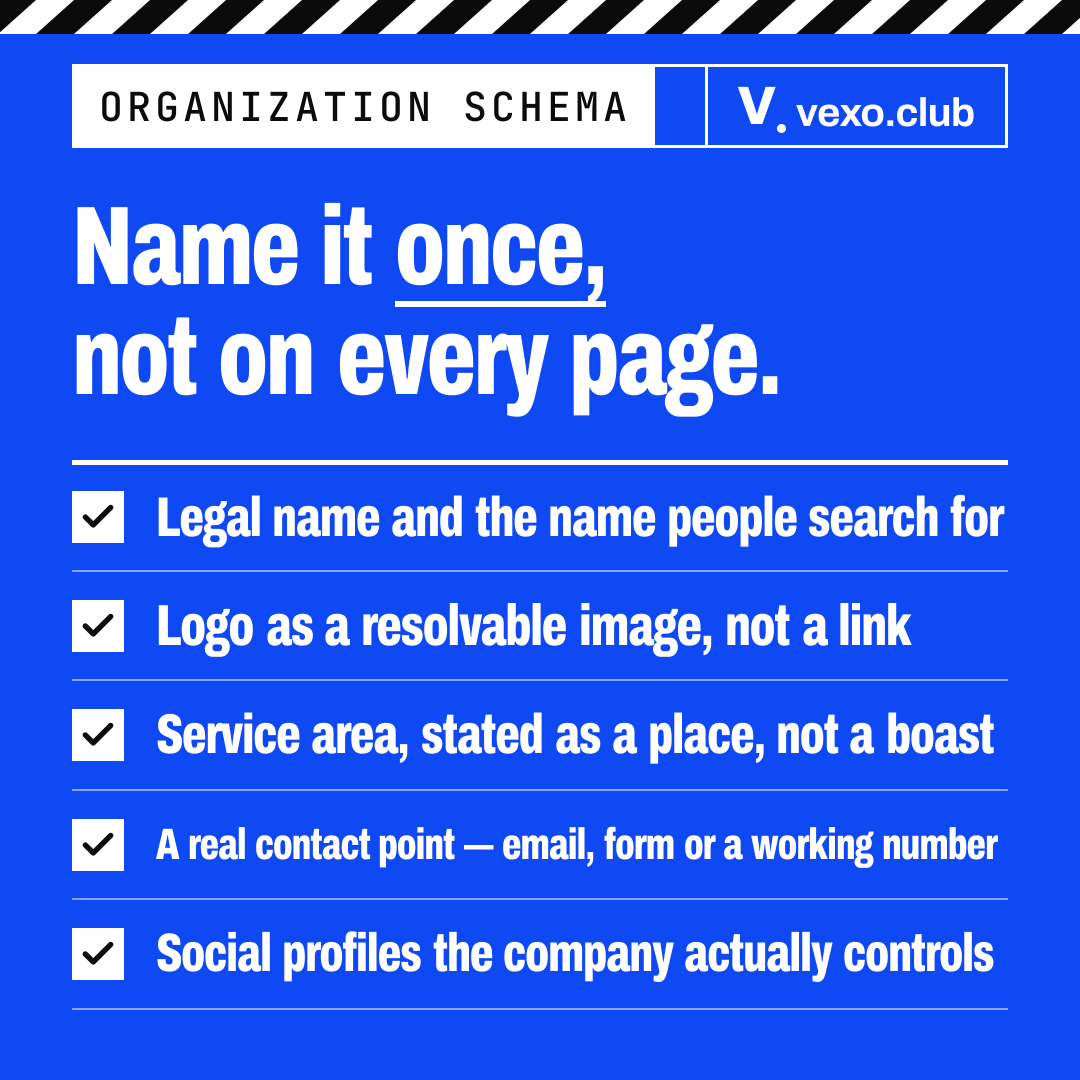
Organization is the block every influencer marketing website should carry once, in the layout that wraps every page, rather than retyped per page. It is the company’s own facts: the legal name and the shorter name people actually search for, a logo as an image a parser can resolve rather than a link to a page, the market the company serves, a contact point that leads somewhere real, and sameAs links to the profiles the company itself runs. Nothing here should be a placeholder written to look complete. A field left out because the fact is not on file reads, to a search engine and a careful developer alike, as more honest than a guessed one: a street address nobody has confirmed, a founding year rounded off, a service area wider than the company actually reaches.
The founders worth naming are the ones who hold a real role, with the title they actually carry, linked to the Organization rather than duplicated as unrelated facts. The social profiles worth linking are the ones the company logs into, not every mention of the brand across the internet: a sameAs list is a claim of ownership, and a parser that cannot verify it either ignores it or treats the mismatch as a sign the rest of the page is unreliable too. A developer building this for the first time needs one decision from the founder: which facts are confirmed and current, because that is the entire content of the node.
What to hand a developer for Organization schema
- The legal name, and the shorter name people actually type into search
- A logo file, served at a stable address, not embedded only as a background image
- The city or region the company serves, stated plainly rather than implied
- One working contact route: an email, a form, a number that is answered
- Only the social profiles the company itself posts from
- Founders or principals, named with the title they currently hold
What an Organization node should name
Person schema: marking up the people, not just the brand
A creator roster, a management agency’s talent page, or a team page is a list of real people, and Person is the schema.org type that says so to a machine: a name, an image, the niche or job title, the languages a person works in, sameAs links to the accounts they actually run. Done well, it lets a search for a creator’s own name resolve to the right profile instead of a stranger with the same handle, and lets an AI assistant answer “who is this creator” with facts the profile states rather than a guess assembled from unrelated mentions.
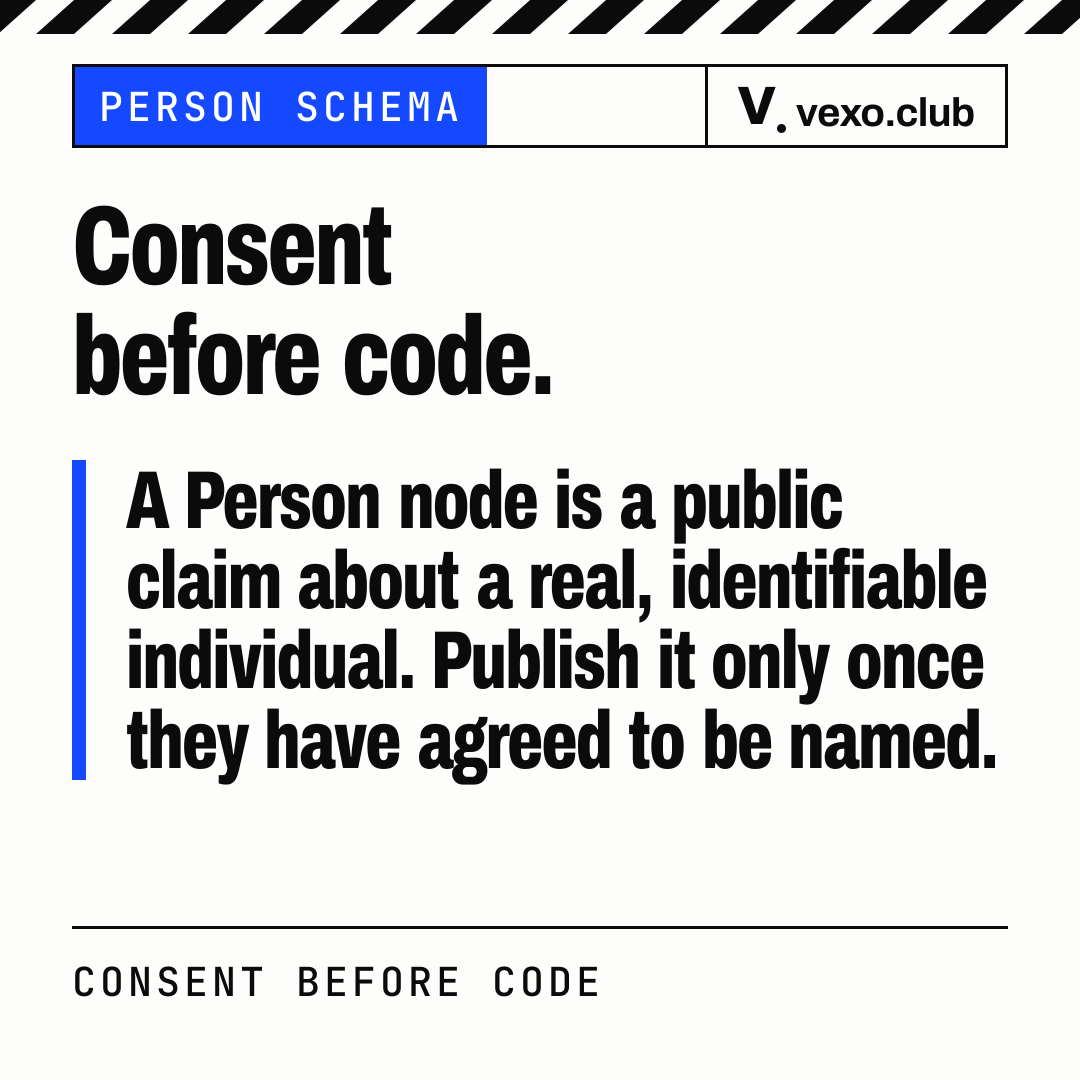
Done carelessly, it is a liability. A Person node is not a description of a brand asset: it is a public, machine-readable assertion that a named, identifiable individual is connected to this business. The rule, and the one place a founder cannot delegate to a developer: publish a Person node only once the subject has agreed to be named, and only with facts confirmed on their own record. Never a follower count estimated from a public profile: a number schema markup states as fact is read as fact by whatever reads it next. The discipline that keeps a page from inventing a statistic about itself should keep a Person node from inventing one about someone else.
The rule a Person node runs on
Review schema: the one that gets agency websites in trouble
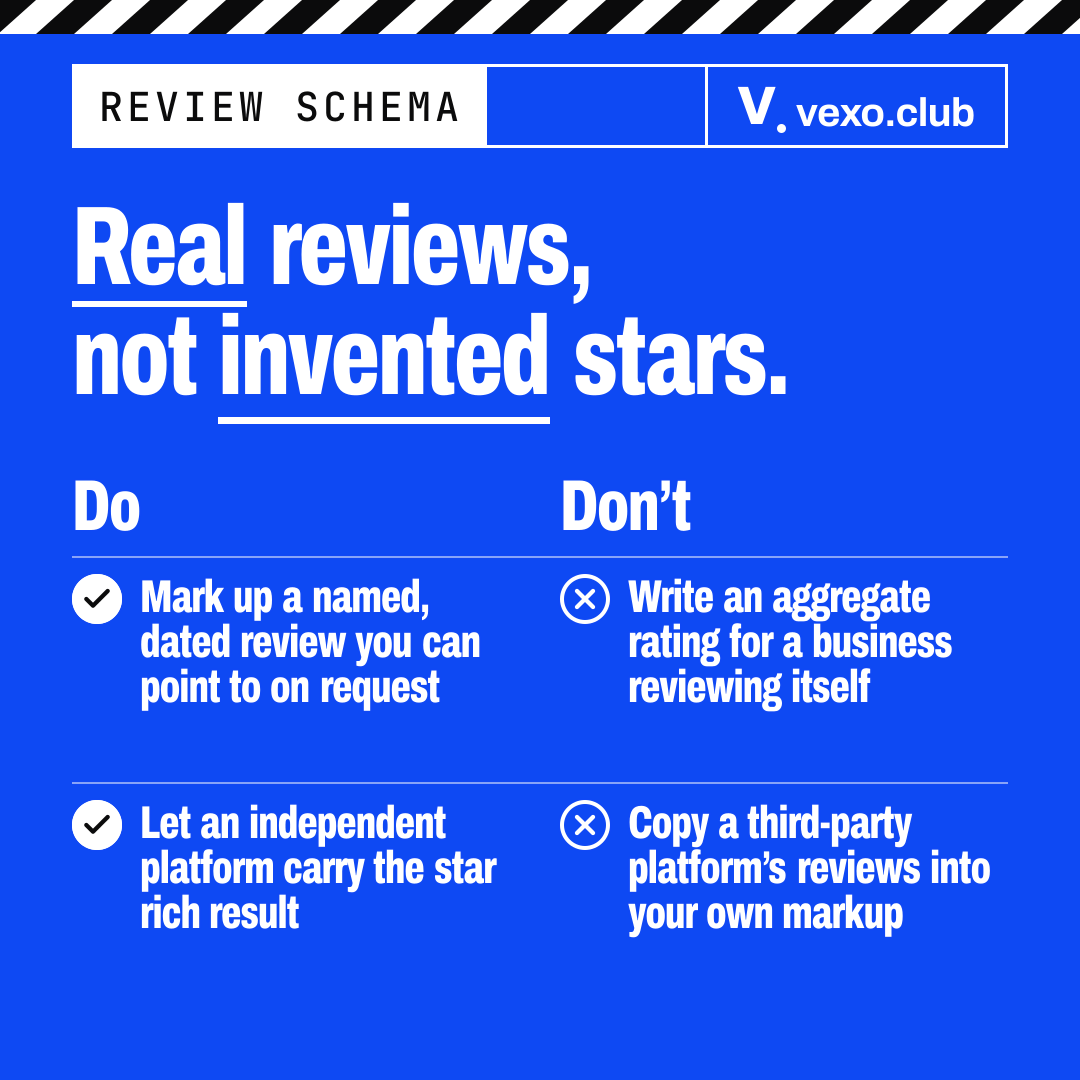
This is the type most influencer marketing sites reach for first (a page full of client praise feels like the obvious place for stars), and the type with the clearest documented rule a founder is unlikely to have read. Google’s review snippet guidelines state plainly that a business is not eligible for the star rich result when it marks up reviews about itself, whether that review sits in the page’s own structured data or arrives through an embedded third-party widget. A review has to come from an independent party, be about a specific item rather than a category or a list of items, and never be aggregated by copying another platform’s ratings into the company’s own markup.
What this means in practice: a testimonial page can still carry a Review node for each dated, named client quote, as a record of what was said and by whom, without claiming the star rich result that only an independent platform (a Google Business Profile, an industry directory, a client’s own site) can earn on a company’s behalf. An AggregateRating built from the company’s own collected quotes is exactly the self-serving pattern the guideline names, and it risks a manual action against the whole site’s structured data, not just the one block. The honest version of Review schema is narrower than most founders expect, and narrower is the version that still works a year later.
Review schema an agency can actually ship
How the four types differ in what they require to be true
Laid against each other, the four types ask for different kinds of honesty, and a developer briefed on the difference will not reach for the wrong one under deadline.
What each schema type states, and what breaks it
| What it states | What has to be true first | |
|---|---|---|
| Organization | The company’s own facts: name, logo, area served, contact | Every field traces to a record the company controls, none is a placeholder |
| Person | A real, identifiable individual connected to the business | The person has agreed to be named and the facts are confirmed on their record |
| Review | What a specific client said, about a specific piece of work | The review is independent of the business being reviewed, not self-collected for a star result |
| FAQPage | Questions the page itself already answers, word for word | The visible text and the markup never diverge, and there are at least two questions |
FAQPage schema: closing the loop for search and AI answer engines
Google stopped showing the FAQ rich result in Search from 7 May 2026 and has since removed its FAQPage documentation, so this node no longer earns a Google rich result; what it still offers is a machine-readable copy of the page’s questions for any other reader that parses it. FAQPage is the quietest of the four types and the easiest to get right, because the rule is a copy, not a composition: whatever question-and-answer section a reader can already see, written out again as structured data, nothing added, nothing paraphrased into a different answer. It is also the most directly useful type for an AI answer engine, which can lift a clearly marked pair verbatim rather than summarising a paragraph and risking the summary. The discipline is to generate the markup from the same component that renders the visible section, so the two can never drift: a markup answer a reader cannot find on the page is the one thing that makes a search engine distrust every other structured block on the same site.
A short FAQ of one question answers nothing a machine needs help with; the type is built for a genuine list, and two is the practical floor worth asking a developer to enforce before a page ships with an FAQPage node that carries only one.
Before an FAQPage node ships
- Every question in the markup appears, word for word, as visible text on the page
- Every answer in the markup is the same text a reader can already read, not a longer or shorter version
- At least two questions: a single question is not a list
- The markup is generated from the same source as the visible section, not typed in twice
- No answer states a number, a rate or a claim the rest of the page does not already make
Handing this to a developer
A founder does not need to write a line of this, but a developer building it blind will fill gaps with guesses, so three instructions are worth giving up front. First, the Organization and contact facts belong in one place in the code, the layout every page shares, so a changed phone number updates everywhere at once. Second, a Person node belongs behind the same consent check the rest of the profile is behind: if a creator or team member is not published, their schema should not be either. Third, anything that touches a client’s own words (a review, a quote, a testimonial) should pass through the same escaping the rest of the page’s structured data does, so a client’s own punctuation can never close the script tag early. That is a one-line fix, and the kind of detail worth asking a developer’s quote whether it includes.
What to check before any of it ships: run the finished page through Google’s Rich Results Test, confirm the Organization node names only profiles the company controls, confirm every Person node sits behind consent, confirm the Review markup never claims an aggregate rating the company collected about itself, and read the FAQPage section back against the visible page once more. None of that is a ranking promise: schema markup for influencer marketing does not move a page up a result page by itself. It moves a page from one a machine has to guess about to one a machine can simply read. vexo.club’s own services page and roster carry three of these types today (Organization, Person and FAQPage; no Review markup), and the company’s trust page states, in the same structured form, exactly what the site will and will not claim about itself.
Questions brands ask
Does schema markup improve search ranking on its own? No credible guideline claims it does. It makes a page’s facts legible to a search engine or an AI model that would otherwise have to infer them from prose, which can earn a richer result or a more accurate AI answer, but it is not a ranking factor by itself.
Can an agency mark up its own testimonials with star ratings? Not for Google’s star rich result. Its review snippet guidelines rule out a business marking up reviews about itself, including through an embedded third-party widget on its own site. A named, dated Review node for a specific piece of work is still honest; an AggregateRating the company compiled about itself is the pattern the guideline exists to stop.
Does a creator need to approve their own Person schema? Yes, by the same standard that should govern publishing their profile at all: a Person node is a public claim about a real individual, and it belongs on the page only once that person has agreed to be named there, with facts confirmed on their own record rather than estimated.
What happens if the FAQPage markup says something the visible page does not? It reads, to a search engine, as the kind of mismatch the general structured data guidelines call out directly: content that does not reflect what a user sees. The safer practice is to generate the markup from the same section a reader reads, so the two cannot diverge.
Is structured data the same thing as an AI answer engine optimisation strategy? It is one part of one. Structured data states facts plainly for any machine reader; generative engine optimisation is the broader practice of writing and structuring a page so an AI assistant can find, trust and quote it, of which schema markup is the most literal piece.
Cite this page
Schema markup for influencer marketing websites: what to hand a developer. vexo.club, published 03 Nov 2026. https://vexo.club/blog/schema-markup-influencer-marketing-websites
Send the desk a brief: it comes back as a shortlist and a directional band, never a public price.
Brief the desk