Schema markup for influencer campaign case studies: what to mark up and what to leave out
A case study page needs one main schema item, an Article or a CreativeWork, linked to an Organization declared once. Review is for a real, named, dated client quote and earns no stars; a business cannot rate itself, and the FAQ rich result is gone. Property by property, and how to validate it.
Benchmarks 21 min read The vexo.club desk
In this article16 sections
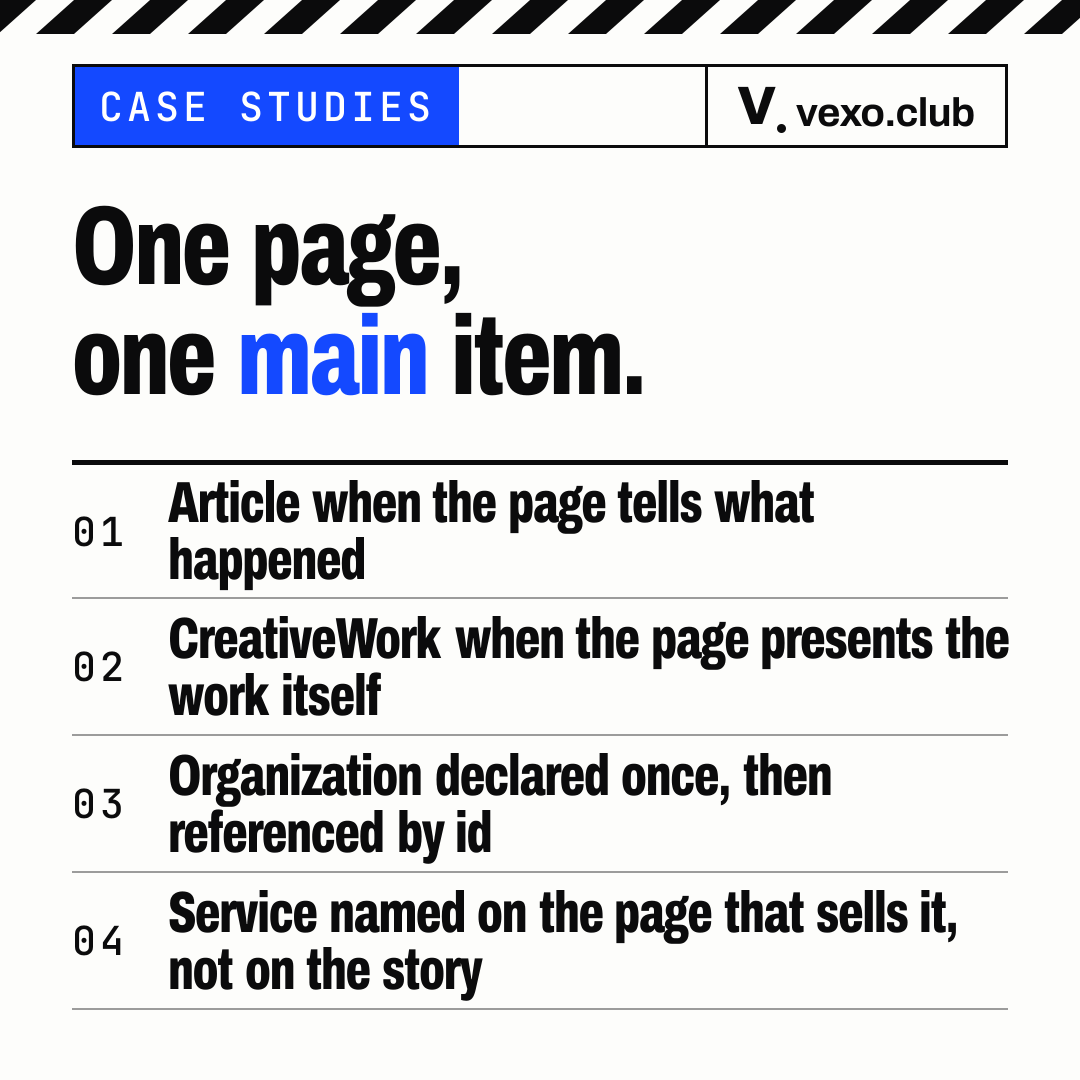
Mark a case study page up as one main item. Use an Article if the page tells what happened, or a CreativeWork if it presents the work itself, and attach an Organization that you declare once for the whole site. Add Review only for a named, dated client quote you hold in writing, and expect no stars from it. Leave AggregateRating alone unless real raters gave a rating that visitors can see, and do not build FAQPage for Google: the FAQ rich result stopped showing on 7 May 2026. What each type needs to be true across a whole site is in the general schema markup post. This one is only about case studies and portfolio pages, where agencies get most things wrong.
Case study schema, in short
- schema.org has no CaseStudy type. A case study page is an Article or a CreativeWork, with the client, the service and the agency attached as related items.
- Service, Article and a plain CreativeWork are not on Google’s list of things a review may be about, and a business reviewing itself is shut out of review stars anyway.
- FAQ rich results stopped appearing in Google Search in May 2026. FAQPage is still valid vocabulary but it earns nothing there now.
- Result figures belong in visible text the client has confirmed. No schema property makes an unverified result safer to state.
- A green Rich Results Test proves the syntax and the feature fit. It cannot tell whether the quote was real.
We read Google’s documentation on 24 October 2026 and name the date because three of the rules below changed in the last twelve months. Check the live text before you brief a developer.
Is there a schema type for a case study?
No. The address schema.org/CaseStudy returned a not-found error when we checked, and the plausible-sounding relatives (a use case, an industry page, a buyer guide) do not exist either. Google’s general guidelines say to use the most specific applicable type that schema.org actually defines, so an invented type buys you nothing and will most likely be ignored.
Two real types look tempting and are wrong. Project is an enterprise planned to achieve a particular aim, which sounds like a campaign, but it is a subtype of Organization, the family Google’s self-serving review rule names. Report is a subtype of Article for a report generated by an organization, which fits a formal results document and not the story of one campaign.
Article or CreativeWork: which one is the page?
The decision rule is what the visitor is looking at. If the page is mostly a written account (the brief, what the desk did, what happened, what the client said) with a headline, a byline and a date, it is an Article. If the page is mostly the work itself (a campaign film, a design set, a creator collaboration shown with a short caption) it is a CreativeWork. Pick one and make it the page’s main entity. Google’s guideline on multiple items says to include the type that reflects the main focus of the page, and other types can sit beside it or inside it. Seven top-level types dumped on one URL tells a parser nothing about which one the page is.
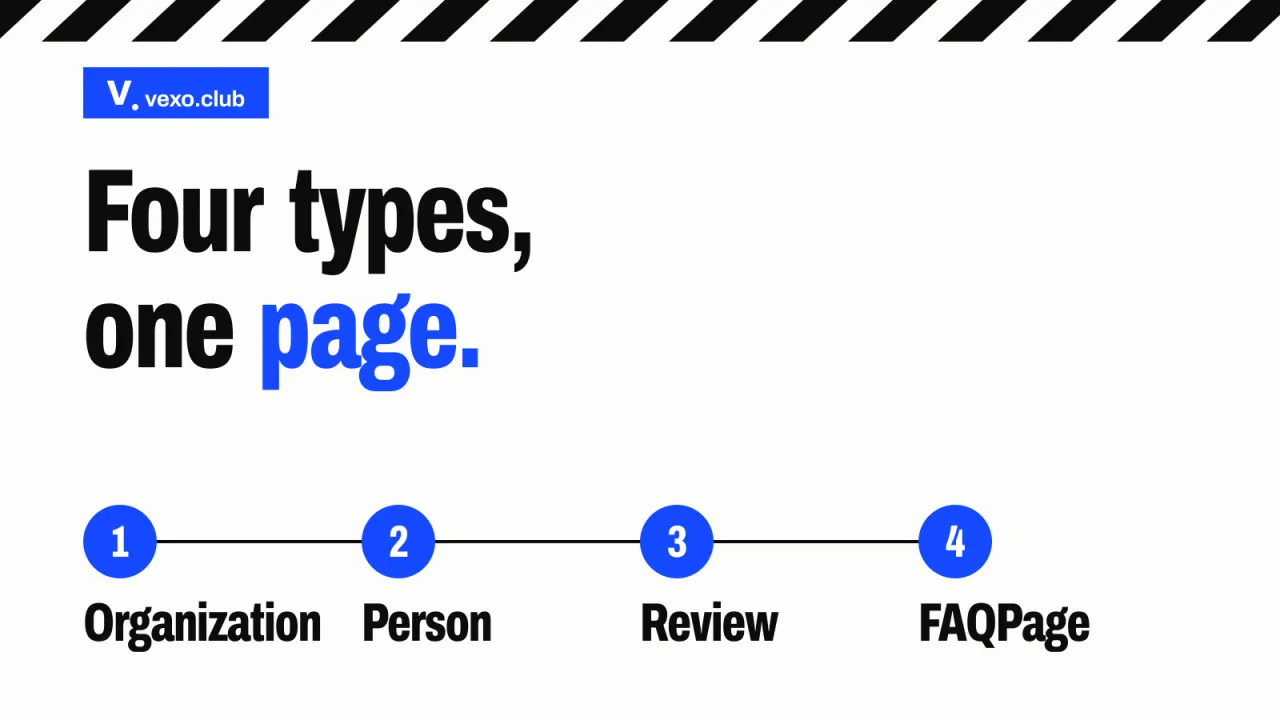
The seven types, against a case study page
| What it says on this page | Google feature today | |
|---|---|---|
| Article | The page is a written account with a headline, a date and an author | Article feature, no required properties |
| CreativeWork | The page presents a piece of work: a film, a design, a campaign | No dedicated feature |
| Organization | Who the company is, declared once for the site | Logo and knowledge panel details |
| Service | What you can be hired for, on the page that sells it | No dedicated feature |
| Review | What a named client said about a named thing | Review snippet, not for a business reviewing itself |
| AggregateRating | An average of many real ratings visitors can see | Same limits, never from other sites |
| FAQPage | Questions the page already answers, word for word | None since May 2026 |
The matrix shows the quieter truth. Google’s gallery lists a feature for Article, for Organization and for the review snippet, and none for Service, a generic CreativeWork or FAQ. That is no reason to skip them, since structured data states facts a machine would otherwise infer. It is a reason to stop promising a client a visible result from markup with no feature behind it.
Which item leads on a case study page
What do Google’s policies say about reviews on your own pages?
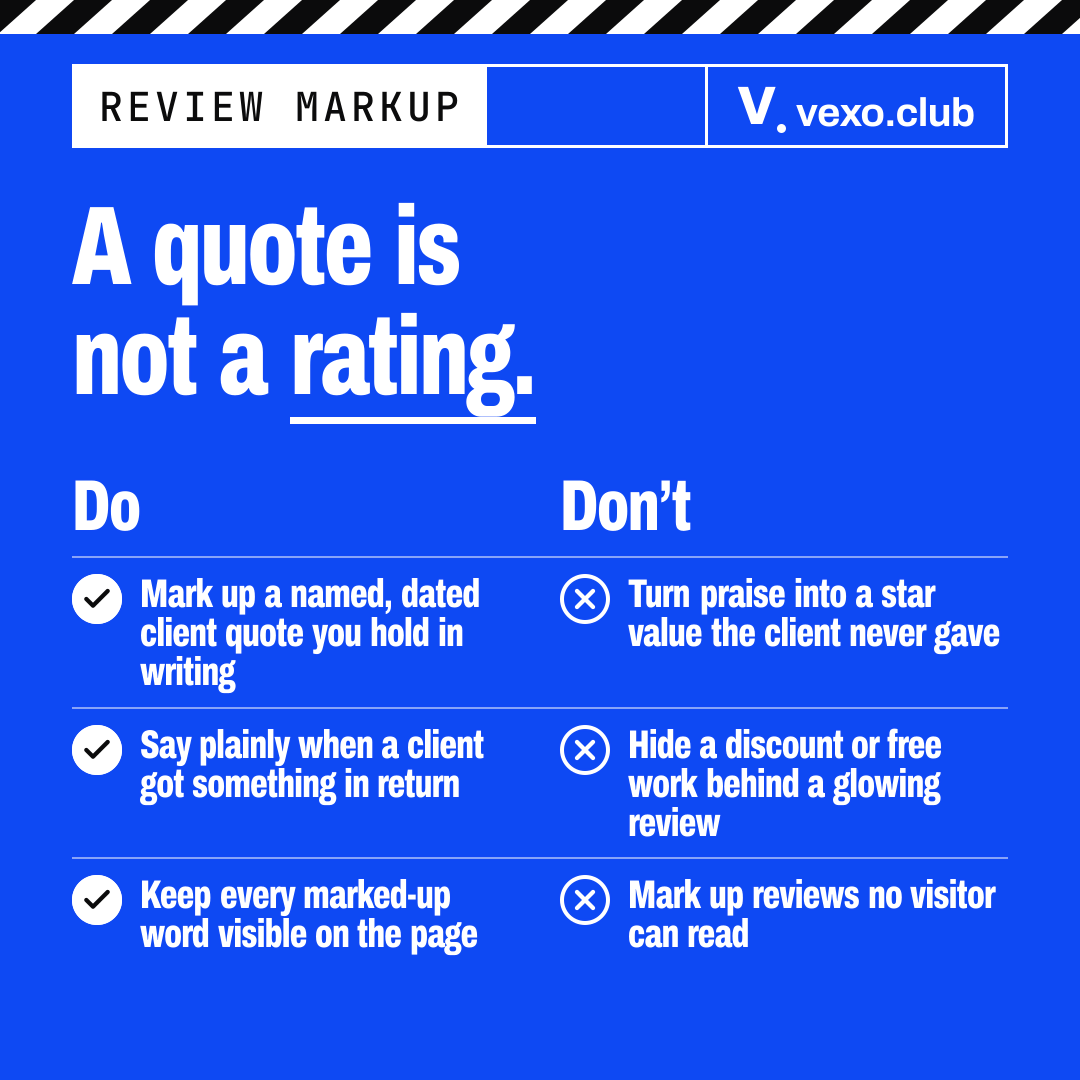
The rule that catches agencies is in Google’s review snippet guidelines. If the entity being reviewed controls the reviews about itself, its pages that use LocalBusiness or any other Organization type are ineligible for the star review feature. Google’s own example is a review about entity A placed on the website of entity A, either in its structured data or through an embedded third-party widget such as a Google Business or Facebook reviews widget. Pasting a widget on your agency’s testimonials page does not change who controls the page.
Three details are missed in most summaries. First, when Google introduced the rule in September 2019 it said self-serving reviews are simply not displayed, not that they trigger a manual action, and that a Business Profile is unaffected because the change concerns organic results only. Getting this wrong by accident costs you the stars and nothing else. Second, the list of things a review may be about is specific: Book, Course, Event, Game, HowTo, LocalBusiness, Movie, Organization, Product, Recipe, SoftwareApplication and a few media and series types. Service is not on it. Article is not on it. A plain CreativeWork is not on it. A review attached to a case study about a service is valid schema.org with no Google feature to appear in. Third, the guidelines ask for reviews about a specific item, not a category, so a quote about the agency in general is the weakest shape.
Fabrication is a separate matter. Google’s general structured data guidelines say not to mark up content that visitors cannot see and not to mark up fake reviews. A structured data manual action costs the page its eligibility for rich results and, according to the same page, does not change how it ranks in web search. In July 2026 Google added a review guideline against fake reviews and undisclosed incentivized ones: reviews not based on a genuine experience, and reviews written in exchange for money, discounts, vouchers or free products without a clear and prominent disclosure. Agencies do this without thinking. A pilot client got a month free and wrote a glowing line. That quote can stay on the page, but the benefit has to be stated next to it.
How Google’s rules on reviews and FAQs moved
- Sept 2019 Self-serving reviews stop earning stars for businesses and organizations Google said this alone is not a manual action
- Nov 2025 Review guidance clarified on nesting Say what is being reviewed one way, not several
- May 2026 FAQ rich result stops appearing Deprecation notice added the day after
- June 2026 FAQ rich result documentation removed
- July 2026 New review guideline on fake and undisclosed incentivised reviews
The rule Review markup runs on
Can an agency put an AggregateRating on its portfolio page?
In practice, no. AggregateRating needs a rating value and a count of ratings or reviews. The same guideline page says not to aggregate reviews or ratings from other websites, so an average copied from a Google profile or a directory is out. An average built from your own clients’ scores is a business rating itself, which is the case already closed to stars. The honest alternatives are boring. Show the actual quotes with names and dates as visible text. Link to profiles you have claimed on independent platforms, and list those in the Organization’s sameAs property. Let a buyer call the reference.
Which properties go on the case study page itself?
For an Article, Google lists no required properties and asks you to add the recommended ones that apply. In words, that means a headline that matches the visible H1, a datePublished and a dateModified with the time zone written in (for an Indian desk, the offset for IST), an image that is relevant to the case and not the logo, and an author. Name the author as a Person with a name and a url or sameAs that points to a real bio page, or as the Organization with its home page. Put only the name in the name field. Google’s author guidance says not to add a job title or the publisher there.
Beyond Google’s list, schema.org properties earn their place where they are true. The publisher property points to your Organization node by its id, so the company is described once and referenced, not retyped. The inLanguage property carries en-IN or hi. The mainEntityOfPage property ties the item to the page address. The about property is where related things go: the client as an Organization (when you are allowed to, see below) and the Service the work was an instance of, referenced by its id. A BreadcrumbList with the listing page as parent is worth the small effort, since breadcrumbs are in Google’s gallery.
Keep the two dates apart. The datePublished is when this page went live. The campaign’s own timing is a different fact. For a CreativeWork, schema.org has dateCreated for when the work was made and temporalCoverage for a period, and a sensible template uses dateCreated for a single year and temporalCoverage for a range such as a campaign that ran across two financial years. A case study published in 2026 about a 2024 campaign should not read as a 2026 result to a machine or to a person.
What changes for a portfolio piece that is the work itself?
A CreativeWork takes the same linking properties and a few of its own. In words: a name and a description that match the visible title and caption, a genre for the category of work, an image or thumbnailUrl that is a real still from it, a creator for the company that made it, a contributor for others who did meaningful work (a production house, a named creator who has agreed), and an isPartOf that points to the portfolio listing page. If the page embeds a film, Google has its own video guidance, and the film should be credited to whoever made it. A brand publishing its own write-up should do the reverse: the brand is the publisher and the agency is a contributor, named with the agency’s consent.
The portfolio index needs less: a BreadcrumbList and the Organization. Google’s carousel feature, per the gallery, is limited to Recipe, Course list, Restaurant and Movie, so a case study grid will not become a carousel. ItemList is valid if a developer wants it, with no result promised.
How do you handle the client, the creators and the results?
Client first. Google’s general rule is that markup must reflect what visitors can see, so the client name in the about property must be the client name the page prints. If the contract lets you describe the work but not name the client, print “a skincare brand” and leave the about property out. Do not name the client in the JSON because it is invisible. That mismatch is the failure the guidelines describe, and it is also a breach of whatever the client agreed. The permission has to be in the agreement or in an email, and a clause in the master services agreement covering case study use is the cleaner way.
Creators next. A named creator is a named individual, and consent is the safe default whatever the legal minimum turns out to be. The usage rights post covers the content side. Treat the markup the same way: no Person node and no sameAs link to a creator’s account unless they agreed to appear on your site in that capacity, and no follower count you cannot source on the day.
Results last, and this is where the temptation is strongest. schema.org has no outcome field for a campaign, so the result lives in visible prose, and the only machine-readable echo that is safe is a plain-text abstract that repeats the approved sentence word for word. Do not turn a client’s “we were happy” into a ratingValue. A client who wrote words and no number gave no rating, and converting sentiment into five stars is a fabrication that you made, not a quote you hold. Do not put a figure in markup that the page does not print, and do not print a figure the client has not approved in writing. For how to count and state results honestly in the first place, what we count as reach and measuring influencer marketing ROI set the standard the markup then has to follow.
The evidence file to hold before any client fact goes into markup
- Written permission to name the client, and the form of the name (company, brand or both)
- Written approval of every result sentence, kept with the date it was approved
- The quote as the client wrote it, with who wrote it, their role and the date
- A note of anything the client received in return for the quote or the case study
- Consent from any named creator or individual, separate from the brand’s consent
- A review date, so a quote from a client who has left is not shown as current
What goes on the Organization and Service nodes?
Google’s Organization documentation says to add it to the home page, lists no required properties, and recommends the ones that apply: name, legalName where it differs, url, a logo as a resolvable image, sameAs for profiles you run, and a contactPoint that leads to a person. Every case page then refers to that node by id instead of repeating it. Add a physical address only if you publish one. A Delhi NCR desk should not imply an office anywhere else, and an areaServed that lists cities you have never worked in is the same overstatement in a different property.
The Service node belongs on the page that sells the service. Its useful properties are a name, a serviceType in plain words, the provider as a reference to the Organization, an areaServed that is true, a description and a url. Leave out offers and a price unless you publish a price, and leave out aggregateRating and review entirely, for every reason above. The case study then points at the Service through its about property. The reverse link (a service page listing its case studies) is better done as visible links a visitor can click than as markup.
Which Indian rules sit behind a testimonial?
Two sources set the bar a client quote should clear, and neither is about schema. The Central Consumer Protection Authority’s Guidelines for Prevention of Misleading Advertisements and Endorsements for Misleading Advertisements, 2022 say in clause 13 that an endorsement in an advertisement must reflect the genuine, reasonably current opinion of the person making it and be based on adequate information about, or experience with, the product or service. Clause 14 asks for disclosure of a connection between the endorser and the advertiser that might materially affect the credibility of the endorsement and is not reasonably expected by the audience. A client quote on your own sales page reads, on a plain reading, as an endorsement in your own advertising. We have not seen the guidelines tested on agency testimonials, so take advice before you rely on that reading in either direction, but the practical consequences are clear. Quotes go stale, so date them and drop the ones from clients who have left. Incentives get disclosed.
The second source is the Bureau of Indian Standards’ IS 19000:2022 on online consumer reviews, launched as a voluntary standard in November 2022. The PIB note says it applies to any organization that publishes consumer reviews online, including suppliers that collect reviews from their own customers. A brand manager’s testimonial about an agency is not a consumer review in the ordinary sense, so we would not claim the standard applies. Press coverage of the launch said it bars reviews purchased or written by people employed for that purpose and asks for rewarded reviews to be marked, which is a fair test for your own page. Check the standard’s current status before you cite it.
Does any of this help with AI answers?
Less than vendors say. Google’s own guide to generative AI features, which we read on the same day, says structured data is not required for generative AI search and that there is no special schema.org markup to add. It adds that it is still sensible to use it for rich result eligibility. A before-and-after test by Ahrefs on pages that added JSON-LD, reported by Search Engine Journal, found no clear lift in AI citations, with the caveat that every page tested was already being cited, so it cannot say whether markup helps a page nobody cites yet. The same article cites an experiment where AI systems relied on visible page text, not hidden markup, when fetching a page.
So the prose has to carry the proof: a clear headline, the brief in two sentences, what the desk did, what happened in words the client approved, and a dated named quote. Markup is the label on a good page. For why a page gets cited in the first place, start with getting cited by AI search.
What about FAQPage now that the FAQ rich result is gone?
Google’s documentation changelog says the FAQ rich result would no longer appear in Google Search starting 7 May 2026, and that it removed the FAQ documentation in June. FAQPage is still a valid schema.org type, and Search Engine Journal reports that Google’s deprecation notice says Google will keep using FAQ structured data to better understand pages. For a case study page the decision is simple. If the page has a real, visible set of questions a buyer would ask, such as what the engagement involved or how long it ran, then writing them out as markup is harmless and the rule is the old one: every question and answer must be visible, word for word. If the page has no such section, do not invent one to add schema. Do not tell a client that FAQ markup will win them space on a results page. It cannot.
How do you validate a case study page?
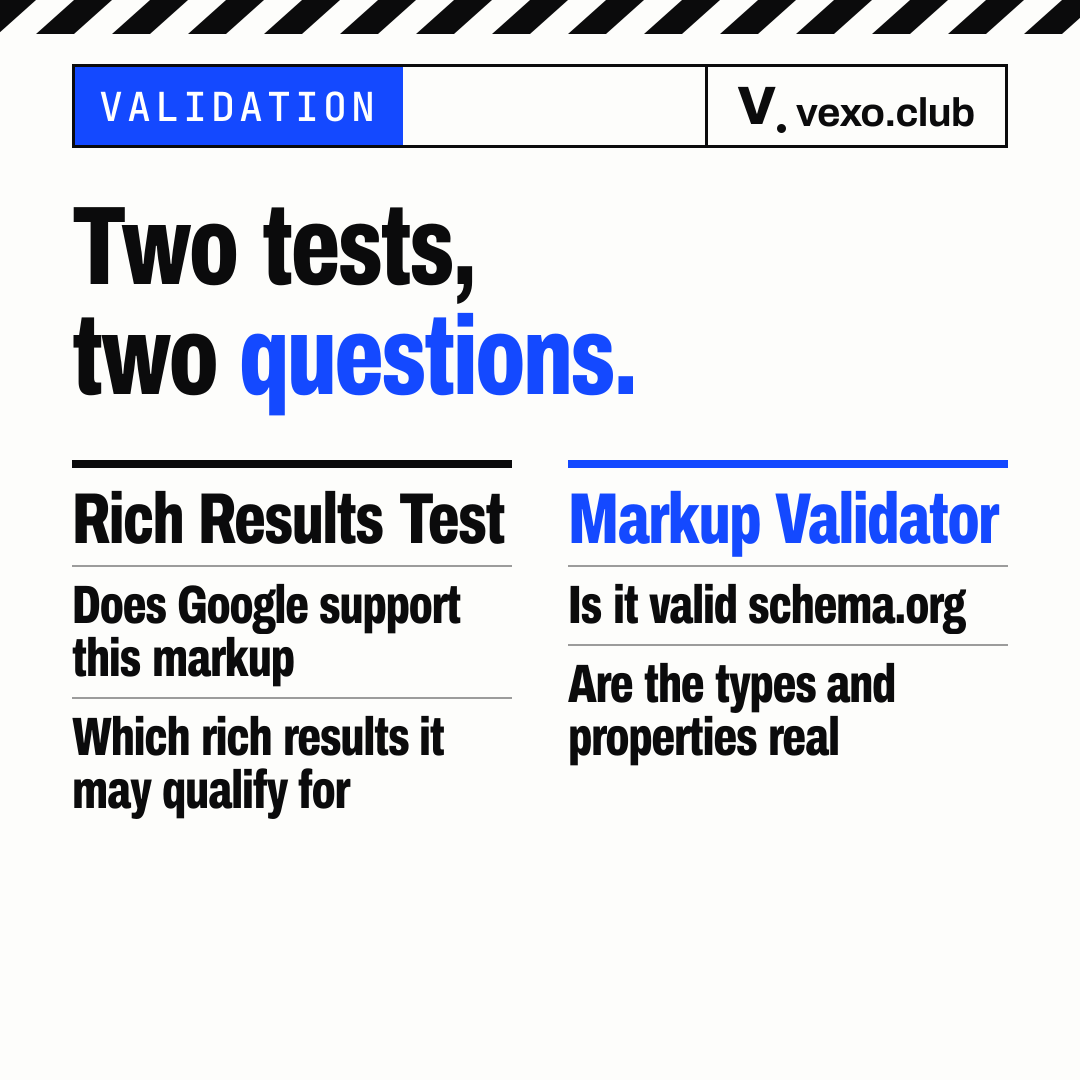
Use two tests because they answer different questions. Google’s Rich Results Test tells you whether the markup is valid for the features Google supports and which rich results it may qualify for, from either a URL or pasted code. The Schema Markup Validator checks the markup against schema.org itself, so it is the one that catches an invented type or a property on the wrong type, and the one to run for the types Google has no feature for, which on a case study page is most of them. After release, Search Console’s rich result status reports and the Manual Actions report show how Google read the live pages, and the URL Inspection tool shows what it rendered.
What each validator answers
Passing is narrower than it looks. Google’s review snippet page says that when markup is not compliant with the guidelines the issue may not be a syntax issue, and that the Rich Results Test will not be able to identify it. A page with an invented five-star rating can pass both tools. So the last check is human: open the page, open the markup, and read one against the other. Every name, date and quote in the markup should be something a visitor can see. Every client fact should trace to the evidence file. If you cannot say where a value came from, take it out.
From template to a page you can defend
- Decide the main item Article or CreativeWork, one per page
- Fill only confirmed fields Leave a field out rather than guess it
- Read markup against the page Every marked-up word must be visible
- Run both validators Google support first, schema.org validity second
- Watch Search Console after release Rich result status and manual actions
What if you are the brand reading an agency’s case studies?
Treat the markup as irrelevant to your decision. A green validator or a tidy graph tells you the developer was competent, not that the results were real. Ask what markup cannot show. Who at the client approved the numbers, and when. Whether the person quoted is still there. Whether the client got anything in return. Whether you can speak to them. An agency with its evidence file in order will answer in a day. The proposal scorecard puts these questions in a form you can score.
Three illustrative pages, and what each carries
These show shape, not real clients. First, a skincare brand approved naming, a dated quote and a results paragraph in writing. The page is an Article with headline, dates, author, the Organization as publisher, an about pointing at the brand and the Service, and the quote as a visible block. Second, a fintech app allowed the work to be described but not named. The page prints “a fintech app” and the markup has no brand in about. Third, a D2C founder publishes a launch write-up. The brand is the publisher, the agency is a contributor named with consent, and nothing about the agency is rated.
What to do this week
You can finish this in an afternoon with a developer and one conversation with each client.
- Pick the main item for each case page: Article or CreativeWork, never both as equals.
- Delete any AggregateRating and any Review whose subject is your own company from the templates.
- Move every client name, quote and result to a written approval, and keep the file.
- Check that every marked-up word appears on the visible page, then check the reverse for client names.
- Run the Rich Results Test and the Schema Markup Validator on one page of each template.
- Remove FAQ rich result targets from any report or proposal, and keep real visible questions if they help readers.
- Date every testimonial and schedule a yearly review so stale quotes come down.
vexo.club builds its own case pages this way: a CreativeWork with about, creator, publisher and inLanguage, a client named only where permission allows, an abstract only when the figures are verified, and no rating anywhere.
Questions brands ask
Is there a CaseStudy schema type? No. schema.org does not define one, and Google advises using the most specific type that exists. Use Article for a written case study and CreativeWork for a page that presents the work, and attach the client and the service through the about property.
Can I get star ratings in Google for my agency’s case studies? Almost certainly not. Google makes pages ineligible for review stars when the business being reviewed controls the reviews about itself, including through an embedded Google or Facebook widget, and Service and Article are not on its list of things a review can be about. It also says not to aggregate ratings from other websites. A named, dated quote can still sit on the page as visible text.
Should I still add FAQPage markup after Google dropped FAQ rich results? Only if the page has a real, visible question section, and not for Google. The rich result stopped appearing on 7 May 2026. Existing markup can stay, and adding it to a page that has no visible questions breaks the rule against marking up content visitors cannot see.
Do I need the client’s permission before I put their name in the markup? Yes, and the markup should only name them if the visible page does. Get permission in writing, including the form of the name, and keep it. If you may describe the work but not name the client, leave the about property out.
Does schema markup get my case studies into AI Overviews or ChatGPT answers? Google says structured data is not required for its generative AI features and that no special markup exists for them. A published test found no clear citation lift from adding it. A clear page with approved facts in plain text is the better bet.
If both validators pass, am I safe? No. They check syntax and feature support, not honesty. Google says the Rich Results Test cannot identify problems that are not syntax errors. A made-up rating passes both tools and still breaks the guidelines, and it still breaks Indian endorsement rules.
If you want a second pair of eyes on a case study template, or a conversation about which client results the desk can state with approval on file, write to us through the contact page.
Sources
- review snippet guidelines (opens in a new tab) developers.google.com
- general structured data guidelines (opens in a new tab) developers.google.com
- Organization documentation (opens in a new tab) developers.google.com
- Guidelines for Prevention of Misleading Advertisements and Endorsements for Misleading Advertisements, 2022 (opens in a new tab) consumeraffairs.gov.in
- voluntary standard (opens in a new tab) pib.gov.in
- PIB note (opens in a new tab) pib.gov.in
- guide to generative AI features (opens in a new tab) developers.google.com
- reported by Search Engine Journal (opens in a new tab) searchenginejournal.com
- Rich Results Test (opens in a new tab) search.google.com
- Schema Markup Validator (opens in a new tab) validator.schema.org
Cite this page
Schema markup for influencer campaign case studies: what to mark up and what to leave out. vexo.club, published 24 Nov 2026. https://vexo.club/blog/review-schema-for-influencer-campaign-case-studies
Send the desk a brief: it comes back as a shortlist and a directional band, never a public price.
Brief the desk