Instagram Collab posts for brands: when to use a Collab, when the paid partnership label is still required, and when a partnership ad is the better route
A Collab post puts one post on two profiles. When a brand should use it, why the paid partnership label still applies, and when to run an ad instead.
Playbooks Updated 16 min read The operators’ desk
In this article9 sections
An Instagram Collab post is one post that two accounts share: the creator invites the brand, and once the brand accepts, the post shows on both profiles and is shared with both accounts’ followers. It is a distribution feature, not a disclosure. A paid or gifted post still needs the paid partnership label, and an ad needs separate permission.
This guide comes from vexo.club: an influencer marketing agency run from one desk in Delhi NCR. Every Instagram behaviour it states as fact comes from Meta’s own pages, linked and read on 18 October 2026; where a third-party guide is quoted, the text says so. Every Indian disclosure rule comes from ASCI’s influencer guidelines. It prints no reach figure. It is a working guide for briefs, not legal advice: a brand with a disputed post takes a lawyer’s view.
Collab posts for brands, in short
- A Collab post is one post on two profiles: the creator invites the brand’s account, the brand accepts, and the post is shared with both accounts’ followers.
- A Collab is not a disclosure. Meta requires the paid partnership label on content made for payment or free gifts, and ASCI wants the disclosure upfront and prominent.
- A partnership ad is a separate route. It needs the creator’s permission, which the creator can withdraw, and a usage term in the contract.
- Meta’s page shows the invite as a step before publishing, and guides differ on adding a collaborator to a live post. Put the invite in the brief.
What is an Instagram Collab post?
An Instagram Collab post is a post that two accounts author together. Instagram’s Help Centre page on collaborative posts says the creator invites another account, and that if it accepts, “their username will be added to the post and the post will be shared with their followers. It will also show on their profile.”
Before publishing, the creator invites the brand’s account from Tag people, and the brand accepts from its messages. Where the creator’s account is private, the brand’s account must follow it. A post can have up to five collaborators, and an accepting account “can see all likes and comments on the post”.
From a creator’s draft to the brand’s profile
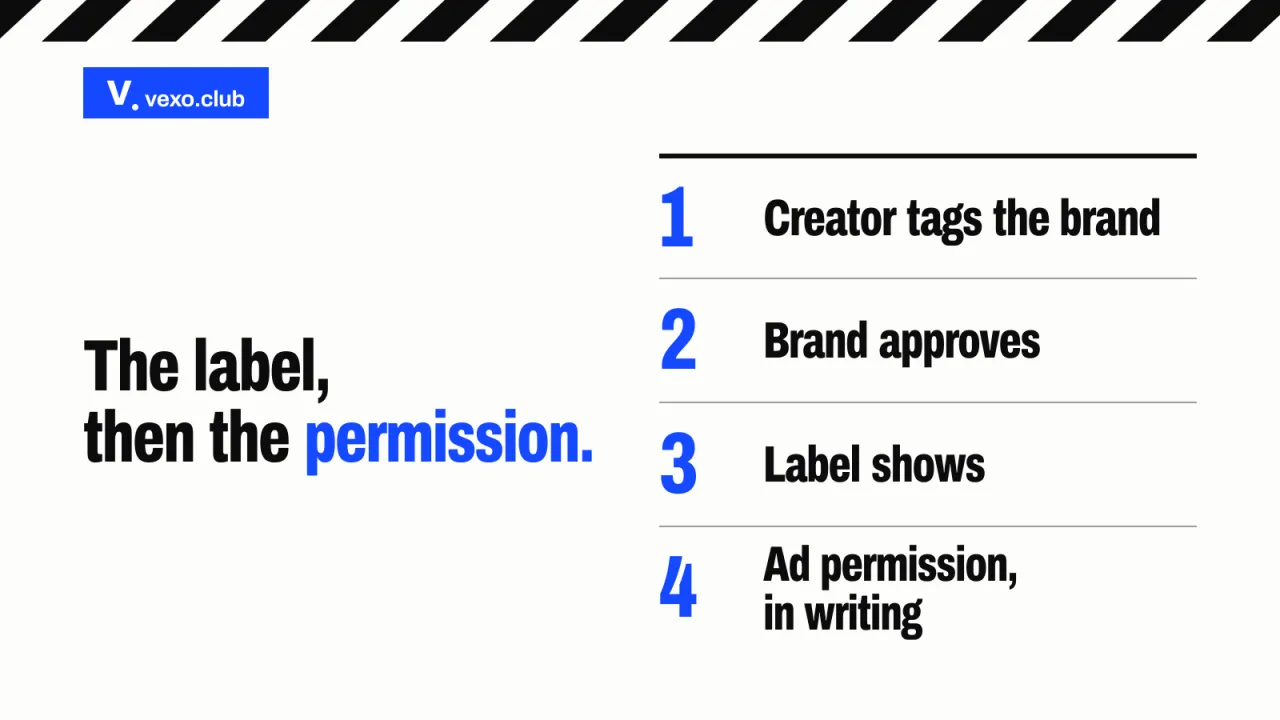
- Draft Before publishing, the creator taps Tag people, then Invite collaborator
- Invite The brand’s account receives the collaboration invite as a message
- Accept The brand opens the invite, taps Review, then Accept
- Shared The brand’s username joins the post, which shows on its profile and is shared with its followers
A Collab is not a tag. The page says a tagged or mentioned photo “won’t be shared with your followers”, while a collaborative post is, and an accepted collaborator is listed as an author. Stories cannot have collaborators.
Is a Collab post a disclosure?
No. A Collab post puts a second account on a post, and Meta’s page on it describes sharing and authorship, not disclosure. Meta’s Branded Content Policies define branded content as content “influenced by a business partner for an exchange of value, such as monetary payment or free gifts”, and say it “may only be posted with the use of the branded content tool”. That covers a post paid in product as much as a fee.
That tool is the paid partnership label. Meta’s page on the label says its policies “require that you use the paid partnership label to tag the brand you are working with”. A paid Collab therefore carries two switches: the Collab shares the post, the label discloses it. The pages read for this guide do not say whether one post can carry both, so the creator confirms it on the draft.
In India the disclosure is also read against ASCI’s influencer guidelines, read on 18 October 2026. Paragraph 1.2 says a disclosure “must be upfront and prominent so that it is not missed by an average consumer”, and 1.2d adds that a platform’s disclosure tool “should be considered in addition to an influencer’s own disclosure”. Paragraph 1.3a lists the permitted labels, among them “Collaboration” and the “Paid Partnership” tag on Instagram; 1.3b says the disclosure should be in English or in the language of the advertisement. The guidelines do not mention Collab posts, so that a second username is not a disclosure is the desk’s reading of Meta’s rule and paragraph 1.2d.
Missing labels are common, and under paragraph 1.5 the duty sits with advertiser and influencer both. ASCI’s half-yearly report for April to September 2025 says a second study of Forbes India’s Top 100 Digital Stars 2024 found “an increase in the number of influencers failing to disclose paid collaborations - 76% vs. 69% the previous year”. The desk’s guides to the paid partnership label, and how brands run sponsored posts and what ASCI asks of a brand cover where the label goes and for how long.
What a Collab post does, and what it does not

When should a brand ask for a Collab?
When the brand wants the same post on its own profile and shared with its own followers: a launch, a festive announcement, a creator the brand would repost anyway. A Collab shows the creator’s original, caption and all, on both profiles instead of a copy, and how search works on Instagram covers which fields Instagram matches. Reuse on the brand’s site or in store is a separate line in the contract, and usage rights takes it apart.
A Collab gives no disclosure, no permission to run the post as an ad and no control of the post: Meta’s page says only the original creator can delete it, and if they do it leaves the collaborator’s profile as well.
What a Collab gives, and what it does not
A Collab gives the brand
- The post on its own profile
- The post shared with its own followers
- Likes and comments, visible to it
- The right to leave at any time
A Collab does not give
- A disclosure
- Permission to run the post as an ad
- Control of the post; only the original creator can delete it
- Any reach figure; the page gives none
Six questions settle whether to ask, and what to write when the brand does.
Six questions before you ask a creator for a Collab
- Does the brand want this post on its own profile, shared with its own followers?
- Can the brand’s account accept the invite, and is one person named to watch for it?
- If the creator’s account is private, does the brand’s account follow it?
- Is the post paid or gifted, so that the label goes on the draft as well?
- Is a minimum time for the post to stay up written into the contract?
- Is any ad permission a separate line, with the posts and the window named?
When is a partnership ad the better route?
When the brand wants the post to reach people beyond what the two accounts already have. A partnership ad is an ad that runs with the creator’s handle in its header: a post of the creator’s that the brand boosts, or content made for the ad. Instagram’s page for creators, dated 20 February 2025, says organic branded content is “distributed just like any other post”, and of an ad: “With a partnership ad, the brand pays to show it to even more people”.
Meta’s page on partnership ad permissions says: “To run partnership ads, advertisers need permission from the partner whose handle the ad will include. Creators and other partners can revoke these permissions at any time.” Permission is given for one post, through the “Allow brand partner to boost” toggle or a code the creator shares, or for the account, covering posts that tag the brand with “the paid partnership label, an @mention, a people tag, a product tag, or a Collab”. A Collab post can become an ad, then, but the Collab itself grants no permission.
Withdrawal works differently by route, and the contract needs both halves. Switching off an ad code stops new ads, but “Any active ads using the code will continue running”, according to Meta’s page on the ad code. Removing account-level permission means “Any ads that are currently running will be paused”, according to its page on stopping partnership ads. The window should name the date the last ad stops. The desk’s guide to whitelisting, explained takes the usage term line by line, and Meta’s creator marketplace covers how brands find creators on Instagram.
What a Collab does to reach, Instagram describes only in words. Its Reels tips page, dated 20 June 2024, says inviting collaborators to a Reel “expands how many people see your post”. Neither the Collab page nor the Reels page gives a reach figure, and neither does this guide.
How far each route can reach beyond the creator’s followers
Reach as any post gets Reach the brand pays for
- Paid partnership label alone Distributed like any other post, Instagram says At Reach as any post gets
- Collab post Also shared with the brand’s followers Leans Reach as any post gets
- Partnership ad The brand pays to show it to more people At Reach the brand pays for
Can a collaborator be added after posting?
Meta’s Help Centre page, read on 18 October 2026, does not say so: its invite steps begin “Before you publish your post, tap Tag people”, and its steps for a live post cover removal only.
Third-party guides split. Sked Social’s guide to collaboration posts, says the original creator can add a collaborator to a live post by opening it and choosing Edit, then Tag people, which Meta’s page does not document. Kontentino’s Q&A of 13 July 2026, asked whether a tagged post can later become a Collab, answers “Typically no, the collaboration needs to be set up at the time of publishing”. Neither is Meta, and menus change, so the brief asks for the invite before the post goes live.
Collab requests from a brand
Do
Put the invite in the brief, before the post is made
Don’t
Ask the creator to add the brand once the post is live
Meta’s page documents the invite before publishing, not after
Do
Name one person to accept the invite for the brand
Don’t
Leave the invite unanswered in a shared inbox
The post is shared with the brand’s followers only if the invite is accepted
Do
Ask for the paid partnership label as well on a paid or gifted post
Don’t
Treat the Collab as the disclosure
Do
Ask for the right to run the post as an ad as its own line
Don’t
Assume a Collab includes ad permission
Do
Write how long the post stays up
Don’t
Assume the brand keeps a post the creator deletes
Only the original creator can delete the post, and it leaves the collaborator’s profile too
What does a Collab do to reporting?
It puts one post under two accounts, so a figure read from either describes the same post. Meta’s Collab page is silent on views and reach for an accepting account. Meta’s developer blog of 22 April 2026 says new API endpoints “allow developers to access media where a user is an accepted collaborator on Instagram”, and that “All media fields are available on collaborative media”, total views among the engagement fields. That is for developers and reporting tools, so the brief also asks the creator for the post’s own insights.
For a post with the label, the brand partner has access to its insights, and Meta’s page on branded content insights lists estimated reach, estimated impressions and engagement, paid and organic combined. For an ad, Instagram’s creators page says “performance metrics are limited to the brand’s account”. The desk’s weekly report names the account each figure came from, and anything unverified is marked and never totalled.
Collab, paid partnership label or partnership ad: which does a brief need?
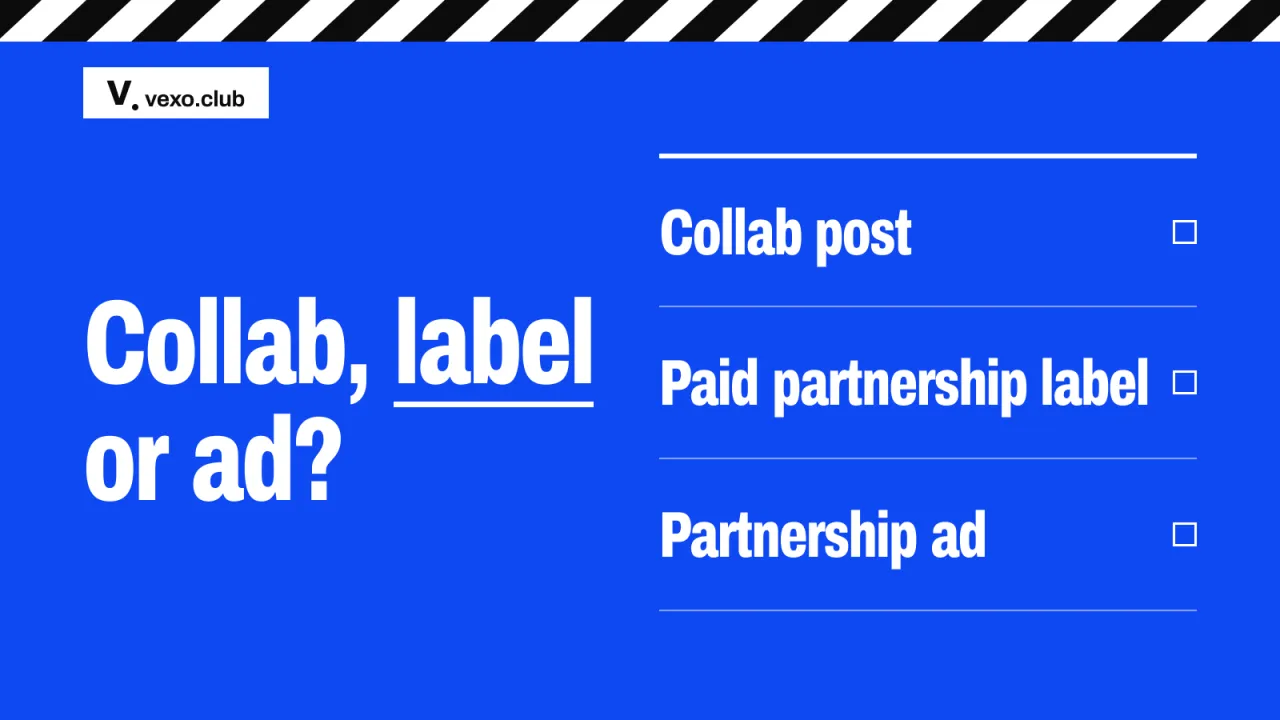
Usually more than one, because they do different jobs: the Collab shares the post, the label discloses it and the ad buys more reach for it.
Collab post, paid partnership label and partnership ad
| Collab post | Paid partnership label | Partnership ad | |
|---|---|---|---|
| What it is for | One post on two profiles | Telling viewers a post is paid or gifted | Paying to show a post with the creator’s handle on it to more people |
| How it starts | The creator invites; the brand accepts | The creator adds the label; the brand approves the tag | The creator gives permission; the brand sets up the ad |
| Meta’s disclosure tool for paid content | No | Yes | Runs as an ad; listed in Meta’s Ad Library |
| Ad spend behind it | No | No | Yes |
| Needs the creator’s separate permission, which can be revoked | No | No | Yes |
| Where the content appears | Both profiles, to both sets of followers | The creator’s profile, with the brand named in the label | In ad placements, with the partner’s handle in the header |
| Best for | A post the brand also wants on its own profile | Every post made for payment or free product | Reach beyond what the two accounts already have |
The grid below is the desk’s reading, not Meta’s; the creator’s answer and the contract decide.
Which route for which brief
| Start with | Add when | |
|---|---|---|
| A launch | A Collab and the label | The date cannot move and reach has to be bought: a partnership ad |
| Always-on posts | The label on each paid post | A post suits the brand’s own profile: a Collab |
| A giveaway | A Collab and the label | The brand wants the post run as an ad: a partnership ad, with the creator’s permission |
| A regional-language brief | The label, plus the creator’s own “Ad” in English or the post’s language | The brand’s followers read that language: a Collab |
| Creator-made content the brand will reuse | The label, usage rights and any ad permission in writing | The brand also wants it on its profile: a Collab |
If a brief keeps one line from this guide, it is this one: a paid Collab post still needs the paid partnership label. Meta’s policy asks for it, and ASCI treats the platform’s tool as an addition to the creator’s own disclosure, not a substitute for it.
The three switches on an Instagram brief

What should the brief and the contract say?
Five lines: one for each of the three switches, then the window and the reading, so nobody assumes one covers another:
- The Collab. Who posts first, who sends the invite, by what date, and who accepts it for the brand.
- The label. The paid partnership label on the draft with the brand tagged, and a plain word such as “Ad” in the content, in English or in the post’s language.
- The ad permission. Whether the brand may run the post as an ad, which posts, by toggle, code or account-level permission, and the fee as its own line.
- The window. When the permission ends, when the last ad stops, and how long the post stays up.
- The reading. Whose insights are shared, and which account each reported figure came from.
These are contract terms, not app settings. Permission can be withdrawn and a Collab ended by either side, so the contract says what each party owes then; the influencer contract clauses give the wording.
Five lines an Instagram Collab brief carries

How a brief runs on Instagram, and how usage and whitelisting are agreed, is on the Instagram brief page. An Instagram brief that needs the Collab, the label and the ad permission written down can be sent to the desk, or opened on WhatsApp from that page.
Questions brands ask
What is a Collab post on Instagram? A Collab post is one post that two accounts author together. The creator invites another account, and if it accepts, the post shows on both profiles and is shared with both accounts’ followers, according to Instagram’s Help Centre. A tag does not do that.
Does a Collab post need the paid partnership label? Yes, when the post is paid or gifted. Meta’s Branded Content Policies require the branded content tool for content made for an exchange of value, and ASCI treats the platform’s tool as an addition to the creator’s own disclosure. A Collab alone is neither.
Can a brand add itself as a collaborator? No. The creator invites the brand’s account, and the brand accepts from its messages. A brand that makes the post itself invites the creator instead, and then the brand is the original creator, the only account that can delete the post.
Can you add a collaborator after posting? Not according to Instagram’s own Help Centre. Its page, read on 18 October 2026, documents the invite as a step before publishing and documents only removal afterwards. Two third-party guides differ: one says Edit then Tag people works on a live post, another says a tagged post typically cannot become a Collab later. Ask for the invite before the post goes live.
Is a Collab post better than a partnership ad? They do different jobs. A Collab is organic: it shares the creator’s post with the brand’s followers. A partnership ad runs with the creator’s handle in its header, as a post the brand boosts or content made for the ad, and it needs the creator’s permission. Many briefs use the label and a Collab, and add an ad where reach has to be bought.
Does the desk arrange Collab posts and partnership ads? Yes. The desk runs whitelisting and paid amplification. Each deliverable in the brief states whether it is a Collab, carries the label or runs as an ad, and the ad permission and its window are written into the contract.
Sources
- Help Centre page on collaborative posts (opens in a new tab) help.instagram.com
- Branded Content Policies (opens in a new tab) help.instagram.com
- page on the label (opens in a new tab) help.instagram.com
- influencer guidelines (opens in a new tab) ascionline.in
- half-yearly report for April to September 2025 (opens in a new tab) ascionline.in
- creators.instagram.com/blog/introducing-partnership-ads (opens in a new tab)
- page on partnership ad permissions (opens in a new tab) facebook.com
- page on the ad code (opens in a new tab) help.instagram.com
- page on stopping partnership ads (opens in a new tab) help.instagram.com
- Reels tips page (opens in a new tab) about.instagram.com
- guide to collaboration posts (opens in a new tab) skedsocial.com
- Q&A of 13 July 2026 (opens in a new tab) kontentino.com
- developer blog of 22 April 2026 (opens in a new tab) developers.facebook.com
- page on branded content insights (opens in a new tab) facebook.com
Cite this page
Instagram Collab posts for brands: when to use a Collab, when the paid partnership label is still required, and when a partnership ad is the better route. vexo.club, published 20 Oct 2026, updated 28 Oct 2026. https://vexo.club/blog/instagram-collab-post-for-brands
Influencer marketing across India
Send the desk a brief: it comes back as a shortlist and a directional band, never a public price.
Brief the desk