Instagram sponsored posts and the paid partnership label: how brands run them in India
A sponsored post on Instagram is a creator’s post a brand has paid for, and it carries the paid partnership label. How the label is added, what a partnership ad is, and what ASCI asks a brand to check.
Playbooks9 min readThe operators’ desk
In this article9 sections
A sponsored post on Instagram is a creator’s post that a brand has paid for, in money or in product, and it carries Instagram’s paid partnership label. A brand that wants the same post to run as an ad needs the creator’s permission for that as well, and in India it also checks the label against ASCI’s influencer guidelines.
This guide comes from vexo.club — an influencer marketing agency run from one desk in Delhi NCR. Everything below about Instagram’s tools is taken from Meta’s own pages, which are linked, and everything about disclosure is taken from ASCI’s guidelines, which are linked too. Meta changes its tools often, so the page you open today is the one that counts, and where this guide cannot confirm a detail it says so.
Sponsored posts on Instagram, in short
In short
- “Sponsored post” covers three different things: a creator’s organic post with the paid partnership label, a partnership ad run from the creator’s handle, and a brand’s own ad.
- Meta’s branded content policies require the paid partnership label on content made for payment or free gifts, with the brand’s approval of the tag.
- Running a creator’s post as an ad needs the creator’s permission, given for the account or for a post, and the creator can take it back.
- In India the label is one of the disclosures ASCI permits, but ASCI also wants it upfront and says the platform’s tool is used in addition to the creator’s own disclosure.
What is a sponsored post on Instagram?
The phrase is used for three things, and a brief that mixes them goes wrong in the contract. The first is organic branded content: the creator posts on their own feed, the brand has paid or gifted something, and the post carries the paid partnership label. The second is a partnership ad, which is that post or another of the creator’s boosted by the brand and shown to a wider audience. The third is a brand’s own ad, which has nothing to do with a creator’s handle. Meta says partnership ads were formerly called branded content ads, in its February 2024 announcement.
Three things called a sponsored post
| Organic branded content | Partnership ad | A brand’s own ad | |
|---|---|---|---|
| Whose handle it runs from | The creator’s, on their feed | The creator’s handle, with the brand in the header | The brand’s |
| Paid partnership label | Yes | Yes | No |
| Needs the creator’s permission | The brand approves the tag | The creator grants it, and can revoke it | Not applicable |
| Who pays Meta for delivery | Nobody | The brand | The brand |
| What the contract must name | Deliverables and the label | Whitelisting: the posts, the window, the fee | Not applicable |
| Best for | A creator’s own audience, in their voice | Reaching beyond that audience with the creator’s face | A message the brand wants in its own voice |
What is the paid partnership label, and who has to use it?
Meta’s Branded Content Policies define branded content as content that features or is influenced by a business partner for an exchange of value, such as monetary payment or free gifts. They say it must be posted with the branded content tool, and that the creator tags the brand with its prior permission. The label is the tool’s output: Meta’s page on the paid partnership tool says it can be used on Feed, Stories, broadcast channels, Live, Reels and Instagram videos.
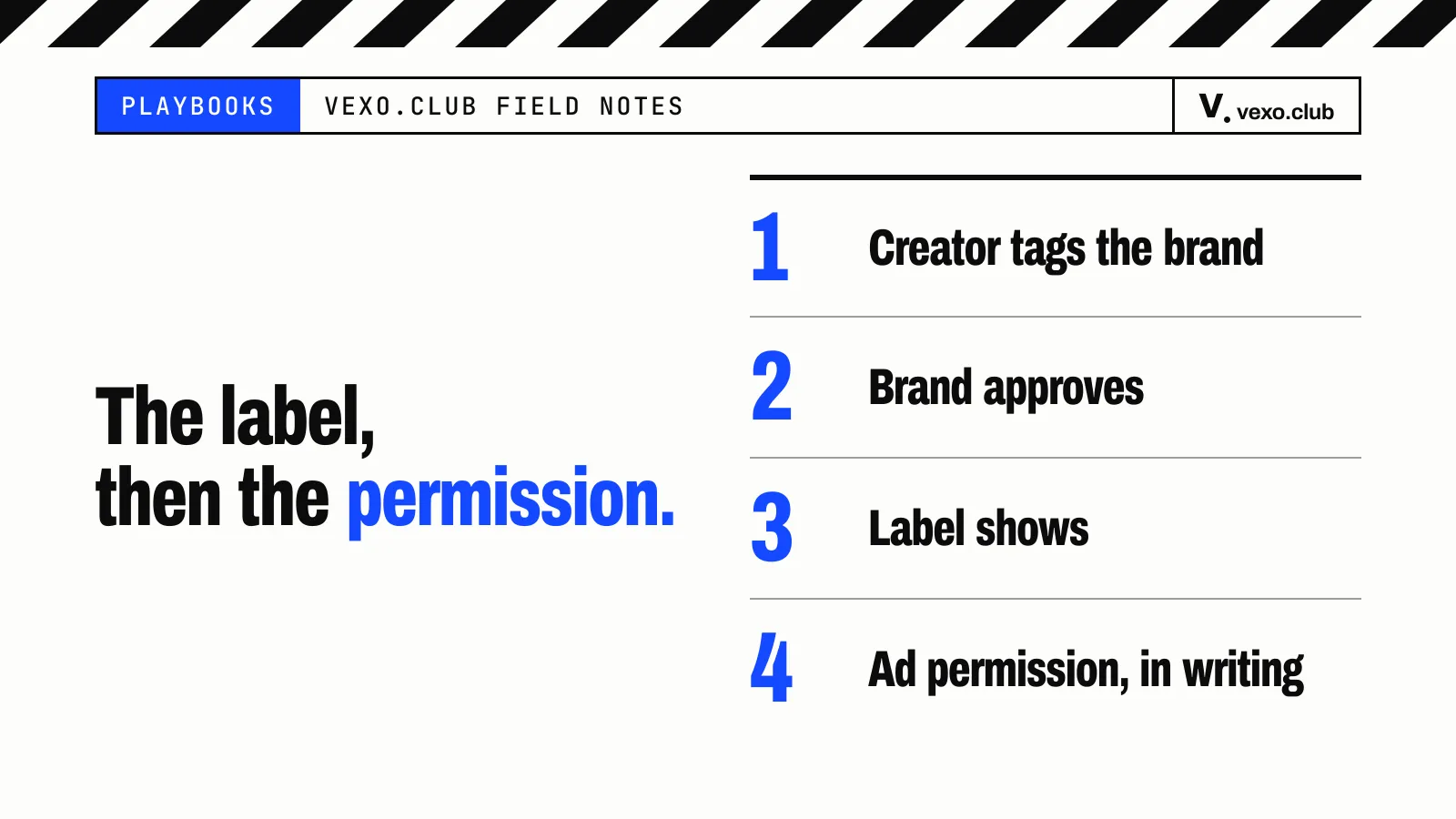
Two details matter to a brand. First, Meta’s page says that if a brand has not approved the creator yet, the post carries the label without the brand’s name, and that if the brand denies the request the label is removed. A removed label does not make the post any less an ad, and the creator still labels it in plain words. Second, a brand can set up approvals in advance: Meta’s page for businesses describes a “Manually approve content creators” setting and a list of approved creators.
How the paid partnership label is applied
- Enable The creator turns on branded content tools on a professional account
- Tag On the post, the creator adds the paid partnership label and names the brand
- Brand approves A request goes to the brand, or the creator is already on its approved list
- Label shows The brand’s name appears once approved; if denied, the label is removed
Which accounts can use the branded content tools?
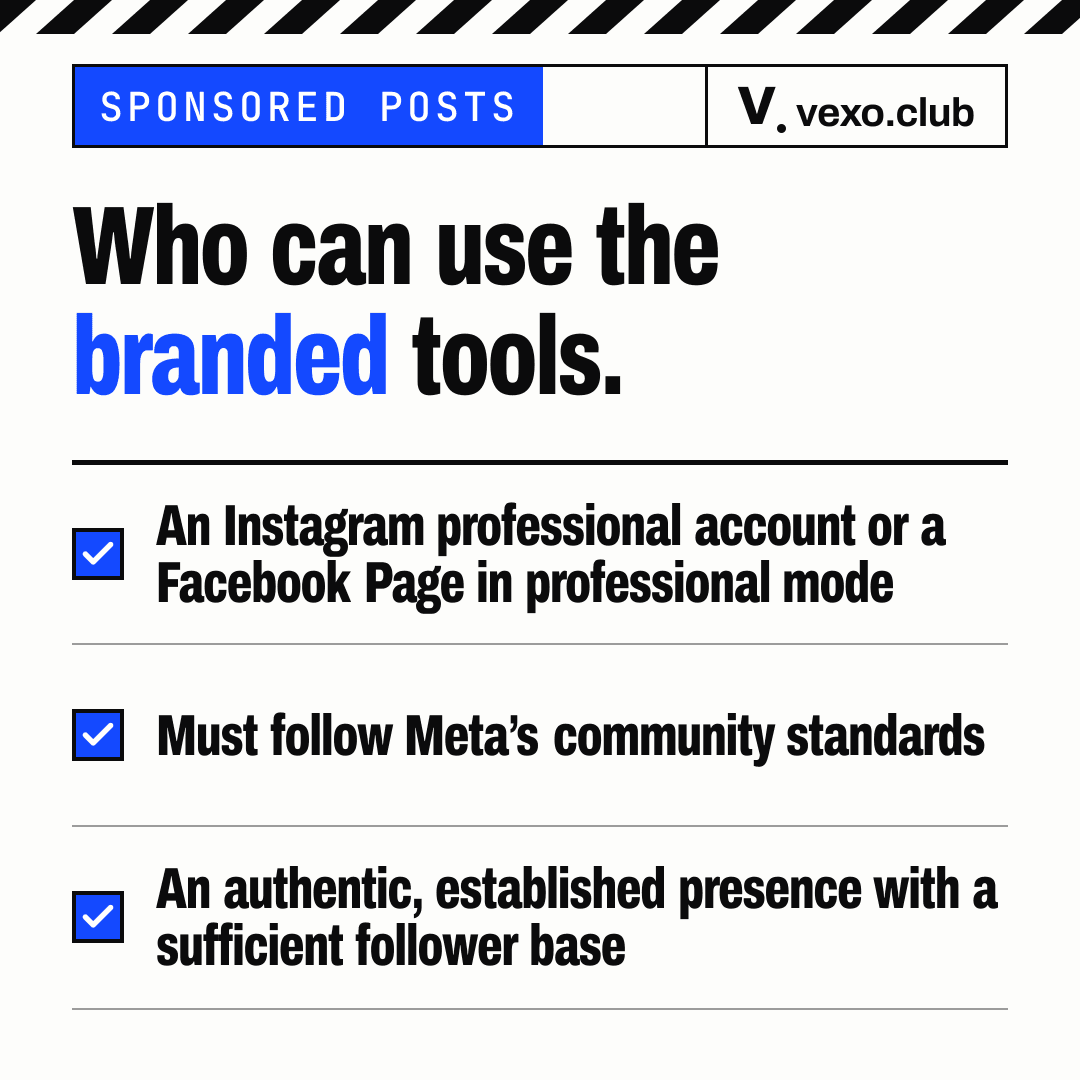
Not every account can. Meta’s eligibility page says an account must be an Instagram professional account or a Facebook Page in professional mode, must follow Meta’s community standards, and must have an authentic, established presence with a sufficient follower base. Meta also says it can suspend or change the features at any time. A brand therefore asks the creator whether the tools are switched on before the shoot, not on the day.
Which accounts can use the branded content tools
What is a partnership ad, and how does the creator give permission?
A partnership ad runs from the creator’s handle with the brand’s budget behind it. Meta’s developer documentation says the ad features the brand and the partner account in its header. It needs permission from the creator, and Meta’s page on partnership ad permissions says there are two kinds and that the creator can revoke them at any time. In contract terms this is whitelisting, which the desk’s guide to creator whitelisting takes from the brand’s side.
How a creator can give a brand permission to run a partnership ad
| What the brand can then run | How it is given | |
|---|---|---|
| Account-level permission | Ads from the partner’s handle with or without existing content, and from posts that tag the brand | Requested by the brand in Meta’s tools; the creator accepts |
| The boost toggle on one post | The one post, while the brand is tagged in the paid partnership label | The creator turns on “Allow brand partner to boost” |
| A partnership ad code | Any post, story or reel the code is shared for, archived Instagram content included | The creator generates the code and shares it; one code can serve up to two partners |
Two cautions come from Meta’s pages. The ad code page says partnership ads are listed in Meta’s Ad Library, so they are public. And because permission can be revoked, the contract names the window, the posts and what the brand may add, as usage rights and the influencer contract clauses set out. A partnership ad that runs past the agreed window is a breach of the contract, not only a setting left on.
Does the paid partnership label meet ASCI’s disclosure rules in India?
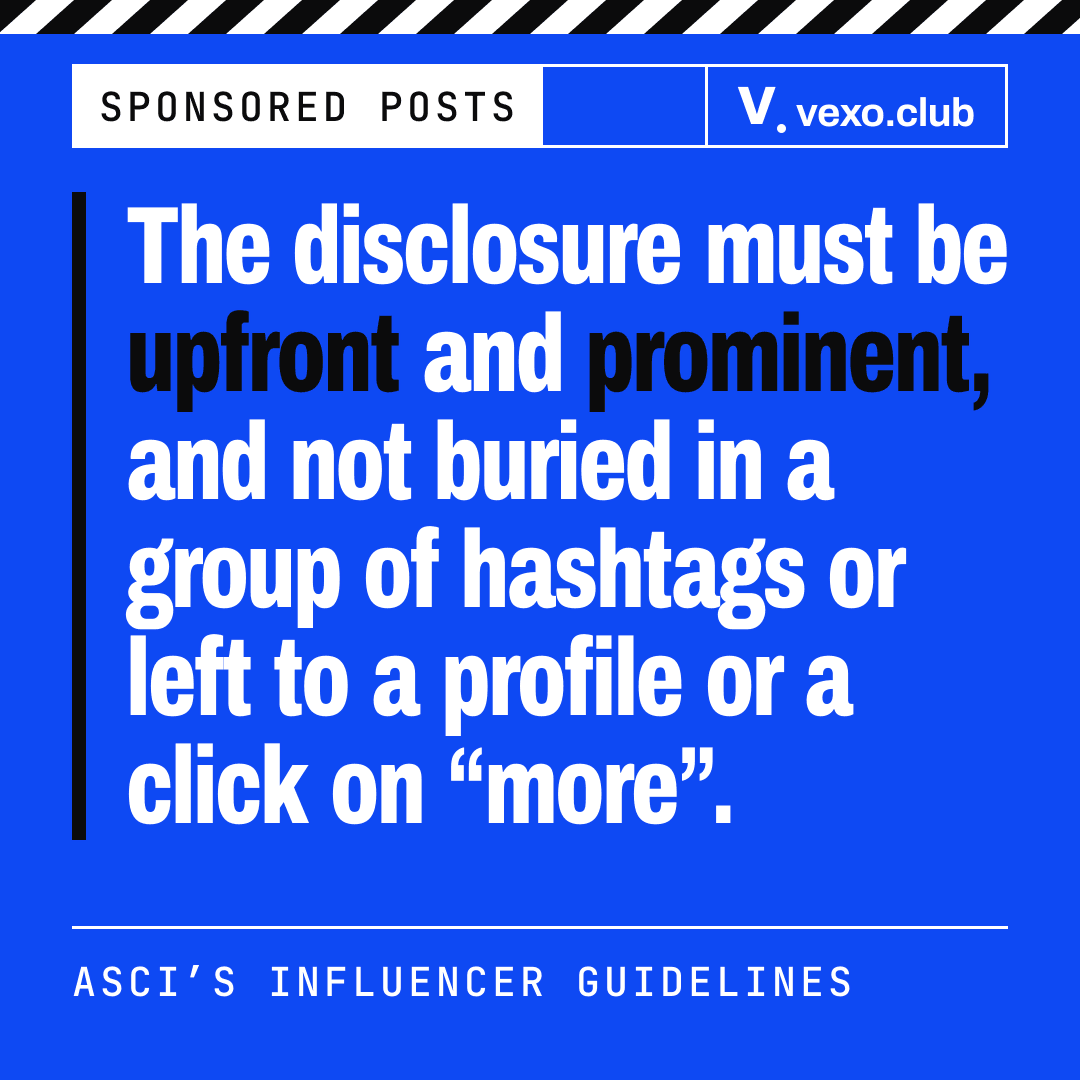
Partly. ASCI’s influencer guidelines list the labels that may be used, and the “Paid Partnership” tag on Instagram is on the list, beside “Ad”, “Sponsored”, “Collaboration”, “Partnership” and “Free gift”. But the same guidelines say the disclosure must be upfront and prominent, and not buried in a group of hashtags or left to a profile or a click on “more”. They add that using a platform’s disclosure tool should be considered in addition to the influencer’s own disclosure. A brand should therefore not treat the tag as the whole disclosure.
ASCI on where the label goes
The guidelines also set how long the label stays on screen, by length of video, and what to do on a story and on a live stream. The responsibility is shared: the advertiser makes sure the post is in line with the ASCI Code, and the influencer makes the disclosure. The desk’s ASCI disclosure for brands turns that into who labels what and who checks.
How long the label stays, and where, by format
- Video of 15 seconds or less The label stays for at least 3 seconds
- Over 15 seconds, under 2 minutes The label stays for one third of the video
- 2 minutes or longer The label stays for the whole section where the brand is mentioned
- A story or a post with no caption The label is superimposed on the picture or video
- A live stream Announced at the beginning and at the end, and added to the caption if the post stays up
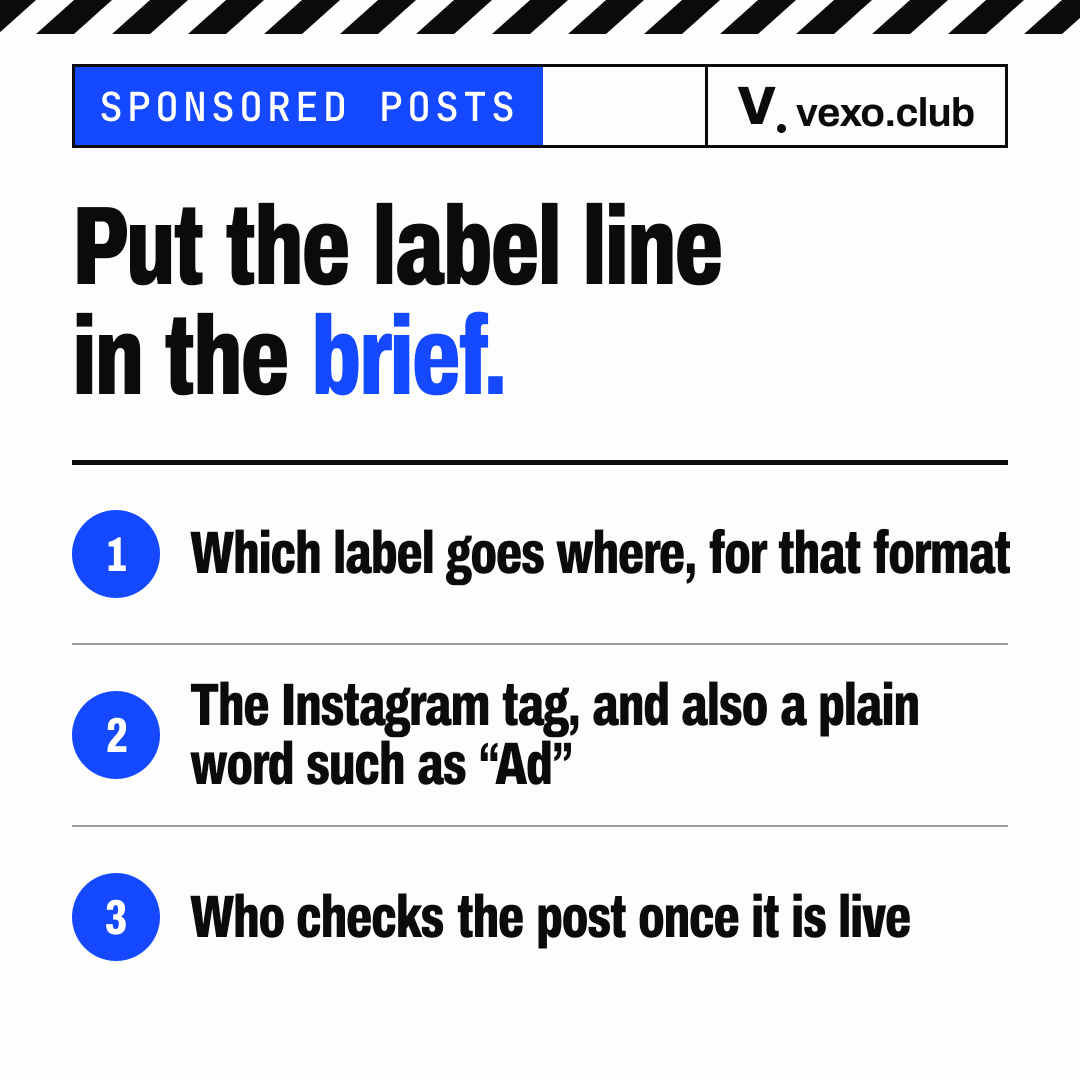
In practice the brief carries a line on the label, and the draft is checked against it. The line says which label goes where for that format, that the Instagram tag is used and also a plain word such as “Ad” in the content, and who checks the post once it is live. A creator who is told this at the brief rarely has to redo a post, and a brand that finds out at the approval round has already lost the day. The line costs nothing to write.
What the label line in the brief says
How often do creators get the disclosure wrong?
Often enough that ASCI measures it. Its Annual Complaints Report 2024-25 says that in a study of 100 influencer posts, run between September and November 2024, only 29 had proper disclosures and 69 violated the disclosure norms; of those 69, most had no label at all and the rest had a label placed among the hashtags. The same report says ASCI processed 1,015 influencer ads for violations in that year, and that 98% of them required modification. A label that a viewer cannot find has not been applied, and the brand’s name is on the ad.
Which categories can a brand not promote as sponsored content?
Meta’s Branded Content Policies list categories that cannot be promoted as branded content, categories that are restricted by age or location, and categories that need Meta’s authorisation first. The list is long and Meta edits it, so the page is the source. A few examples from it are enough to show the shape, and a brief in any of the restricted areas is settled with the page open and, in India, with counsel for the category.
Meta’s branded content policies, in two lists
Cannot be promoted as branded content
- Tobacco and vaporizers
- Drugs and drug-related products
- Weapons and ammunition
- Multi-level marketing
- Payday loans
Restricted, or needing Meta’s authorisation
- Alcohol, with age and location limits
- Financial and insurance products, with limits
- Cosmetic procedures and weight loss, with limits
- Real-money gambling and dating services, only with authorisation
What should a brand check before a sponsored post goes live?
Seven checks cover the label, the permission and the audience. They sit in the approval round with the same weight as the product claim, and the audience method is in how to check an influencer’s audience before you pay.
Before a sponsored post goes live
- The creator has branded content tools switched on, on a professional account
- The brand’s handle is named, and its approval of the tag is settled
- The label is where a viewer meets it first, in the content, and in plain words as well as the tag
- The claim in the post is one the brand can substantiate
- Any partnership ad permission is written: the posts, the window, the fee
- The audience was read from the creator’s own exports before a rate
- The live post is checked again, and the window’s end date is in someone’s diary
The desk’s Instagram influencer marketing page says how a brief runs on Instagram, and the creators it works with are on the roster. A brief that needs a label check, a permission and a window written in one place can be sent to the desk.
Questions brands ask
Is a sponsored post the same as a paid partnership? A paid partnership is the label on a creator’s organic post, which Meta requires for content made for payment or free gifts. A sponsored post is the everyday phrase, and it can also mean a partnership ad or a brand’s own ad. Say which you mean in the brief.
Do I still need an ASCI disclosure if I use the paid partnership label? ASCI lists the tag among the labels it permits, but it asks that the disclosure be upfront and prominent and says the platform’s tool is used in addition to the influencer’s own disclosure. The desk adds a plain-language label in the content as well.
Does a free product need the label? Yes. Meta’s policy names free gifts as an exchange of value, and ASCI counts free products, with or without conditions and including those received unsolicited, as a material connection. A product sent to a creator who then posts about it is advertising.
Can I run a creator’s post as an ad without asking? No. Partnership ads need the creator’s permission, given at account level or for the post, and the creator can revoke it. The contract should name the post, the window and the fee for it.
Who adds the label, the creator or the brand? The creator adds it to their own post, and the brand approves the tag. Responsibility is shared: ASCI puts the disclosure on the influencer and the duty to ensure the post is in line with the Code on the advertiser, so the brand checks the draft before it goes live.
More on how an influencer marketing company works
Send the desk a brief — it comes back as a shortlist and a directional band, never a public price.
Brief the desk