How much advance should a brand pay an influencer, and what does the upfront share actually protect
Half now and half later is a habit, not a rule. An advance protects the creator from your cash flow and does little to protect you. How to size it, what to do when asked for the full amount, checking the payee, getting money back, and why an advance can start a registered creator’s GST bill.
Pricing 19 min read The vexo.club desk
In this article13 sections
Pay an advance that covers what the creator has to spend before you can see any work. Add a small hold for the date if the creator is turning away other bookings. Stop there. A fixed split such as half now and half later is a habit and not a rule. No statute sets it, and no regulator does either. It protects the creator from your cash flow. It does very little to protect you from the creator.
The advance, in short
- Size the advance from what the creator must spend before you can see any work. Add a small hold only when the date is scarce.
- An advance protects the creator. What protects the brand is the part of the fee it has not yet paid.
- No statute or regulator sets a standard split. The half and half rule is a habit that guides repeat without a source.
- Verify the account and the payee before the first transfer. Impersonation is as likely a loss as a missed post.
- For a registered creator, an advance can start the GST liability before the post exists. Ask for a receipt voucher.
This is for a brand manager about to pay a creator who has to decide what to ask for and what to concede. It covers how to size the advance and what to say when a creator wants the full amount. It also covers how to check the payee and what the law says about getting money back. Last comes the GST point on the creator’s side. The back end of the payment is a separate question. The tax mechanics sit in the posts on GST on influencer payments and TDS on influencer payments. Nothing here is legal or tax advice.
What does an advance actually protect?
It protects the creator. Before a shoot, a creator may pay for a location or a travel booking. They may pay for props, an editor or a second camera operator. They also hold your posting window and sometimes say no to other work because of yours. An advance moves that cash outlay onto the brand’s books. It also signals that the brand is real and has the money.
It does not protect the brand. Once the money has left, you hold a promise and nothing else. The only thing that protects a brand is the part of the fee it has not yet paid. Every amount moved forward is bargaining power given up. So the useful question is never what is standard. It is how much of that power you can afford to give up for this creator on this brief.
Practitioners disagree, and the disagreement is honest. A brand-side marketer on a public forum thread says payment after delivery has always been standard where they work. Another poster on a different thread says they pay small advances because creators refuse to post without one, and then some never post. Both can be true. Creator-platform guides in India call half upfront normal. Brand-side guides call pay-after-delivery normal. None that we read cites a survey, so treat each as the preference of the writer.
How do you size the advance?
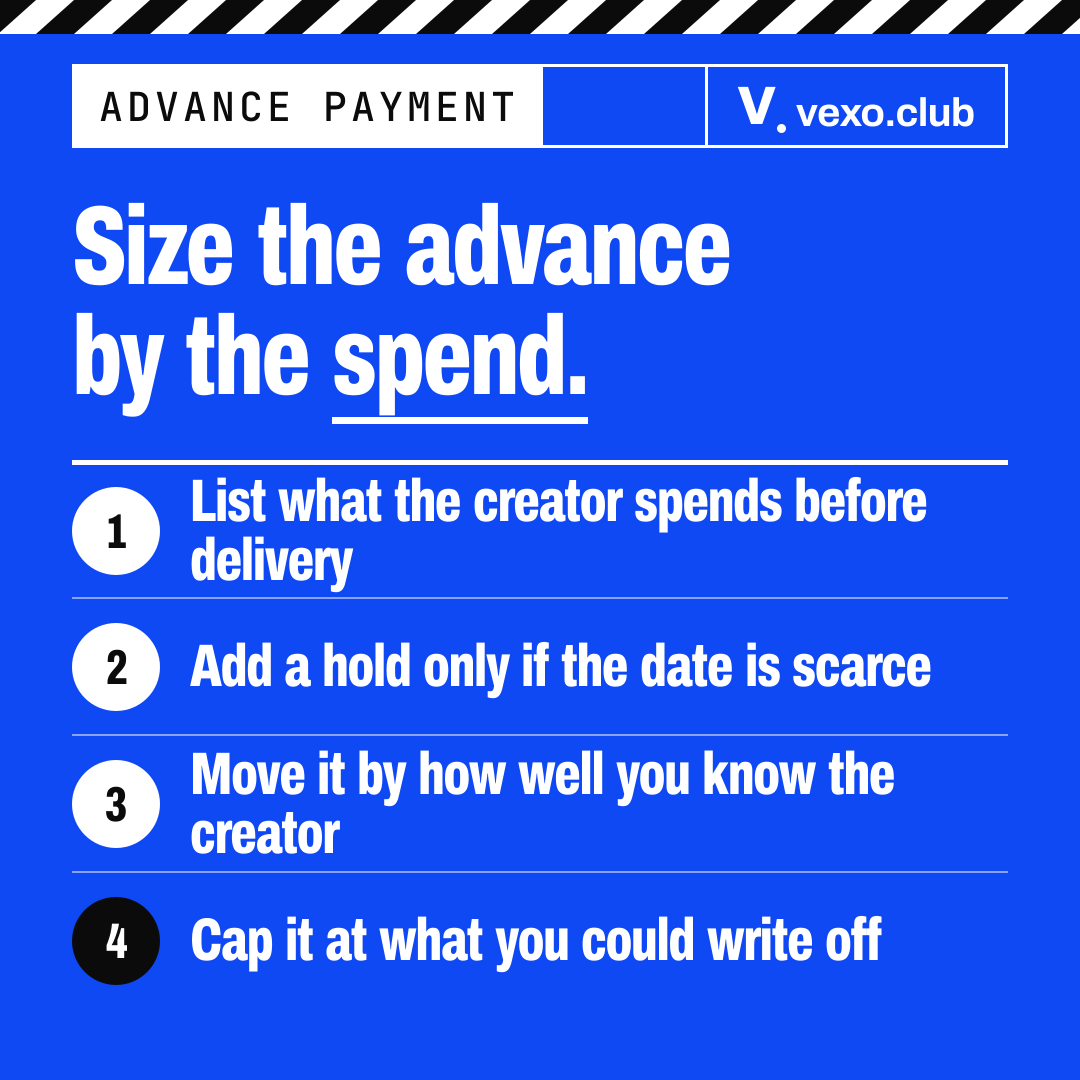
Work through four steps in order.
- Ask what the creator will spend before delivery and make them itemise it. A creator shooting on a phone at home with no editor has almost no cash outlay. A creator who hires a location, an editor and travels has plenty. That outlay is the honest floor for an advance.
- Add a hold only if the date is scarce. If the creator is blocking a festival week and turning down other brands, they carry a real cost. A modest commitment on top of the costs is fair. With no scarce date, add nothing.
- Move up or down for how well you know the creator. Someone who has delivered for you before earns more of the fee early. Someone you found last week earns the costs and no more.
- Cap it at what you could write off. Decide the sum you would shrug at losing, and never let the advance pass it for a creator you cannot verify. If the real costs are higher than the cap, then pay those costs to the vendors directly.
The order matters. Most brands start from a percentage and then argue about trust. Starting from the creator’s real costs turns that argument into a conversation about an invoice, and invoices are easier to agree on. Make the itemised list a normal part of the quote. A creator with real costs hands it over at once. A creator who cannot say what the money is for has told you something too. What a rate card contains shows where those costs sit inside a quote.
Four steps to size an advance
Two briefs on the same fee
Take a food creator filming a recipe Reel in their own kitchen. The brand ships the product. The cash outlay before delivery is close to nothing. The right advance is close to nothing too. A creator who insists on a large one is asking you to fund something other than the work.
Now take a travel creator booked for a hotel stay and a short film. The brand books the room and the flights itself. What the creator still carries is local transport, an editor and perhaps a hired camera. The advance should cover those and nothing more. The fee behind the two briefs could be identical. The advance should differ a great deal. That is the point of sizing it from costs and not from a percentage.
How far should you trust a creator you have never paid?
As far as you can check and no further. The table below is a starting position for the first conversation. Move it when the creator shows you something real. A past brand that will confirm the delivery directly with you counts for more than a screenshot. A manager who answers from a business email counts for more than one who answers only from a messaging app. How to vet small creators and how to check an audience cover the checks that come before any payment talk.
How the advance moves with the creator and the brief
| Advance | Pay direct instead | Balance released on | |
|---|---|---|---|
| New creator found by outreach | Costs only or a small first tranche | Anything the brand can book itself | A live post that matches the approved draft |
| Creator introduced by an agency or manager you know | Costs and a modest hold | Travel and stays | A live post and a short stay-live window |
| Creator who has delivered for you before | A larger share early is reasonable | Only what is simpler to book centrally | A live post |
| Brief with heavy production costs | Costs in full against an itemised list | Location and crew where possible | Final cut approved and live |
| Brief with almost no production costs | None or a token amount | Not applicable | A live post |
What if a creator asks for the full amount before posting?
First, separate two kinds of creator. One has real costs and a real record, and asks for a lot early because they have been paid late before. That is a negotiation and a reasonable one. The other refuses any written term, refuses a posting deadline and insists on all of it first. That second pattern is the one brand-side threads describe when they talk about creators who vanish after payment. Ask three questions and listen to how they are answered.
- What are the costs the money covers.
- Which account will receive it and whose name is on it.
- What happens if the post does not go live by the agreed date.
A creator who answers all three and accepts a refund clause is someone to deal with. Counter in this order. Offer to pay the costs directly to the vendors. Offer a split with a second payment at draft approval, so the creator sees money before the post is live. Or offer a small paid pilot first and put the larger plan behind it. The pilot is the cleanest option for a creator you do not know. It costs you a small deliverable and teaches you how they behave under a deadline.
Why a full advance moves all the risk onto the brand
With everything paid, the creator has no financial reason to hurry. The brand has no lever left except a polite message. On paper, the law helps. Section 65 of the Indian Contract Act, 1872 says a person who has received an advantage under a contract that becomes void must restore it or compensate for it. One of the Act’s own illustrations is a singer paid in advance who is too ill to sing and who must refund the money (Section 65 text).
That is the clean case where performance becomes impossible. A creator who simply chooses not to post has broken the contract, and the claim runs under Section 73 for loss that naturally follows. Section 74 lets a court award reasonable compensation up to a sum the contract names. That last point is why a refund clause should name a sum. Check the current text of the Act and ask a lawyer before relying on any of it.
The practical problem is time and cost. A notice takes effort, and a court takes longer. A transfer you authorised is generally treated by banks as a payment you chose to make, so ask your bank early if something goes wrong. Treat the law as the backstop. Treat the balance you have not yet paid as the real protection.
Why paying nothing upfront backfires too
A brand that pays only after the post is live makes the creator fund the campaign. The better creators decline. The ones who accept may cut corners on production because they carry the cost. When a corporate payment cycle adds weeks after approval, the creator carries it longer still. Creators who work with large brands know this and price it in or walk away.
Many finance teams cannot release money before an invoice exists. That is a real constraint, and it is fine to have it. Say so in the first message and not after the contract. Then offer what you can do: pay the vendors directly, reimburse against receipts or invoice a first milestone on signing. A constraint that is disclosed early reads as a policy. The same constraint discovered late reads as a trap.
Three ways to time the money
| Full advance | Half now and half later | Pay after live | |
|---|---|---|---|
| Who carries the risk of no post | The brand carries all of it | Shared and the brand holds the balance | The brand carries almost none |
| Who carries the risk of no payment | The creator carries none | The creator carries the balance | The creator carries all of it |
| The creator’s cash during production | Covered and more | Costs are covered | The creator funds the shoot |
| Pressure on the creator to finish | Low once the money is in | Moderate while a balance is owed | High because nothing is paid until live |
| Fits best | A creator you know well on a small deal | A first deal with real production costs | A brand with a proven payment record and a creator with no costs |
What can you offer instead of cash in advance?
There are six moves, and most deals need only one or two.
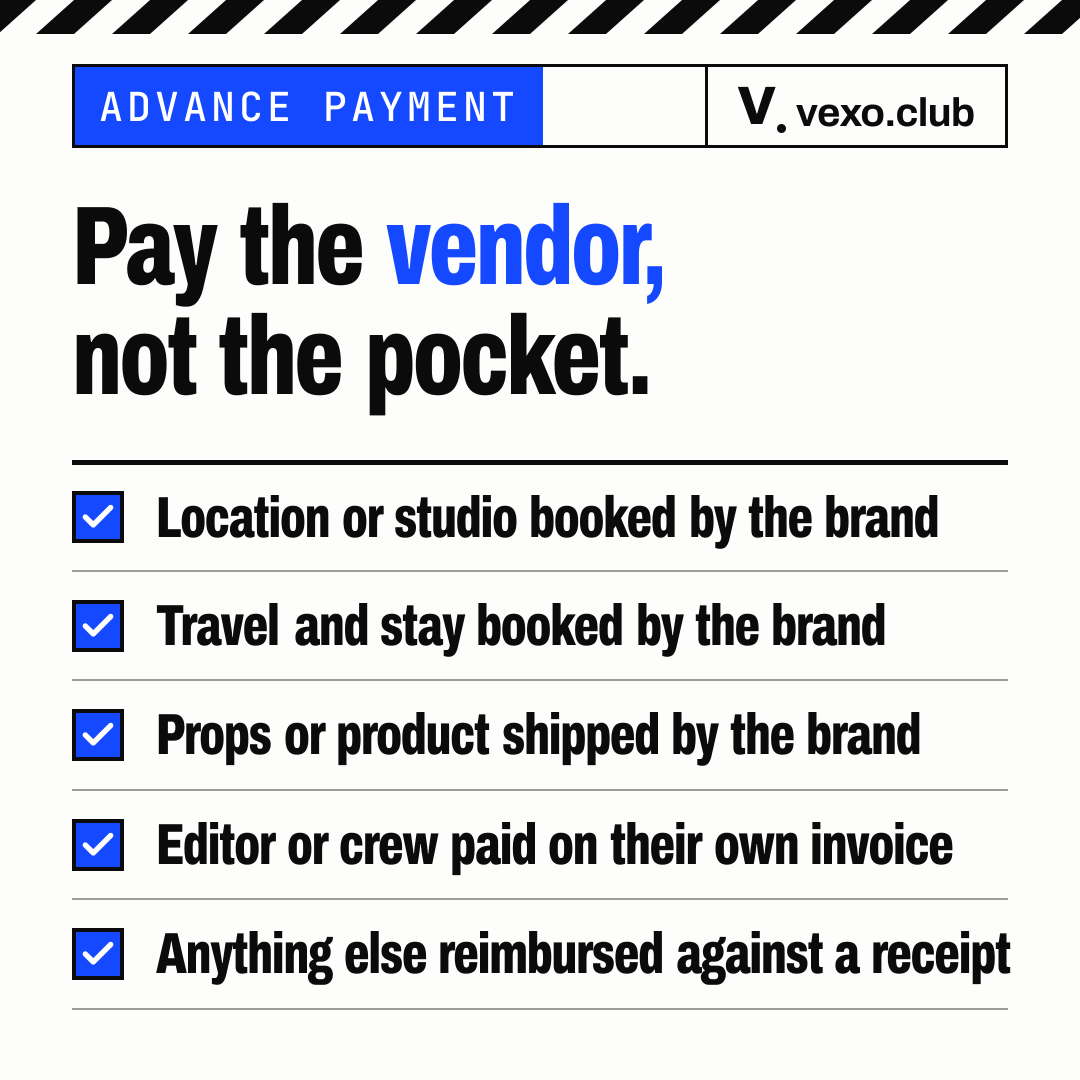
- Pay the vendors directly for the location, the travel and the stay.
- Reimburse costs against receipts after they are incurred.
- Release a first milestone at script or draft approval, so the creator sees money before the post.
- Ship the product early, so the creator is not waiting on you.
- Start with a small paid pilot before a multi-post plan.
- Route the money through an agency that holds it and pays on delivery. Some platforms offer escrow too. We have not verified any provider’s terms, so read theirs.
A product-first start is another route for a small brand. Running a micro influencer seeding program sets that out and nano creators are not cheap explains why small creators still expect to be paid for a post. Whichever route you take, keep it on paper.
Costs a brand can pay directly instead of advancing cash
How do you check the payee before the first transfer?
Treat the advance as a fraud target as well as a dispute risk. A recent forum thread from a brand-side marketer describes a rise in people posing as creators or as managers who do not represent the creators they name. A fake deal is not a missed post. The money goes to someone who never meant to deliver. Run the checks below in order for any creator you reached through a cold message or an unfamiliar intermediary.
Before the first transfer
- Confirm control of the account Ask for a message sent from the account itself or an agreed word placed in a Story or the bio for a day.
- Confirm the person A short video call with a name that matches the profile and the invoice.
- Confirm any manager A written letter of authority from the creator checked through the account’s own messages.
- Get the invoice or receipt first With a PAN on it and a GSTIN if the creator is registered.
- Match the payee The bank account name matches the invoice name. Never pay a third party’s personal account.
- Pay the first part and keep the reference Hold the transfer reference with the contract.
If the deal turns out to be fake, the route is different from a contract dispute. The national cybercrime helpline for online financial fraud is 1930, and the National Cyber Crime Reporting Portal takes complaints. Report quickly because speed is what makes any freezing of a transaction possible. A real creator who is late is a contract matter. Do not file a fraud report for a late post.
Does an advance trigger GST for the creator?
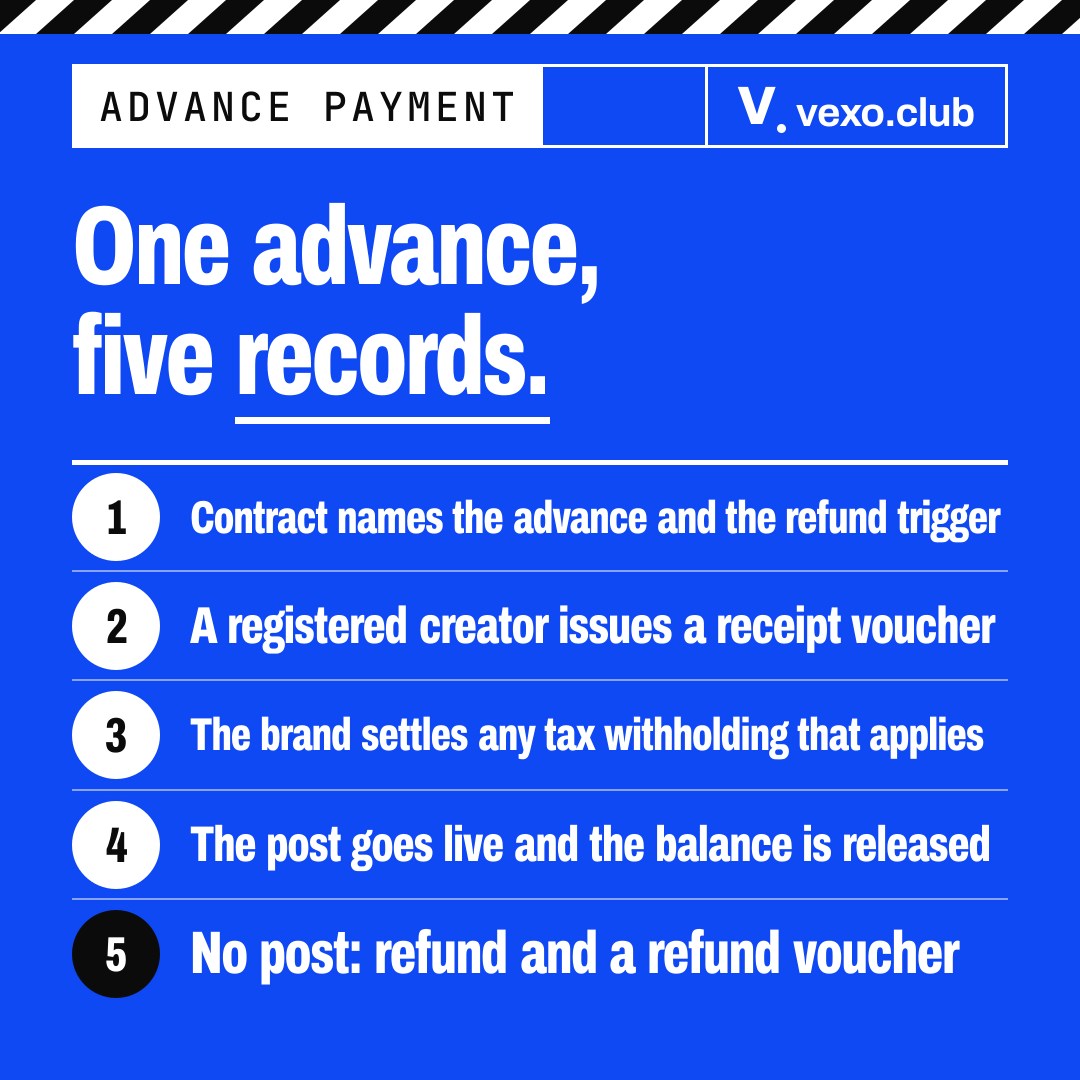
Only if the creator is registered for GST. For a creator who is not registered, there is no tax on the advance. For a registered creator, the timing is the surprise. Under Section 13 of the CGST Act, the time of supply of services is the earliest of the invoice date and the date payment is received where the invoice is issued within the prescribed period. The GST Council’s flyer on advances says the time of supply for an advance is fixed when the advance is received whether or not the supply is made.
The same flyer says a 2017 notification relieved suppliers of goods from paying GST on advances and did not relieve suppliers of services. A creator selling a Reel is selling a service. So a registered creator can owe tax on the advance the day it lands and before the post exists. That flyer is an older publication, and the rules move, so confirm the current position with a GST practitioner. This is also one reason a registered creator may prefer a smaller advance or ask to invoice at signing.
What follows on paper is short. The flyer describes a receipt voucher issued on the advance under Section 31(3)(d) read with Rule 50. If the work is never done, the creator can issue a refund voucher under Section 31(3)(e) and Rule 51. If a tax invoice has already been raised, a credit note under Section 34 is used instead. So when you pay an advance to a registered creator, ask for the receipt voucher or an invoice and keep it. Whether and when the brand can take credit on an advance paid against a receipt voucher is a question for your practitioner, and we have not verified it. The conditions for credit in general are in the GST invoicing post.
Withholding tax is a separate matter. An advance is a payment, so the question of deduction arises when it is paid and not only at the end. The TDS post sets out when deduction falls due. Decide before the advance goes out whether the brand deducts from it and say so in writing, so the creator’s net figure holds no surprise.
The paper trail behind one advance
What should the advance clause say?
Wording to adapt with counsel before use. Replace each bracket with your own terms.
- The Brand will pay an advance of [amount] within [days] of the signed agreement and a valid invoice or receipt voucher from the Creator. The advance is for the production costs listed in Schedule A and for holding the posting window.
- The balance of [amount] is payable within [days] of the approved deliverable going live and remaining visible for [days].
- If the Creator does not deliver by [date], the Creator will refund the advance in full within [days] of written notice. The Brand may also recover reasonable loss up to [sum].
- If the Brand cancels after work has begun, the Creator keeps the advance to the extent of costs incurred and work completed, and refunds the rest.
- Payment is made only to the account in the Creator’s name shown in Schedule B. Any change needs a signed request from the Creator.
The third line names a sum on purpose because of Section 74. The fourth is the kill fee idea in plain form. Influencer contract red flags covers the other payment traps and usage rights covers what the fee does and does not buy once the content is live.
What if the creator takes the advance and does not post?
Move in steps and keep a record at each one.
- Check it is really a miss. The agreed date has passed, and nothing is waiting on you, such as a product or an approval.
- Write once with a clear new date and a short extension. Most delays end here.
- If that passes silently, send a written notice naming the clause and the missed date. Offer a choice of posting by a final date or refunding the advance. Send it by email and by registered post, and not only by a messaging app.
- For sums that justify it, have a lawyer send a notice.
- Use the fraud route only when the deal itself was fake.
The desk’s read is that for a small advance, the legal route often costs more than the money. That is not a statistic. It is the reason to keep the advance small for any creator you cannot verify, and the reason the cap in the sizing steps exists. Prevention is cheaper than recovery here every time.
What to do this week
- Add an itemised pre-delivery cost list to every creator quote request
- Decide the sum you could write off and use it as the cap for unverified creators
- Put the advance and refund clause into your creator agreement template
- List which costs you can pay to vendors directly
- Run the six payee checks before the next first transfer
- Ask your GST practitioner how an advance to a registered creator is documented
- Tell your finance team which deals need money before an invoice
For a wider view of how fees are built, see the cost page and how to hire influencers in India.
Questions brands ask
An influencer is asking for the full amount in advance. What should I do? Ask what the money covers, whose account it goes to and what happens if the post does not go live. Offer to pay costs directly to the vendors, to split the payment around draft approval or to run a small paid pilot first. A creator who refuses every written term and every deadline is the pattern to walk away from.
How much advance should I pay an influencer before a campaign in India? No law or regulator sets a number. Start from what the creator must spend before delivery and add a small hold only if the date is scarce. Then adjust for how well you know them and cap the sum at what you could write off.
Is half upfront and half after posting the standard? It is a common starting point in practitioner guides and a convenient one. It is not a rule, and the guides that call it standard cite no survey. A first deal with real production costs fits it well. A creator with almost no costs does not need it.
Should a brand pay upfront or after the post goes live? It depends on bargaining power and trust. Paying nothing makes the creator fund your campaign. Paying everything leaves you holding a promise. The usual answer is costs first and the balance on a live post that matches the approved draft.
Is GST payable on an advance an influencer receives? Only if the creator is registered. For services, the GST Council’s flyer says tax is payable when the advance is received whether or not the post exists. A registered creator should issue a receipt voucher. Confirm the current rules with a GST practitioner.
Can I get the advance back if the influencer does not post? The law gives you a claim. Section 65 covers a contract that becomes void, and Sections 73 and 74 cover a breach with compensation up to a named sum. In practice, the contract clause and the withheld balance do the real work. Recovery through a notice or a court is slow.
How do I know the person asking for the advance is the real creator? Ask for a message from the account itself or an agreed word in a Story or the bio. Hold a short video call. Match the name on the invoice to the name on the bank account. Ask any manager for a written letter of authority and check it with the creator directly.
vexo.club runs briefs from Delhi NCR. If a payment term is blocking a deal you want, send the brief and the terms, and the desk will read them with you.
Sources
- Indian Contract Act, 1872 (opens in a new tab) indiacode.nic.in
- Section 65 text (opens in a new tab) ibclaw.in
- Section 73 (opens in a new tab) ibclaw.in
- Section 74 (opens in a new tab) ibclaw.in
- National Cyber Crime Reporting Portal (opens in a new tab) cybercrime.gov.in
- Section 13 of the CGST Act (opens in a new tab) taxinformation.cbic.gov.in
- flyer on advances (opens in a new tab) gstcouncil.gov.in
Cite this page
How much advance should a brand pay an influencer, and what does the upfront share actually protect. vexo.club, published 28 Nov 2026. https://vexo.club/blog/advance-payment-to-influencers-how-much-upfront
Send the desk a brief: it comes back as a shortlist and a directional band, never a public price.
Brief the desk