Celebrity ambassador or rotating macro-influencers: how to choose
A long-term celebrity ambassador buys one recognisable face and a fixed commitment; rotating macro-influencers buy breadth, information and an easy exit. How the cost is shaped, what exclusivity covers, the CCPA guidelines on endorsers, and a decision tree by brand maturity and goal.
Pricing 20 min read The vexo.club desk
In this article10 sections
Sign a celebrity ambassador when you need one recognisable face across television, outdoor and retail for a year or two and you can pay for the media that gives that face a stage. Rotate macro-influencers when you still have to learn which voice, language and format moves your buyer, or when your buyers live on Instagram and YouTube rather than in front of a television. Most brands that ask the question end up with a hybrid: one anchor and a rotating bench around it. What follows is how to decide, what each route does to your cost structure and legal exposure, and how to leave either one.
What to take from this article
In short
- A celebrity ambassador buys one recognisable face and continuity across television, outdoor and retail. It only pays off when the brand can also fund the media that gives the face a stage.
- Rotating macro-influencers buy breadth and information. They fit a brand that still has to learn which voice and language moves its buyer, and they can be stopped between rounds.
- The fixed commitment is the real price difference. A celebrity fee is owed whether or not the campaign works. Rotation spreads the bet across many smaller contracts.
- The CCPA guidelines treat both kinds of endorser alike. Penalties and the due-diligence defence sit in section 21 of the Consumer Protection Act, 2019, not in the guidelines themselves.
- Write the exit in before the fee: a suspension right, a change-in-law clause and a sell-off date. A post-term lockout on the star is not something to rely on.
Legal points were checked against primary sources on 24 October 2026 and are linked inline. Read the current text, and take advice. This is not legal advice.
What each route actually buys
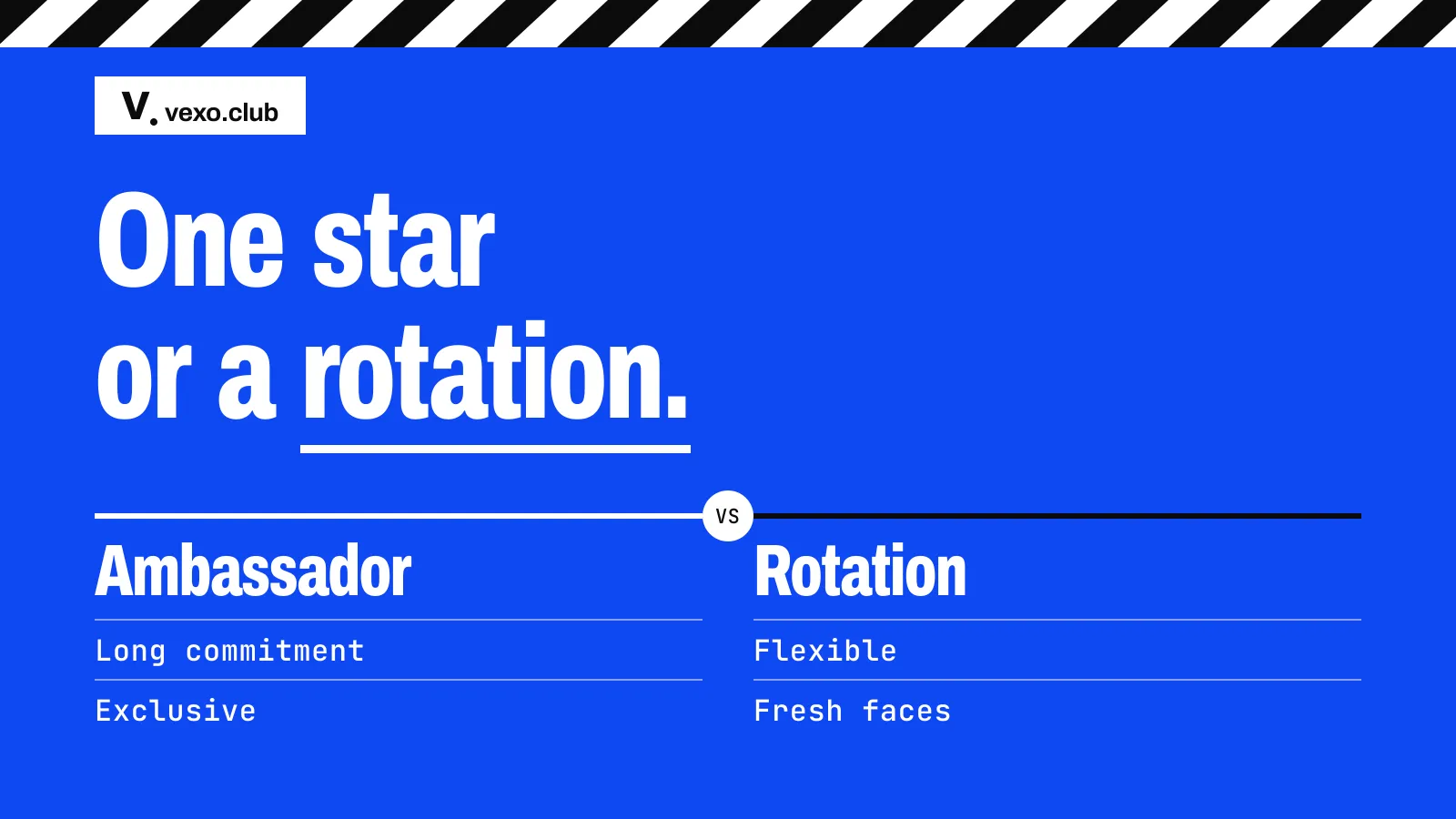
A celebrity ambassador buys salience. The audience already knows the face, so the brand borrows recognition and some credibility on day one, in places a macro creator does not reach: a television break, a hoarding, a shelf. It also buys continuity. The same person says the same thing for a year or two and the audience has something to remember. Rotating macro-influencers buy breadth and information. Each creator speaks to a narrower audience in their own language and format, and each round tells you who responds. The price is consistency. Six creators will explain your product six ways unless the brief holds them to one spine, and coordinating several creators in one campaign is a job of its own. How tiers are drawn is in how vexo.club sorts creators.
A long-term celebrity ambassador against rotating macro-influencers
| Celebrity ambassador | Rotating macros | |
|---|---|---|
| What it buys | Recognition on day one, one face across media | Breadth, niche and language reach, and information on what works |
| Commitment | A fixed fee for a fixed term, owed whether or not it works | One round at a time, stoppable between rounds |
| Shape of the cost | One large contract plus usage, shoot days and the media behind it | Many small contracts, each with its own usage and coordination cost |
| Brand fit risk | A crowded endorsement list dilutes the association | The same lines in many feeds read as a campaign, not a recommendation |
| Exclusivity | Negotiated, priced and the main thing being bought | Short windows by default, so rivals can use the same creators |
| If someone is in the news | Rarer but larger, and the brand is tied to one person | More frequent but smaller, and one post can be paused alone |
| How it ends | Notice, suspension and sell-off clauses decide the cost of leaving | Each contract simply ends, but nothing is learned without a scorecard |
Category matters first. Business Standard reported in September 2025, quoting a vice-president of media at Digitas, that FMCG, banking and insurance and automobiles remain celebrity-driven while e-commerce, direct-to-consumer, gaming and consumer technology are becoming influencer-first. Read that as one agency voice, not a rule.
How the cost is structured and where it surprises people
A celebrity ambassador deal is a fixed fee for a fixed term. Kroll’s note on celebrity endorsements in India describes the traditional structure as a fixed fee over a specified term, usually one or two years, paid across the pre- and post-endorsement cycle, against a one-time appearance for a single campaign. The fee is owed whether the campaign works or not. That is the commitment. On top sit shoot days, appearances and posts, extra fees to extend usage by media, territory or time, the star’s team and travel, GST and TDS, and your agency’s fee if one runs the deal. Equity and royalty structures lower the cash going out but trade it for ownership, so take them to counsel and your investors first.
The cost buyers miss is the media behind the face. Reach still has to be paid for, and a star on a brand that cannot fund the television, outdoor or paid social to carry the campaign is a fee spent on content. Rotating macro-influencers invert the shape: priced per deliverable and per usage right, stoppable between rounds. The money goes into many small contracts, each with its own brief, approval round, invoice and usage negotiation, and paid amplification of a creator’s post is a separate fee again. Usage rights are where budgets quietly break.
The layers of a celebrity ambassador deal
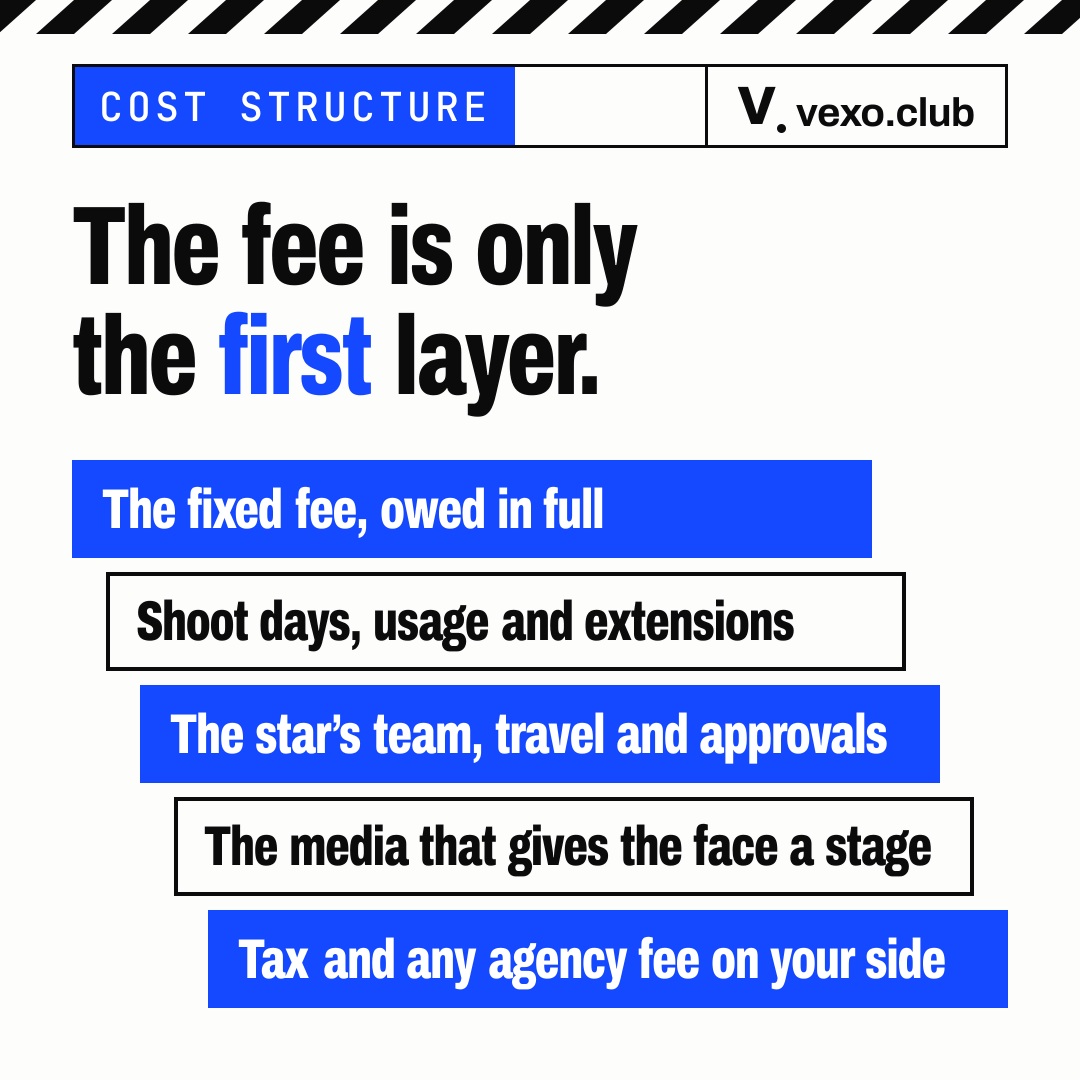
Illustrative, with no figures: an apparel brand is choosing between one film actor for twelve months and four macro creators across four rounds. The actor deal fixes the year on signature, and the first real test of whether the audience cares arrives after the fee is owed. The rotation commits one round at a time, so round two can be cheaper, different or cancelled. Neither is the cheaper route. One is reversible.
Which one sounds believable for your brand
Audiences accept a celebrity as a paid face. What they reject is a face that visibly does not use the thing. Fit has three tests. Does the person plausibly use the category. Does their public image match what you want the brand to stand for in two years rather than two months. And how many other brands do they already front. Buyers skip the third. A crowded list gives you recognition and little ownership of the association.
Fit is also a compliance point. Guideline 13(1), quoted below, requires an endorsement to rest on adequate information about, or experience with, the product, so a star who has never held yours cannot honestly say they use it. Send the product and schedule a real trial before any shoot. Macro creators carry a different credibility: trust for taste or expertise in a niche and a language. It breaks when the audience meets your brand in a dozen feeds in one fortnight with the same lines. Stagger the posts, brief for a point of view rather than a script, and check each creator’s audience before you pay.
Exclusivity and category conflicts: what to write down
Exclusivity is what an ambassador fee mostly pays for, so define it more tightly than for a creator. The general economics are in exclusive or non-exclusive. The traps specific to a star are three. The portfolio you inherit: the star may already front brands in adjacent categories, so ask for the schedule and a written statement that nothing conflicts. Umbrella brands: a law-firm note on sports endorsement deals in India says players may insist on exemptions for some products under a brand name, so say whether the deal covers one product, a range or a no-go list. And the star’s own ventures: exclusivity that skips a product the star owns is a hole.
Ask for these in writing before an ambassador deal is signed
- A schedule of the star’s current and recent endorsements, by category
- Which categories and brand extensions the exclusivity covers, and which are carved out
- Whether it covers the star’s own products, investments and equity stakes
- Territory and media: where the face may appear for you and for others
- What happens to approved content after the term: takedown date, sell-off period, archival use
- A suspension right as well as a termination right, with the fee treatment while suspended
- A change-in-law and unavailability clause: injury, film or tour clashes, a category made unlawful to advertise
- Who signs off on claims, and what substantiation the star receives before each shoot
Rotation has the opposite problem. Macro creators are non-exclusive by default, so the creator you booked this month can post your competitor next month. A short window tied to the campaign and a named list of competitors are cheaper to buy and easier to police than a whole category. Price the restriction separately, because the creator gives up income for it.
The end of the term is where brands over-trust the paper. Section 27 of the Indian Contract Act, 1872 says: “Every agreement by which any one is restrained from exercising a lawful profession, trade or business of any kind, is to that extent void.” In Percept D’Mark v Zaheer Khan, decided on 22 March 2006, the Supreme Court looked at a cricketer’s agreement with his management company that gave it a right to match third-party endorsement offers. It said such a clause may be valid during the term but is hit by section 27 once it operates after the term ends. That was a right of first refusal, so do not assume it decides every clause, and ask counsel about a short cooling-off period. The practical rule holds anyway: get exclusivity through the last day, open renewal talks early, and do not plan around the star staying away from your rival afterwards.
What happens when the celebrity is in the news
A long-term face ties your brand’s calendar to one person’s public life, including things that person did not do. Three reported cases show three shapes. None is named here, because the links carry the names.
In October 2021 an edtech brand halted all ads featuring its film-star ambassador after the star’s son was arrested, and the ads were back after a while. The trigger was a family member. Most morality clauses concern the endorser’s own conduct, so that pause may have had no clause behind it. You want a suspension right and a rule for the fee meanwhile. The same month a veteran actor ended a pan masala endorsement, saying through his office that he had not known it was surrogate advertising, and returned the money. Trade press later reported the ads still airing, which is the case for a takedown date and a sell-off period.
The third case is current. In August 2026 the Maharashtra Food and Drug Administration issued show-cause notices to three film actors over a 2024 elaichi advertisement that, the notice said, appeared to create an association with a pan masala brand prohibited in that state. Business Standard reported on 30 September that the regulator had also directed them to stop participating and remove campaign material, and that all three had responded. These are allegations at the show-cause stage and the desk found no final order. The lesson is that exposure can arrive two years after the shoot, from a regulator rather than the press, and can force an ambassador out mid-term.
Rotation does not remove this risk. It changes its shape. With several macro creators the chance that one is in the news in a quarter is higher, but each carries a small share of the campaign, one post can be paused alone, and no single person is the brand. One route is a rarer, larger hit and the other a more frequent, smaller one. The clause wording, who decides, the cure period and the first 48 hours are in the morality clause playbook, which this article does not repeat.
What the CCPA guidelines actually say about endorsers
Summaries say the CCPA made celebrities liable and required them to do due diligence. The text is narrower. The instrument is the Guidelines for Prevention of Misleading Advertisements and Endorsements for Misleading Advertisements, 2022, notified on 9 June 2022 under section 18 of the Consumer Protection Act, 2019. The desk read the Gazette text and a second copy on 24 October 2026 and found no amendment. Guideline 3 applies them to all advertisements in any form, format or medium, and to an advertising agency or endorser whose service is used. Guideline 2(1)(f) defines an endorser as an individual, group or institution whose opinion, belief, finding or experience the advertisement appears to reflect. A film star and a macro creator are both endorsers.
Guideline 13 is headed due diligence, but its text is a standard for the endorsement itself.
What the 2022 guidelines require of an endorsement
“Any endorsement in an advertisement must reflect the genuine, reasonably current opinion of the individual, group or organisation making such representation and must be based on adequate information about, or experience with, the identified goods, product or service and must not otherwise be deceptive.”
Central Consumer Protection Authority, Guidelines for Prevention of Misleading Advertisements and Endorsements for Misleading Advertisements, 2022, guideline 13(1),
Source: consumeraffairs.gov.in (PDF)
It does not list what an endorser must verify or what a brand must supply. Guideline 14 requires disclosure of an endorser’s connection with the advertiser where it might materially affect credibility and the audience would not expect it. Guideline 12 puts the duty to substantiate claims on the manufacturer, service provider, advertiser and advertising agency, who must produce the substantiation if the CCPA asks. The Guidelines set no penalty themselves.
Liability comes from section 21 of the Act. After an investigation the CCPA may direct a trader, manufacturer, endorser, advertiser or publisher to discontinue or modify an advertisement. It may impose a penalty of up to ten lakh rupees on a manufacturer or endorser, and up to fifty lakh rupees for each subsequent contravention. It may bar an endorser from endorsing anything for up to one year, and up to three years for a subsequent contravention. Section 21(5) is the defence, and it turns on what the endorser did before speaking.
What the Act says protects an endorser
“No endorser shall be liable to a penalty under sub-sections (2) and (3) if he has exercised due diligence to verify the veracity of the claims made in the advertisement regarding the product or service being endorsed by him.”
Parliament of India, Consumer Protection Act, 2019, section 21(5),
Source: consumeraffairs.gov.in (PDF)
Section 89 puts criminal exposure for a false or misleading advertisement on the manufacturer or service provider who causes it to be made: up to two years’ imprisonment and a fine of up to ten lakh rupees, with higher limits for a subsequent offence. The brand carries more than the face does. And in a food and health case the Supreme Court said in its order of 7 May 2024 that advertisers, advertising agencies and endorsers are equally responsible for false and misleading advertisements, pointing to guideline 13. That is one court’s view in one case, not a statute, but an endorser’s lawyers will know it.
Softer sources fill in what an endorser is expected to do. The Endorsements Know-hows released on 20 January 2023 are addressed to celebrities, influencers and virtual influencers alike, and as Business Standard summarises them advise against promoting what the endorser has not used or checked. ASCI’s Guidelines for Celebrities in Advertising, dated 13 July 2023, ask for due diligence on claims and a signed confirmation to ASCI from the celebrity or their agent. A celebrity there means fame plus either an annual endorsement-income threshold or a following of 500,000 or more on one handle, so a large macro creator may fall inside it. ASCI’s Endorser Due Diligence service is advisory, and ASCI treats a celebrity whose advertisement follows its advice as having completed due diligence. That is ASCI’s own view. The desk found nothing making it a statutory shield, so treat it as support for the section 21(5) defence, not a replacement.
In practice, expect a star’s lawyers to ask for a substantiation file before signature: test reports, certificates, a list of every claim, and probably an indemnity. The defence belongs to the endorser but you are the source of the evidence, so a brand that cannot produce a file is not ready for a celebrity. With rotation the same duty applies to every creator: more scripts to check, a smaller blast radius for each. Build one claim sheet and make every creator work from it, and never script “I have used this for months” when the product arrived last week. Labels are in ASCI disclosure for brands. An illustrative clause to take to counsel:
“Before any shoot or post the Brand will give the Endorser a written list of every claim the content will make, with the evidence for each. The Endorser may decline any claim the Brand cannot substantiate and that refusal is not a breach. The Endorser will make no statement about personal use or results beyond the Endorser’s own experience, and the Brand will arrange a trial period before any such statement is filmed.”
Exit options: how each route ends
The exit decides what the commitment really costs, so write it before the fee. Six routes are worth naming. Natural expiry, where the work is the notice date: calendar it and never let a renewal run on unpriced. A conduct trigger, covered in the morality clause playbook. A suspension right, the tool the edtech case needed. A change-in-law clause: the Online Gaming Act, 2025 prohibits advertising of online money games, so a category can be closed to advertising by statute and an ambassador deal in it must be able to stop without a fight. Unavailability, covered by a key-person clause. And a midpoint break in a long term, rarely free but cheaper to negotiate on day one than on day four hundred.
The exits to write into an ambassador contract
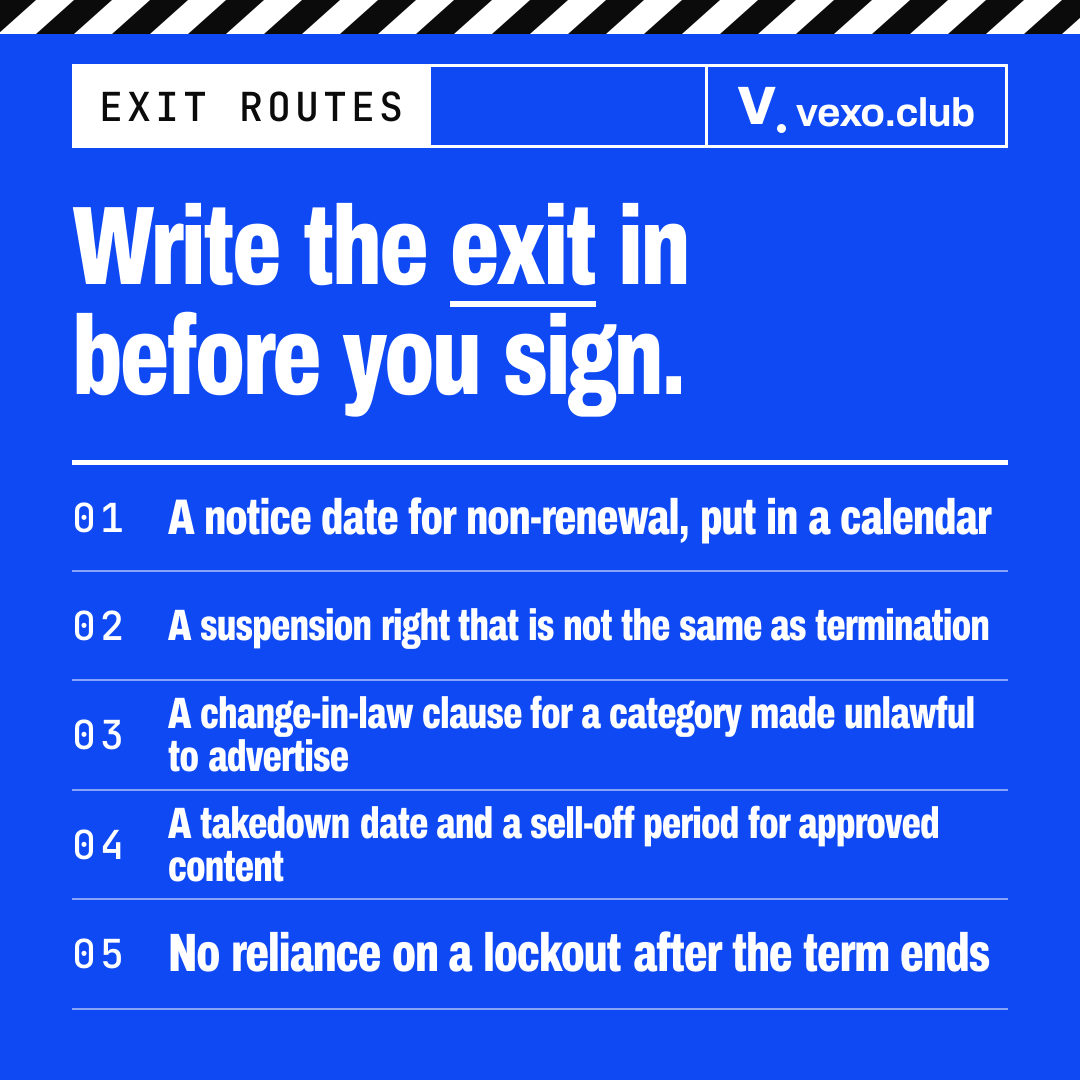
Then the tail. Approved content does not vanish on the last day, so fix the takedown date, the sell-off period for booked media and what archival use needs in fresh consent and payment. The influencer contract clauses that change the price cover termination and takedown. Rotation exits are easy because each contract simply ends. The danger there is the opposite one: rotate without a scorecard and you forget what you tested.
A decision tree by brand maturity and goal
Ask four questions in order, as in the plate below. A no to the second, third or fourth points to rotation, or to a star for a single campaign window rather than a term. A no to the first points to rotation and learning before anything long.
The four questions behind the choice
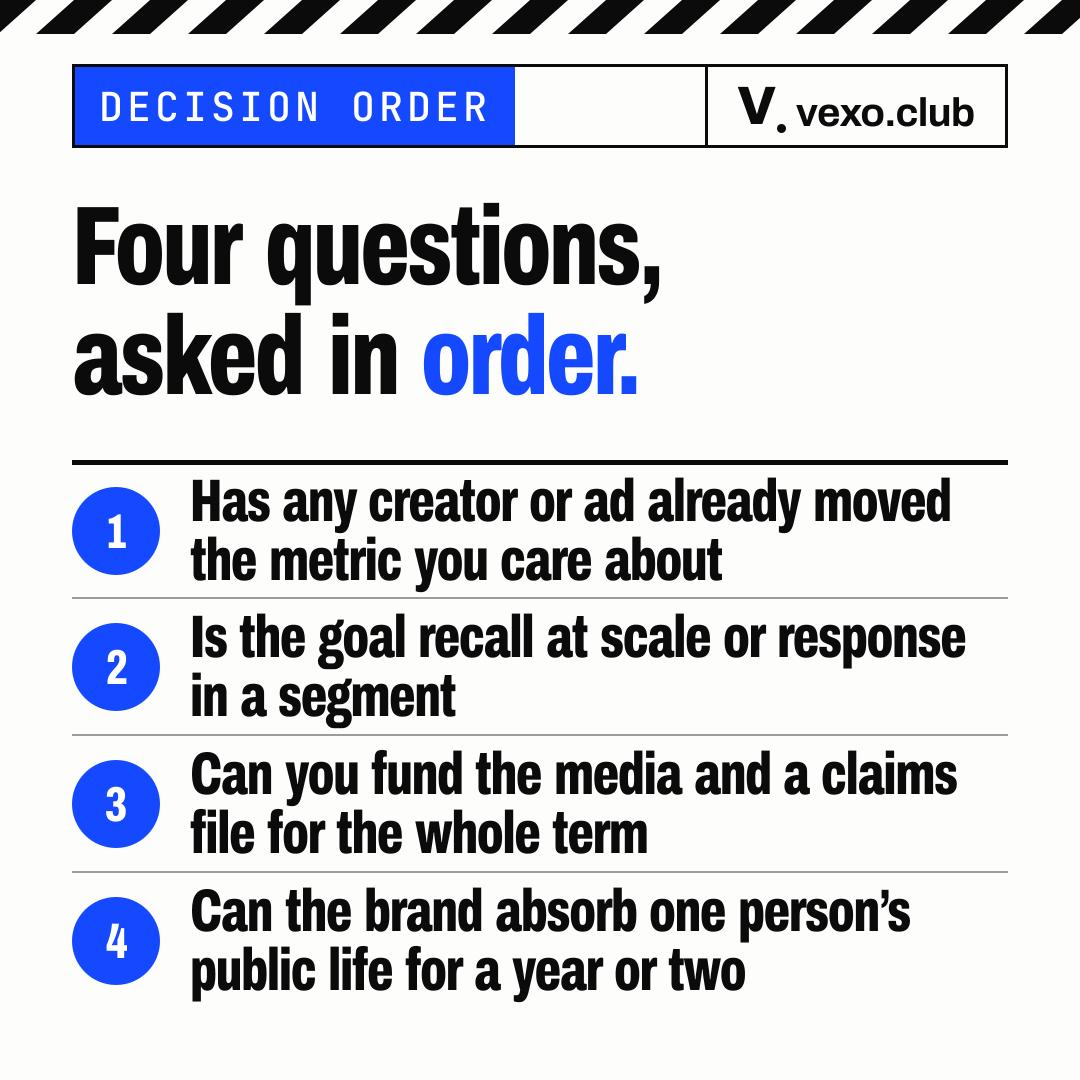
The matrix turns those questions into a direction. In the trust-heavy row, note ASCI’s March 2025 addendum asking influencers who advise on health and financial products to hold relevant qualifications and state them upfront. A creator there may need credentials as well as reach.
Brand maturity against goal: where each route usually points
| Recall at scale | Trial and conversion | A dated launch | |
|---|---|---|---|
| New brand, no proof yet | Not yet: rotate and learn first | Rotate macros with tracked offers | A macro burst, or one star only if the media is funded |
| Growing brand, one channel that works | A creator ambassador on a retainer, or one star for a single campaign | Rotate with a returning bench | A star for the window with macros around it |
| Established brand, wide distribution | An ambassador for one to two years with macros for platform-native work | Rotate by region and language | The star as anchor and macros to extend it |
| Trust-heavy or regulated category | An ambassador only with a claims file and a change-in-law exit | Creators with stated qualifications and one claim sheet each | A star only once the claims file is complete |
The hybrid is common for a reason. In Storyboard18 L’Oréal India described celebrity ambassadors for awareness and influencers for consideration, and in Mint a jewellery retailer said it used regional influencers alongside its brand ambassadors to reach tier-two and tier-three cities. The cost is coordination: your macros’ content must not contradict the star’s claims, and the star’s exclusivity does not bind your creators. How the split should move with the goal is in budget allocation by goal. If the product is unproven or you cannot serve the orders a spike would bring, neither route fixes that. Spend on the product first.
What to do this week
- Write the single goal in one sentence and the date by which you would know it worked.
- Price both routes on the same lines: fee, usage window, production, amplification media, management time and the cost of stopping early.
- If a star is on the table, ask management for the endorsement schedule and the exclusivity map.
- Ask counsel for the suspension, change-in-law and sell-off clauses and the indemnity position.
- Build the claims file now, whichever route you pick.
- If you rotate, fix one spine message, one claim sheet, a staggered schedule and the scorecard before round one.
- Decide in advance what result renews and what ends, and calendar the notice dates.
Questions brands ask
Is a celebrity ambassador worth it for a D2C brand? Only when the brand has proof that its buyer responds, a goal of recall rather than conversion, and money for the media behind the face for the whole term. Without those, rotating macro-influencers teach you more per rupee and can be stopped between rounds. A star for one campaign window is a middle step.
How long does a celebrity ambassador contract usually run? Kroll describes the traditional structure as a fixed fee over usually one or two years, and Storyboard18 quoted a celebrity-management executive saying deals had shortened to one to two years. Ask for a shorter first term with a renewal right rather than a long term with a break clause.
Can the celebrity endorse a competing brand while they are my ambassador? Only if the contract lets them, which is why exclusivity has to be written by category, brand extension and territory. After the term you cannot rely on a lockout: in Percept D’Mark v Zaheer Khan the Supreme Court held that a post-term right to match third-party endorsement offers was void under section 27 of the Contract Act. Ask counsel about any cooling-off clause.
Is a celebrity liable for a misleading advertisement in India? They can be. Section 21 of the Consumer Protection Act, 2019 lets the CCPA penalise an endorser and bar them from endorsing for a period, and section 21(5) protects an endorser who exercised due diligence to verify the claims. Liability is not automatic, and the manufacturer carries separate criminal exposure under section 89.
Do a celebrity ambassador’s posts need an ad label? Yes, where there is a material connection with the brand. The Endorsements Know-hows are addressed to celebrities as well as influencers, and ASCI requires a clear label on paid posts. A fee, a free product or any other benefit counts. ASCI disclosure for brands has the placement rules.
What should I do if my ambassador is in the news? Verify from the original source, pause scheduled posts and paid amplification, and leave live content up unless the content itself is the problem. Then read your clause, hear the other side and decide. If the clause covers only the star’s own conduct, a pause caused by a family matter or a regulator needs a separate suspension right.
If the route you are weighing is a rotating bench of macro-influencers or a creator on a macro-level retainer, send the desk a brief with the goal, the market and the term you have in mind. vexo.club is a Delhi NCR desk that briefs creator campaigns. A film or sports star’s deal runs through their management and your counsel.
Sources
- September 2025 (opens in a new tab) business-standard.com
- note on celebrity endorsements in India (opens in a new tab) kroll.com
- may insist on exemptions (opens in a new tab) conventuslaw.com
- Indian Contract Act, 1872 (opens in a new tab) indiacode.nic.in
- Percept D’Mark v Zaheer Khan (opens in a new tab) api.sci.gov.in
- halted all ads (opens in a new tab) business-standard.com
- ads were back (opens in a new tab) economictimes.indiatimes.com
- ended a pan masala endorsement (opens in a new tab) aninews.in
- reported the ads still airing (opens in a new tab) bestmediainfo.com
- show-cause notices to three film actors (opens in a new tab) business-standard.com
- Business Standard (opens in a new tab) business-standard.com
- Guidelines for Prevention of Misleading Advertisements and Endorsements for Misleading Advertisements, 2022 (opens in a new tab) consumeraffairs.gov.in
- section 21 of the Act (opens in a new tab) consumeraffairs.gov.in
- order of 7 May 2024 (opens in a new tab) api.sci.gov.in
- Endorsements Know-hows (opens in a new tab) pib.gov.in
- as Business Standard summarises them (opens in a new tab) business-standard.com
- Guidelines for Celebrities in Advertising (opens in a new tab) ascionline.in
- Endorser Due Diligence service (opens in a new tab) ascionline.in
- prohibits advertising of online money games (opens in a new tab) pib.gov.in
- ASCI’s March 2025 addendum (opens in a new tab) ascionline.in
- Storyboard18 (opens in a new tab) cnbctv18.com
- Mint (opens in a new tab) livemint.com
Cite this page
Celebrity ambassador or rotating macro-influencers: how to choose. vexo.club, published 28 Nov 2026. https://vexo.club/blog/celebrity-ambassador-vs-rotating-macro-influencers
Send the desk a brief: it comes back as a shortlist and a directional band, never a public price.
Brief the desk