Micro vs macro vs celebrity influencers in marketing — comparing CPM, engagement and ROI
Benchmarks8 min read
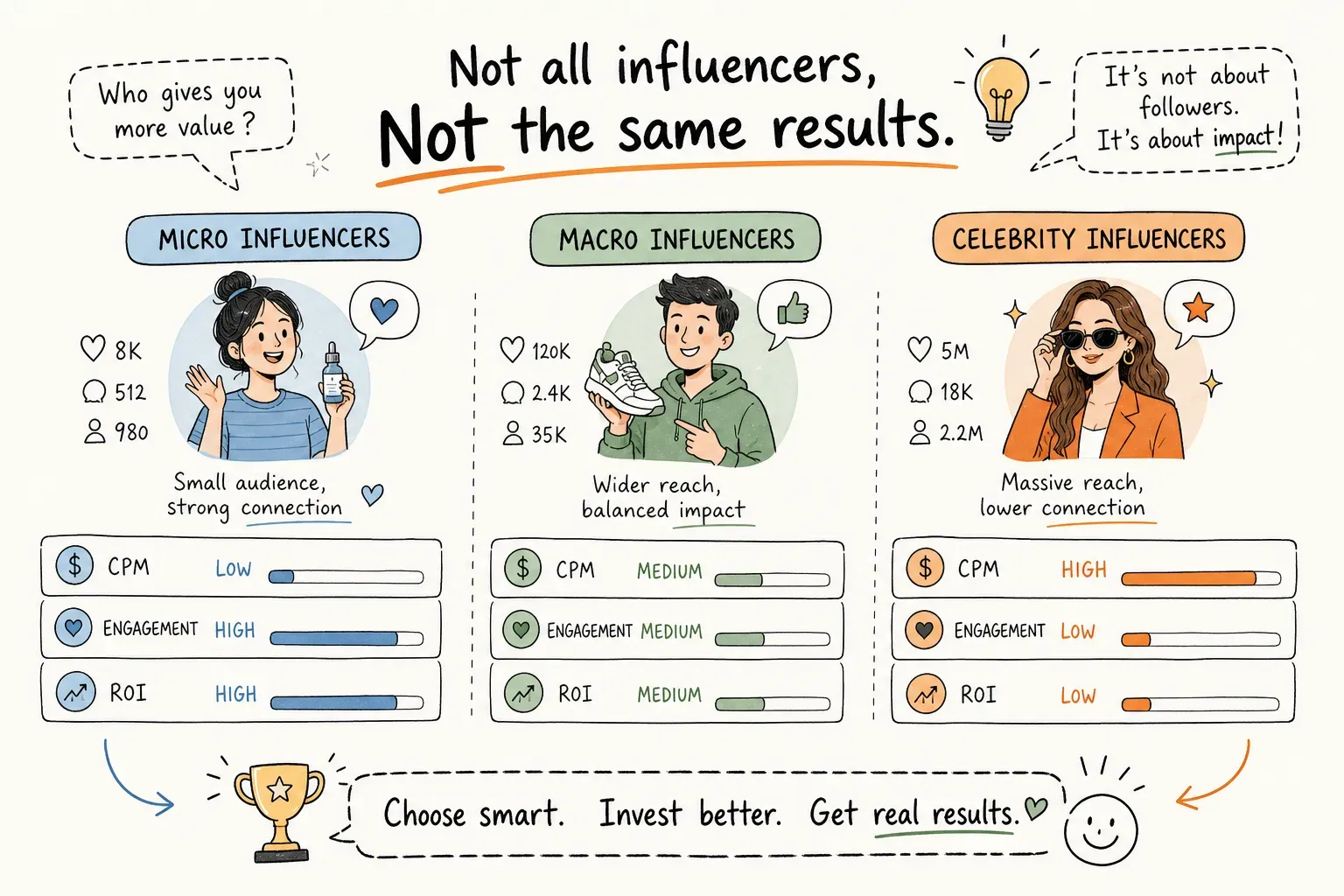
Every brand running influencers in marketing meets the same pull: put the product in a celebrity’s hands and reach millions. It is a reasonable instinct and often the wrong first move. A tier is a choice about what the campaign is for — awareness, consideration or sales — and each tier does one of those jobs better than the others. This article is how the desk reads the three tiers on cost per person reached, engagement and ROI, and how to pick one before the brief goes out. It carries no benchmark figures, on purpose: the numbers that decide a campaign belong to your category and your dates, and the desk gives directional bands on a brief.
What each tier means for influencers in marketing
Tiers are a follower-count convention, nothing more. They are commonly described as nano (under about 10,000 followers), micro (about 10,000 to 100,000), macro (about 100,000 to a million) and celebrity (a million and above). Platforms and agencies draw the lines in slightly different places, so treat the bands as shorthand.
Micro influencers are the voice a small, specific audience already trusts — a language community, a hobby, a city. Their followers know them as a person rather than a channel, and a recommendation carries that weight. Macro influencers have built an audience large enough to behave like a media property: wider, more mixed, less personal. Celebrity influencers bring cultural reach and brand association — film, sport, television — and an audience that follows for the person, not the category.
None of these is better in the abstract. A product aimed at one language community in one state is a micro brief; a national launch that must be talked about in a week is a macro or celebrity brief. The micro and nano influencer marketing page sets out when small creators are the right call and what it takes to run many of them well.
Why follower count is a weak proxy
Followers are the number a creator can see and a brand can read in two seconds, so it became the unit everyone prices and compares in. It is also the least reliable figure on the page: a following can be bought, years stale, or sitting in a country the product does not ship to. What a post reaches — the people who saw it, in the right place, recently — is the figure that matters.
Two creators with the same following can deliver very differently, which is why the desk casts on audience fit first and tier second. The method is in how to check an influencer’s audience before you pay.
Cost per person reached: how the tiers compare
CPM — the cost of a thousand impressions — is the cleanest way to put tiers side by side, with one caution: an impression is not a person, so read it against reach, not followers.
Read that way, the pattern is steady. Celebrity and large macro creators tend to cost more per person reached — you are paying for scale and association. Mid-sized creators sit in the middle. Micro creators tend to reach each person for less, but each is a separate brief, contract and approval, and that operating time returns to the real cost. We have written about that trade in why nano creators are not cheap. Cheap per head and cheap to run are two different claims.
Bands for your category are not something to take from an article. The desk gives directional bands on a brief, and what influencer marketing costs in India explains the five things that move a quote: the creators, the formats, the usage rights, production and exclusivity. Fees come back as line items, so you can see which one is moving the number.
Engagement rate: where it holds and where it thins
Engagement rate is the share of an audience that does something with a post — a like, a comment, a save, a share. The general shape is familiar: engagement tends to be strongest on smaller accounts and to thin as an audience widens. A small audience is closer to the creator; a very large one includes many people who follow out of habit and never act.
That is a tendency, not a law, and three things break it. Platform changes what is counted: a rate on views is not a rate on followers. Category changes what is normal. And engagement can be manufactured — comments that are a row of emojis, or a spike with no growth behind it, are a reason to ask for the exports before you cast, as in the audience check above.
A high engagement rate on a small account says the audience is paying attention. It does not say the audience can buy the product, or is in the right city. Engagement is a signal to investigate, not a result to report.
ROI: matching the tier to the objective
Return on investment is where tiers stop being comparable on a single number, because they are doing different jobs. Judge each against its own objective.
- Awareness and launches. Macro and celebrity creators give a fast burst of attention across a wide audience. Judge them on reach, completion and how much conversation follows — not on cost per acquisition, which they are not built to win.
- Always-on credibility. Micro creators sustain a steady presence and category authority without the premium of larger talent. Judge them on repeat reach, saves and the quality of comments.
- Performance and conversion. Micro and mid-tier creators with codes, tracked links or whitelisted ads give the most directly attributable results, because the audience is close to the creator and the action is close to the post.
- Festive scale. A deliberate mix across tiers, sequenced so audiences move from discovery to consideration to purchase.
Before launch, decide which method will measure the result. Codes, tracked links, whitelisted ads and post-purchase surveys each see a different slice of a sale, and none sees all of it. Measuring influencer marketing ROI without inventing it covers how to choose, and how to report what a method cannot see. A tier is only a good buy if you can say afterwards what it bought.
Formats for influencers in marketing: reach versus direct response
The tier decides who is talking. The format decides what the audience is asked to do. Reviews, brand takeovers and long-form YouTube integrations suit awareness and consideration. A review is also a hybrid: it builds credibility through product education and, with a trackable link, becomes measurable.
For measurable sales, the strongest formats are affiliate arrangements, shoppable creator content and livestream commerce. Affiliate ties part of the creator’s pay to verified conversions; livestream commerce compresses discovery and purchase into one session, which suits categories where seeing the product used drives the decision.
The posts that work should not stop at organic reach. When a creator’s post performs, running it as a paid ad from their handle extends it, and that is a usage right, agreed separately. Creator whitelisting, explained for brand teams sets out what to agree, for how long, and who holds the ad account. The desk runs whitelisting and paid amplification alongside the creator work, so the creative that converts gets the budget.
A festive mix across tiers
Festive campaigns are where a single tier is least likely to be enough. The sequence the desk plans around is simple. Celebrity and macro creators open the window with reach. Mid-tier and micro creators carry consideration through the middle, in the languages and cities where the product sells. Closer to the sale, small creators and affiliate mechanics drive tracked purchases with a deadline in the content. Festive shoot calendars fill early, so the plan is worth settling before creators are booked. Planning festive-season influencer campaigns in India sets it out month by month.
Casting influencers in marketing without expensive mistakes
Most casting mistakes are the same few, and they repeat across tiers.
- Choosing by follower count alone, so the shortlist is whoever is biggest within budget.
- Ignoring language and region. A nationally popular creator can have little reach in the city or language group the campaign needs.
- Skipping the audience check, so a bought or mismatched following goes unseen until the report.
- Reading sponsored posts as if they were organic, when they should be judged separately.
The remedy is dull and effective: score the audience fit, the quality of the engagement and the fit with the brand before you look at scale, and read the creator’s recent posts rather than the media kit. How to read a media kit you did not commission shows why a screenshot is a claim and not a record. The desk runs audience checks before casting — the exports, the comment reading, the geography — so the shortlist arrives already checked.
Running the campaign end to end
A good brief names one objective, the product facts that must be right, the claims that are off limits, the deliverables and formats, the posting window, the revision rounds and the disclosure requirement. It does not script every sentence; over-controlled briefs produce stiff content. How to brief an influencer marketing agency in two paragraphs shows the shape.
Before a post goes live, someone has to check that the claims are accurate, the tracking links and codes work and the disclosure is clear. Under the ASCI influencer guidelines, a paid post carries a visible label, and at the desk that check is made before the post goes live — see ASCI disclosure for brands for who labels what.
Then reporting. A weekly report should show reach, engagement rate, CPA, CPM and the next move, with any figure that cannot be verified marked as such and never added into a total. That is the report the desk sends every week; the column-by-column logic is in the weekly report teardown. Each campaign should close by feeding what it learned into the next brief.
Choose the tier before you spend
The framework is short. Match the tier to the objective. Choose the format for the funnel stage. Fix the measurement method before the first rupee moves. The most common waste in influencers in marketing is not a poor creator; it is a campaign whose success was never defined, then measured with whatever data happened to be available.
The desk works this way for every brief: one operator from shortlist to last report, a creator shortlist in 18 hours, contracts and briefing inside a week, and first content live in 10–14 days for most categories. Creator fees come as line items, and the in-house studio covers production when a creator’s own setup is not what the brief needs. Browse the creators the desk represents on the roster, read the guide to micro and nano influencer marketing, or send the desk a brief — objective, budget band, market and timeline — and a shortlist comes back in 18 hours.


