The morality clause in an influencer contract: what it says, how to word one fairly, and what a brand does in the first 48 hours after a creator is in the news
What a morality clause in an influencer contract says, how to word one fairly, and the first 48 hours after a creator is in the news, step by step. With an illustrative clause set to take to counsel and a grid for whether to pull, pause, keep or recast.
Playbooks Updated 15 min read The operators’ desk
In this article10 sections
A morality clause lets a brand end an influencer contract, and ask for its posts to come down, if the creator’s conduct harms the brand. A fair one lists the triggers, names who decides, allows a cure period and pays for work delivered. When a creator is in the news, the brand verifies, pauses, reads the clause, then decides.
This guide comes from vexo.club: an influencer marketing agency run from one desk in Delhi NCR. It names no creator and no brand, and quotes ASCI and the Indian Contract Act from their own documents, as of 18 October 2026. It is general information, not legal advice: have counsel draft the final wording.
The morality clause, for a brand
In short
- A morality clause, also called a bad acts clause, lets a brand exit an influencer contract when the creator’s conduct or statements harm the brand.
- It has six parts: the trigger, who decides, the cure period, the remedy, the takedown and the creator’s mirror clause.
- A fair clause lists objective triggers, pays for work already delivered and lets the creator leave a brand that is itself in the news.
- In the first two days of a controversy, verify from the original post, pause what is scheduled, read the clause and decide at one named level.
- It is an ordinary contract term under Indian contract law, so the wording carries the weight. Counsel writes the final version.
What is a morality clause in an influencer contract?
A morality clause is a contract term that lets a brand suspend or end an influencer agreement, and ask for content to come down, when the creator’s conduct or public statements damage the brand. It is also called a bad acts clause.
Storyboard18 printed one from an influencer’s contract with an FMCG brand (Imran Fazal, “Brands turn risk averse as influencer controversies trigger surge in morality clauses”, 10 October 2025). It opens: “Influencer shall conduct himself or herself at all times with due regard to public morals and conventions.” The brand may end the agreement “in its reasonable good faith discretion” for conduct “offensive to decency, morality” or that reflects badly on the brand, and ask the influencer to “promptly remove all Content and Communications”.
Marketing agencies and legal experts quoted in the article say such clauses “are fast becoming standard in influencer contracts”; it gives no count. This one is easy to sign and hard to apply: its conduct test names no event, it sets no cure period, and it makes the brand’s view final.
What does a morality clause usually cover?
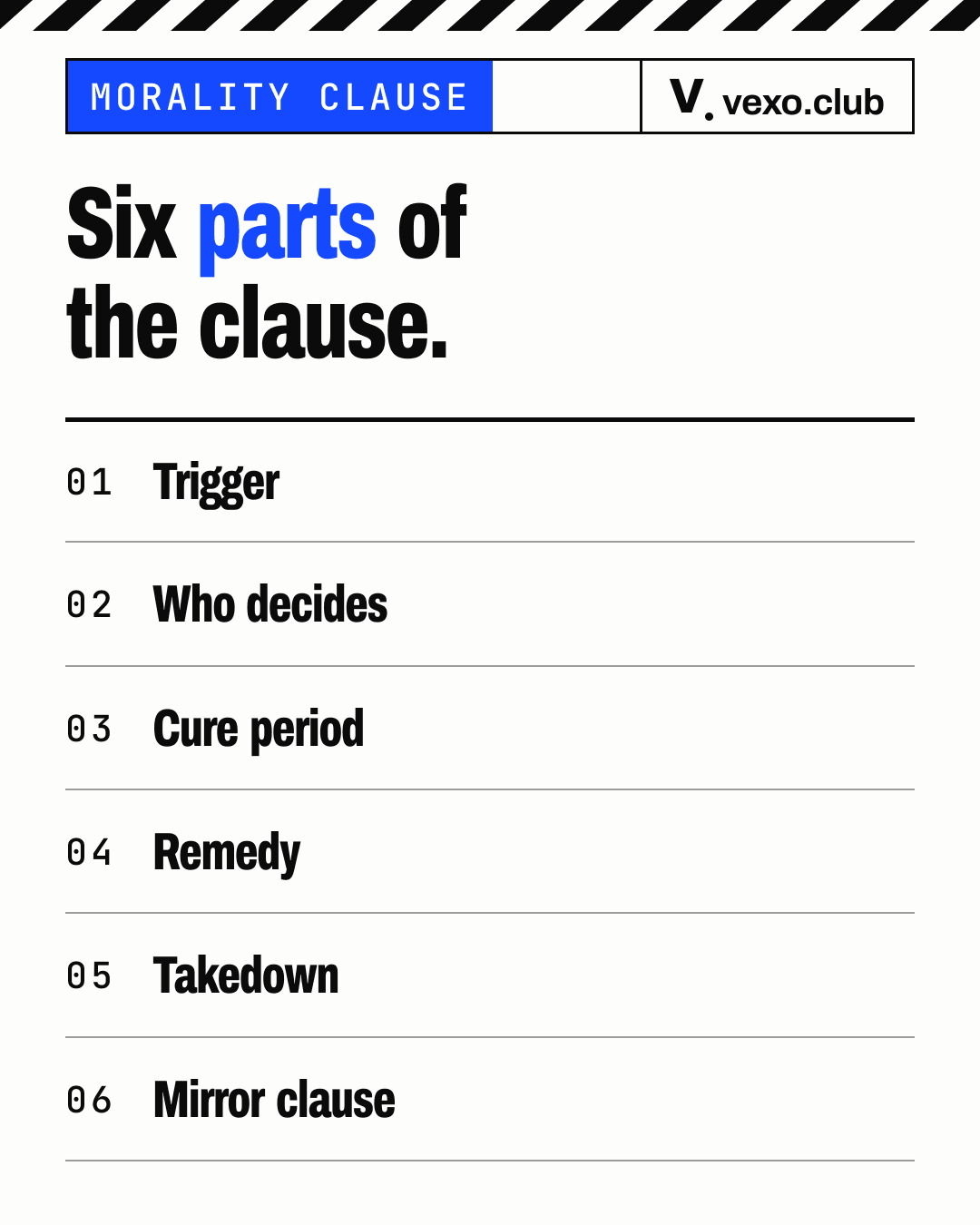
A morality clause covers six things: what triggers it, who decides, whether a cure period runs, what the brand may do, what happens to live posts, and whether the creator has the same right against the brand.
The anatomy of a morality clause
- The trigger Conduct, statements, legal events, and acts against the brand such as disparagement
- Who decides The brand alone, the brand acting reasonably, or a listed event that decides itself
- The cure period A window in which the creator can edit, remove or apologise before the brand acts
- The remedy Pause, hold payment, end the contract, and whether any fee comes back
- The takedown Which posts come down or are hidden, by when, and when the brand stops using them
- The mirror clause The same exit for the creator when the brand, its product or its claims are in the news
Triggers fall into four groups: conduct; statements, sometimes in old posts; legal events such as an FIR, a charge-sheet, a conviction or a regulator’s order; and acts against the brand, such as disparagement or breaking exclusivity, both in the Storyboard18 contract.
Remedies run from mild to final: pause, hold the next payment, take content down, end the contract, recover fees. A claw-back is a term that makes the creator return fees already paid.
The six parts of a morality clause
Who decides that the clause has been triggered?
The clause says who decides, and that line matters more than the triggers. At one end the brand’s sole opinion is final; at the other, the clause fires only on an objective, listed event, such as a charge-sheet filed or a regulator’s order.
The Storyboard18 contract sits near the brand’s end: “Company’s reasonable good faith decision on all matters arising under this paragraph shall be conclusive.” “Reasonable” and “good faith” give the creator something to argue; “conclusive” takes most of it back.
How a trigger is judged
The brand’s opinion decides A listed event decides
- In the brand’s sole opinion Fast for the brand, and nothing for the creator to test At The brand’s opinion decides
- A reasonable good-faith view, stated to be conclusive The FMCG contract quoted above Leans The brand’s opinion decides
- A reasonable opinion, formed after hearing the creator In the middle
- Material harm, shown by evidence the clause names A retailer’s complaint, a regulator’s notice, a platform’s action Leans A listed event decides
- A listed event, such as a charge-sheet filed or a regulator’s order Certain, but blind to conduct that breaks no law At A listed event decides
Neither end suits both sides: a sole-opinion trigger lets a brand walk away over a joke, and a list of legal events misses a lawful post that sinks the campaign. The workable middle: listed events end the deal; anything else needs a reasonable opinion, formed after hearing the creator.
What makes a morality clause fair to both sides?
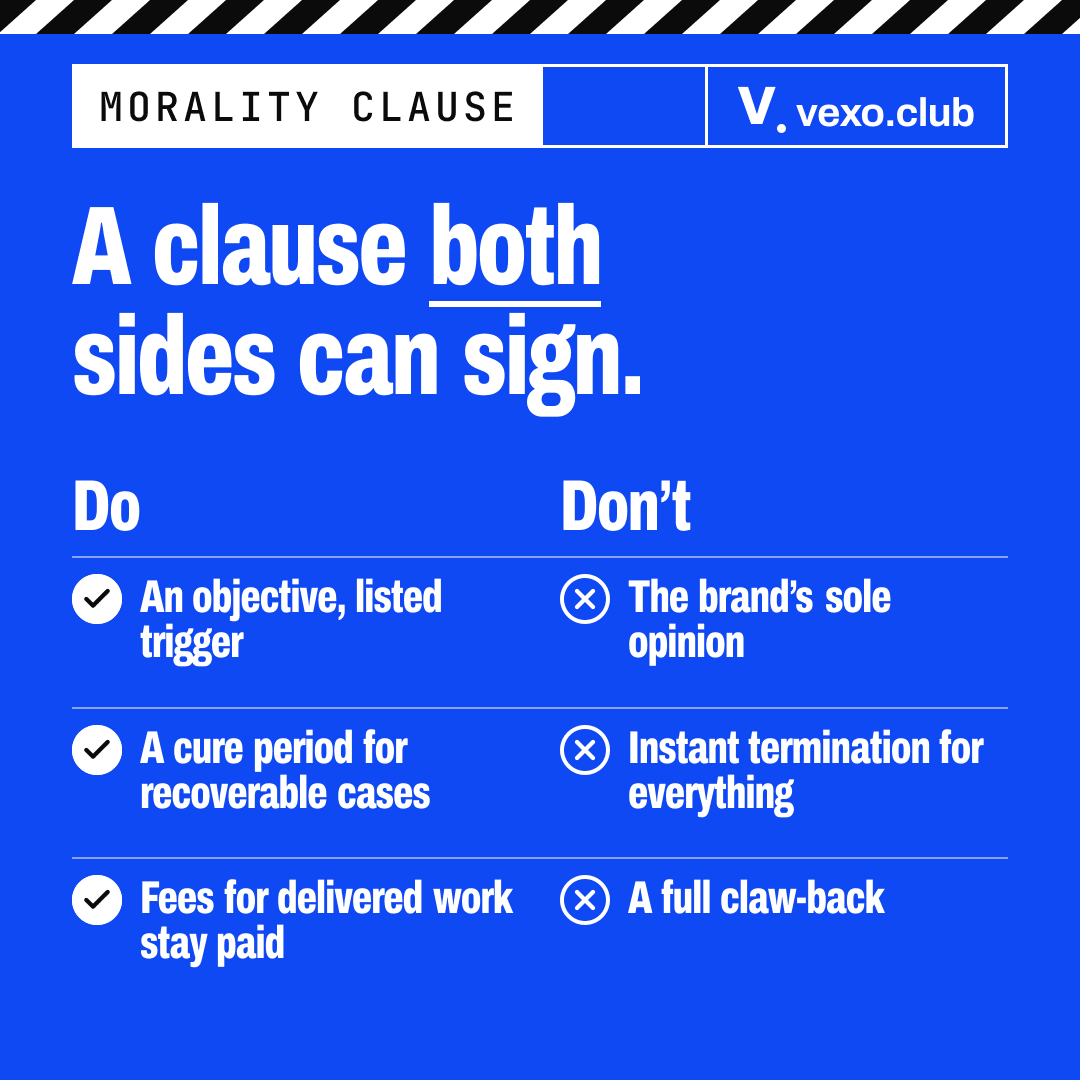
A fair morality clause lists the triggers that end the deal, gives a cure period for what can be put right, pays for delivered work, reaches old posts only through the creator’s disclosure, and lets the creator exit when the brand is in the news.
A cure period is a stated window in which the creator can put a problem right, by editing, removing or apologising, before the brand may end the contract. It suits a careless caption, not a criminal case.
A one-sided clause and a fair clause
| One-sided clause | Fair clause | |
|---|---|---|
| Trigger | Anything offensive or unfavourable to the brand, left undefined | Listed events, plus a reasonable-opinion test for the rest |
| Who decides | The brand’s sole opinion, final | The brand, acting reasonably, after hearing the creator |
| Cure period | None: termination is immediate | A stated window to edit, remove or apologise, for recoverable cases |
| Old posts | Any post, from any year | Conduct during the term, plus a warranty that known issues were disclosed |
| Money already paid | All of it comes back | Fees for delivered work stay paid; an advance for undelivered work returns |
| The brand in the news | Not covered | The creator may exit on the same terms |
A mirror clause gives the creator the same right against the brand. ASCI’s Guidelines for Influencer Advertising in Digital Media (guideline 2, ‘Due Diligence’) advise influencers to “satisfy themselves that the advertiser is in a position to substantiate the claims made in the advertisement”. A creator who answers for a brand’s claims has a fair case for an exit when those claims are in the news.
What makes a morality clause fair to both sides
How should a brand word a morality clause fairly?
Word it as short clauses, one per part, that both sides can read without a lawyer. The set below is illustrative wording to take to counsel, not a document to sign from:
- Term. Conduct and statements during the term. The creator warrants that they have disclosed any pending matter, and any past post they know could embarrass the brand.
- Listed events. The brand may end the agreement at once if, for an offence the schedule names, an FIR naming the creator is registered or a charge-sheet is filed (the schedule says which); if a regulator’s advertising order names the creator; or if the creator disparages the brand, breaks exclusivity or breaks the disclosure warranty.
- Other conduct. For anything else, the brand may act only if it reasonably believes the conduct has caused or is likely to cause material harm, and only after telling the creator in writing.
- Cure period. For other conduct, the creator has a stated window from the notice to respond, edit, remove or apologise.
- Steps short of ending. While it decides, the brand may pause scheduled posts, suspend paid amplification and hold the next payment.
- Content. On termination, the creator removes or hides the campaign posts within a stated time, and the brand stops using them by that date.
- Money. Fees for work delivered before the notice stay paid; an advance for undelivered work is returned; any further sum is a named amount for counsel to check.
- Mirror clause. The creator may end the agreement on the same terms if the brand, its product or its claims face a regulator’s order or a recall, or, after telling the brand in writing, if the creator reasonably believes the brand’s conduct would cause them material harm.
- Statements. While a decision is pending, neither side comments in public except in agreed words.
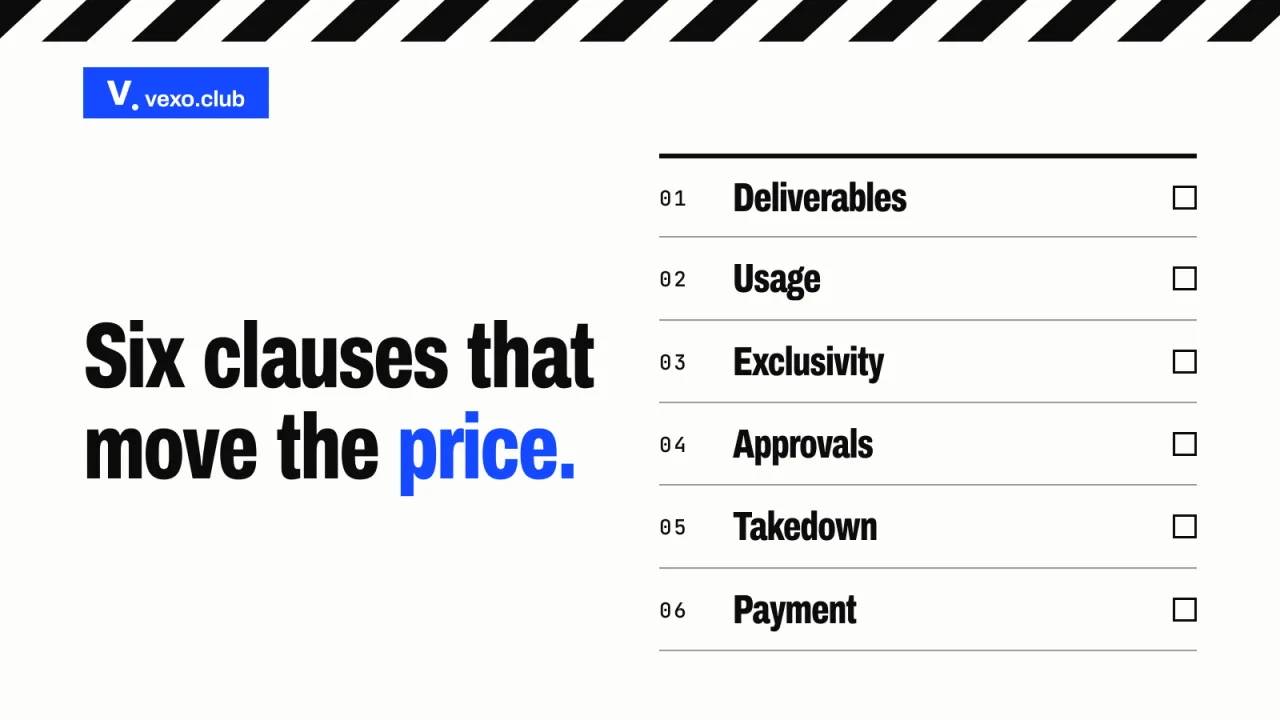
Have counsel fill in the schedule and the cure window, and check the takedown and money terms against the contract clauses that change the price and what the brand may keep using after the campaign.
What should a brand do in the first 48 hours after a creator is in the news?
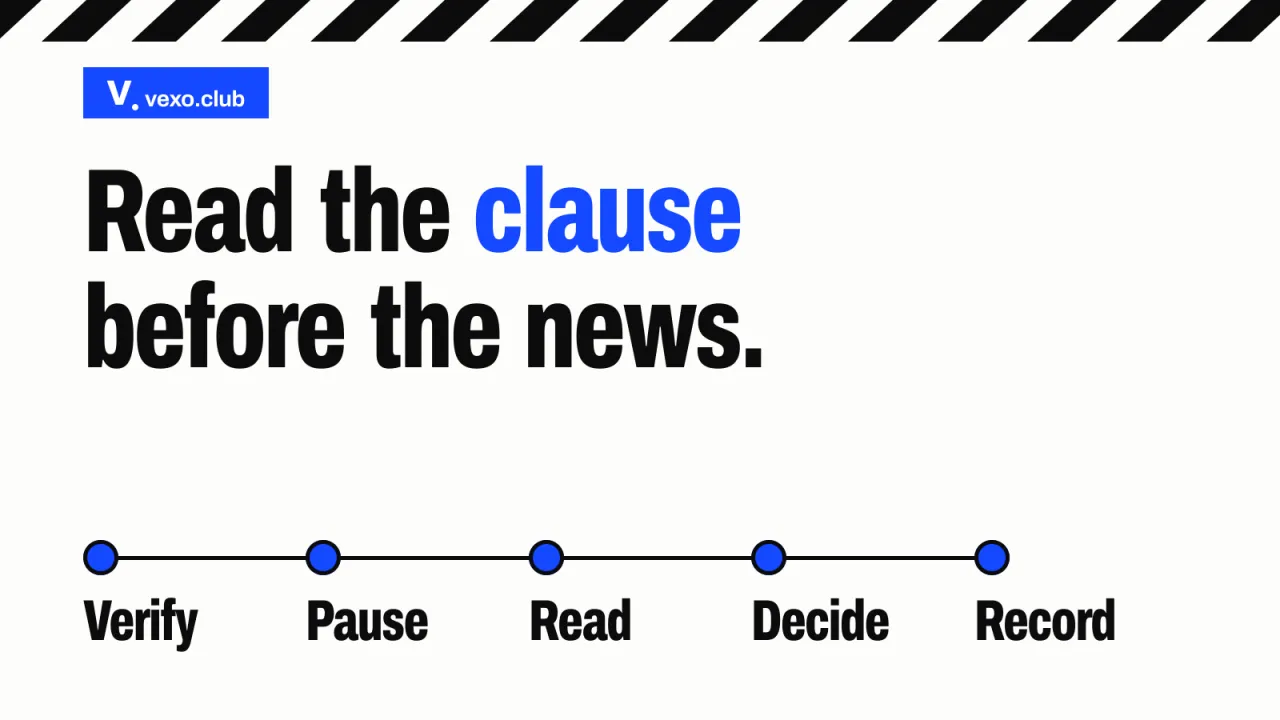
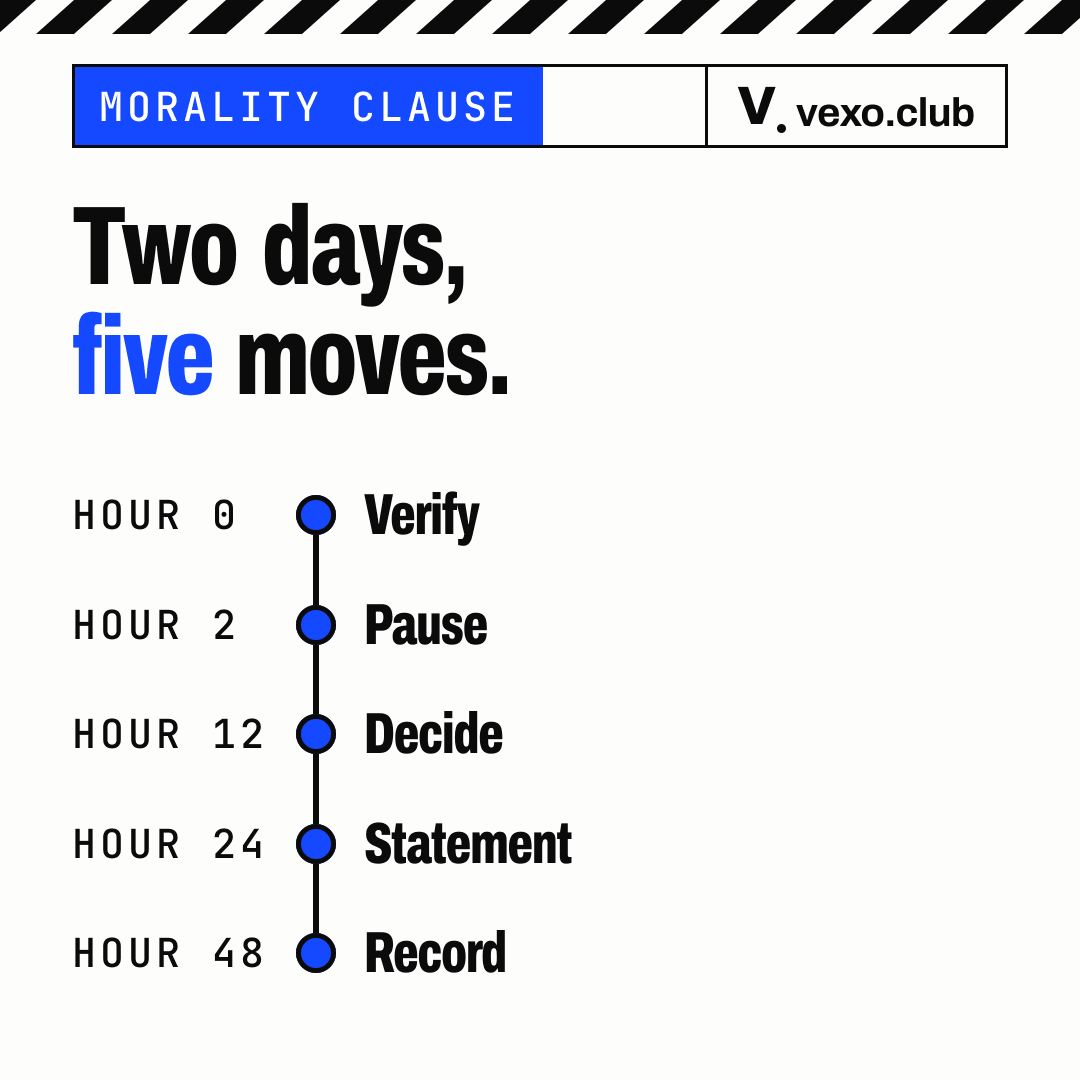
In the first 48 hours a brand verifies from the original source, pauses anything scheduled, leaves live posts up, reads the clause, decides at one named level, says one thing or nothing, and records the decision for the weekly report.
The first 48 hours
- Hour 0 Verify from the original post, video or filing, not from a screenshot or a repost
- Hour 2 Pause scheduled posts and paid amplification; leave live posts up for now
- Hour 12 Read the clause, hear the creator, and decide at one named level
- Hour 24 One short statement if one is needed, or none
- Hour 48 Record the facts, the clause, the decision and who made it
Verify. A controversy often arrives as a clip, a screenshot or a WhatsApp forward. Find the original and its date: a resurfaced old clip is a different case. A clip cut from a long Hindi or Tamil stream loses its context, so get the full stream and a trusted translation. The desk holds its own site to the same test, the record over the repost: how the desk verifies.
Pause, then read the clause. Stop scheduled posts and paid amplification, and leave live posts up, unless the post itself is the problem or a platform, regulator or court asks for its removal: deleting is final and reads as a verdict; a pause can be undone. Check which trigger the facts meet, who decides and whether a cure period runs; call the creator or their manager; then one person, usually the marketing head with legal, decides.
During a creator controversy
Do
Find the original post, video or filing
Don’t
React to a screenshot or a forward
Do
Pause scheduled posts and paid amplification
Don’t
Delete live posts before there is a decision
Do
Hear the creator before deciding
Don’t
Let the creator learn the decision from the news
Do
Decide at one named level, with legal in the room
Don’t
Let several teams decide, each on its own
Do
Say one short, agreed thing, or nothing
Don’t
Publish a statement that rules on the facts
Say one thing, then record it. A statement, if needed, is short, factual and agreed with the creator. Record the facts, the clause, the decision and who made it: the desk’s weekly report ends on a next move, and this is one.
A brand’s first 48 hours after a creator is in the news
Should a brand pull the campaign?
Pull a campaign when the facts are verified, serious and close to what the brand sells. Pause when they are serious but far from the category, keep going when they are minor and far from it, and pause to ask when they are minor but close to it. Until the facts are verified, every case stays paused.
Pull, pause, keep, or recast
Pause, then decide
Serious, Far from the category
- Hold scheduled posts
- Read the clause and the reaction
Pull and recast
Serious, Close to the category
- End under the clause
- Brief a new creator
Keep
Minor, Far from the category
- Note it in the report
- Watch the comments
Pause and ask
Minor, Close to the category
- Ask the creator
- Hold the next post
Across Far from the category Close to the category
Up Minor Serious
If the brief and the script still work, the fix is a different creator, not a different campaign: recast, not rewrite. In the festive season, a shortlisted recast option can save the window.
What does the desk check before casting?
Before casting, the desk runs a news check on every name it proposes and checks the audience, so the brand knows what it is signing before the clause matters. A brand casting on its own can run the same check:
Before casting: the brand-safety check
- Is there any current news, complaint or court matter about the creator?
- Have you read the creator’s recent posts on every channel the brief will use, live streams included?
- Does any old post contradict the brand’s claims in a way its audience would notice?
- Does the audience export match the market the brief is for?
- Has the creator accepted the clause set, the cure period and the mirror clause?
- Is one named person on the brand’s side ready to decide if something happens?
- Is the paid label agreed, and will it be checked on the draft and after the post is live?
The audience question has its own guide, the audience check before you pay.
What does Indian law say about a morality clause?
A morality clause is an ordinary contract term, read under the Indian Contract Act, 1872. The desk found no reported Indian judgment on an influencer morality clause in a search of Indian Kanoon and news coverage in October 2026, so the wording, not precedent, carries the weight.
Section 74 of the Indian Contract Act, 1872 says that where a contract names a sum payable on breach, the party complaining is entitled to “reasonable compensation not exceeding the amount so named”. Read plainly, where a claw-back is a fixed sum payable on the creator’s breach, that sum caps what the brand can recover rather than guaranteeing it; whether a given claw-back falls under section 74, and what a court would allow, is a question for counsel.
Jay Sayta, a technology and gaming lawyer, told Storyboard18 in the 10 October 2025 article that “Using offensive language on online platforms could invite registration of offence under the relevant provisions of the Bharatiya Nyaya Sanhita and Information Technology Act.” The clause decides only the contract.
ASCI’s guidelines (guideline 1.5) add a separate takedown, for a label or code problem rather than conduct: the advertiser shall, “where needed, call upon the Influencer to delete or edit an advertisement or the disclosure label”. Storyboard18’s Media Dialogues episode of 26 November 2025 asked “who gets to decide what’s moral in an era defined by virality”. A good clause answers it in writing, before the news.
A brief that needs the clause set written in before casting can be sent to the desk, by form, WhatsApp or email. Your counsel reads the agreement; the desk runs the news check.
Questions brands ask
Can a brand terminate an influencer contract for a controversy? Under the morality clause, only if the facts meet its trigger, judged the way the clause says; the agreement may also allow an exit on notice or for breach of another term, on its own payment terms. Ending it without such a right may itself be a breach by the brand. Ask counsel before acting.
Should an influencer sign a morality clause? A fair one, yes: listed triggers, a cure period, fees kept for delivered work and a mirror clause. One that lets the brand decide alone, with no cure period and a full claw-back, is worth negotiating.
What should a brand do first when a creator is in the news? Verify from the original post, video or filing; pause scheduled posts and paid amplification; leave live posts up unless the post itself is the problem. Then read the clause, hear the creator and decide.
Does the desk check creators for past controversies? Yes, before a creator is cast: the desk runs a news check on every name it proposes, for any complaint, FIR, court order or pending matter, and checks the audience. A brand casting on its own should also read the creator’s recent and older posts.
Is a morality clause enforceable in India? It is an ordinary contract term under the Indian Contract Act, 1872; the desk found no reported Indian judgment on an influencer morality clause in an October 2026 search of Indian Kanoon and news coverage. Listed triggers leave less to argue about.
Sources
- Guidelines for Influencer Advertising in Digital Media (opens in a new tab) ascionline.in
- Indian Contract Act, 1872 (opens in a new tab) indiacode.nic.in
- Media Dialogues episode (opens in a new tab) storyboard18.com
Cite this page
The morality clause in an influencer contract: what it says, how to word one fairly, and what a brand does in the first 48 hours after a creator is in the news. vexo.club, published 21 Oct 2026, updated 28 Oct 2026. https://vexo.club/blog/influencer-morality-clause-controversy-playbook
Send the desk a brief: it comes back as a shortlist and a directional band, never a public price.
Brief the desk