Prompt monitoring for AI visibility: a spreadsheet method for influencer agencies
You cannot check a rank in ChatGPT. You can ask a fixed set of real buyer questions on a schedule, log every answer, and count mentions, citations and correct facts. Here is the spreadsheet method, how to handle answers that change every run, and what no method can measure.
Benchmarks 20 min read The vexo.club desk
In this article12 sections
You cannot rank in ChatGPT the way you rank in Google, so there is no position to check. What you can do is ask a fixed set of real buyer questions on a schedule, record exactly what comes back, and count how often your name, your pages and your facts appear. Do that in a spreadsheet before you pay for anything. It costs time rather than a licence, and it teaches you what any paid tool has to do properly before its dashboard deserves your trust. This guide is the measurement layer only. How to earn a mention is in getting cited by AI search and how to rank when someone asks AI for an influencer agency. This one tells you whether that work is landing and how much you are allowed to believe the answer.
What to take from this article
In short
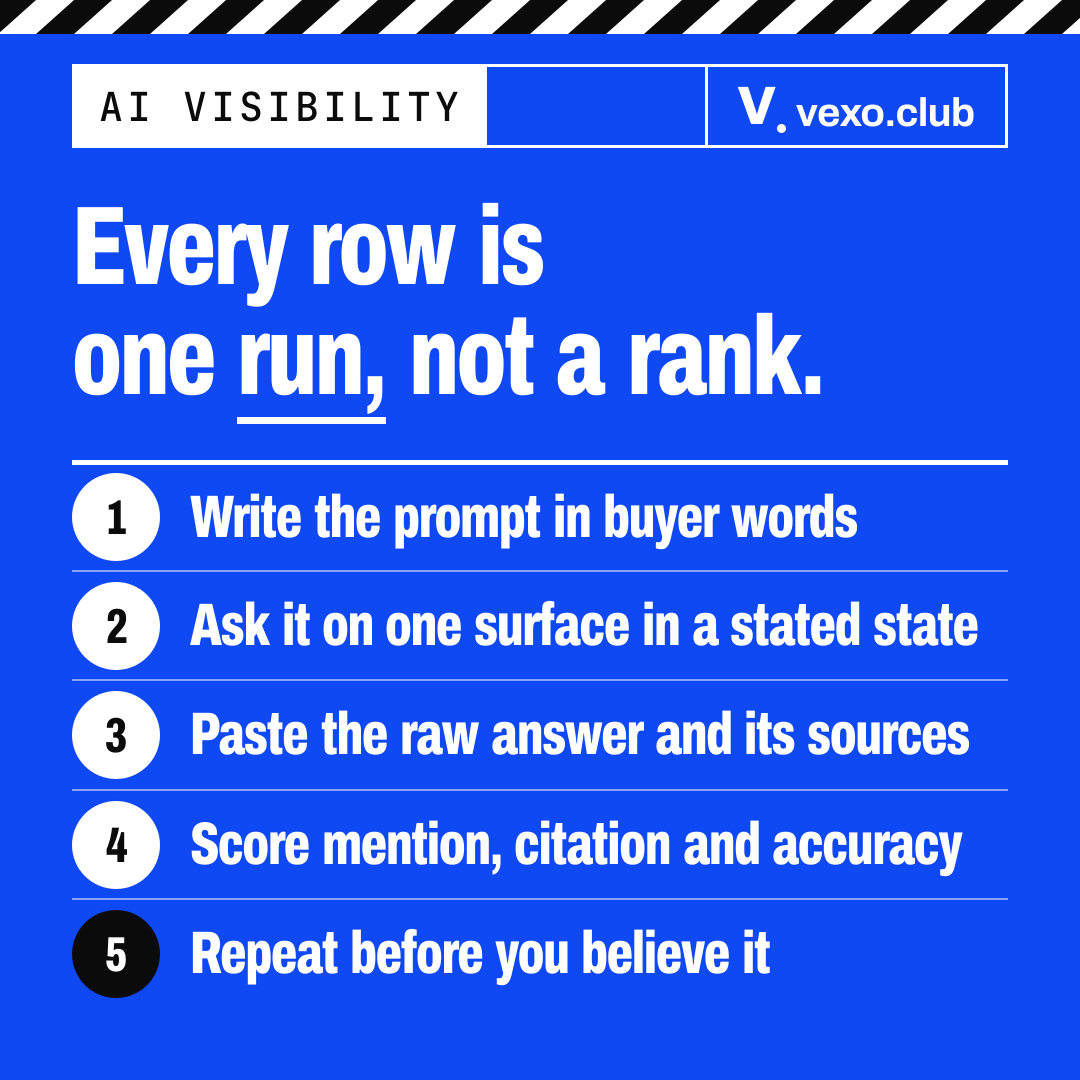
- A generated answer has no stable rank. The unit of measurement is one observation: one prompt, on one surface, in one stated state, at one time.
- Build the prompt set from words buyers have already used, in five clusters, and never edit a prompt once it has an ID.
- Repeat every prompt that matters, keep logged-out and logged-in answers in separate columns, and report counts such as three of five rather than tidy percentages.
- Score mention, citation and accuracy as three different things. A wrong fact in an answer is a bigger finding than a missing mention.
- Measure your own noise before you claim a change, and state what the method cannot see: real demand, real users’ personalised answers and anything that never produced a click.
Why is this not a ranking?
A Google results page has an order. If you were third on Tuesday and fifth on Friday the comparison means something. A generated answer has no such order. The engine rewrites the question into its own searches, reads what comes back and writes a fresh paragraph. Ask again and the searches, the sources and the wording can all differ. Google says as much about its own features: AI Overviews and AI Mode may run a technique it calls query fan-out, issuing several related searches to build one response.
Two consequences follow. First, any single answer however flattering is an anecdote. A founder who screenshots the day ChatGPT named the agency has learned nothing about tomorrow. Second, every figure you report is a sample estimate. Write “named in three of five runs” and never a tidy percentage. The count shows how thin the sample is. The percentage hides it.
The unit of measurement is one observation
How do you build a prompt set from real buyer questions?
Start from words buyers have already used rather than your own service list. Four places to mine:
- Inbound enquiries and first-call notes. A brand manager’s first line in a contact form is a prompt in disguise.
- Briefs and RFPs you have received, with the brand names and numbers removed. A sheet of buyer messages with names in it is a personal-data problem you created for no reason, so strip them before anything lands in a shared file.
- Search Console queries that are long or phrased as questions. These are searches real people made, which is more than a keyword tool’s estimate.
- Founder communities and threads on Reddit and LinkedIn where D2C teams ask who to hire. Copy the phrasing as it is written, awkward bits included.
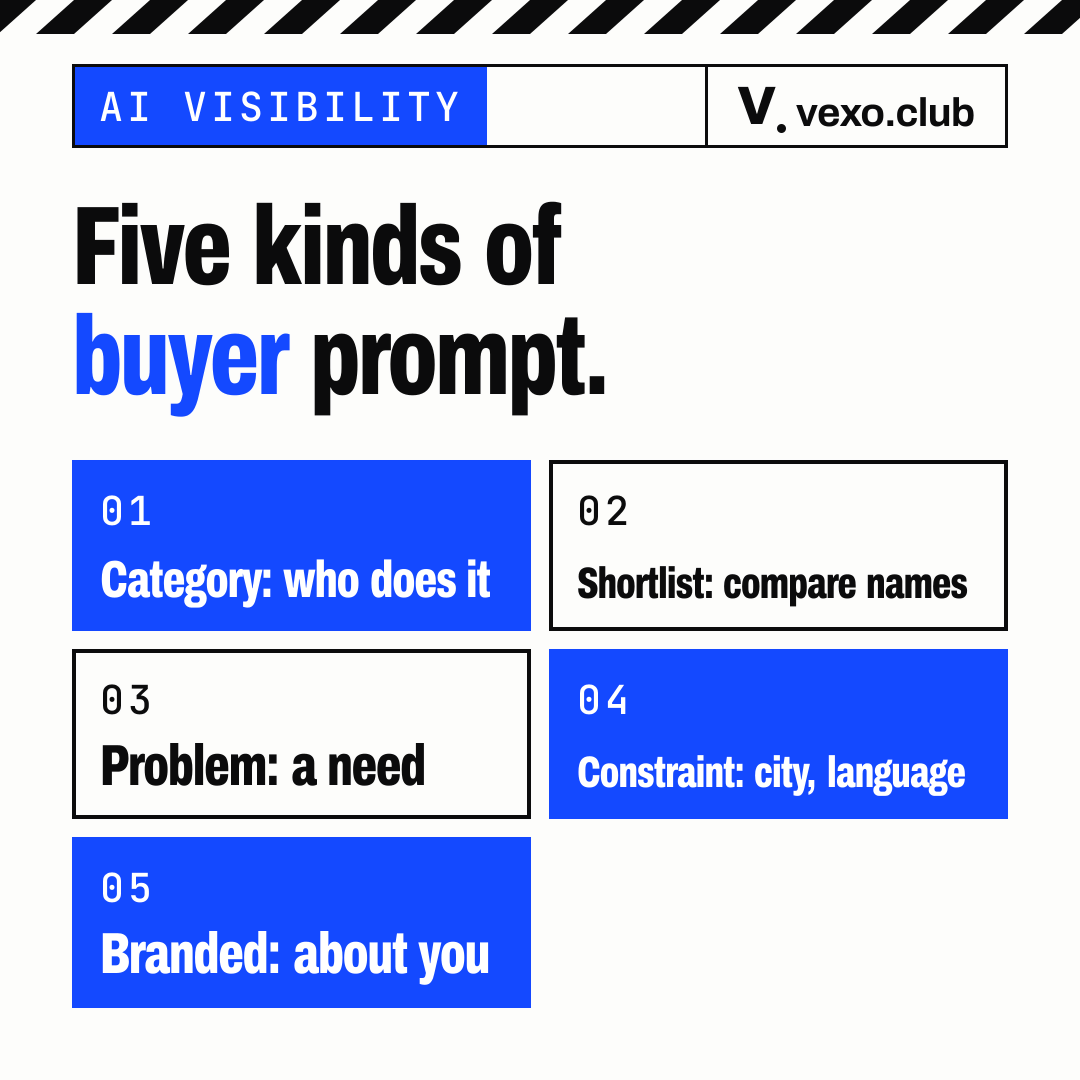
Then sort what you collected into five clusters. Examples you can paste and adapt:
- Category: “Which agencies run creator campaigns for D2C brands in India?”
- Shortlist: “Compare agencies for regional-language creator campaigns for a skincare brand.”
- Problem: “Our creator posts get views but no sales. Who can fix the brief?”
- Constraint: “Influencer agency in Delhi NCR that works in Hindi and Punjabi for a food brand.”
- Branded: “What does [agency name] do and who is it for?”
Treat the branded cluster as a control. It shows whether the engines know you exist and whether what they say is true. It never shows whether buyers find you because buyers do not know your name yet. A sheet padded with branded prompts will flatter you and mislead you in the same cell.
Five clusters for a buyer-prompt set
Write each prompt once and give it a permanent ID. Never edit the wording later: if you change it, create a new ID and keep the old one so history stays comparable. Write down in advance the five or six competitors you expect to see so that scoring is not improvised after the fact. Add prompts in Hindi or Hinglish if your buyers write that way. Google lists Hindi and several other Indian languages among the languages where AI Overviews are available, so treat each language as its own cluster instead of a translation of the English one.
How many prompts is a judgement and not a standard. Fewer than about twenty cannot cover five clusters. Past about a hundred a single person stops logging carefully. A workable start is around forty, split in two tiers. Tier one is the ten or so prompts that match the briefs you actually want. Run those several times each cycle. Tier two is everything else. Run it once per surface per cycle as a scan for surprises and never as a score. That keeps a cycle to an afternoon.
Which surfaces do you sample and how?
The four surfaces behave differently enough that each needs its own rule, and the first rule is to keep them in separate columns. A combined number hides which engine disagrees with the others.
The four surfaces and how each one is sampled
| How to sample it | What you can log | The trap | |
|---|---|---|---|
| ChatGPT | Fresh chat with search on, signed out or temporary and unpersonalised | Answer text and the Sources panel | Memory can reshape the search ChatGPT runs |
| Perplexity | New thread in a private window with web on | Answer and its source list | Signed-out threads expire, so save your own copy |
| Gemini | New chat, signed out or on a clean account | Answer and a Sources button when one appears | Some answers carry no sources at all |
| Google AI Overviews | By hand in a normal browser, never by script | Whether an overview showed, its text and links | No overview shown is not a miss |
ChatGPT. Use a fresh chat for every run so that earlier turns do not bleed into later answers. OpenAI says a temporary chat can be started unpersonalised, meaning it uses no memory and no custom instructions. Open prompts can make the app ask a clarifying question instead of answering. Log those runs as “asked back” and keep them, because a real buyer sees exactly that. If you ever evaluate a paid tool, ask whether it reads the app or the API. One data-integration vendor tested both on the same prompts and found the two named different tools and placed them differently. That is one vendor’s study on one kind of prompt, so read it as a reason to ask and not a law.
Perplexity. It is built around cited answers, so it is the easiest place to log sources. Use a new thread in a private window. Its help centre says web search can be switched off at the start of a thread, and an answer with web off tests what the model already knows. That is a different question, so keep those runs out of the main log. Signed-out threads are also kept only for a limited time, so paste the answer into the sheet the same day.
Gemini. Google’s own help says not all responses include sources. A citation count on Gemini is therefore weak evidence and should not headline any report. Score mention and accuracy there and log a citation only when one appears.
Google AI Overviews. Do this by hand in a normal browser window and never by script. Google’s spam policies list sending automated queries to Google, including scraping results for rank-checking, as machine-generated traffic that violates its policies and terms of service. Ask any paid tool where its AI Overview data comes from. Google shows an overview only when its systems decide generative AI will help, so a query with no overview is a result and not a failure. Log “no overview shown” as its own outcome. If your buyers also use AI Mode, decide once whether it is in scope and write it into the sheet.
Why does the answer change every time, and what do you do about it?
Because retrieval and generation both vary. The engine may issue different searches. It may read different pages. It may phrase a shortlist in a different order or drop the fourth name. That is the medium, and your method has to absorb it. Four habits do that work:
- Repeat each tier-one prompt several times per surface per cycle. Three runs is the floor and five is better for the prompts that decide your pipeline. One run cannot tell a rare event from a common one.
- Spread the repeats across different days and hours instead of asking five times in a row. Back-to-back runs share what the engine retrieved that minute.
- Fresh chat or thread every time. Same device and the same stated state for the whole cycle.
- One person logs, or two people who have agreed the scoring rules. Scoring drift between loggers looks exactly like model drift.
An illustrative case. An agency in Delhi NCR runs its regional-language prompt five times on ChatGPT in one cycle and is named in three runs. The next cycle it is named in one. Nothing changed on its site. That swing is the engine, not the agency. Without a baseline the team celebrates the first cycle and panics at the second. With two baseline cycles on record they know a swing of that size is ordinary here, and they wait. Different prompts carry different noise, so you cannot borrow a tolerance from anyone else.
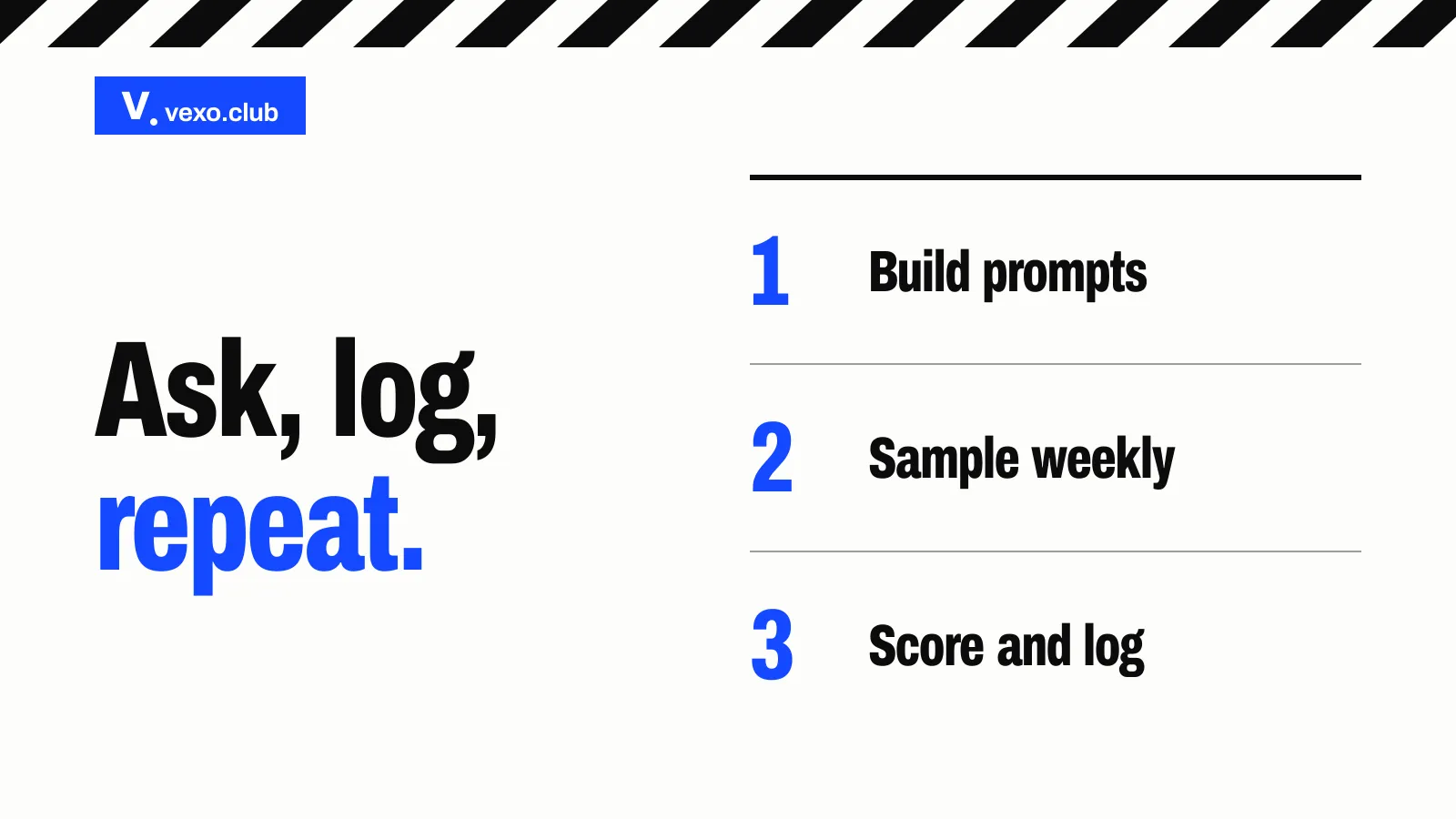
Skip daily runs. They mostly capture ordinary variation. A fortnightly cycle for the full set and a weekly pass for tier one is enough for a small agency. If nobody will act on the result, monthly is fine.
Should you test logged out or logged in?
Use logged out as the baseline and keep logged in as a separate labelled column. Logged out is reproducible. It approximates a buyer who has never used the product with any history, which is the buyer you are trying to reach. Logged in is closer to what a regular user sees but it is not reproducible by anyone else, because the answer depends on that account.
The reason is personalisation. OpenAI says that when Memory is on, ChatGPT may use relevant details to shape a search query. So an account that has spent months discussing your agency, your clients and your competitors will not see what a stranger sees. That is why the account of whoever runs the monitoring is the worst possible test account. If you want a signed-in column, create a clean account used for nothing else. Where the product allows it, use a temporary chat set to unpersonalised. And never fold the two states into one number. A mixed score cannot be reproduced.
Location matters for city prompts. OpenAI says ChatGPT can use location information for local results, so sample from the place your buyer would be sitting and write the city in the log. A Delhi NCR prompt asked from Bengaluru is a different test.
How do you score a mention, a citation and an accurate fact?
They are three different things and a sheet that merges them hides the most useful finding. A mention means your name appears in the answer text. A citation means a page appears as a source, and you should log your own domain and third-party pages about you in separate cells. Accuracy means the facts the answer states about you match a fact sheet you wrote before the first run.
How much each kind of appearance tells you
Weak evidence Strong evidence
- Named in passing inside a long list Leans Weak evidence
- Named with a wrong or stale fact A problem to fix at its source, not a win At Weak evidence
- Your own page listed as a source Proves the page was read, not that you were recommended In the middle
- Named and described correctly Leans Strong evidence
- Recommended for the exact need in the prompt, with correct facts At Strong evidence
The combinations tell you different things. A mention with no citation means the engine knows you from somewhere but did not link where. Find out where. A citation with no mention means a page of yours was used and your name was dropped, which often points to a page that answers the question without saying who you are. A mention with a wrong fact is the case to chase first. A buyer reading “this agency does not work in Hindi” when it does has been talked out of a call by a sentence nobody wrote on your behalf. Trace the claim to its source, fix that source and note the date. The method for doing that is in how AI search engines choose sources.
Write the fact sheet before you score anything. Ten or so plain claims: what you do, where you are based, which platforms and languages you work in, how you charge, who you do not work with. For each answer mark every claim right, wrong or absent. Absent is not wrong. It is a gap, and it points to the page you have not written yet. Add a role for each mention: recommended, listed, passing, or warned against.
What should the spreadsheet look like?
Three tabs. The prompts tab holds ID, wording, cluster, tier and language. The raw log tab holds one row per observation using the columns below. The summary tab counts: mentions, citations and right facts per cluster per surface, written as a count over runs. Use COUNTIFS on the raw tab so the summary rebuilds itself and nobody types a number twice.
Columns for the raw log tab
- Run ID and date and time in IST
- Prompt ID, cluster and tier
- Surface and the model or mode label the screen shows
- State: signed out, signed in, or temporary and unpersonalised
- Location noted, for city prompts
- Mentioned: yes or no
- Role: recommended, listed, passing or warned against
- Own domain cited, and any third-party page cited about you
- Competitors named
- Facts checked against the fact sheet: right, wrong or absent
- Raw answer pasted, screenshot link and who logged it
Paste the raw answer first and score second. Scoring from memory is how a sheet becomes unauditable. Note the model or mode label the screen shows, and keep a separate timeline row whenever you notice a product change such as a new model name or a redesigned results page. Those dates explain jumps you did not cause.
How do you separate signal from noise?
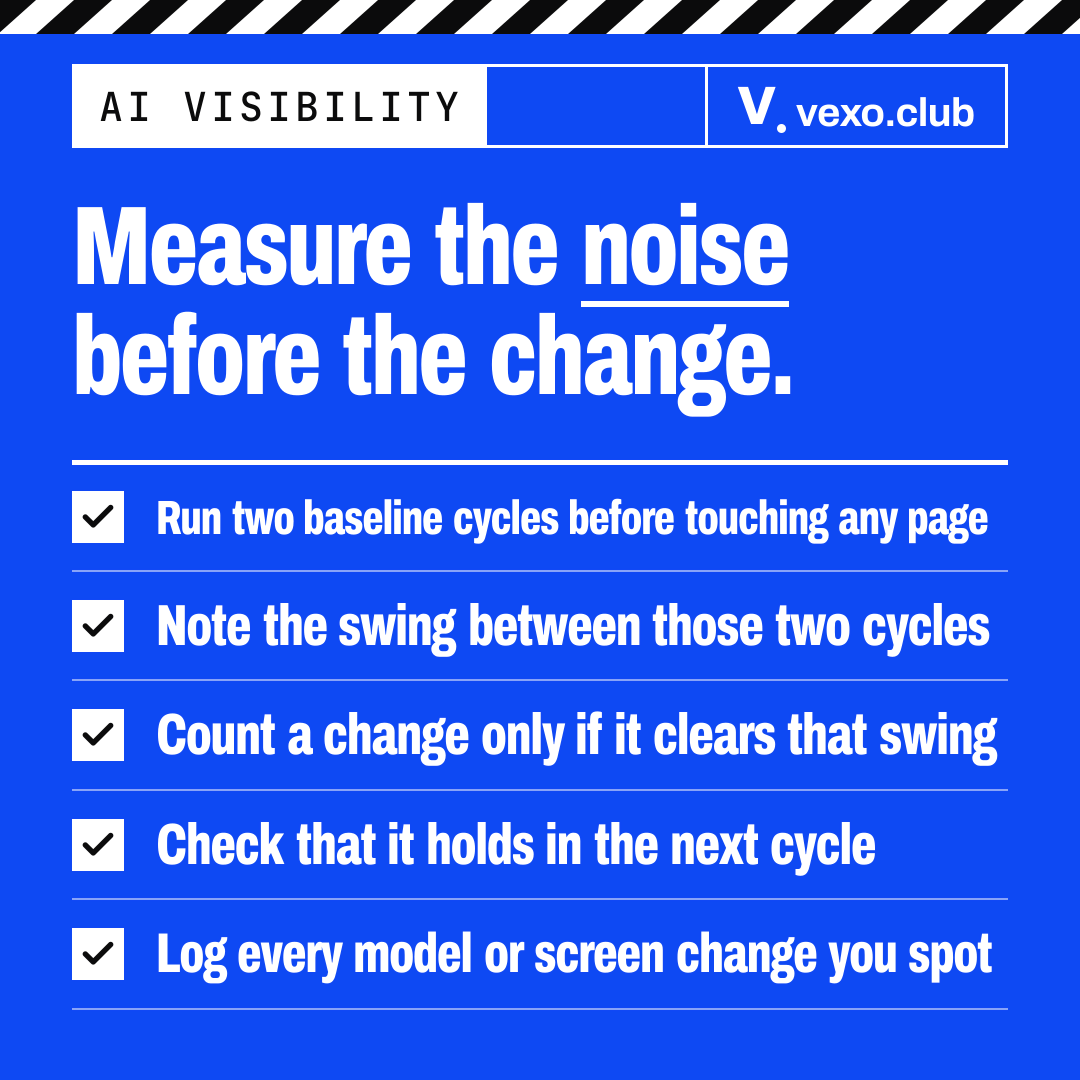
Run two baseline cycles before you change a single page, and treat the gap between them as your noise. Then apply four rules. Read clusters rather than single prompts, because one prompt can swing on its own while a whole cluster rarely does. Count a change only if it clears your baseline swing and holds in the next cycle. Look for agreement across surfaces: a rise on Perplexity alone is a weaker story than a rise on Perplexity and ChatGPT together. And log the competitors too, because a rival disappearing from answers lifts your share without anything you did.
Separating signal from noise
Pair the sheet with evidence that does not come from sampling. OpenAI says ChatGPT adds utm_source=chatgpt.com to referral URLs from its search results, so tagged visits can be counted in your analytics. That covers one assistant and only people who clicked. A visit that arrives with no tag will look like direct traffic. Add one line to your enquiry form asking how the brand manager first heard of you, with “asked an AI assistant” as an option. It is crude and self-reported and still worth having. Measuring influencer marketing ROI draws the same line between a signal and a claim for campaigns.
What cannot be measured?
More than the dashboards imply. Be blunt about it in every report.
What a prompt sheet can and cannot tell you
A sheet can show
- How often your name appears for a fixed set of prompts in a stated state
- Which sources the engines list beside your name
- Whether the facts stated about you are right
- Which competitors travel with you in answers
- Whether a change held across several cycles
No sheet can show
- How many real people asked each prompt
- What a signed-in buyer with a long history was shown
- How many people saw an AI Overview and never clicked
- Whether an answer won or lost a brief
- Why a particular answer changed
Demand is the biggest gap. None of the help pages we read for ChatGPT, Perplexity, Gemini or Google publishes how many people ask a given prompt. A tool that reports prompt volume is estimating it. You also cannot see what a real signed-in buyer was shown, because personalisation is per account. For Google specifically, Search Console reports AI Overview and AI Mode traffic inside the overall Web search type, so you cannot isolate it there, and an impression with no click is invisible to your own analytics. Nor can the sheet prove an answer won or lost a brief: a buyer who asked an assistant and then phoned looks the same as one a friend referred. And it cannot explain a change. It records that the answer moved. Why stays a hypothesis.
Why one screenshot proves nothing
When is a paid tool worth it?
When the sheet breaks. That means more prompts than one person can log carefully, several clients to report on, or a need for daily sampling. Not before. Do not buy a tool because you want a number if you have no fact sheet, no agreed scoring and nobody who can edit the pages the engines are reading. When you do evaluate one, put these questions to the vendor in writing:
- Do you sample the consumer app or the API, and is that stated on each result?
- How many repeat runs per prompt do you do, and can I see the individual runs and not only an average?
- Do you store the raw answer text and the source URLs, and can I export them?
- Which state do you sample in: signed out, signed in, or something else? What location and language?
- Where does your Google AI Overview data come from, and does it respect Google’s terms?
- How do you show the uncertainty of a score from a small number of runs?
What do you do this week?
The first cycle is one afternoon. In order:
- Write the fact sheet of about ten claims about the agency or brand.
- Collect twenty to forty real buyer sentences from enquiries and threads and strip any names.
- Sort them into the five clusters and give every prompt an ID.
- Choose the ten that map to the work you want and mark them tier one.
- Open a clean signed-out browser profile and run tier one on all four surfaces, pasting every raw answer into the log.
- Score mention, citation and each fact. Mark “asked back” and “no overview shown” as outcomes.
- Repeat on two other days this week and again next fortnight. Change nothing on your site until two cycles are logged.
vexo.club is a Delhi NCR desk and this guide reports no results of its own. It describes a method, and no count in it is a measurement the desk took. Once the baseline is in, the Google AI Overviews piece and schema markup for influencer marketing websites are the two obvious places to act on what the sheet shows.
Questions brands ask
How do I track whether ChatGPT recommends my agency? Write a fixed set of buyer prompts without your name in them and ask each one in a fresh signed-out chat with search on. Paste every answer into a sheet and mark whether you were named and in what role. Repeat on different days before you read anything into it.
Why does ChatGPT give a different answer every time I ask? The engine can issue different searches and read different pages each time and then writes a new paragraph. So a single answer is a sample and never a verdict. Repeat the prompt and report counts such as three of five runs.
How many prompts and how many repeat runs do I need? There is no agreed standard, so this is a judgement. Around forty prompts is workable by hand. Run the ten or so that matter at least three times per surface per cycle and the rest once. If your result swings between cycles with no site change then you need more repeats on that prompt, not a new theory.
Can I automate checking Google AI Overviews? Not with your own scripts. Google’s spam policies treat automated queries to Google, including scraping for rank-checking, as machine-generated traffic that breaks its policies and terms. Sample by hand or ask any tool vendor where its data comes from.
Is a mention the same as a citation? No. A mention is your name in the answer text. A citation is a page listed as a source. You can have either without the other, and each points to a different fix. Log them in separate columns along with whether the facts stated about you are right.
Can I see how many people ask AI about my brand? Not from the platforms. The help pages we read for ChatGPT, Perplexity, Gemini and Google do not publish prompt volume. Tools that show it are estimating. Your own enquiry form and tagged referral sessions are firmer evidence of real interest.
Should I test in a logged-in account or logged out? Baseline on logged out because it can be reproduced and resembles a new buyer. Keep any signed-in tests on a clean account used for nothing else and log them in their own column. Never test from your own daily account because stored memory can change the searches that run.
Do I need a paid AI visibility tool? Not at the start. A spreadsheet teaches you the method and the noise level. Pay when you have more prompts or clients than one person can log carefully and when someone is ready to act on the findings. Ask the vendor whether it samples the app or the API and how many repeat runs sit behind each score.
If you would rather talk through a prompt set or a fact sheet with the desk before you build it, send a note with the market and the kind of brands you work with.
Sources
- query fan-out (opens in a new tab) developers.google.com
- languages where AI Overviews are available (opens in a new tab) support.google.com
- unpersonalised (opens in a new tab) help.openai.com
- tested both on the same prompts (opens in a new tab) windsor.ai
- kept only for a limited time (opens in a new tab) perplexity.ai
- not all responses include sources (opens in a new tab) support.google.com
- spam policies (opens in a new tab) developers.google.com
- may use relevant details to shape a search query (opens in a new tab) help.openai.com
Cite this page
Prompt monitoring for AI visibility: a spreadsheet method for influencer agencies. vexo.club, published 25 Nov 2026. https://vexo.club/blog/llm-prompt-monitoring-for-influencer-agencies
Send the desk a brief: it comes back as a shortlist and a directional band, never a public price.
Brief the desk