Influencer campaigns in Varanasi, Ayodhya and Prayagraj: pilgrimage-season rules
The pilgrim circuit of Kashi, Ayodhya and Prayagraj is a real audience for hotels, retailers, devotional and travel brands, and where a careless reel causes the most trouble. The season calendar, what you can film, and what ASCI, consumer law and the criminal code say about religious sentiment.
Playbooks 20 min read The vexo.club desk
In this article12 sections
A brand can run influencer campaigns around Kashi, Ayodhya and Prayagraj, and many do, but the work is mostly restraint. The audience is large and warm toward the right hotel, shop or devotional product. The cost of one careless line is also high, because religious sentiment is the one subject where a complaint, a police report and a viral pile-on can arrive in the same afternoon. The short rule: film the journey and the place you serve, never the sanctum. Claim only what you can document. And treat the creator as a visitor, not a priest.
The pilgrim circuit, in short
- There is no Kumbh at Prayagraj to plan around until the Ardh Kumbh in 2031. The yearly calendar is Dev Deepawali, Deepotsav, Magh Mela, Mahashivratri and Sawan.
- Phones and cameras are kept out of the Kashi Vishwanath and Ram Mandir complexes by the temples themselves. A brief that needs sanctum footage is a brief that cannot be filled.
- On ghats and mela grounds the limits come from the district police and administration, and they change by season. Drone rules in particular are issued per event.
- ASCI bars advertising that derides a religion or promotes intolerance, and the Consumer Protection Act reaches the false claim, not the sentiment. Criminal law on religious feelings sits on top of both.
- Devotional product claims are the sharpest risk: authorisation for any temple name, no cure or luck guarantees, and a creator who has seen the evidence before saying a word.
This guide covers the season calendar, what the temples and administrations actually allow, how to find local-language creators who suit the work, and what ASCI, the Consumer Protection Act, the criminal code and the magic-remedies law each say. It is written for hospitality, retail, devotional-product and travel brands. It reflects primary sources as of 24 October 2026. None of it is legal advice, and rules at sacred sites change by season.
Is there a Kumbh to plan around, and what is the real calendar?
Not at Prayagraj for several years. The Maha Kumbh there ran in early 2025, and the next at the Sangam is the Ardh Kumbh in 2031. The Kumbh that makes news in 2027 is the Simhastha at Nashik in Maharashtra, and an Ardh Kumbh at Haridwar in Uttarakhand is also reported for that year. Neither is in Uttar Pradesh. If a brief says “Kumbh” for a UP campaign, the first job is to ask what it really means. The answer is usually the annual Magh Mela at Prayagraj, which the Times of India reported in September 2026 as running about 52 days in 2027 from mid-January and ending on Mahashivratri on 6 March.
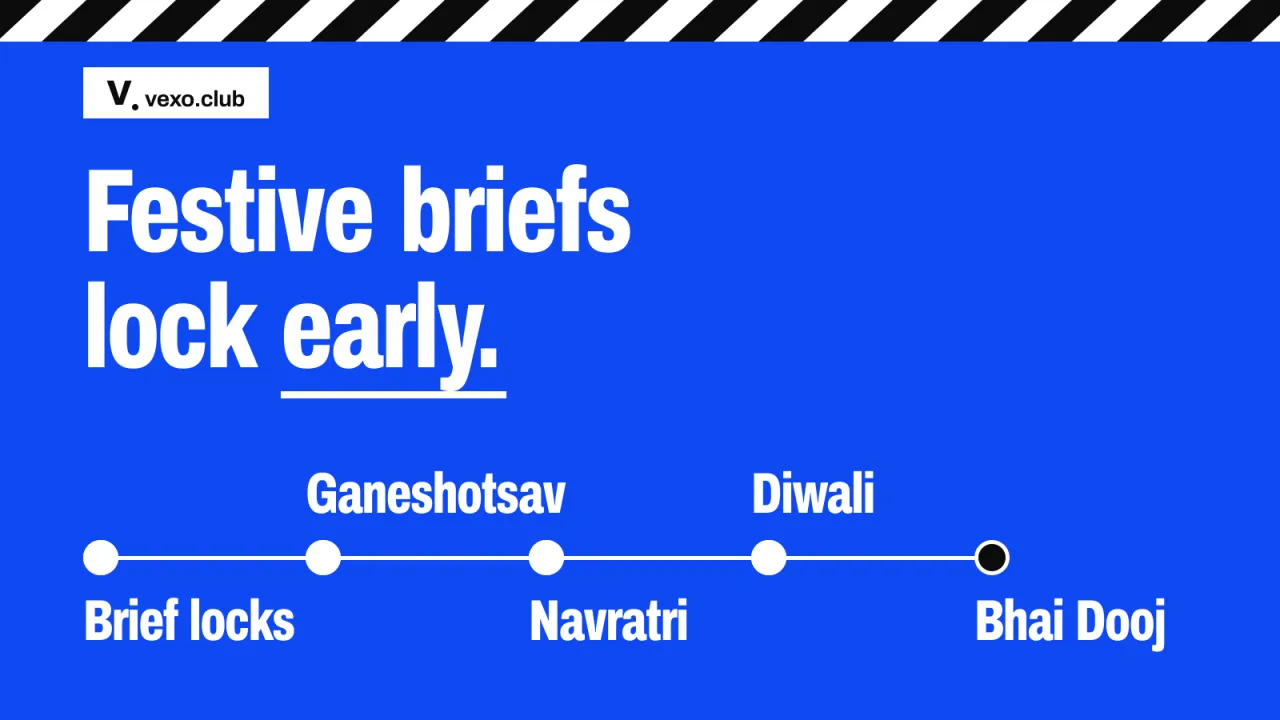
The rest of the calendar is Ayodhya’s Deepotsav on the eve of Diwali, Varanasi’s Dev Deepawali on Kartik Purnima, which falls on 24 November this year, and Sawan, when Kashi Vishwanath is busiest on Mondays. Use the UP Tourism listing for Dev Deepawali and the Magh Mela 2027 listing as the starting point, then confirm with the district office. Festival weeks sell out rooms and boats in advance, so a hotel or travel brief that starts a month before the date has very little room to cast, host and edit. Festive season influencer planning and the Diwali campaign guide cover the booking side.
The pilgrim circuit calendar, 2026 to 2027
| Month | On the calendar |
|---|---|
| January | Magh Mela opens Prayagraj, from 15 January 2027 with Makar Sankranti |
| February | Magh Mela bathing days The main bathing days run through the month. Get the list from the mela administration |
| March | Mahashivratri The 2027 Magh Mela ends on Mahashivratri, 6 March. Kashi Vishwanath is the draw |
| July | Sawan Kashi Vishwanath Mondays are the crowd peak, and entry controls have been tightened in past years |
| November | Deepotsav and Dev Deepawali Ayodhya lights up the Saryu on the eve of Diwali. Varanasi follows on Kartik Purnima, 24 November 2026 |
Can a creator film inside Kashi Vishwanath or the Ram Mandir?
No, and brands should not brief for it. The Shri Kashi Vishwanath Temple Trust’s own FAQ answers the question about carrying a phone by saying that electronic and non-electronic gadgets and even pens are not allowed inside the premises. At Ayodhya the Shri Ram Janmbhoomi Teerth Kshetra trust has publicly told devotees not to carry phones, as the Indian Express reported in March 2024. Check the trust’s current notice before travel, since we could not confirm the present text.
Breaches have consequences beyond the creator. When a young man wore smart glasses into the Kashi Vishwanath sanctum and posted the footage, the Times of India reported that the temple administration and police opened an investigation into how he crossed three layers of security, and that he deleted the video and his account after criticism. A brand whose creator is in that story does not get to say it was the creator’s own decision. The post carried the brand’s product.
A brief should therefore say plainly that nothing is filmed inside restricted areas, including with wearables. Ask each creator for a sentence confirming it. A creator who answers with a workaround has answered the question you needed answered.
What about ghats, aarti spaces and the mela grounds?
These are public or semi-public spaces with no single gatekeeper, which is exactly why they need more care, not less. The practical limits come from the district administration and the police commissionerate, and they are issued for events. For the 2025 Maha Kumbh the Prayagraj Commissionerate required creators to get prior police permission before flying a drone and barred posts that could incite unrest or hurt religious sentiments, as ABP reported from PTI. In Varanasi in October 2026 the police set a temporary drone-free zone around Namo Ghat for an air display, per the Times of India. The lesson is that a drone shot you were allowed last month may be illegal this week.
Filming at each site, what is stated and who decides
| What is stated | Who to ask | |
|---|---|---|
| Kashi Vishwanath, Varanasi | The temple trust’s own FAQ says electronic and non-electronic gadgets are not allowed inside the premises | Shri Kashi Vishwanath Temple Trust helpdesk |
| Ram Mandir, Ayodhya | The trust has told devotees not to carry phones into the complex | Shri Ram Janmbhoomi Teerth Kshetra trust |
| Ghats and aarti spaces | No single owner. Drone bans are issued by the police commissionerate for events | District administration and police commissionerate |
| Magh Mela and Kumbh grounds | In 2025 the Prayagraj Commissionerate required prior police permission for drones and barred provocative posts | Mela administration and the police commissionerate |
Is a brand reel a “film shoot” needing a permission letter? We could not confirm that. UP’s Film Bandhu runs a single-window shooting permission through its app, but it is set up for film producers and we found nothing that says a creator’s paid reel must use it. The safe route is to write to the district administration or police commissionerate, state the crew, the equipment and the dates, and keep the reply. Local guides also report that photographing the cremation ghats in Varanasi is not accepted. That is a custom rather than a published notice, and it is reason enough to leave those ghats out entirely.
The working rule for a temple town shoot

How do you shoot a pilgrimage story if the best places ban cameras?
You shoot everything around them. A hotel’s story is the room, the rooftop, the early tea and the walk to the gate. A retailer’s story is the lane where the shop sits and the person at the counter. A devotional-product story is the making, the packing and the home it ends up in. A travel brand’s story is the logistics pilgrims worry about: where to leave footwear, how long the walk is, which gate to use.
Treat bathers and queues as private by default. Women bathing at the Sangam, elderly pilgrims and children are not extras. Shoot wide, shoot from behind or ask. This is a practice rule rather than a legal one, but a post that shows an identifiable stranger at a sacred moment is the one that gets reported.
Building a shoot that works with a no-camera temple
- Write the story outside the gate Lane, ghat step, shop counter, room, kitchen, the walk back
- Ask the owner of each space Trust, district office or hotel, in writing, with dates and crew size
- Fix the shoot on a quiet day Not a snan day, not a Monday in Sawan, not the evening of a festival
- Keep pilgrims out of focus No identifiable bathers, no queues as backdrop without consent
- Send the cut to the brand before posting One reviewer who knows the place, not only the agency
Which creators fit, and how do you vet them for this?
The audiences for these places speak Hindi first, with Bhojpuri around Varanasi and Awadhi around Ayodhya as the dialects that make a voice sound local. Confirm what each creator really speaks rather than assuming from the city tag. Regional launch in four languages explains why one translated script across languages underperforms, and influencer marketing in Lucknow covers the nearest large creator pool in the state. Travel and pilgrimage vloggers are a separate pool, covered in travel vloggers in India.
Vetting for this category adds three checks to the usual audience check:
- Read their past posts from religious sites, and the comments under them. A creator whose comments are respectful and local is worth more than one with bigger reach and angry replies.
- Ask whether they have ever filmed in a restricted area and what happened. Honest answers are rare and useful.
- Check that the creator can say the name of the deity, the festival and the ritual correctly. A mispronounced name is the quickest way to lose a local audience.
Illustrative scenario: a Varanasi guesthouse wants bookings for Dev Deepawali week. The sound plan is two local creators hosted on a quiet weekday before the week, a short guide to the ghat walk from the property, a clear note on what the stay includes, and the paid-partnership label in the first line. The weak plan is a reel shot at the aarti with the guesthouse tagged in the caption. The first helps a pilgrim decide. The second uses a ritual to sell a room, and that is the version that gets complaints. The wider travel playbook is in influencer marketing for travel and hospitality brands.
What does ASCI actually say about religion?
The Advertising Standards Council of India is a voluntary self-regulatory body, not a government one, and its Code applies to advertisers, agencies and media. Two parts matter here. Chapter III says no advertisement shall be permitted which derides any individual or group on the basis of religion, among other grounds, or which tends to promote intolerance. Chapter I requires that claims be truthful and substantiated, and says advertisements must not abuse the trust of consumers or exploit their lack of experience or knowledge. A pilgrim buying a “blessed” item is relying on exactly that trust.
ASCI’s own study of complaints, What India Takes Offence To, names hurting religious sentiments as one of six patterns. It describes ads portraying mixed religious narratives, new interpretations of traditions or religious and cultural motifs used humorously as the trigger points. The report notes that some of the ads it studied were not in breach of the Code and still offended people. That is the practical lesson. Passing the Code is the minimum, and the audience applies a stricter test.
A creator’s post is an advertisement under the Code once it is paid for, owned or authorised by the advertiser, which covers a gifted stay or product tied to a brief. ASCI’s influencer guidelines require a visible disclosure label, make the advertiser and the influencer share responsibility for it, and expect influencers to check that the advertiser can back its claims. The full label rules are in ASCI disclosure rules for brands. One extra caution for this circuit: a gifted pilgrimage trip must be labelled, even when the creator is sincerely devout.
Writing a script about a sacred place
Do
Describe what the product or stay is and what it includes
Don’t
Imply the product is blessed, temple-made or temple-endorsed without authorisation
Do
Show respect through the setting: the lane, the lamps, the quiet
Don’t
Use a deity, a mantra or a ritual as a joke, a trend sound or a punchline
Do
Name the occasion and the dates the stay or offer covers
Don’t
Promise luck, wealth, a child or a cure from a charm, kavach or yantra
Do
Disclose the paid or gifted link in words the viewer reads first
Don’t
Present a paid pilgrimage stay as a personal vow or a spontaneous visit
What does the law add on top of ASCI?
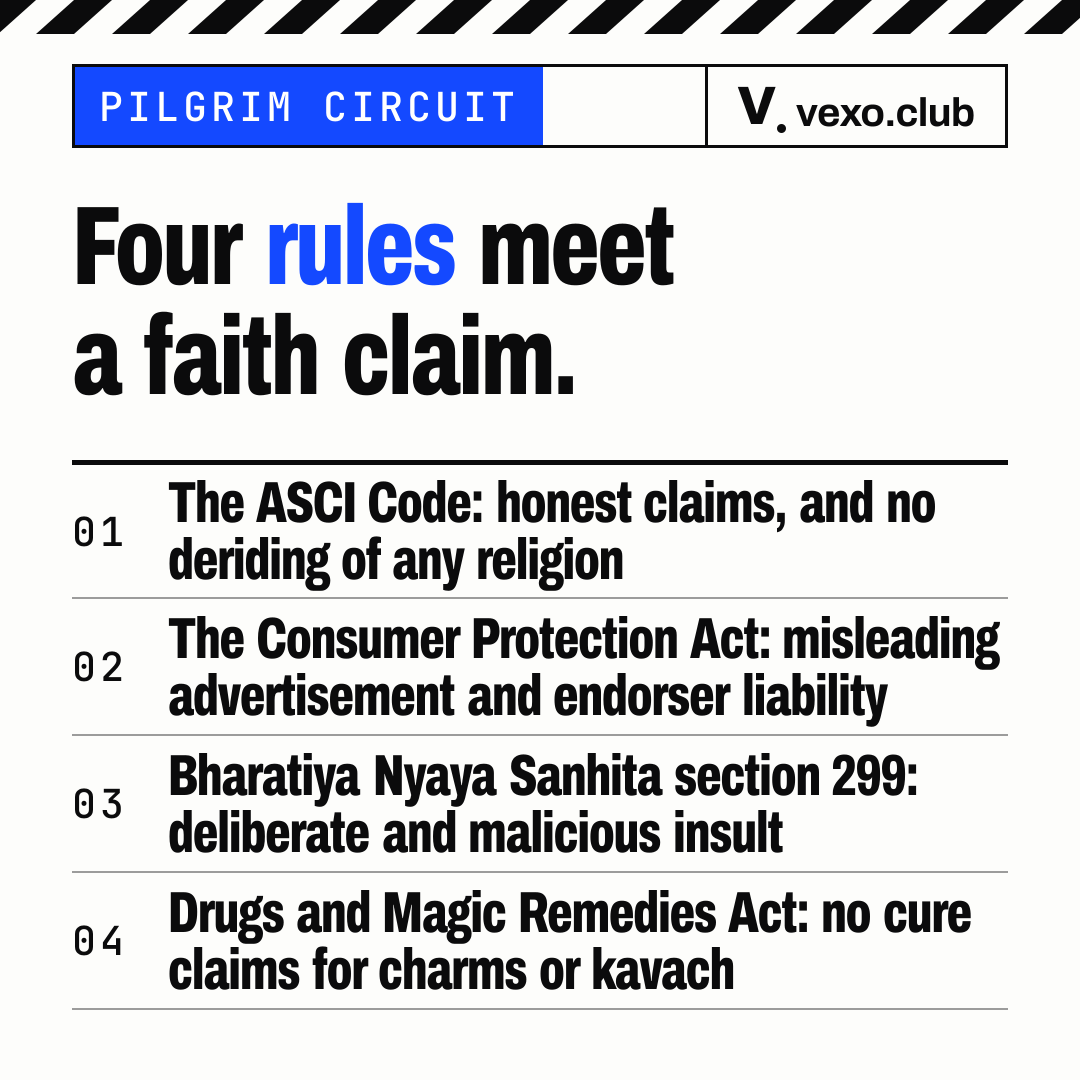
Three statutes, each aimed at something different. The first is consumer law. The Consumer Protection Act, 2019 defines a misleading advertisement in section 2(28) as one that falsely describes a product or gives a false guarantee, or is likely to mislead about its nature, substance, quantity or quality. Under section 21 the Central Consumer Protection Authority can direct a trader, endorser, advertiser or publisher to stop or change the advertisement, impose a penalty of up to ten lakh rupees on a manufacturer or endorser and up to fifty lakh rupees for a repeat, and bar an endorser from endorsing for up to one year. An endorser who exercised due diligence to verify the claims is protected from those penalties. Section 89 separately provides for imprisonment of up to two years and a fine for a manufacturer or service provider who causes a false or misleading advertisement. The CCPA’s 2022 endorsement guidelines require an endorsement to reflect the endorser’s genuine, current opinion and to rest on adequate information or experience.
The second is the one most specific to this circuit. In January 2024 the CCPA issued a notice to Amazon over sweets sold as “Shri Ram Mandir Ayodhya Prasad”, noting the e-commerce rules’ bar on unfair trade practices and the section 2(28) definition. The CCPA’s orders page lists an Amazon order on that matter dated 4 August 2026. In it the authority finds that devotees understand the phrase as sacred food offered to the deity at the temple, imposes a penalty of one lakh rupees and directs the platform to keep products falsely claimed as prasad for ten named shrines, including Kashi Vishwanath, off its site. The principle is already clear from the notice: a temple’s name or word “prasad” on a product is a claim about authenticity.
The third is criminal law, and it is where nuance matters. Section 299 of the Bharatiya Nyaya Sanhita, which replaced section 295A of the Indian Penal Code, punishes with up to three years, a fine or both anyone who, with deliberate and malicious intention of outraging the religious feelings of a class of citizens, insults or attempts to insult their religion or beliefs, including through electronic means. The text is quoted in a High Court order and the offence is classed as cognizable and non-bailable in the BPRD ready reckoner. The courts have said the law is aimed at aggravated insult with deliberate and malicious intent, and in 2017 the Supreme Court quashed a case over a cricketer’s magazine cover on that basis, as ThePrint recounts. The same report notes that FIRs are often filed because of online anger rather than because the ingredients are met. A brand that is eventually cleared has still spent weeks on it, and the post is gone either way.
The four rules a devotional or pilgrimage claim runs into
What can a devotional-product brand say about its product?
A short list, and it is stricter than most D2C teams expect. Name a temple, trust or shrine only with written authorisation, and keep the letter. Do not use “prasad”, “bhog” or “blessed at” for anything not made or offered there. Source claims need a source: if gangajal is said to come from a named place, the brand should be able to show the collection and packing record. Do not state health, fertility, wealth or protection outcomes for rudraksha, yantra, kavach or any charm.
The last point has statute behind it. The Drugs and Magic Remedies (Objectionable Advertisements) Act, 1954 defines a magic remedy as including a talisman, mantra or kavacha alleged to have miraculous powers to cure or prevent disease or to affect a bodily function. Section 5 prohibits a person carrying on or purporting to carry on the profession of administering magic remedies from publishing an advertisement claiming such a remedy works for the purposes in section 3, which include cures for scheduled diseases and conditions. Section 7 sets a penalty of up to six months on a first conviction. Whether a given retailer falls inside section 5 is a question for counsel. The safe line is simpler: a sacred object is sold as a sacred object, not as medicine.
Who answers when a post goes wrong?
Everyone in the chain, which is why the chain needs a paper trail. The ASCI Code says responsibility lies with all who commission, create, place or publish an advertisement. The consumer-law penalties reach the manufacturer, the endorser and anyone party to the publication, with the due-diligence defence available to an endorser who verified the claims. For a creator, that defence only works if the brand gave them something to verify.
Put that in the contract before the product ships. The clauses to add to your influencer contract:
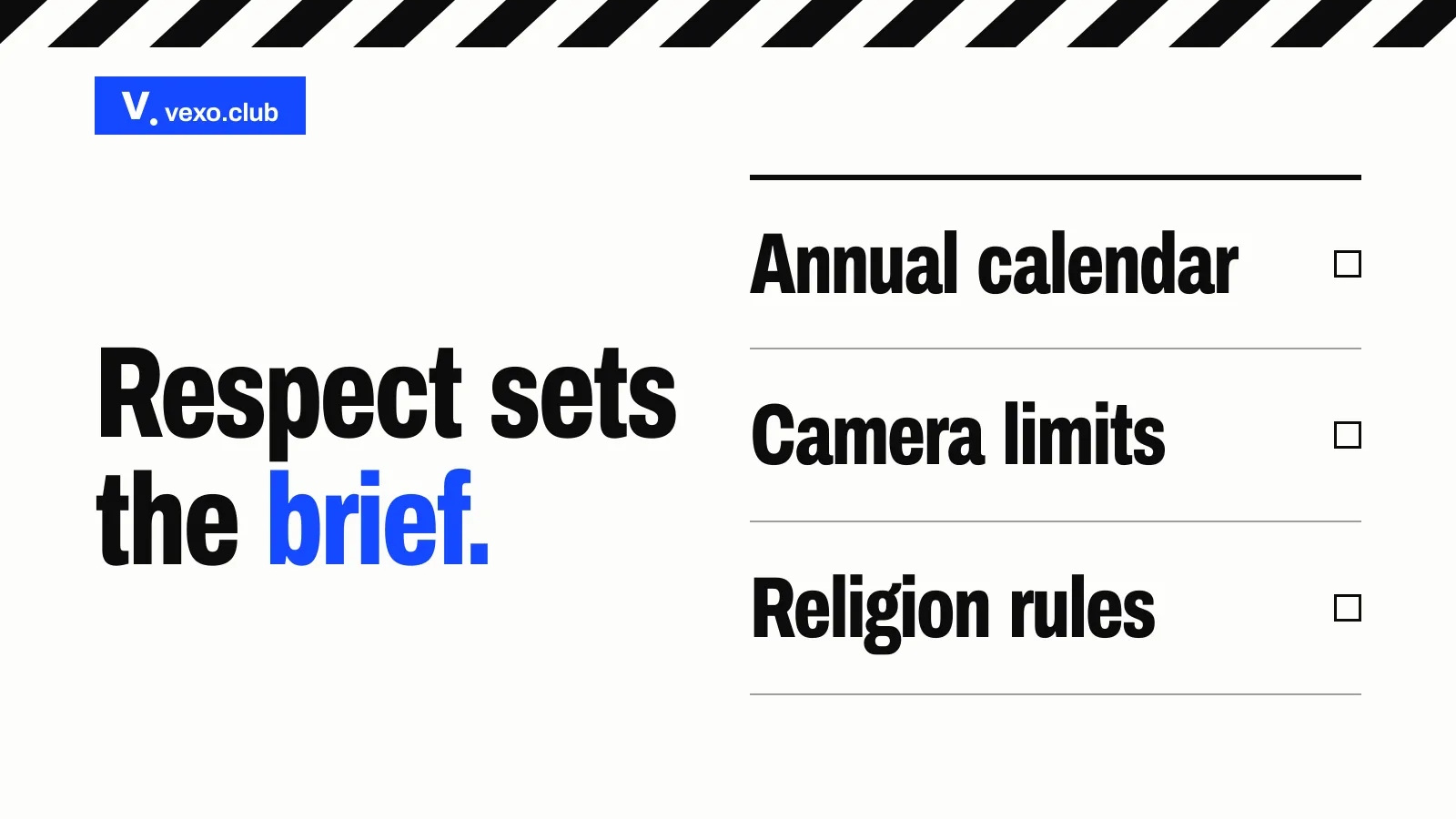
- No filming in any area where the temple, trust or administration prohibits it, including with wearables or drones, and a written warranty from the creator to that effect.
- A claims schedule, signed by the brand, listing every statement the creator may make about the product, with the document behind each.
- No use of deities, mantras or rituals as humour, trend audio or a punchline, and no comparison of faiths or communities.
- Brand approval of the cut before posting, and a takedown right within a set number of hours if a complaint or notice arrives.
- A morality and conduct clause that covers a post about a religious site, as set out in the morality clause playbook.
A paste-ready line for the brief: “All footage will be shot only in areas open to the public and with the written permission of the owner of each location. No footage will be shot inside any temple sanctum or area where cameras, phones or wearables are prohibited. No drone will be flown without written police permission. Every claim spoken or written about the product must come from the attached claims schedule.” Pair it with the usual creator brief.
Who answers for a post about a sacred place

When is the right answer not to run this campaign?
Three cases. First, if the offer needs sanctum or ritual footage to make sense. Second, if the product’s appeal rests on a temple link you cannot document. Third, if nobody on the brand side can read the comments in Hindi and spot trouble. In the third case, hire the reader before you hire the creator. Smaller hotels and shops often do better with a few local creators on a hosted visit than a single big film.
Where vexo.club fits
vexo.club is an influencer marketing desk in Delhi NCR and runs briefs from here. It has no office or team in Varanasi, Ayodhya or Prayagraj, so permissions, site visits and local review have to be arranged with the people on the ground. What the desk can do from Delhi NCR is write the brief, check the claims schedule and contract, and cast creators who have the language and the track record.
Before you spend anything, run this short list.
What to do this week
- Pick the one season you are actually buying for and put its date in the brief, with a confirm-again date a month out.
- List every claim the creator will say aloud and tie each one to a document you can open: licence, label, trust letter or booking terms.
- Write to the owner of every location you want to film and keep the reply with the brief.
- Ask each creator for two past posts from a religious site and read the comments, not just the views.
- Add the clause set below to the contract and send it before the product ships.
- Name one local reader who can stop the post if something sounds wrong.
Questions brands ask
Can influencers film inside Kashi Vishwanath or the Ram Mandir? No. The Kashi Vishwanath trust’s FAQ says gadgets are not allowed inside the premises, and the Ram Mandir trust has told devotees not to bring phones. Plan footage for the approach, the lanes and the ghats instead, and check the trust’s current notice before travel.
Is there a Kumbh Mela at Prayagraj in 2027? No. The Maha Kumbh was in early 2025 and the next Ardh Kumbh at the Sangam is in 2031. The annual event is the Magh Mela, listed by UP Tourism for 15 January to 6 March 2027. The 2027 Kumbh in the news is at Nashik in Maharashtra.
Do I need permission to fly a drone at a ghat or mela? Treat the answer as yes, every time. For the 2025 Maha Kumbh the Prayagraj Commissionerate required prior police permission, and Varanasi police have declared temporary drone-free zones for events. Ask the police commissionerate in writing and keep the reply.
What does ASCI say about religious sentiment in ads? Chapter III of the Code bars advertising that derides any group on the basis of religion or tends to promote intolerance, and Chapter I requires truthful, substantiated claims. ASCI is self-regulatory, so its remit is complaints and non-compliance, not prosecution, but its Code is recognised in the cable rules and used as the industry baseline.
Can a brand be prosecuted for hurting religious sentiments? Section 299 of the BNS punishes deliberate and malicious insult to a class’s religion with up to three years, a fine or both. The courts have said it needs that intention, but complaints and FIRs are filed regardless. The sensible defence is to never make a sacred subject the joke.
Can we sell a product as temple prasad or use a temple’s name? Only with the temple’s written authorisation. In 2024 the CCPA issued a notice to Amazon over sweets sold as Ram Mandir prasad, and its order of 4 August 2026 imposed a penalty and directed a block on false prasad listings for named shrines. Treat the name of a shrine as a claim you must prove.
Are creators liable for what a brand tells them to say? They can be. The Consumer Protection Act lets the CCPA penalise an endorser and bar them from endorsing for up to one year, though an endorser who exercised due diligence to verify the claims is protected. Give creators the evidence and a signed claims schedule so that defence exists on paper.
Can a charm or rudraksha be advertised as curing a problem? No. The Drugs and Magic Remedies Act, 1954 includes talismans, mantras and kavacha in its definition of a magic remedy, and section 5 bars advertising them as cures for the conditions the Act lists. Sell the object as a devotional item and leave health outcomes out.
If you are planning a pilgrimage-season brief for a hotel, shop, devotional product or travel offer and want a second pair of eyes on the claims, the casting and the contract, write to the desk and say which season and which city you are targeting.
Sources
- UP Tourism listing for Dev Deepawali (opens in a new tab) incredibleindia.gov.in
- Magh Mela 2027 listing (opens in a new tab) incredibleindia.gov.in
- own FAQ (opens in a new tab) shrikashivishwanath.org
- Indian Express (opens in a new tab) indianexpress.com
- the Times of India (opens in a new tab) timesofindia.indiatimes.com
- ABP (opens in a new tab) news.abplive.com
- per the Times of India (opens in a new tab) timesofindia.indiatimes.com
- single-window shooting permission (opens in a new tab) play.google.com
- Code (opens in a new tab) ascionline.in
- What India Takes Offence To (opens in a new tab) ascionline.in
- influencer guidelines (opens in a new tab) ascionline.in
- section 21 (opens in a new tab) indiacode.nic.in
- 2022 endorsement guidelines (opens in a new tab) pib.gov.in
- notice to Amazon (opens in a new tab) pib.gov.in
- orders page (opens in a new tab) jagograhakjago.gov.in
- text is quoted in a High Court order (opens in a new tab) elegalix.allahabadhighcourt.in
- BPRD ready reckoner (opens in a new tab) bprd.nic.in
- ThePrint recounts (opens in a new tab) theprint.in
- Section 5 (opens in a new tab) indiacode.nic.in
Cite this page
Influencer campaigns in Varanasi, Ayodhya and Prayagraj: pilgrimage-season rules. vexo.club, published 18 Nov 2026. https://vexo.club/blog/influencer-marketing-varanasi-ayodhya-prayagraj
Send the desk a brief: it comes back as a shortlist and a directional band, never a public price.
Brief the desk