Pet and animal influencers in India: an emerging niche for brand partnerships
Pet influencers in India are pet-parent accounts, trainers, rescue advocates and the occasional vet, and the niche is still forming. What the content looks like, why pet food, pet care and vet-adjacent brands are starting to book it, and how to evaluate a creator before a brief goes out.
Playbooks 10 min read The vexo.club desk
In this article8 sections
Pet and animal content creators in India make the animal, not themselves, the subject of the page: a dog being trained, a rescue being fed, a cat doing something a cat should not be able to do. The niche is younger than fashion or fitness and has no settled shape yet, which is itself useful information for a brand deciding whether to book into it. Less competition for attention also means less proof of what works, so the brief has to do more of the thinking a bigger category would already have answered.
This guide comes from vexo.club: an influencer marketing agency run from one desk in Delhi NCR; the registered company is Vexocore IT Services Private Limited. It sorts pet and animal creators by what they are set up to say, names no creator this desk cannot stand behind, and leaves follower counts out entirely, because a niche this new is better read by its content than by a number that moves daily.
Pet and animal creators in short
- Pet and animal creators range from pet-parent lifestyle accounts to certified trainers, rescue advocates and veterinary professionals, and what each may be asked to say differs.
- A credential matters most where the claim touches health, diet or training outcomes; a pet-parent account speaks from its own experience and nothing more.
- The animal on screen is part of the brand asset, so how it is handled in the content matters as much as the claim made about it.
- Format follows the claim: a trick or a product in use suits a short reel, and a training series or an adoption story needs the room of a longer video.
Who are the pet and animal content creators in India?
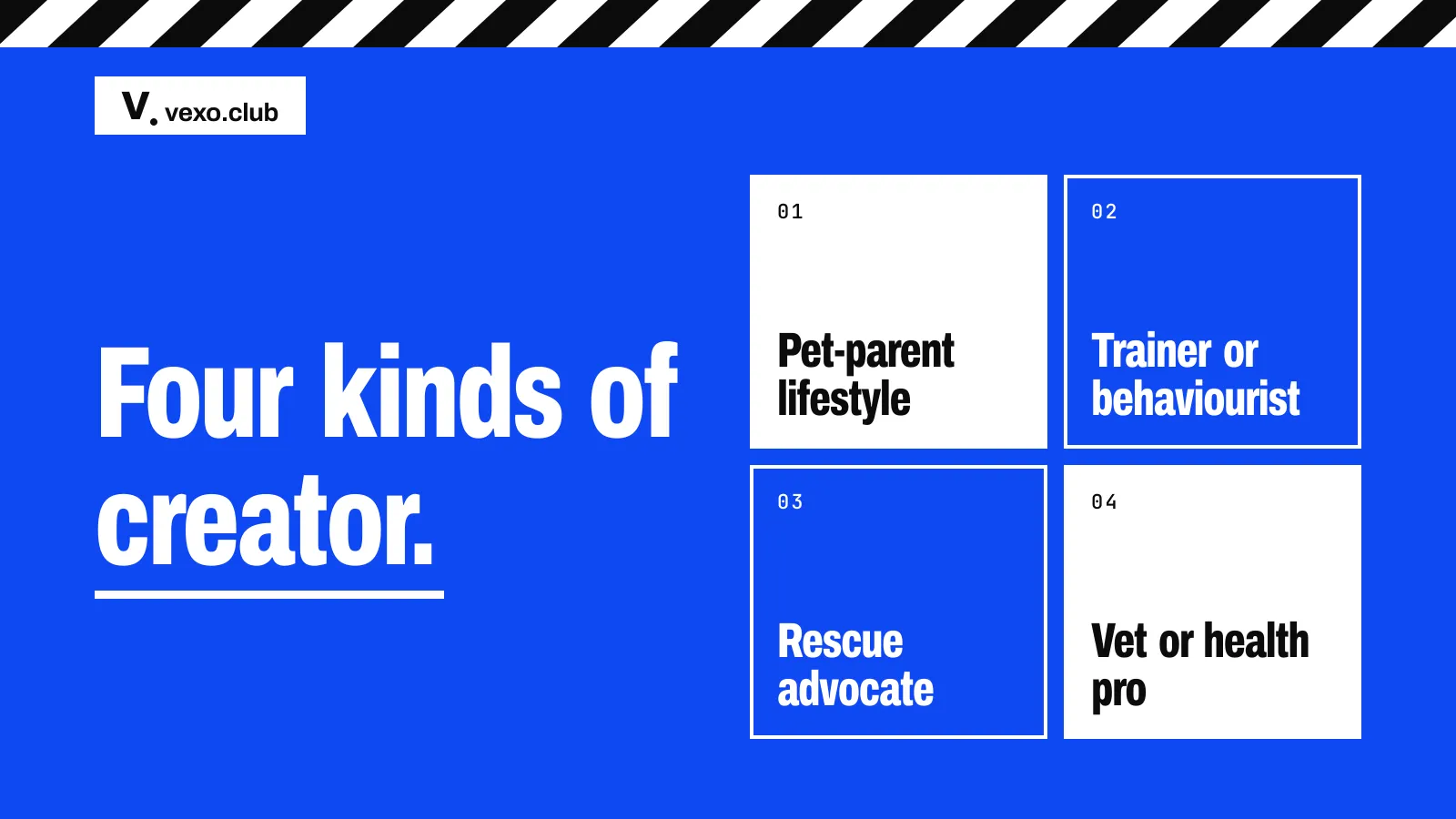
They sort into a handful of working types, and a brief should name the type before it names a creator. A pet-parent account posts daily life with one animal or a household of them. A trainer or behaviourist posts method: obedience work, correcting a habit, reading a dog’s body language. A rescue or shelter advocate posts intake stories, recovery arcs and adoption calls. A veterinary or animal-health professional posts diagnosis-adjacent content: what a symptom means, what a routine check looks like, when to worry and when not to. Exotic-pet and farm-animal accounts sit alongside these as smaller, specialist corners of the same niche.
Four kinds of pet and animal creator, and what each is for
| What they bring | Suited to | Brief rule | |
|---|---|---|---|
| Pet-parent lifestyle creator | Daily life with a pet, told with warmth | Pet food, toys, grooming, bedding and lifestyle products | Speaks from ownership; no training or health claims |
| Certified trainer or behaviourist | A method and a trained eye for behaviour | Training aids, behaviour products, obedience and boarding services | States the certification; claims stay inside it |
| Rescue or shelter advocate | Reach into an audience that adopts and donates | Adoption drives, welfare products, shelter and NGO partnerships | Claims about outcomes for other animals stay out of the post |
| Veterinary or animal-health professional | A veterinary or nutrition credential | Diet changes, supplements, clinics and insurance, health-adjacent claims | States the qualification upfront; claims stay inside it |
What does pet and animal content actually look like?
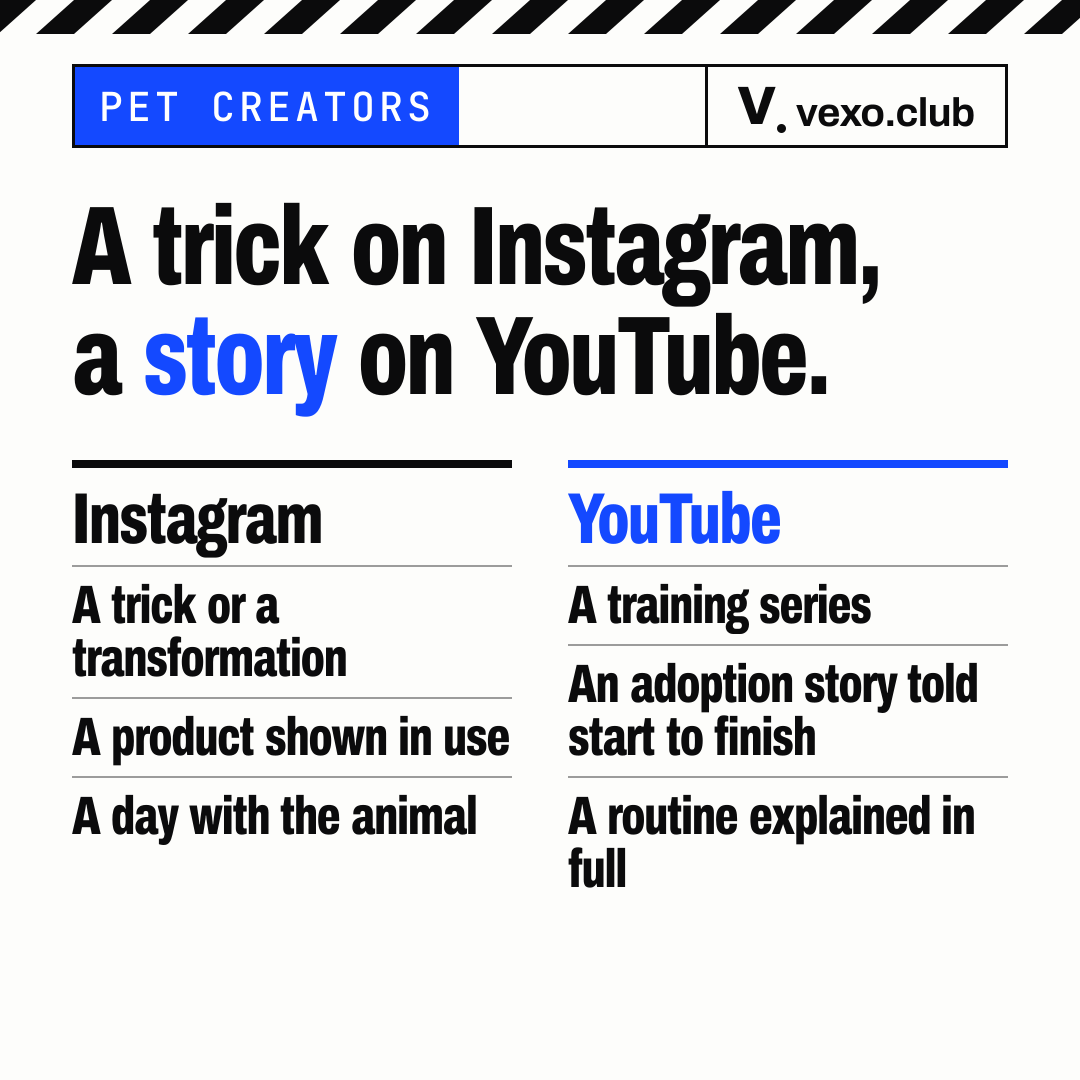
The platform decides the length and the claim decides the rest. Instagram favours the short unit: a trick that pays off in seconds, a transformation (a nervous rescue settling in, a matted coat groomed out), a product shown mid-use rather than described. YouTube favours the long unit: a full training series across several sessions, an adoption story followed from intake to a home, a routine or a diet change explained with enough room to show the method, not just the result. A brand new to the category often books the wrong length for the claim it needs to make, which is the single most common brief mistake here.
Where pet and animal creators show their work
Why are brands starting to book pet and animal content creators?
Three kinds of brand have a reason to be here. Pet food and treat brands need the product shown in use, by an animal that is plainly enjoying it, in a way a studio shoot cannot fake. Pet care brands (grooming, bedding, carriers, cleaning products built around a pet in the house) need the same thing: real mess, real animal, real reaction. Vet-adjacent brands (clinics, diagnostics, insurance, telehealth for animals) need a credible voice explaining a routine or a decision, which is harder to buy from a studio actor than from someone who already has that audience’s trust.
What all three are buying is not reach in the way a fashion or tech brief buys it. It is a kind of attention that forgives a flaw in the product faster than it forgives a flaw in the animal’s handling, and that rewards a creator who clearly knows and likes the animal over one who is simply photogenic with it.
How a pet-category brief reaches a live post
- Approved claim Written by the brand, with its evidence on file
- Creator check Credential matches the claim; how the animal is handled is checked too
- Draft Claim, credential and animal welfare all visible early
- Approval Draft approved only once all three are seen
- Live review Label and claim read again after posting
What a pet-category brief is really buying
What claims and welfare questions need care in a pet-category brief?
A claim about an animal’s health, diet or behaviour deserves the same discipline a human health claim gets, even though the audience on the other side of the screen is a pet owner rather than a patient. A pet-parent account can say a food was switched and the dog seems happier on it, told as its own experience. It should not be asked to say the food treats or prevents a condition, because that is a claim a nutrition or veterinary credential carries, not an opinion. The same split applies to training: a trainer can speak to method within their own certification; an enthusiast with a well-behaved dog cannot be asked to diagnose someone else’s.
Welfare sits beside the claim, not under it. An animal that looks stressed, cornered into a reaction for a punchline, or used for a stunt dressed up as a trick is a problem a brand should catch before the post goes live, because the audience catches it faster than any disclosure label does. A paid partnership label still has to be on the post and in the caption, the same rule as any other category; the desk’s guide to ASCI disclosure sets out where it goes and how it reads.
Claims and welfare in a pet-category brief
Do
State the credential before any diet or treatment claim
Don’t
Let a trainer or pet parent make a health claim they cannot back
Do
Show an animal that looks calm and well handled
Don’t
Use a stunt, or a visibly stressed animal, for a reaction
Do
Keep a rescue claim to the creator’s own case
Don’t
Imply the same outcome for every animal in a shelter
How should a brand evaluate a pet or animal content creator?
The same way it evaluates any creator, with one extra question: what is this account’s relationship to the specific animal on screen. A brand should read enough of the feed to see whether the animal looks like a settled, well-kept part of a real household or shelter, rather than a prop that appears only when a sponsor is paying. Species and breed matter in a way they rarely do elsewhere: a cat-food brand does not want a dog account’s audience, however large it reads, and the comments section is where that mismatch shows before any export does.
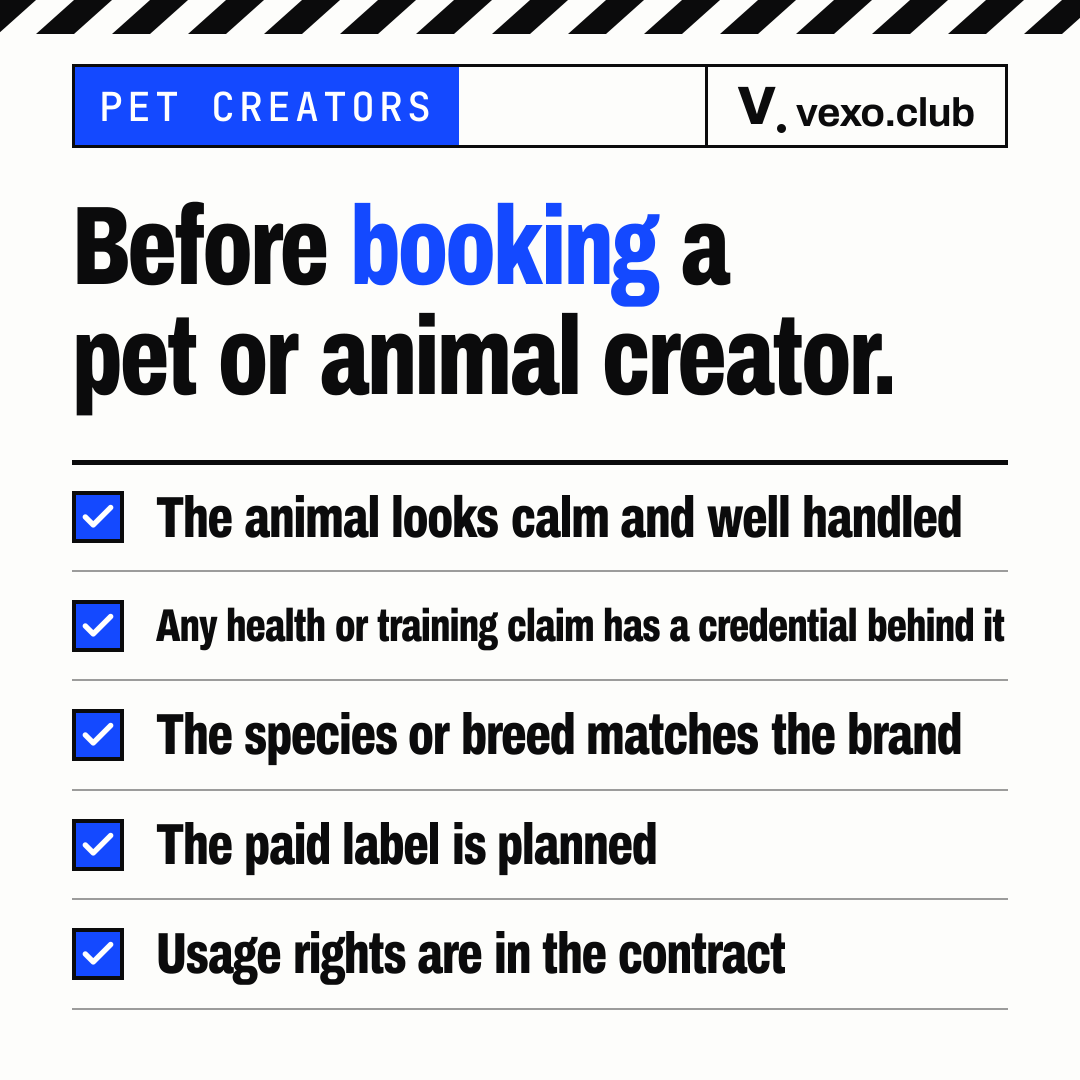
Before booking a pet or animal content creator
- Which of the four kinds is this creator, and what is the proof
- Does any health, diet or training claim have a credential behind it
- Does the animal in the content look calm, healthy and well handled
- Does the species or breed shown match the brand’s product
- Do the comments show pet owners, not only animal lovers scrolling past
- Is the paid label planned on the visuals and in the caption
- Are usage rights, and any animal-welfare commitments, written into the contract
Five checks before booking a pet or animal creator
Does vexo.club have pet or animal creators on its roster?
Not under a category of its own today. Pet and animal content does not yet have a dedicated niche on the roster; it sits across the broader Lifestyle and Digital & Social Content categories, where a handful of creators already post it alongside other subjects. For a pet-category brief the desk casts from the roster and from outside it, naming the kind of creator from the table above for each name it puts forward, so a pet-parent testimonial is never sold to a client as veterinary advice.
Should a brand book a pet or animal creator directly or through an agency?
A brand can brief these creators directly, through a manager where one exists, or through an agency, and each route can work; a niche this new has fewer managers in the loop than an established one. What an agency adds is a second reader on every draft, who checks the claim against the creator’s actual credential and checks how the animal is handled in the footage before it ships, not after a complaint arrives. At vexo.club every paid post is also checked for its disclosure before sign-off.
For the wider picture of who posts what on Indian social media, see influencers in India. Audience checks that matter in any category, not only this one, are in checking an influencer’s audience, and the contract lines worth getting right before a shoot are in influencer contract clauses. To start a pet or animal-category brief, send it to the desk.
Questions brands ask
Who are the top pet influencers in India? The desk ranks no one, and in a niche this new a ranking would say more about who happened to go viral than about who fits a brief. The useful list is by kind (pet-parent, trainer, rescue advocate, veterinary professional), and the useful check is whether the kind matches the claim the brand needs made.
Does a pet content creator need a qualification to recommend a food or treatment? For a claim that touches diet, health or a training outcome, yes: the same discipline ASCI expects of a human health claim applies in spirit here. A pet-parent account without a credential can share its own experience with a product. It should not be asked to say the product treats or prevents a condition.
What content format suits a pet food or pet care brand? A short Instagram reel suits a product shown in use or a quick reaction; a longer YouTube video suits a routine, a diet change or a training method that needs room to be shown properly rather than implied. The claim decides the length, not the other way round.
Can a brand use footage from a rescue or training account in paid ads? Only with the creator’s written permission for that specific use, and only once the brand has confirmed the animal’s welfare in the footage holds up to scrutiny. Usage rights for this category are the same contract question as any other: a fee and a term, agreed before the shoot, not after.
Does vexo.club have pet or animal creators on its roster? Not under a dedicated category yet. A handful of creators post pet and animal content alongside other subjects under the roster’s broader lifestyle categories, and a pet-category brief is cast to the brief from across and outside the roster.
Cite this page
Pet and animal influencers in India: an emerging niche for brand partnerships. vexo.club, published 06 Nov 2026. https://vexo.club/blog/pet-animal-influencers-india
Send the desk a brief: it comes back as a shortlist and a directional band, never a public price.
Brief the desk