AI influencers in India: what a virtual creator is, which brands have used one, and what must be said on the post
What an AI influencer is, which Indian brands have used one, what ASCI and the IT Rules require on the post, and when a human creator is the better buy.
Playbooks Updated 16 min read The operators’ desk
In this article9 sections
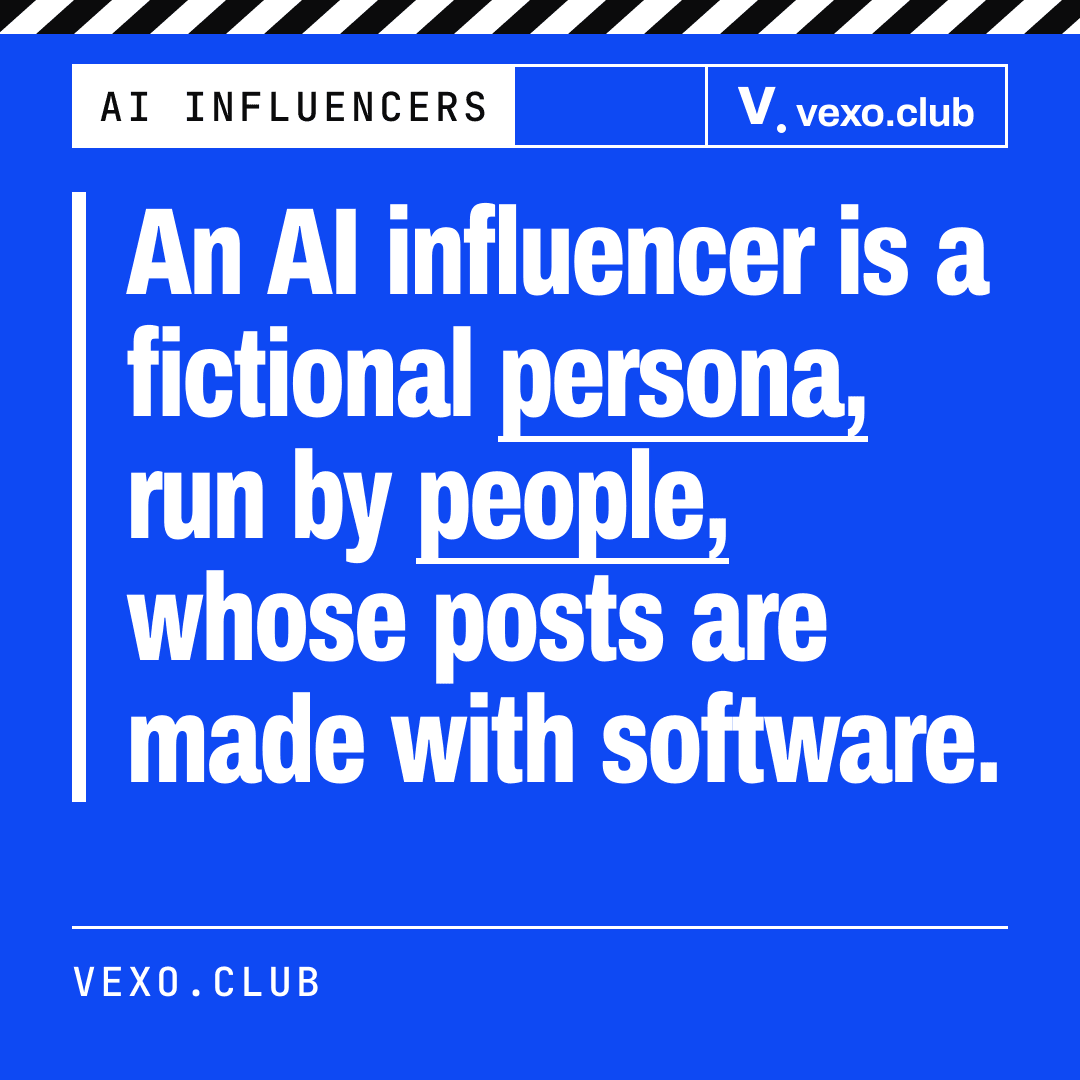
An AI influencer is a fictional persona, run by people, whose posts are made with software. A brand in India can brief one, but the post is an advertisement and has to say what it is: ASCI’s influencer guidelines require a virtual influencer to tell people that they are not interacting with a real human being.
This guide comes from vexo.club, an influencer marketing agency run from one desk in Delhi NCR, whose own shortlists are of human creators from its roster. Each rule is quoted from the regulator’s or platform’s page as of 18 October 2026 and linked, and no follower count, reach or result is printed for any persona. It is a brand’s guide, not legal advice.
AI influencers in India, in short
- An AI influencer is a persona, not a person: people run the account, and ASCI calls such a character a virtual influencer.
- Indian brands have used them. WION’s explainer names several Indian personas, and the brands two of them worked with.
- The post is an advertisement. It carries the paid label, a statement that the persona is not a real human being and, from 29 December 2026 under ASCI’s labelling guidelines, an AI label.
- A persona cannot have used the product, so it cannot review it, and it holds no qualification for finance or health advice.
- A persona suits a controlled brand channel or a rendered look. A human creator suits trust, reviews and a regional voice.
What is an AI influencer?
An AI influencer is a fictional character with its own social accounts, run by a studio or an agency, whose images, voice or video are made with software. ASCI’s influencer guidelines call it a virtual influencer and define it as “fictional computer generated ‘people’ or avatars who have the realistic characteristics, features and personalities of humans”.
Three things sit beside it without being it. A human creator who uses AI to edit, colour-correct or subtitle a film is a human creator: ASCI’s labelling guidelines list routine edits, colour correction and subtitles among the uses that need no label. A brand mascot speaks for the brand and is not offered to followers as a person. A real person’s cloned face or voice is a different case: ASCI’s labelling guidelines name replicating it, even with consent and for personalised messaging, among the cases that need a label.
Between a fully human creator and a fully synthetic one there is a scale, not a switch, and the rules change along it.
From a human creator to a virtual persona
Fully human Fully synthetic
- A human creator posting in their own words At Fully human
- A human creator who uses AI for subtitles, colour and formatting ASCI lists routine edits as needing no label Leans Fully human
- A real person’s face or voice, replicated ASCI’s personalised-messaging example needs a label even with consent In the middle
- A virtual persona run by a studio Both of ASCI’s texts can apply At Fully synthetic
Whatever the character is called, people run it, so the brief names them.
What an AI influencer is
Which Indian brands have used AI influencers?
Kyra and Radhika Subramaniam are two of the Indian AI personas that WION’s explainer of 27 July 2026 names. It says Kyra, created by the marketing firm TopSocial, has collaborated with brands including boAt, Amazon Prime Video, L’Oréal and John Jacobs, and that Radhika Subramaniam, created by Collective Artists Network, has partnered with brands like Campus Activewear.
Media Infoline reported on 18 September 2025 that Campus ran a six-day campaign with Radhika, which it calls an AI influencer. The sources do not say what each brief asked of the persona or how any campaign performed, so this guide prints no follower count for either, because a total says little about who the audience is.
What must an AI influencer’s post say?
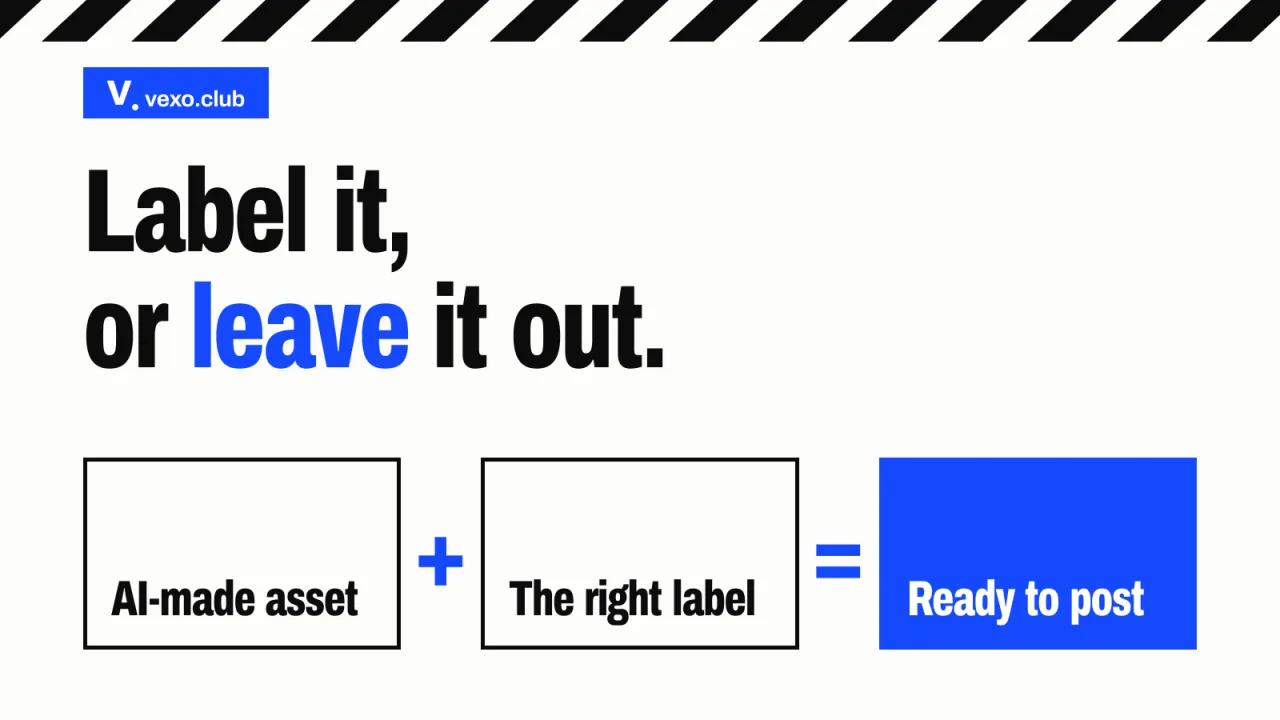
An AI influencer’s post in India carries the paid label where a brand has a material connection, a statement that the persona is not a real human being, the platform’s AI setting and, from 29 December 2026, ASCI’s AI label. The first two apply now, and the platform’s setting applies where the platform asks for it.
ASCI’s influencer guidelines cover a persona. Paragraph 1.4 reads: “A virtual influencer must additionally disclose to consumers that they are not interacting with a real human being. This disclosure must be upfront and prominent.” Paragraph 1.5 makes the advertiser and the influencer both responsible for the disclosure and the content: the advertiser ensures the post meets the ASCI Code and, where needed, asks for the post or its label to be edited or deleted, and the influencer makes the disclosures. The text does not say who the influencer is for a character, so the brief names the operator. For where the label goes, see ASCI’s disclosure rules for brands; for Instagram’s tool, the paid partnership label.
From 29 December 2026 a second layer applies. ASCI’s guidelines on labelling synthetically generated content say they come into effect “on the expiration of 3 months from the date of their publication” and are dated 17 September 2026. ASCI’s press release dates their release 29 September 2026, which gives 29 December 2026, the date this guide uses. The text lists “Using synthetically generated influencers and ambassadors” among the cases where a label is mandatory. The test is whether the content materially influences consumer decisions and would mislead if unlabelled, so the desk’s reading is that a safe brief labels every persona. The labelling rules, format by format, have their own guide.
The platforms add duties of their own. Meta’s help page says content with signals it can identify as AI-made is labelled “AI info”, that people may be required to label “photorealistic video or realistic-sounding audio”, and that an account which mostly posts AI-generated content can add an “AI creator” label to its profile. The requirement “does not apply to images”, though Meta may still label one it detects as AI-generated; a persona’s stills carry the paid label and the not-a-real-person statement regardless. YouTube’s help page says it requires creators “to disclose AI-generated or -altered content that seems realistic”, through an “AI use” setting in YouTube Studio.
MeitY’s IT rules bind the large platforms. Its FAQ says the amendment, G.S.R. 120(E), came into force on 20 February 2026, and the consolidated rules require a significant social media intermediary to ask users to declare whether information is synthetically generated, to verify the declaration and to label it, so the brief tells the operator to make the declaration. A MeitY notice of 21 April 2026 proposed a further change to the label rule, which this guide does not rely on. The table sets the layers side by side.
Which rule asks what of a persona’s post
| Applies to | Asks of a persona’s post | Status | |
|---|---|---|---|
| ASCI influencer guidelines | Advertisers and influencers | Say it is not a real human being, up front, and carry the paid label | In force |
| ASCI labelling guidelines | Advertisers | Label a synthetic influencer, for example “Audio/Video created using AI” | From 29 December 2026 |
| MeitY IT rules | Large platforms; the uploader declares | Declare synthetic content on upload; the platform verifies and labels | In force from 20 February 2026 |
| Consumer Affairs endorsement guide | Celebrities, influencers and virtual influencers | Disclose a material connection; do not endorse what was not used | Released 20 January 2023 |
| Meta and YouTube help pages | Creators on each platform | Set the AI label where the content looks real | In force on each platform |
None of these layers replaces another. ASCI says a platform’s disclosure tool is “in addition to” an influencer’s own disclosure, so a brand checks that each label shows on the post.
These lines can be copied into a brief, with the names filled in. ASCI asks for the disclosure in English or in the advertisement’s own language.
- “Ad · Paid partnership with [Brand]”: the desk’s wording, from the labels paragraph 1.3 permits and Instagram’s “Paid Partnership” tag.
- “[Persona] is a virtual character, not a real human being”: the desk’s wording for paragraph 1.4.
- “Video created using AI”: ASCI’s suggested “Audio/Video created using AI”, from 29 December 2026.
- The platform’s AI setting: “AI info” on Meta where asked, “AI use” in YouTube Studio.
What can a virtual influencer not do?
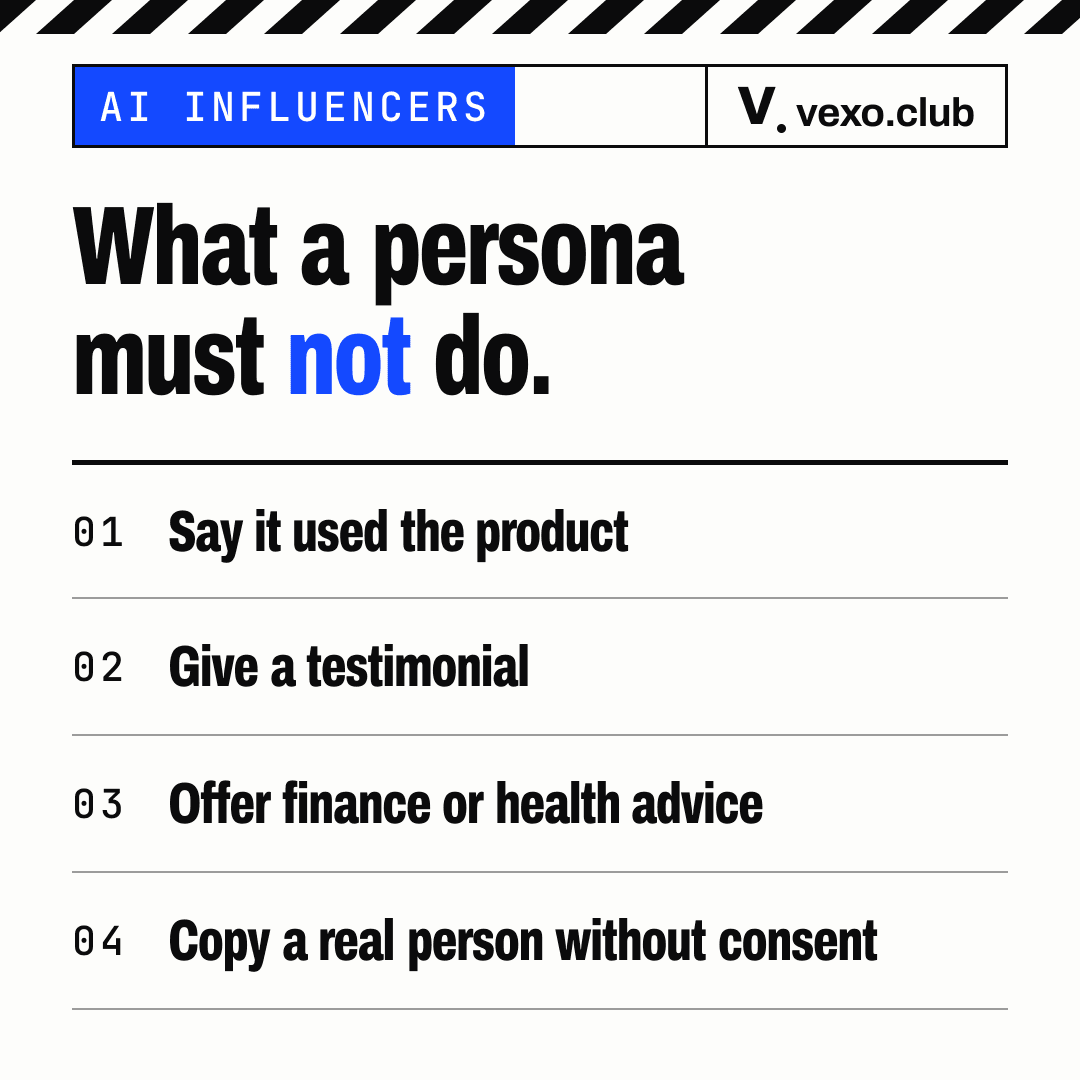
A virtual influencer cannot have used the product, so it cannot give a review that says it did. The Department of Consumer Affairs’ release of 20 January 2023 says its endorsement guide is for “celebrities, influencers and virtual influencers”, and that they should not endorse a product or service “that they have not personally used or experienced”.
The release does not say how that applies to a character, so the desk’s reading is the cautious one: the persona presents, the brand makes the claim, and the post never says or implies “I use this”. Four further limits come from the texts:
- ASCI’s labelling guidelines prohibit using AI to make it appear that a real person has used or endorsed a product when they have not, and such ads violate the ASCI Code “even if an AI label is used”. A persona’s own “I use this” falls under the use rule above and the same guidelines’ ban on misleading claims.
- The same guidelines prohibit using “a person’s likeness without consent”, so no persona is built on a real person’s face or voice without consent.
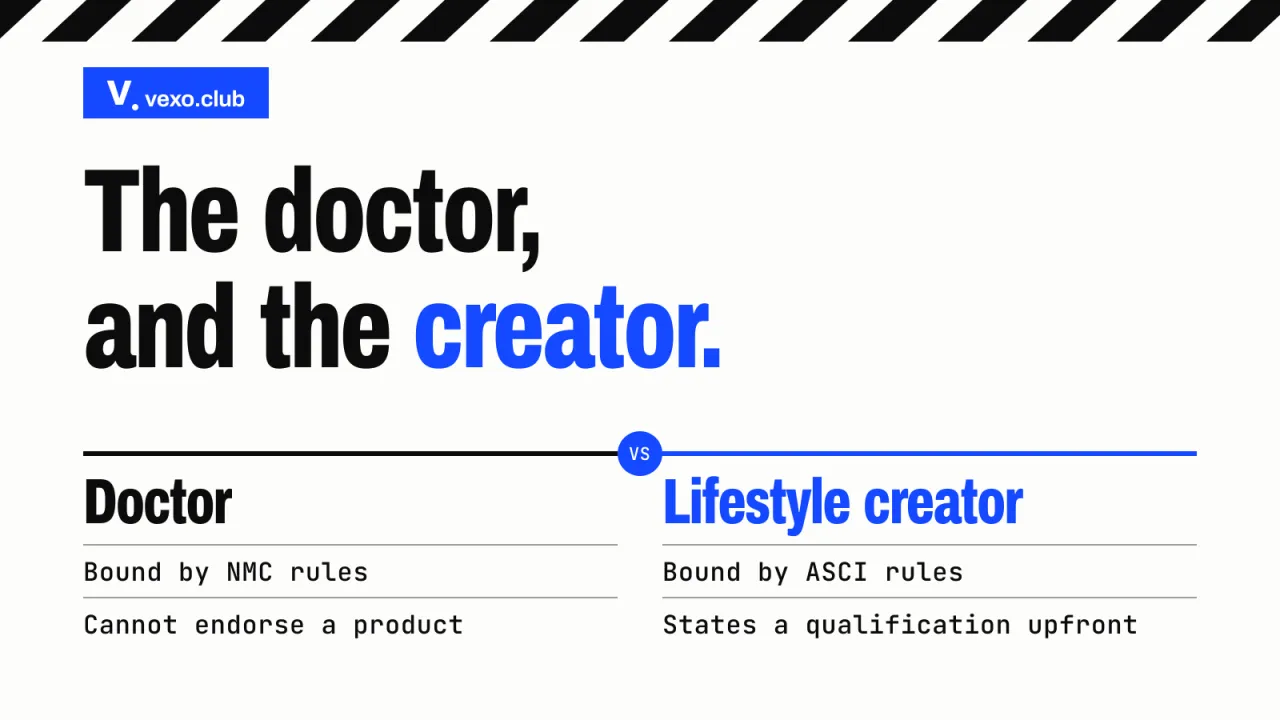
- ASCI’s addendum of 17 August 2023 requires influencers who advise on finance or health to hold qualifications, and says those without them “can share generic information”. A persona holds none, so it stays generic.
- The National Medical Commission’s guidelines of 6 October 2026 say at paragraph 7.2: “AI Generated promotional campaign for furtherance of commercial interest is prohibited.” The same paragraph requires any AI-generated promotional content that conforms to the guidelines to carry “the source mark, explicitly stating that the origin of the content is AI”. They bind registered medical practitioners and clinical establishments, not every brand; the NMC rules have their own guide.
What a virtual influencer’s post must not do
When does a virtual influencer fit a brief?
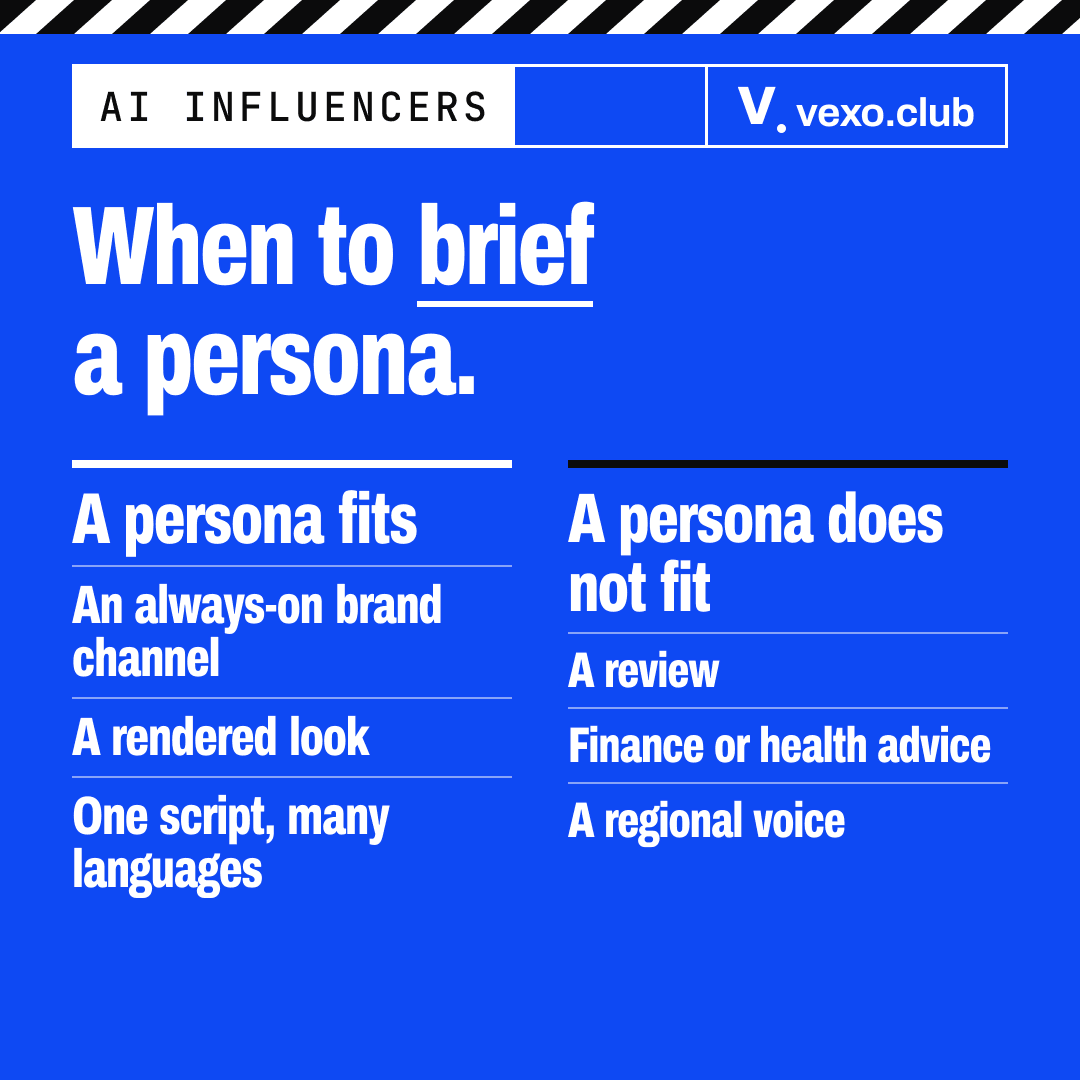
A virtual influencer fits a brief that wants a controlled, repeatable character and does not need anyone to have used the product: an always-on brand channel, a rendered look or one script spoken in several languages. It does not fit a review, a trust-led category or a regional voice.
A virtual influencer for a brand
Strengths
- The script, the look and the posting hours are set by the brief
- A character has no off-camera life to monitor The people who run it still have one.
- One character can speak in more than one language
Limits
- It cannot have used the product, so it cannot review it
- The post carries more labels than a human creator’s
- Its audience still has to be checked, and a total says little
- The look and the persona need an agreement of their own
Verdict Worth a brief when control and a rendered look matter more than a person’s word. Not worth it when the buyer has to believe a person.
A persona has to earn trust, so the audience check comes first: the desk checks a human creator’s audience from the platform’s own exports before casting, and the operator supplies the same export for a persona before any rate. A follower band, which is how the roster sorts human creators, says how large an account is, not who is in it.
When a persona fits a brief, and when it does not
Human creator or AI persona: how does a brand choose?
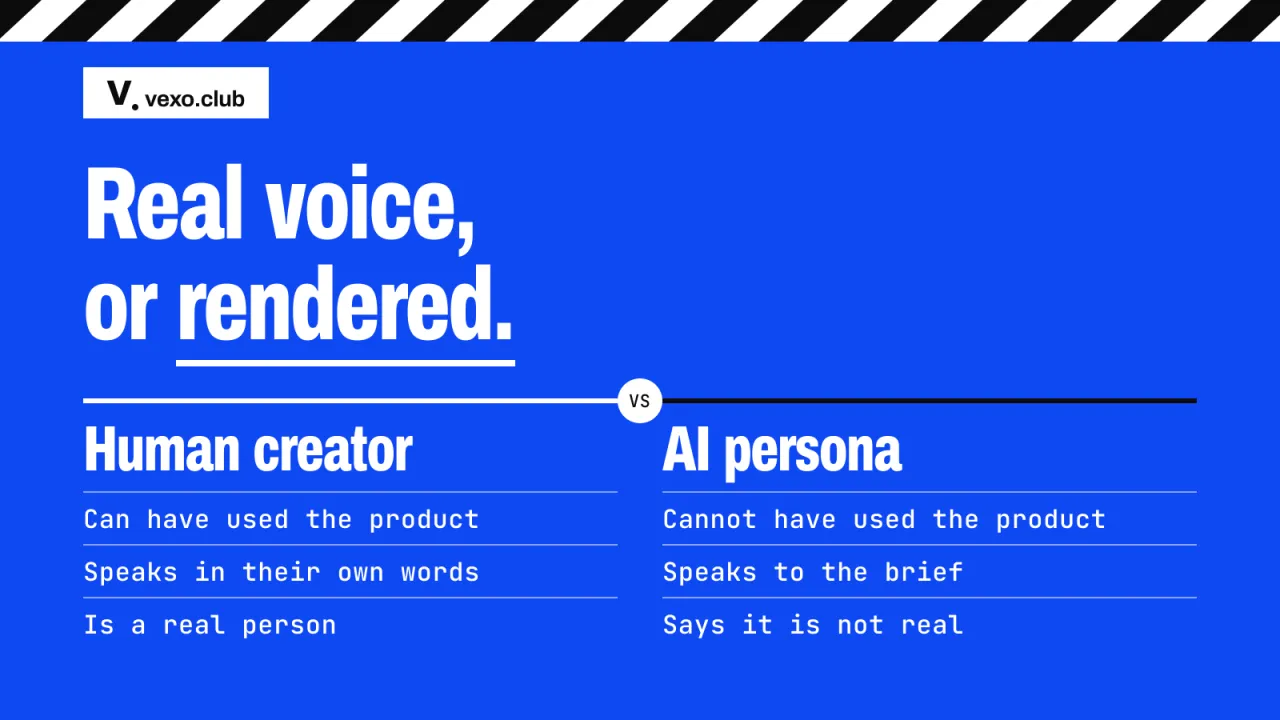
A brand chooses by what the post has to prove. If a viewer must believe that someone used the product, book a human creator. If the post only has to present a product in a controlled way, a persona can do it, with more labels and a separate agreement.
Human creator or AI persona, for a brand
| Human creator | AI persona | |
|---|---|---|
| Can say it used the product | Yes, if they have used it | No, it cannot have used it |
| What the post must say | The paid label, and an AI label from 29 December 2026 where AI is material | The paid label, a statement that it is not a real human, and an AI label from 29 December 2026 |
| Who owns the likeness | The creator, licensed for the brief | Set by the contract: who owns the look, the voice and the accounts |
| Audience trust | Built on a person’s record and voice | Built on a character and its story |
| Script control | Shared: the creator keeps the words | High: the operator writes to the brief |
| Conduct risk | A creator’s past and present posts | None off camera; the operator’s record counts |
| Best for | Reviews, trust-led categories and a regional voice | A controlled brand channel or a rendered look |
How is a virtual influencer priced?
A virtual influencer is paid for in three parts: building the persona, running its accounts and making each post. A brand can pay for them by commissioning a persona of its own, licensing one that an agency already runs, or buying posts from one.
One vendor puts a figure on the first part. In a byline piece on Storyboard18 dated 28 August 2026, Shudeep Majumdar, Zefmo Media’s co-founder and chief executive, wrote: “Zefmo estimates that developing a brand-ready virtual influencer fell from about Rs 3.6 crore in 2022 to roughly Rs 26 lakh in 2026.” That is a vendor’s own estimate, and it prices a build, not a campaign. vexo.club publishes no prices. Ask any operator to price four lines separately, the licence included:
- Building the persona and its look
- Running its accounts and approvals
- Each post or film, with its labels
- The licence to use the persona: where, on which handles and for how long
What should a brief for a virtual influencer contain?
A brief for a virtual influencer contains six things, in writing: the operator, the persona and its look, the claims, the labels, the rights and the exits. The first two are new to a persona brief; the other four are in a human creator’s brief too, set out in usage rights. Have counsel read the persona agreement and the label wording before the first post.
What the persona agreement lists
- The operator Who runs the persona, who answers for each post and who holds the accounts
- The persona and its look Who owns it, and whether it was built from any real person’s face or voice
- The claims The brand approves every claim, and the persona never says it used the product
- The labels The paid label, the not-a-real-person statement, the AI label from 29 December 2026 and the platform setting, in words and in place
- The rights Where the posts may run, on which handles, as ads or not, and until when
- The exits A takedown on request, a pause when a rule changes, and what happens to the persona after the term
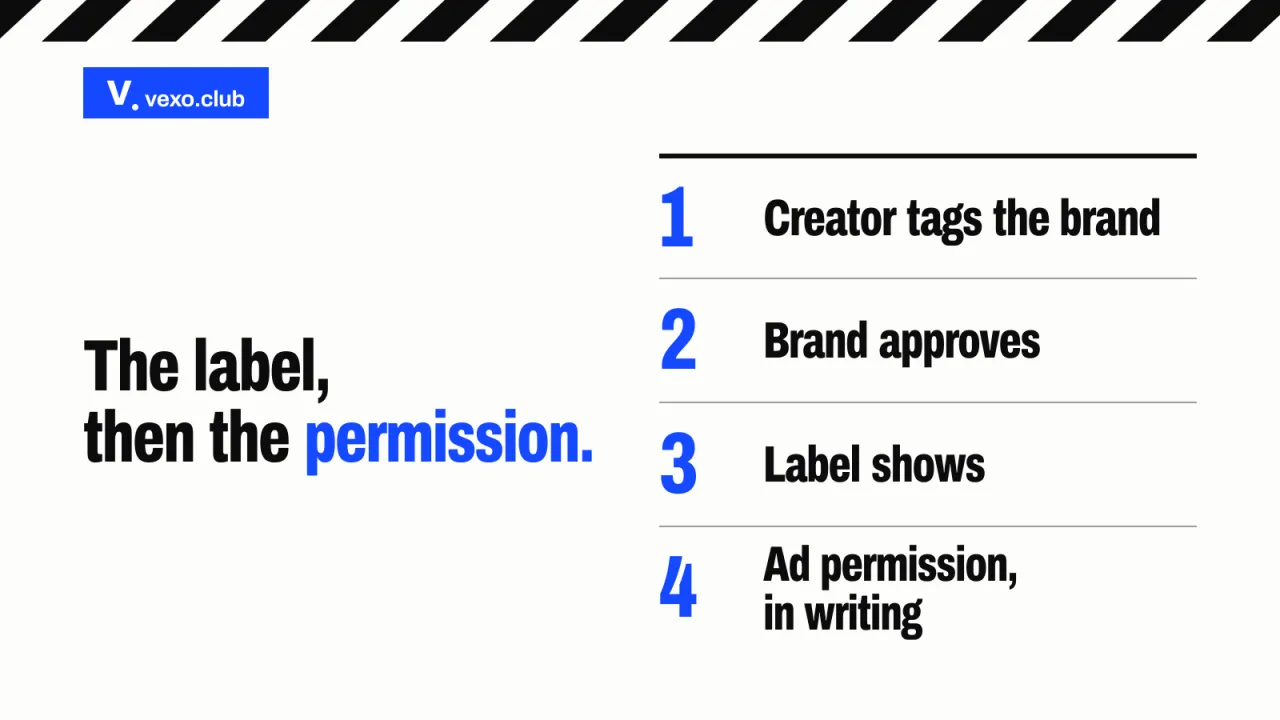
Approvals run in the same order as for any paid post, with one change: the labels are drafted with the script, not added to the finished asset.
From persona to post: approvals and labels
- Name the persona and its operator In the brief and in the agreement
- Approve the script and the claims The brand signs off every claim
- Draft the labels with the script The paid label, the not-a-real-person statement and, from 29 December 2026, the AI label
- Make and check the asset The labels are on the draft, in the right place and for long enough
- Set the platform’s options The paid partnership tool and the AI setting
- Check it live, and after any edit A caption can be edited and a label lost in a re-share
A brief that is weighing a virtual persona against a human creator can be sent to the desk. The shortlist says which fits, per creator, before any rate, and what a brief to the desk contains is on the brands page.
Questions brands ask
What is an AI influencer? An AI influencer is a fictional persona, run by people, whose posts are made with software. ASCI’s influencer guidelines call it a virtual influencer. It is not a human creator who uses AI tools, nor a brand mascot.
Are there AI influencers in India? Yes. WION’s explainer of 27 July 2026 names Kyra, created by TopSocial, and Radhika Subramaniam, created by Collective Artists Network, with the brands each has worked with.
Do AI influencer posts need a disclosure in India? Yes. ASCI’s influencer guidelines already require a virtual influencer to disclose, up front, that it is not a real human being, and the paid label applies where there is a material connection. From 29 December 2026 ASCI’s labelling guidelines add an AI label, and the platforms ask for their own.
Can an AI influencer review a product? It cannot have used the product, so a review that says it did would mislead, and the Department of Consumer Affairs’ guide says endorsers should not endorse what they have not personally used. The honest form is a labelled advertisement in the brand’s voice: the persona presents and the brand makes the claims.
How does a brand hire an AI influencer? Through the studio or agency that operates the persona, under an agreement that names the operator, the owner of the look, the claims, the labels, the rights and the exits. The desk’s shortlists are of human creators; a brief weighing a persona can be sent to it.
Is an AI influencer cheaper than a human creator? The sources cited here do not compare the two like for like. A persona adds build, running and licence costs, which vary with whether a brand builds one, licenses one or buys posts, and vexo.club publishes no prices of its own. One vendor, Zefmo Media, estimated on 28 August 2026 that a build fell in cost between 2022 and 2026; that is its own estimate.
Sources
- influencer guidelines (opens in a new tab) ascionline.in
- WION’s explainer (opens in a new tab) wionews.com
- reported on 18 September 2025 (opens in a new tab) mediainfoline.com
- guidelines on labelling synthetically generated content (opens in a new tab) ascionline.in
- ASCI’s press release (opens in a new tab) ascionline.in
- help page (opens in a new tab) meta.com
- help page (opens in a new tab) support.google.com
- FAQ (opens in a new tab) meity.gov.in
- consolidated rules (opens in a new tab) meity.gov.in
- notice of 21 April 2026 (opens in a new tab) meity.gov.in
- release of 20 January 2023 (opens in a new tab) pib.gov.in
- guidelines of 6 October 2026 (opens in a new tab) nmc.org.in
- Storyboard18 (opens in a new tab) storyboard18.com
Cite this page
AI influencers in India: what a virtual creator is, which brands have used one, and what must be said on the post. vexo.club, published 22 Oct 2026, updated 28 Oct 2026. https://vexo.club/blog/ai-influencers-in-india-brands
Send the desk a brief: it comes back as a shortlist and a directional band, never a public price.
Brief the desk