Influencer marketing for real estate brands in India: site visits, local trust and disclosure
Real estate influencer marketing runs on site-visit walkthroughs, a mix of local-area and national creators, and a disclosure that survives scrutiny on a purchase nobody makes on impulse.
Playbooks 11 min read The operators’ desk
In this article7 sections
A home is bought once or twice in a lifetime, on a timeline measured in months, after more checking than almost any other purchase a creator’s audience will see advertised. Influencer content can shorten that checking, or it can look like one more glossy claim a buyer has learned to discount. What decides which one it is has less to do with the creator’s following and more to do with the format, the mix of voices, and whether the sponsorship reads as honest about what it is.
This playbook comes from vexo.club, an influencer marketing agency run from one desk in Delhi NCR, and sets out how a developer or a real estate brand runs a creator brief for a high-consideration purchase: which content formats actually carry a site visit, when a local voice outperforms a national one and the reverse, what a trust-building brief has to show and not just say, and how a sponsored property tour is labelled so it survives the scrutiny a buyer brings to it. It states no price, no inventory figure and no campaign result, because a public playbook has no record behind any of the three.
Real estate influencer marketing, in short
- The format carries the message: a real walkthrough reads as proof, a produced flythrough reads as an advertisement.
- Local-area and national lifestyle creators do different jobs, and a brief gets weaker, not stronger, by picking one tier and ignoring the other.
- Trust content has to show the site, the registration and the paperwork, not just say the project is trustworthy.
- A sponsored property tour needs a label a buyer cannot miss, because the claim behind it is one they will act on with real money.
Why real estate influencer content runs on different rules
Most categories a creator covers are considered in minutes and bought in a tap. Real estate is considered over weeks, often with a family, a loan and a site visit of the buyer’s own sitting between the video and the sale. A brief built for a fashion or a food category (a quick hook, a strong call to action, a code at checkout) does not transfer, because nothing in that sequence resembles how a flat actually gets bought. What transfers instead is slower: a creator’s content earns a place in that research phase only if it answers a question the buyer already has, about the commute, the build quality, the paperwork or the neighbourhood, rather than trying to compress the decision into one clip.
That changes what a brand asks a creator to make. A reel built to be rewatched during research behaves differently from a reel built to be scrolled past once, and most real estate briefs still default to the second kind because that is what the platform rewards elsewhere.
Site-visit and walkthrough formats that fit a long buying cycle
A site visit is the one asset a real estate brand has that no other category does: a physical place a creator can actually stand in and show. The strongest real estate content treats the visit as the point of the video rather than a backdrop for it, and a few formats do that job in different ways.
Five ways a site visit becomes content
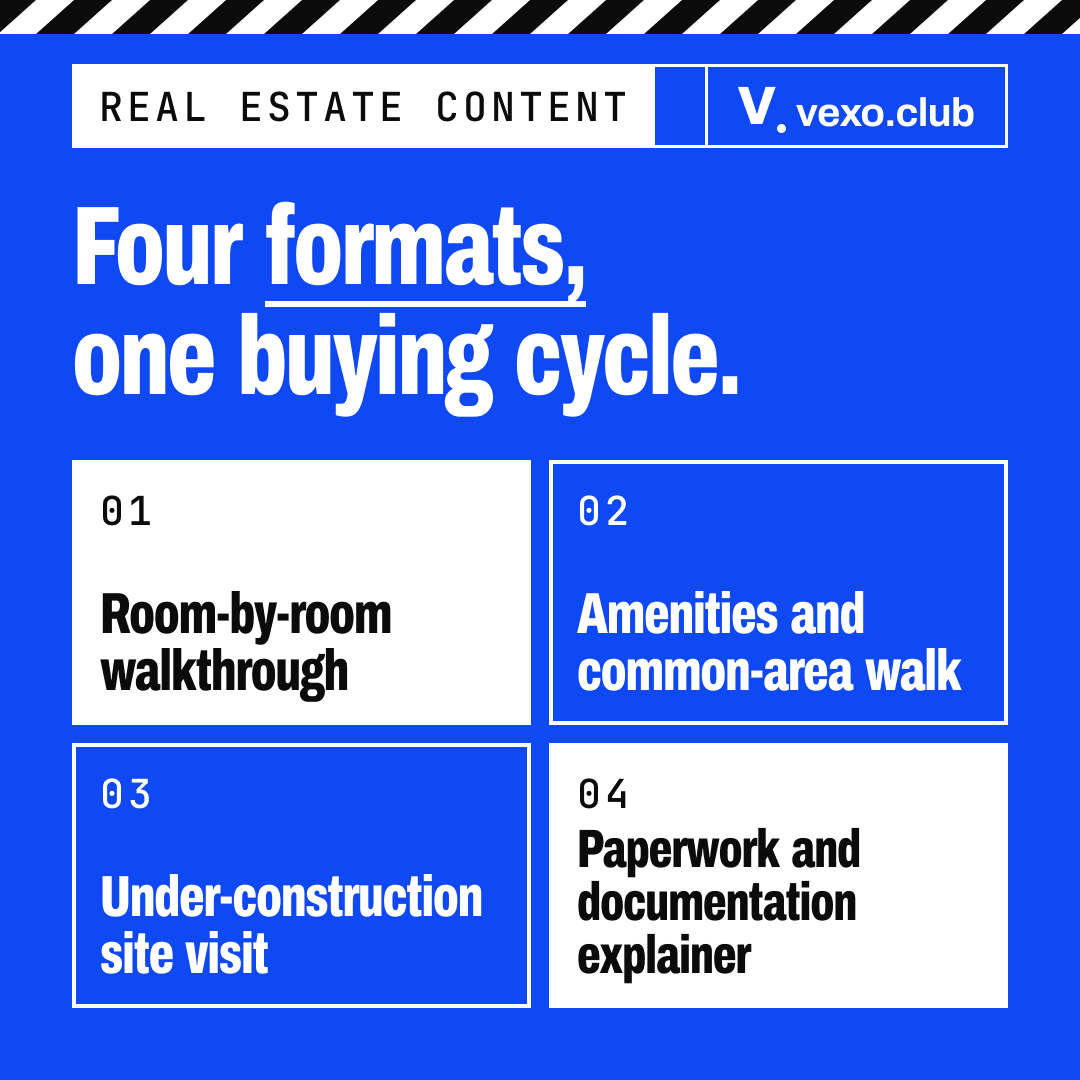
- Raw, largely unedited walkthrough Close to how a buyer would experience the visit themselves, cuts kept to a minimum
- Structured room-by-room tour Captioned and sequenced, built to be rewatched in full before a visit is booked
- Amenities and common-area walk The clubhouse, the landscaping and the parking, shown apart from the unit itself
- Under-construction progress visit A dated visit to the live site, useful for a pre-launch or early-possession project
- Paperwork and documentation explainer What the agreement and the registration actually say, read rather than summarised
The first two formats are often treated as interchangeable and they are not. A raw walkthrough reads as closer to what the buyer would see in person, which is exactly what makes it credible, and exactly why it should not be scripted to sound like a sales pitch. A structured tour earns its place by being easier to rewatch and share within a family deciding together, which a raw clip rarely is. A brief that only ever buys the structured version is buying polish at the cost of the credibility the format exists to carry.
Four walkthrough formats for a real estate brief
Local-area creators or national lifestyle creators?
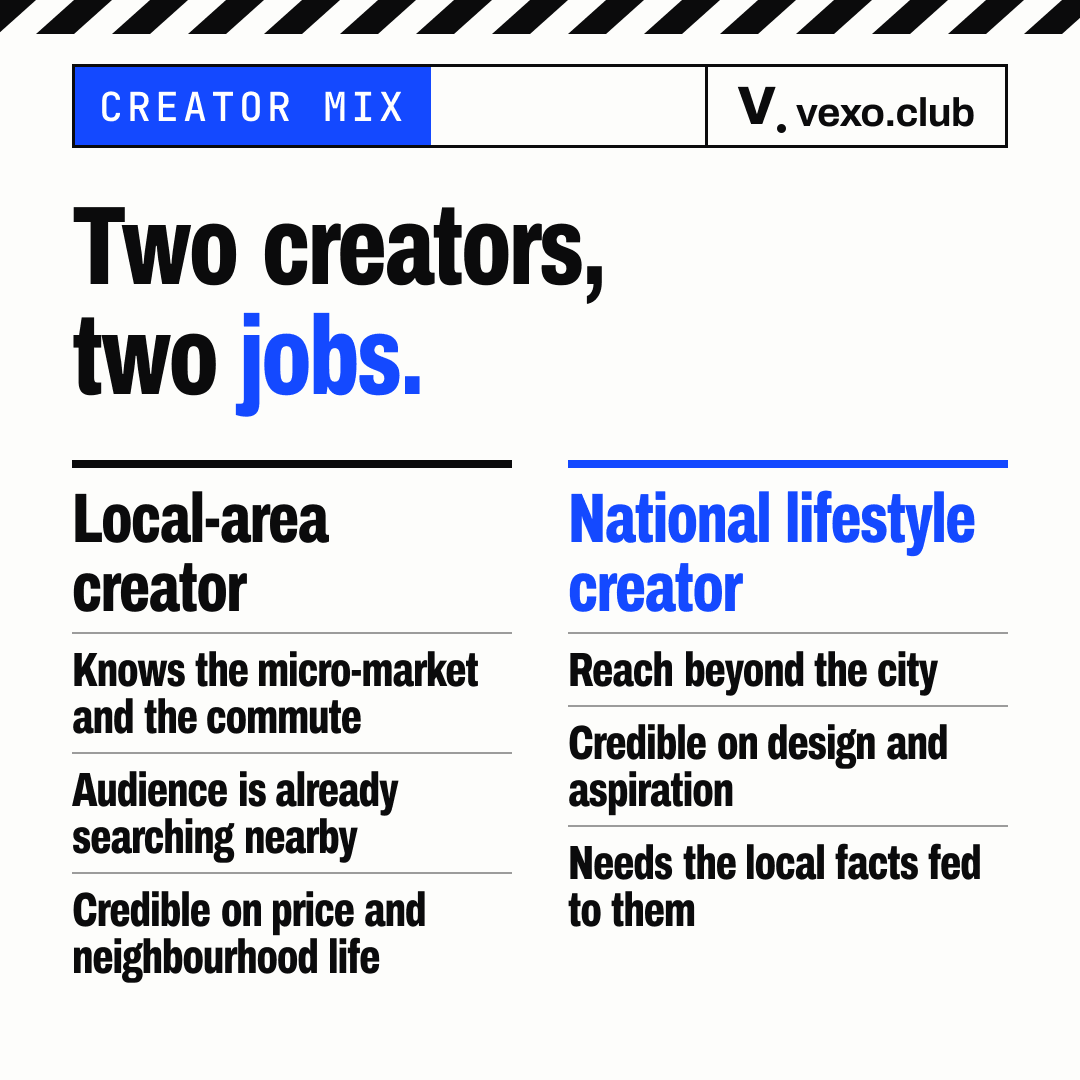
The two sit on the roster for different reasons, and a brief that treats them as cheaper and costlier versions of the same job will misuse both. A local-area creator already has an audience house-hunting in or near that micro-market, can speak to the commute and the resale pattern from lived experience, and is checkable: a viewer who doubts the claim can go and look themselves within a day. A national lifestyle creator brings reach a local account cannot, and is better placed to frame a flagship project as an aspiration worth travelling for, but has no local standing of their own and needs every fact about the project fed to them rather than assumed.
Local-area creators and national lifestyle creators, set against each other
| Local-area creator | National lifestyle creator | |
|---|---|---|
| Audience | Already searching in that micro-market | Spread across cities, searching for no particular project |
| What they can show first-hand | The commute, the neighbourhood and the resale market nearby | The design language and the aspirational framing of a home |
| Best project stage | Pre-launch and under-construction, where local word of mouth already runs | A flagship project worth a national audience travelling to see |
| Credibility risk if a claim is off | Low: the nearby audience can walk over and check | Higher: the audience has no easy local check |
| Typical format | A walkthrough filmed on site, in the local language | A produced tour, framed for a national feed |
| Best for | Proving one project to a buyer who can visit | Building a developer’s name across cities |
Where the two meet is on a single large launch: a local creator covers the site and the neighbourhood for buyers already circling it, and a national creator carries the launch’s name past that city, with the local content providing the on-the-ground proof the national clip never could on its own.
What a local-area creator brings that a national one cannot, and the reverse
Why trust content matters more here than in most categories
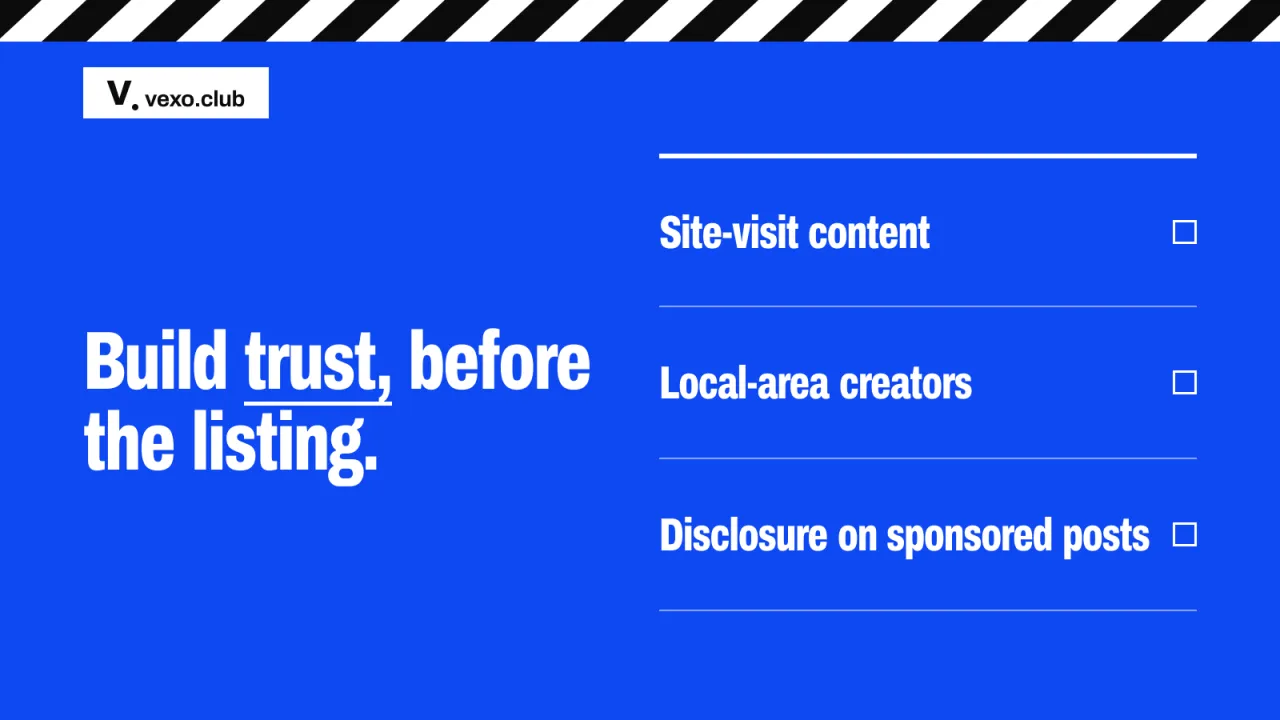
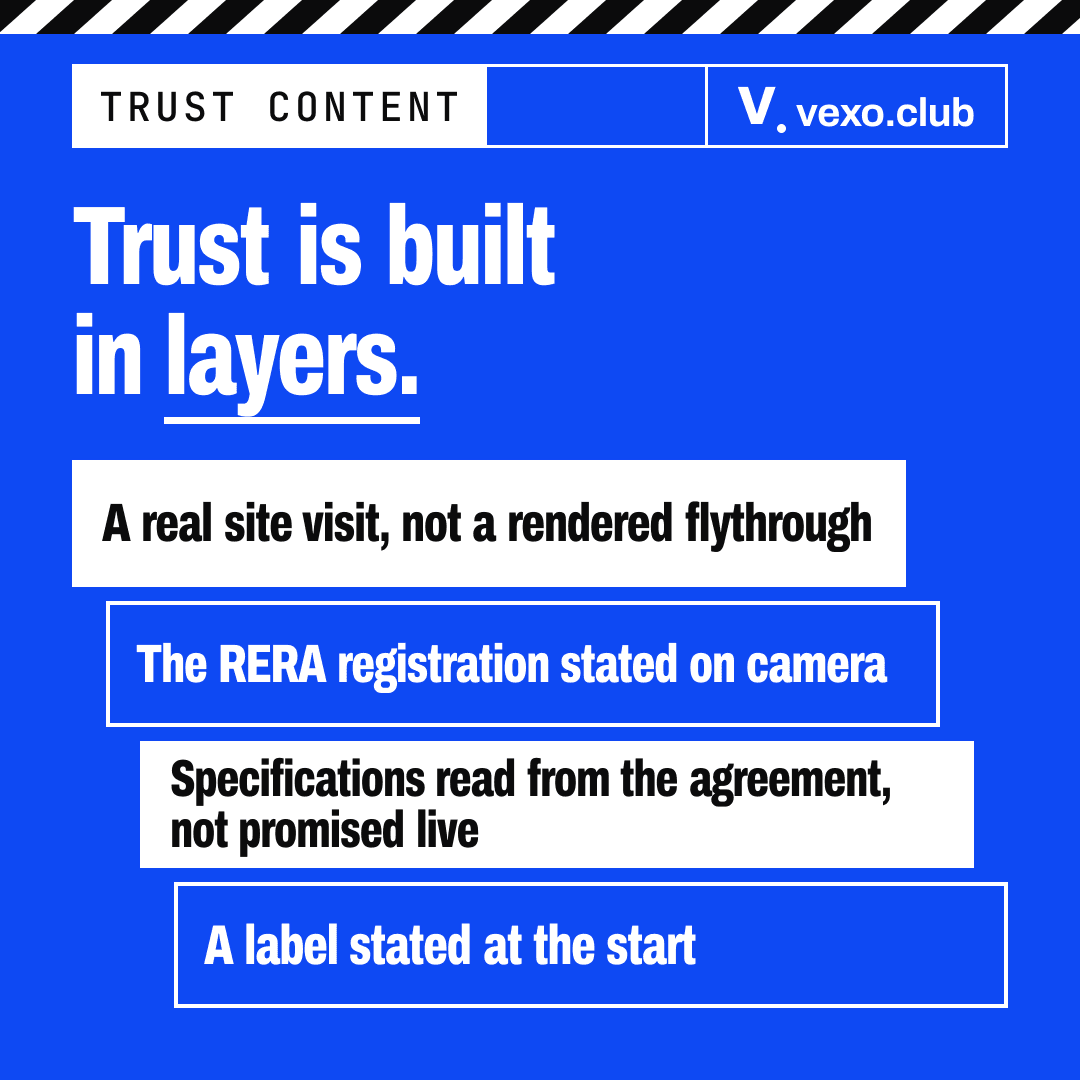
A buyer deciding between two flats has already learned to discount a glossy render and a confident voiceover, because the category has trained them to. Trust content works by showing rather than asserting: the actual site rather than an artist’s impression, the registration number rather than a claim of being registered, the agreement’s own wording rather than a creator’s paraphrase of it. None of that makes the content less persuasive. It makes the persuasion survive the buyer’s own checking, which is the only kind of persuasion a purchase of this size responds to.
Building trust in a high-consideration category
Do
Film the walkthrough on the actual unit or the actual site
Don’t
Pass off a rendered flythrough as a creator’s own visit
Do
Show the project’s RERA registration number and the RERA website on screen
Don’t
Leave a registered project’s registration unstated
Do
Read specifications and possession dates from the agreement
Don’t
Let a creator promise a date or a price live, unscripted
Do
Show the commute and the neighbourhood, not just the show flat
Don’t
Cut straight to the most finished room and skip what surrounds it
The paperwork explainer in the format stack above exists for the same reason. It is the least glamorous asset a brand can commission and often the one a serious buyer shares with their family before anyone books a second visit.
What trust content for real estate has to show
Disclosure on a sponsored property tour
A paid site visit is a material connection between the creator and the developer, and ASCI’s influencer guidelines apply to it the same way they apply to a paid post in any other category: the label has to be prominent, in a word the guidelines permit (such as Advertisement, Sponsored or Partnership), and placed where the audience sees it before they form an opinion of the content, not buried in a description box. ASCI disclosure for brands sets out who labels what across a brief; what is specific to real estate is the size of the decision sitting on the other side of a missed or vague label.
A property tour that reads as an independent review, when it was in fact commissioned and paid for, is not a labelling technicality in this category. It is the difference between a buyer treating a creator’s claim as one more fact to check and treating it as the deciding one.
Disclosure for a sponsored property tour
Do
Label the video Sponsored or Partnership from the first frame
Don’t
Let a paid site visit read as an independent review
Do
Keep the claims inside the label’s scope: this unit, this project
Don’t
Let a paid claim drift into general market advice
Do
Keep the label on screen for the whole walkthrough once it runs two minutes or more
Don’t
Rely on a single caption tag the viewer may never open
Do
Write the label in English or in the language the walkthrough is filmed in
Don’t
Use a label the video’s audience cannot easily read or understand
ASCI’s guidelines accept English or the language of the ad, as long as an average viewer can understand it.
What to check before a real estate influencer brief goes out
Settle the format and the creator mix before the rate. A brief that starts with price ends up buying whichever creator is available rather than the one the project stage actually calls for. How to check an influencer’s audience before you pay sets out the audience check that should happen before either; usage rights covers what to settle if a walkthrough is good enough to reuse as a paid ad once it has proved itself organically.
A real estate brief for Delhi NCR starts at the Delhi desk page, and a brief for any city can be sent to the desk directly.
Questions brands ask
Does influencer marketing work for real estate? It works where the content answers a question the buyer already has (about the site, the paperwork or the neighbourhood) rather than trying to close a decision of that size inside one short video. This guide prints no campaign result, because none is on record to publish.
Should a real estate brand use local creators or national ones? Both, for different jobs. A local-area creator is credible on the commute, the micro-market and the resale pattern, and their claims are checkable by an audience that can visit the site itself. A national lifestyle creator brings reach beyond that city and is better suited to framing a flagship launch as an aspiration, but needs the local facts supplied rather than assumed.
What should a real estate walkthrough show to build trust? The actual site rather than a rendered flythrough, the project’s RERA registration number and the RERA website shown on screen, and specifications or possession dates read from the signed agreement rather than promised live. A paperwork explainer, unglamorous as it is, is often the asset a buyer shares with their family before booking a second visit.
Does a sponsored site visit need a disclosure label? Yes. A paid visit is a material connection under ASCI’s influencer guidelines, and the label (for example Sponsored, Advertisement or Partnership) has to be visible before the audience forms an opinion of the content, kept on screen for the whole promoted stretch of a video of two minutes or more, and written in English or in the language the video is filmed in.
Can a creator state the price or the possession date in a real estate video? Only what the agreement or the builder’s own documentation states, read rather than improvised. A live promise of a date or a price a creator is not authorised to make is a claim the buyer will hold the brand to later.
Does vexo.club handle legal review of real estate content? No. The desk briefs the creator, checks the audience and sets the disclosure, but the project’s RERA status, specifications and possession timeline are the brand’s own facts to supply and stand behind.
Sources
- influencer guidelines (opens in a new tab) ascionline.in
Cite this page
Influencer marketing for real estate brands in India: site visits, local trust and disclosure. vexo.club, published 29 Oct 2026. https://vexo.club/blog/influencer-marketing-real-estate-brands-india
Influencer marketing across India
Send the desk a brief: it comes back as a shortlist and a directional band, never a public price.
Brief the desk